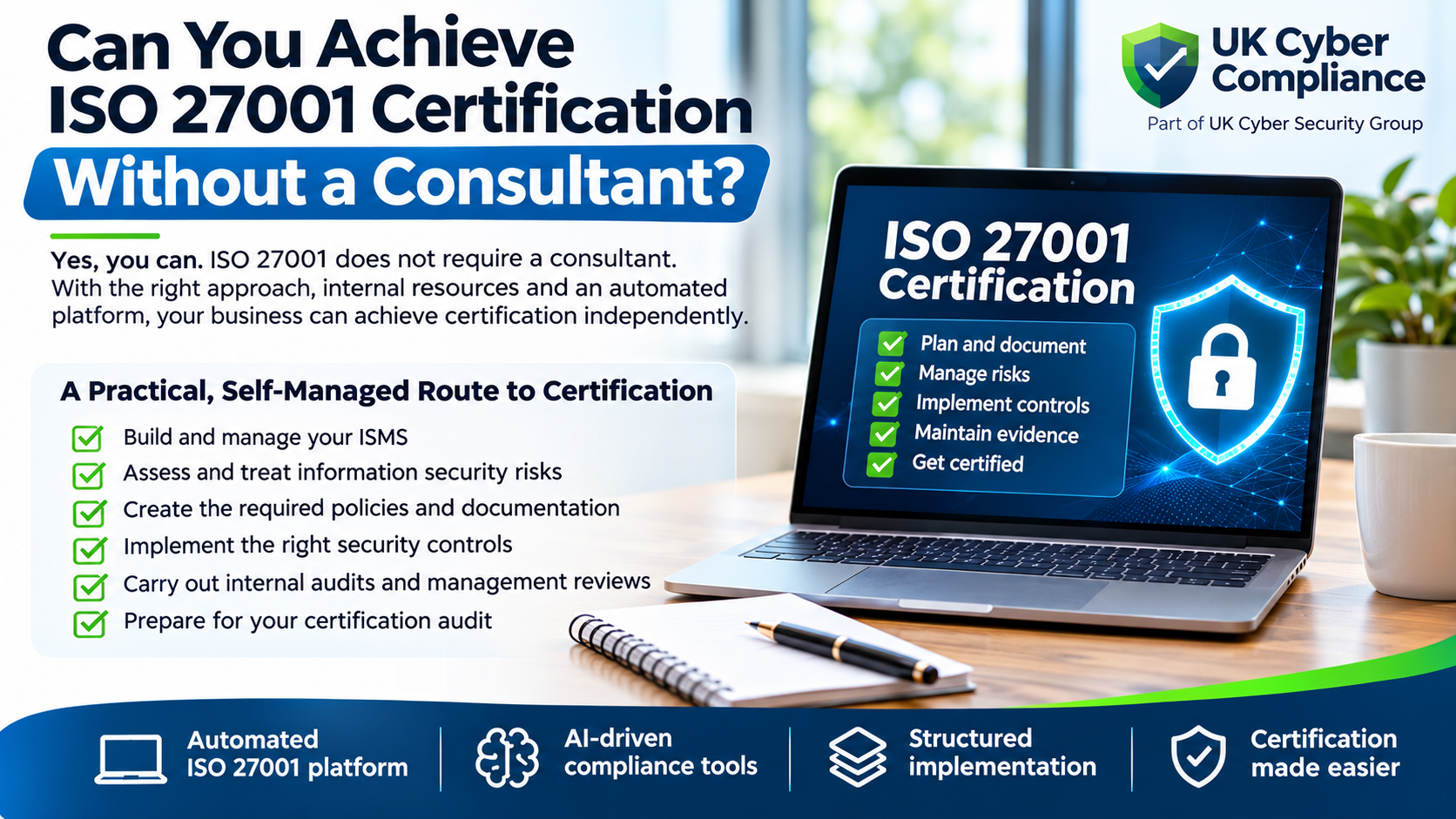
Can You Achieve ISO 27001 Certification Without a Consultant?
Yes, you can achieve ISO 27001 certification without hiring a consultant. There is no requirement within ISO/IEC 27001 that says businesses must use external consultancy services to implement an Information Security Management System (ISMS) or prepare for certification.
For many UK businesses, particularly small and medium-sized enterprises, this is welcome news. ISO 27001 certification can sometimes appear complicated, expensive and difficult to achieve without specialist knowledge. However, with the right approach, suitable internal resources and access to automated compliance tools, organisations can manage much of the certification process themselves.
The important distinction is that while a consultant is optional, an independent certification audit is still necessary if your business wants to become formally certified.
Your organisation must demonstrate that it meets the requirements of ISO/IEC 27001:2022, including the applicable 2024 amendment, regardless of whether a consultant helped prepare its management system.
According to the UK Government’s Cyber Security Breaches Survey 2025/2026, 43% of UK businesses identified a cybersecurity breach or attack during the previous 12 months. Yet only 30% reported carrying out a cybersecurity risk assessment.
These findings demonstrate why structured information security management is becoming increasingly important.
ISO 27001 provides a recognised framework for identifying security risks, protecting business information and demonstrating effective governance.
Traditionally, businesses have often relied on external consultants to guide them through implementation. However, automated compliance platforms now provide another option.
UK Cyber Compliance, part of UK Cyber Security Group, offers an automated and AI-driven platform designed to simplify ISO 27001 implementation, documentation, risk assessment and certification preparation.
For businesses that want greater control over their compliance activities, using such a platform can make achieving ISO 27001 considerably more accessible.
So, what can your business realistically manage without a consultant, what work is still required and when might professional assistance be worthwhile?
Understanding ISO 27001 Before Deciding Whether You Need a Consultant
The first step is understanding what ISO 27001 actually requires.
Some businesses assume certification is primarily about purchasing cybersecurity technology or completing a lengthy collection of security questionnaires.
In reality, ISO 27001 is a management system standard that focuses on how an organisation identifies, assesses and manages information security risks.
what is iso 27001
ISO/IEC 27001 is an internationally recognised standard that specifies the requirements for establishing, implementing, maintaining and continually improving an Information Security Management System.
An ISMS brings together policies, procedures, people, technology and management responsibilities to protect information.
The standard focuses on three essential principles:
- Confidentiality: Ensuring information is only accessible to authorised individuals.
- Integrity: Protecting information against unauthorised changes, errors or corruption.
- Availability: Ensuring information and essential services remain accessible when required.
These principles apply to businesses across every industry.
For example, an accountancy firm must protect confidential financial information, while a technology company may need to safeguard customer systems, intellectual property and operational services.
Both organisations can achieve ISO 27001 certification, but their security arrangements will reflect their individual risks and business activities.
What is ISO 27001 Certification?
ISO 27001 certification is independent confirmation that an organisation’s ISMS meets the applicable requirements of ISO/IEC 27001.
The certification process involves an assessment by an independent certification body.
An auditor reviews documentation, examines evidence, interviews relevant personnel and evaluates whether information security processes operate effectively.
Certification demonstrates that the business has established a structured framework for managing information security risks.
However, certification does not guarantee that a cybersecurity incident will never happen.
Instead, it provides assurance that the organisation has implemented an appropriate management system and is committed to maintaining and improving it.
Is an ISO 27001 Consultant Mandatory?
No. ISO 27001 does not require organisations to appoint an external consultant.
Your business can establish its own ISMS, complete risk assessments, develop policies, implement controls and prepare for certification using internal resources.
You can also use specialist software to guide your implementation.
What matters is whether the management system meets the standard’s requirements and operates effectively.
The certification body assesses the ISMS, not whether you employed a consultant to create it.
This means a business using an automated compliance platform can pursue the same ISO 27001 certification as an organisation that has engaged a traditional consultancy.
Why Businesses Traditionally Use ISO 27001 Consultants
Consultants have historically played an important role in helping organisations achieve ISO 27001 certification.
The standard covers several management activities, and businesses unfamiliar with information security governance may struggle to understand where to begin.
A consultant can provide knowledge, experience and practical assistance.
However, many of the activities traditionally performed by consultants can also be managed internally with appropriate tools and guidance.
Understanding Complex Requirements
ISO 27001 contains mandatory management system requirements covering organisational context, leadership, planning, support, operations, performance evaluation and improvement.
Consultants help businesses interpret these requirements and determine how they apply to their operations.
For organisations without previous experience of management system standards, this assistance can be valuable.
However, businesses can also work through the requirements themselves using the official standard, structured guidance and automated workflows.
Developing Policies and Documentation
A traditional consultant may assist with preparing information security policies, risk assessment methodologies, a Statement of Applicability and other supporting documents.
Without suitable templates or guidance, businesses can spend considerable time developing this documentation.
Automated platforms simplify the process by providing structured document management and AI-assisted policy preparation.
The organisation must still review and approve its documents to ensure they reflect actual working practices.
Supporting Risk Assessment
Risk assessment is central to ISO 27001.
Consultants often help organisations identify information assets, assess threats and determine appropriate security controls.
However, businesses can undertake these activities independently when they have a suitable methodology and sufficient understanding of their operations.
A guided risk assessment platform can make the process more consistent and easier to manage.
Preparing for Certification Audits
Consultants may conduct readiness reviews, identify documentation gaps and help organisations understand what auditors expect.
These activities can also be undertaken internally, provided the organisation has appropriate competence and maintains sufficient objectivity.
Importantly, a certification body’s audit is separate from implementation consultancy.
A business cannot replace independent certification with a consultant’s declaration that its ISMS is compliant.
What Must You Complete to Achieve ISO 27001 Without a Consultant?
Although external consultancy is optional, the requirements of ISO 27001 remain the same.
Every organisation seeking certification must demonstrate conformity with Clauses 4 to 10 of the standard.
These clauses establish the mandatory requirements for an effective ISMS.
Define Your Organisation and ISMS Scope
The first requirement is understanding your business and identifying the boundaries of your information security management system.
This involves considering internal and external issues that influence information security.
Examples include business activities, customer requirements, suppliers, relevant legislation and information security threats.
The organisation must also identify interested parties and determine their relevant requirements.
You then need to establish the scope of your ISMS.
The scope should clearly explain which business activities, locations, departments, services and information assets are included.
For example, a software development business might establish an ISMS covering the development, maintenance and support of its cloud-based services.
The scope must be appropriate and consider relevant interfaces and dependencies.
It cannot simply exclude important activities to avoid dealing with known information security risks.
The 2024 amendment also requires organisations to determine whether climate change is relevant to their organisational context.
Establish an Information Security Policy
Every organisation seeking certification needs an information security policy that meets the requirements of the standard.
The policy should explain the organisation’s commitment to information security and provide a framework for establishing objectives.
It must be appropriate to the business and communicated to relevant personnel.
Senior management is responsible for demonstrating leadership and commitment.
An external consultant can assist with writing a policy, but one is not necessary if the organisation understands its requirements.
Automated policy generation can provide a useful starting point, provided the content is reviewed and approved by management.
Identify Information Security Risks
ISO 27001 requires a documented information security risk assessment process.
The organisation must establish criteria for identifying, analysing and evaluating risks.
This process should produce consistent and comparable results.
For example, a business may identify risks involving:
- Unauthorised access to customer information.
- Loss or disclosure of confidential documents.
- Compromised employee accounts.
- Business disruption caused by cyber incidents.
- Supplier security weaknesses.
- Accidental information sharing.
- Inadequate recovery arrangements.
Each risk should be evaluated using the organisation’s established methodology.
Risk assessments should reflect genuine business circumstances rather than generic assumptions.
This is particularly important when using automated compliance tools.
AI can assist with identifying potential risks, but management must verify their relevance and determine appropriate responses.
Create a Risk Treatment Plan
Once information security risks have been assessed, the organisation must determine how they will be treated.
Risk treatment may involve introducing controls, avoiding certain activities, sharing aspects of risk with another party or accepting residual risks where appropriate.
The organisation needs to document its treatment decisions and obtain the required approvals.
A risk treatment plan should identify the necessary actions and responsibilities.
Using a structured compliance platform helps businesses connect identified risks with treatment activities and monitor progress.
Prepare a Statement of Applicability
The Statement of Applicability, commonly referred to as the SoA, is a mandatory ISO 27001 document.
It records the security controls determined to be necessary, explains why they are included and identifies their implementation status.
It must also justify exclusions from Annex A.
ISO/IEC 27001:2022 contains 93 Annex A reference controls across four groups:
| Control group | Number of controls |
|---|---|
| Organisational controls | 37 |
| People controls | 8 |
| Physical controls | 14 |
| Technological controls | 34 |
| Total | 93 |
Businesses do not automatically need to implement every control.
Instead, they must identify the controls necessary to address their information security risks and compare their selected controls with Annex A to ensure nothing important has been overlooked.
A smaller organisation may be able to justify excluding controls that are not relevant to its operations.
However, exclusions must be appropriately documented.
An automated compliance platform can help manage the SoA and maintain the relationship between risks, controls and supporting evidence.
Implement Relevant Security Controls
ISO 27001 requires businesses to implement the controls identified as necessary through their risk treatment process.
These may include access management, employee awareness, information handling rules, supplier management, business continuity arrangements and incident reporting.
The important consideration is whether the controls are appropriate and effective.
For example, an organisation that handles confidential customer information may need to demonstrate that access is restricted to authorised personnel.
A company relying on external service providers may need appropriate supplier security arrangements.
Auditors will expect to see evidence that relevant controls are operating, rather than policies that only describe intended actions.
Provide Employee Awareness and Competence
Employees play a central role in information security.
ISO 27001 requires organisations to determine the competence necessary for people whose work affects information security performance.
Relevant personnel must also understand the information security policy, their contribution to the ISMS and the implications of not meeting applicable requirements.
Employee awareness may cover phishing, confidential information, secure authentication and incident reporting.
According to the UK Government’s Cyber Security Breaches Survey 2025/2026, only 19% of businesses reported providing cybersecurity training or awareness activities during the previous year.
This highlights an area where many organisations could strengthen their security practices.
Formal ISO 27001 qualifications are not automatically required for every employee.
However, businesses must maintain appropriate evidence of competence and ensure that staff understand their responsibilities.
Conduct an Internal Audit
An internal audit is a mandatory ISO 27001 requirement.
It evaluates whether the ISMS meets the organisation’s own requirements and conforms to the standard.
The internal audit also considers whether the management system is effectively implemented and maintained.
A consultant is not automatically required to perform this audit.
However, ISO 27001 requires internal auditing to be objective and impartial.
An employee should not audit activities for which they cannot maintain sufficient impartiality.
For very small businesses, this can be challenging.
In these circumstances, using an appropriately independent external auditor for the internal audit may be a practical solution without engaging a consultant for the entire implementation.
Complete a Management Review
Senior management must review the ISMS at planned intervals.
The review considers information security performance, audit results, risk management activities, changes affecting the organisation and opportunities for improvement.
The organisation must retain documented evidence of the results.
Management review is a responsibility that cannot simply be transferred to an external consultant.
Consultants may provide guidance or support, but management remains accountable for the ISMS.
Demonstrate Continual Improvement
ISO 27001 requires organisations to improve their management system continually.
This includes responding to nonconformities, addressing relevant causes and evaluating the effectiveness of corrective actions.
Businesses must demonstrate that their ISMS is maintained and adapted as necessary.
Certification is therefore not simply a matter of preparing documents for one audit.
The management system must continue operating after certification.
How to Achieve ISO 27001 Without a Consultant: A Practical Roadmap
Businesses choosing a self-managed approach should follow a structured implementation plan.
This helps prevent important requirements from being overlooked.
Step 1: Obtain the Current ISO 27001 Standard
Begin by obtaining and reviewing ISO/IEC 27001:2022, including its applicable amendment.
The official standard provides the requirements against which your ISMS will be assessed.
Understanding these requirements is essential, even when using automated compliance software.
Step 2: Assess Your Existing Security Arrangements
Conduct a gap assessment to determine which requirements your business already meets and where additional work is necessary.
You may already have useful policies, employee procedures, access controls and incident management arrangements.
Identifying existing evidence avoids unnecessary duplication.
Step 3: Assign Internal Responsibilities
Select an appropriate person to coordinate implementation.
This might be a director, operations manager, IT manager or another suitably competent employee.
Ensure senior management remains actively involved.
The organisation should also identify personnel responsible for relevant security controls and business processes.
Step 4: Develop Your ISMS
Establish your ISMS scope, information security policy, risk assessment process and objectives.
Identify and evaluate risks, select appropriate controls and prepare the Statement of Applicability.
A structured platform can help guide these activities and maintain the required documentation.
Step 5: Operate the Management System
Implement relevant security measures and ensure employees understand their responsibilities.
Maintain evidence demonstrating that policies, procedures and controls operate effectively.
For example, retain appropriate records of employee training, risk assessments, supplier reviews and security monitoring.
The evidence should demonstrate actual business practice.
Step 6: Evaluate Readiness
Conduct an internal audit and management review.
Identify outstanding issues and implement appropriate corrective actions.
Check that your documents accurately reflect the way the organisation operates.
This stage is particularly important when managing implementation without external consultancy.
Step 7: Arrange Independent Certification
Select an appropriate certification body and arrange the certification assessment.
The certification body will conduct the necessary audits and determine whether certification can be awarded.
You can obtain accredited certification without having used an external consultant during implementation.
Can AI and Automated Compliance Software Replace a Consultant?
For many businesses, automated compliance software can reduce the need for extensive consultancy assistance.
The biggest administrative challenges in ISO 27001 implementation often involve understanding requirements, maintaining documentation, assessing risks, tracking controls and collecting evidence.
Automation can help coordinate these activities.
However, software should be viewed as a tool that supports the ISMS rather than something that independently guarantees certification.
Guided Compliance Workflows
An automated platform can break ISO 27001 implementation into manageable activities.
Instead of attempting to interpret every requirement without assistance, businesses can follow a structured process.
This makes it easier for managers to identify what has been completed and what remains outstanding.
AI-Assisted Policy Development
AI can help prepare draft policies based on information about the organisation and its requirements.
This reduces the amount of repetitive documentation work.
However, AI-generated documents should never be accepted without review.
Policies must reflect actual business activities, approved responsibilities and relevant security arrangements.
A well-written document that describes processes the business does not follow will not demonstrate effective compliance.
Automated Risk Management
Risk assessment software can help businesses record assets, evaluate threats, document treatment decisions and maintain risk registers.
It may also help management identify outstanding actions and monitor residual risks.
The organisation must still make informed decisions about risk acceptance.
Centralised Evidence Management
One challenge with manual ISO 27001 preparation is that evidence can become scattered across spreadsheets, shared folders and email correspondence.
An automated platform can bring relevant information together.
This makes it easier to demonstrate how individual policies, risks and controls relate to the wider ISMS.
Tracking Certification Readiness
Progress dashboards help businesses understand their implementation status.
Management can identify incomplete activities and prioritise outstanding work.
However, a high completion percentage within a software platform is not equivalent to independent certification.
The ISMS must still satisfy the requirements of the standard and pass the external assessment.
How UK Cyber Compliance Makes ISO 27001 Easier to Achieve
UK Cyber Compliance, part of UK Cyber Security Group, provides an automated and AI-driven platform designed to support organisations working towards ISO 27001 certification.
The platform combines compliance management tools with structured guidance and access to professional support.
This approach offers an alternative to relying entirely on traditional consultancy arrangements.
Manage Compliance in One Place
UK Cyber Compliance helps businesses coordinate key activities within their Information Security Management System.
Its published capabilities include:
- Guided ISO 27001 compliance workflows.
- Intelligent information security risk assessment.
- AI-assisted policy generation.
- Security control management.
- Statement of Applicability preparation.
- Compliance progress tracking.
- Audit-ready reporting and documentation.
- Access to specialist compliance support.
By bringing these activities into one environment, the platform can reduce repetitive administration and improve visibility across the organisation.
Make Better Use of Internal Resources
For smaller businesses, staff may already have several responsibilities.
A director might oversee commercial operations, finance and information security.
A structured compliance platform can help these organisations manage certification preparation without creating a large internal compliance department.
It also allows management to retain greater control over decisions and supporting evidence.
Combine Automation with Professional Guidance
One advantage of UK Cyber Compliance is that businesses can use automation while retaining access to professional assistance.
This creates flexibility.
An organisation may manage most implementation activities internally but require advice on a particularly complex risk assessment, information security control or audit readiness issue.
Targeted support can be more economical than outsourcing the entire implementation.
Maintain Compliance Beyond Certification
ISO 27001 requires continual improvement.
After certification, organisations still need to review risks, maintain policies, monitor performance and prepare for surveillance audits.
A centralised platform can support these ongoing activities.
This is important because the value of ISO 27001 extends beyond obtaining a certificate.
An effective ISMS should help the business manage information security risks throughout its operations.
Consultant, Automated Platform or Internal Implementation?
There are several ways to approach ISO 27001 certification.
The most appropriate option depends on your organisation’s experience, available resources and information security requirements.
| Consideration | Traditional consultant | Automated platform | Internal management |
|---|---|---|---|
| Specialist guidance | Direct professional support | Guided workflows and available support | Depends on internal knowledge |
| Policy preparation | Consultant-assisted | AI-assisted and structured | Prepared internally |
| Risk assessments | Consultant-supported | Guided assessment process | Managed internally |
| Evidence management | Often coordinated with the consultant | Centralised compliance records | Managed through existing processes |
| Internal resources required | Still necessary | Still necessary | Usually substantial |
| Management accountability | Remains with the organisation | Remains with the organisation | Remains with the organisation |
| Independent certification audit | Required | Required | Required |
| Ongoing maintenance | Internal or contracted support | Supported by the platform | Managed internally |
The table illustrates the practical differences rather than suggesting that one approach automatically guarantees certification.
For businesses with experienced internal personnel, self-managed implementation may be entirely achievable.
For organisations with limited knowledge or more complex requirements, automation combined with targeted professional guidance may be more suitable.
When Might an ISO 27001 Consultant Still Be Worthwhile?
Although consultants are optional, there are situations where external expertise provides genuine value.
Complex Business Operations
Larger organisations may have numerous departments, business locations, information systems and supplier relationships.
Establishing an ISMS across these operations can require extensive coordination.
Specialist guidance may help management address complex requirements consistently.
Significant Regulatory Obligations
Some organisations operate within heavily regulated sectors.
They may need to address requirements relating to financial services, healthcare, data protection or critical business services.
ISO 27001 can support information security governance, but it does not automatically demonstrate compliance with every applicable regulation.
Specialist assistance may therefore be valuable.
Limited Internal Knowledge
A business without relevant information security experience may find some requirements difficult to interpret.
This does not automatically mean full consultancy is necessary.
Targeted assistance with risk management, internal auditing or certification readiness may be sufficient.
Independent Internal Auditing
Very small organisations can find it difficult to maintain impartiality when auditing processes managed by the same individuals.
External internal audit assistance can provide appropriate independence and help identify weaknesses before the certification assessment.
Urgent Commercial Requirements
Businesses may occasionally need ISO 27001 certification to satisfy a customer requirement or participate in a procurement opportunity.
External expertise can help identify the work required.
However, no consultant can legitimately remove mandatory requirements or guarantee that a business will pass its certification audit.
The organisation must still establish and operate an effective ISMS.
What UK Cybersecurity Statistics Tell Us About Self-Managed Compliance
The importance of structured information security is reinforced by recent UK Government research.
The Cyber Security Breaches Survey 2025/2026 provides several useful findings.
| UK business cybersecurity measure | Reported figure |
|---|---|
| Businesses identifying a cyber breach or attack | 43% |
| Businesses undertaking cybersecurity risk assessments | 30% |
| Businesses providing staff security training or awareness | 19% |
| Businesses with a formal incident response plan | 25% |
| Small businesses undertaking cybersecurity risk assessments | 41% |
Source: UK Government, Cyber Security Breaches Survey 2025/2026.
These findings suggest that many businesses still have opportunities to improve their security governance.
For example, a business may have appropriate security technology but lack a documented risk assessment process.
Another organisation may have effective technical safeguards but insufficient evidence of employee training or management review.
ISO 27001 addresses these issues by requiring organisations to manage information security systematically.
An automated compliance platform can help businesses organise these activities, particularly where internal resources are limited.
However, the statistics also reinforce the importance of genuine implementation.
Simply producing documentation does not automatically improve cybersecurity.
The organisation must use its ISMS to make informed decisions and manage relevant risks.
How the Certification Works
Achieving ISO 27001 certification without a consultant follows the same independent assessment process as certification with consultancy support.
The main difference is who coordinates the preparation and implementation work.
Stage 1: Certification Readiness Assessment
The first certification audit stage evaluates the organisation’s readiness for the main assessment.
The auditor reviews relevant ISMS documentation, the defined scope and important management system arrangements.
This helps determine whether the organisation is adequately prepared for the next stage.
Stage 2: Evaluation of the Operating ISMS
The second stage examines whether the ISMS is implemented and effective.
Auditors may interview employees, review risk assessments, examine security records and evaluate relevant operational controls.
They will also consider whether the organisation has completed required activities, including internal auditing and management review.
If nonconformities are identified, corrective action may be necessary before certification can be granted.
Independent Certification Decision
Following the audit, the certification body evaluates the findings and determines whether certification can be awarded.
For accredited certification, the certification body must hold appropriate accreditation for the relevant standard.
In the UK, organisations can use UKAS CertCheck to help verify UKAS-accredited management system certifications.
Maintaining Certification
Accredited ISO 27001 certification normally follows a three-year cycle.
Surveillance audits take place during the cycle, followed by reassessment for continued certification.
Businesses must therefore maintain their ISMS after the initial audit.
Whether the system was originally developed internally, through consultancy or with an automated platform does not change this responsibility.
ISO 27001 Certification Levels
ISO 27001 does not have official Bronze, Silver, Gold or Platinum certification levels.
Organisations are assessed against the requirements of the standard within their defined ISMS scope.
However, businesses often describe implementation using practical stages.
These may include:
- Initial assessment and gap identification.
- ISMS development and documentation.
- Risk assessment and control implementation.
- Internal audit and management review.
- Independent certification.
- Ongoing compliance and improvement.
These are project milestones rather than separate certification grades.
A business using an automated platform may track progress through individual activities or completion indicators.
Such measurements are useful for implementation management, but they should not be confused with formal certification status.
Who needs iso 27001 certification
ISO 27001 can benefit businesses across a broad range of industries.
It is particularly relevant where organisations handle confidential information, provide technology services or need to demonstrate effective security governance to customers.
Examples include:
- Managed IT service providers.
- Cybersecurity consultancies.
- Software development businesses.
- Financial and professional services organisations.
- Healthcare and social care providers.
- Recruitment agencies.
- Manufacturers handling sensitive commercial information.
- Cloud service providers.
- Businesses supplying larger organisations or public sector customers.
ISO 27001 certification is not universally mandatory for UK businesses.
However, some customers and procurement frameworks require suppliers to hold recognised information security certification.
For smaller organisations, achieving certification can help demonstrate a structured approach to information security.
Importantly, certification is available to organisations with relatively few employees.
ISO 27001 does not require a large workforce or a dedicated compliance department.
The management system must simply be appropriate to the organisation’s operations and risks.
Common Mistakes When Pursuing ISO 27001 Without a Consultant
Businesses taking a self-managed approach should be aware of several common problems.
Assuming Software Automatically Guarantees Certification
Automated compliance software can simplify the process, but it cannot replace organisational accountability.
Management must ensure that relevant controls are implemented and evidence accurately reflects business operations.
Using Generic Policies Without Review
Templates and AI-generated documents can be helpful.
However, policies must reflect the organisation’s actual arrangements.
An auditor may identify weaknesses where documented procedures do not match everyday practice.
Underestimating Risk Assessment
Risk assessment is one of the most important elements of ISO 27001.
Businesses should avoid relying on generic risk lists without considering their own activities, information assets and dependencies.
Forgetting Internal Audits and Management Reviews
Both are mandatory requirements.
A business that has completed its policies and risk assessments but has not undertaken these activities may not be ready for certification.
Overlooking Employee Responsibilities
Information security is not solely an IT responsibility.
Employees need appropriate awareness and competence relevant to their work.
Failing to Maintain Evidence
Auditors need to assess whether required activities have taken place.
Businesses should retain appropriate records of risk assessments, training, monitoring, internal audits, management reviews and corrective actions.
Rushing Into an External Audit
Certification should be arranged when the ISMS is sufficiently established and operating effectively.
Rushing the process can result in avoidable nonconformities and additional work.
Frequently Asked Questions About ISO 27001 Without a Consultant
Can I Really Get ISO 27001 Certified Without a Consultant?
Yes. ISO 27001 does not require an organisation to employ an external consultant.
You can develop and maintain your ISMS internally, provided the management system meets the relevant requirements.
An independent certification audit is still required to obtain certification.
Can a Small Business Manage ISO 27001 Internally?
Yes. Small businesses can implement ISO 27001 using existing staff and appropriate resources.
The standard allows organisations to establish an ISMS proportionate to their business activities and information security risks.
Automated compliance tools can help manage the administrative workload.
Is an Automated ISO 27001 Platform Enough?
An automated platform can support risk assessments, documentation, control tracking and audit preparation.
However, your organisation must still implement its management system, maintain evidence and demonstrate effective information security management.
The platform supports compliance preparation but does not replace the independent certification body.
Do I Need Technical Cybersecurity Qualifications?
ISO 27001 does not require every member of staff to hold formal cybersecurity qualifications.
However, organisations must determine the competence necessary for people whose work affects information security performance.
Specialist expertise may be necessary for certain activities.
Can I Complete My Own ISO 27001 Internal Audit?
An organisation can arrange internal audits using its own personnel, provided the auditors are competent, objective and impartial.
Where independence cannot be maintained internally, external internal audit support may be appropriate.
How Much Work Is Involved Without a Consultant?
The workload depends on the organisation’s existing security arrangements, ISMS scope and complexity.
Businesses must address all mandatory management system requirements and maintain suitable evidence.
Automation can reduce repetitive administration, but it cannot eliminate necessary risk management, governance or operational responsibilities.
Do I Still Need an External Certification Body?
Yes. Formal ISO 27001 certification requires an independent certification assessment.
An organisation cannot issue itself an independently recognised ISO 27001 certificate simply because it believes its ISMS is compliant.
Which UK-based firms offer ISO 27001 consultancy services?
UK businesses can obtain ISO 27001 assistance from specialist cybersecurity consultancies, information security management advisers and providers of automated compliance platforms.
UK Cyber Security Group provides cybersecurity and compliance services, while its UK Cyber Compliance platform offers automated and AI-driven tools for ISO 27001 implementation and certification preparation.
The platform includes guided workflows, risk assessment, policy generation, control tracking, reporting and access to professional compliance support.
Businesses can explore these services at www.ukcybercompliance.co.uk.
When choosing a provider, organisations should consider relevant experience, available support and whether the proposed approach enables them to maintain their ISMS independently after certification.
Is Self-Managed ISO 27001 the Right Choice for Your Business?
Achieving ISO 27001 certification without a consultant is entirely possible.
The standard does not prescribe how an organisation must obtain implementation assistance.
What matters is whether the business has established a suitable ISMS, assessed its information security risks, implemented necessary controls and demonstrated conformity with the standard.
For businesses with experienced internal personnel, a self-managed approach can be practical and effective.
For smaller organisations without dedicated compliance resources, automated compliance platforms provide another way to manage implementation.
UK Cyber Compliance combines structured ISO 27001 workflows, AI-assisted documentation, risk management and progress monitoring to make certification preparation easier to manage.
Businesses can also access professional support where additional knowledge is required.
This flexibility allows organisations to retain responsibility for their information security management while reducing unnecessary administrative work.
Most importantly, achieving certification should not become an exercise in producing documents simply to satisfy an auditor.
An effective ISMS should protect valuable information, support customer confidence, improve operational resilience and help management make better security decisions.
The real objective is to establish a management system that works for the business and continues to deliver value after certification.
Start Your ISO 27001 Certification Journey with UK Cyber Compliance
If your business wants to achieve ISO 27001 certification without relying entirely on a traditional consultant, an automated compliance platform can provide a practical alternative.
UK Cyber Compliance, part of UK Cyber Security Group, offers an automated and AI-driven approach designed to make ISO 27001 implementation easier, more efficient and more affordable.
The platform helps businesses work through the requirements of ISO 27001, manage their information security risks, develop relevant documentation, monitor compliance progress and prepare for an independent certification audit.
Whether you are starting from the beginning or improving an existing ISMS, a structured approach can help you avoid unnecessary complexity and maintain clearer control over your compliance responsibilities.
You do not need an ISO 27001 consultant to achieve certification. You need an effective Information Security Management System, appropriate evidence and a successful independent certification assessment.
With the right tools, internal commitment and access to professional guidance when necessary, ISO 27001 certification can become a realistic goal for businesses across the UK.
Visit UK Cyber Compliance to explore how automated and AI-driven compliance management can simplify your route towards ISO 27001 certification.
UK Cyber Compliance is here to help
For more information, please do get in touch.
Please check out our Free Cyber Insurance
Other blog posts, Your ISO 27001 Questions Answered, Get ISO 27001 Certified ,
If you would like to know more, do get in touch as we are happy to answer any questions. Looking to improve your cybersecurity but not sure where to start? Begin by getting certified in Cyber Essentials, the UK government’s scheme that covers all the technical controls that will provide the protection that you need to help guard against criminal attacks.