
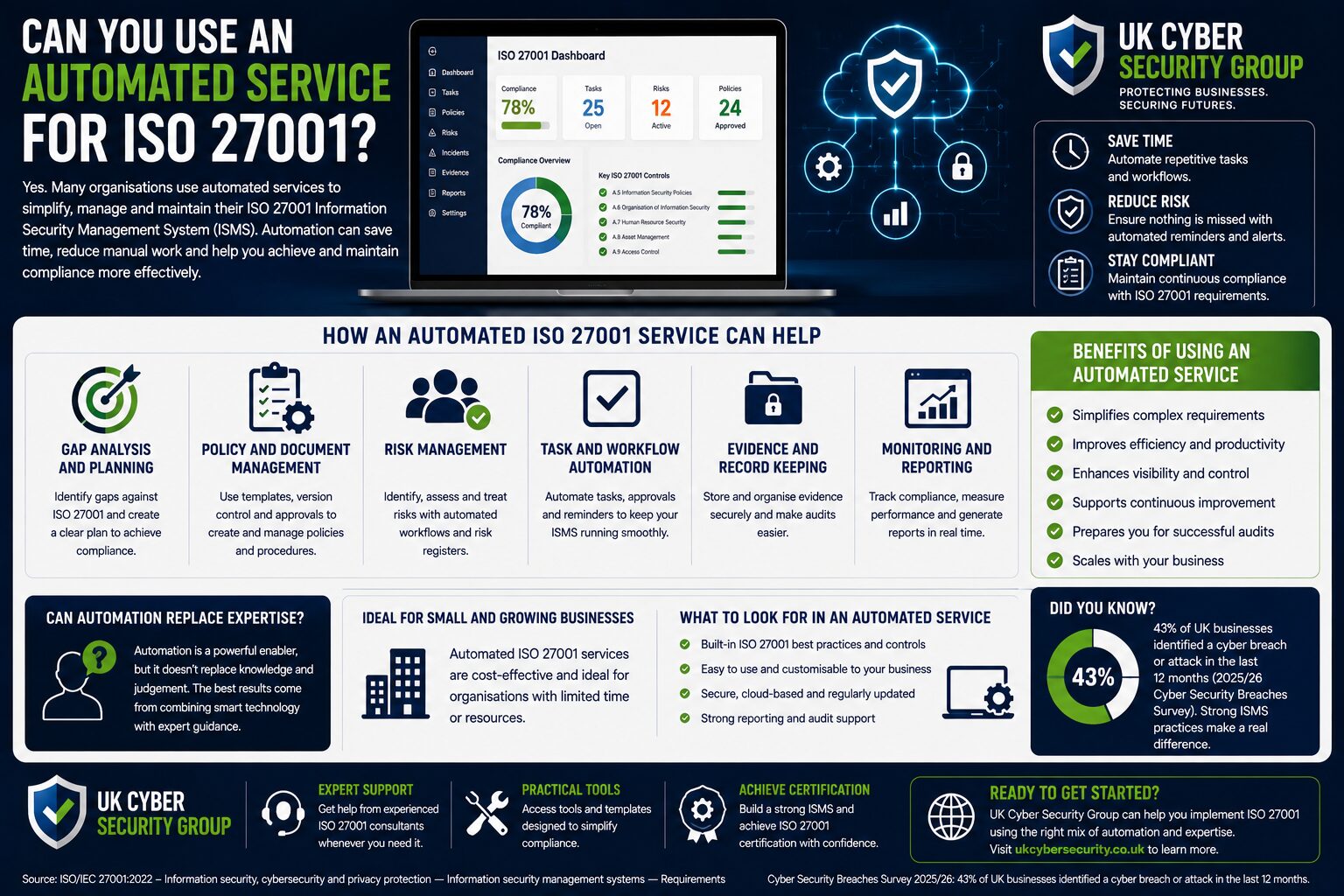
Can you use an automated service for ISO 27001?
The short answer is yes: automated and AI-driven platforms can support you through scoping, documentation, evidence collection and ongoing maintenance of your information security management system (ISMS). They can remove a lot of repetitive work and help smaller teams behave like much larger, more mature security functions. But you still need people to make decisions, own risks and embed security in day-to-day operations.
UK Cyber Compliance (a part of UK Cyber Security Group) provides these services and has a platform to make certification much easier and cheaper.
Automation and ISO 27001 – a realistic overview
Automated ISO 27001 platforms have become popular because they tackle some of the biggest pain points for businesses:
- Heavy documentation requirements
- Complex mapping between risks, controls and evidence
- Keeping everything up to date for audits and re-certification
- Coordinating responsibilities across IT, HR, operations and suppliers
Globally, ISO 27001 adoption has grown steadily, with tens of thousands of certificates issued worldwide and strong growth in sectors like SaaS, finance, healthcare and professional services. In parallel, UK Government cyber surveys have consistently shown that around a third of UK businesses identify a cyber security breach or attack each year, with higher rates in medium and large organisations. That mix of growing risk and growing expectations from clients is exactly why companies look for smarter, more automated ways to get certified.
An automated service will not magically make you secure, but it can give you:
- Structured workflows so you do not miss steps
- Pre-built policy frameworks aligned with the standard
- Task management and reminders so actions do not silently slip
- Evidence collection and audit trails in one place
- Dashboards that make it easier for leadership to see progress
The rest of this document unpacks how that fits with the formal standard, and where human judgement still matters.
Clarifying the basics: what is ISO 27001 and what does certification involve?
Before talking about automation, it is worth getting the fundamentals straight, especially for people coming to the standard for the first time.
Understanding what the standard actually is
What is iso 27001.
In plain terms, ISO/IEC 27001 is the international standard that sets out how to create, run and improve an information security management system. It is not a checklist of technical tools. Instead, it combines:
- Management requirements – things like leadership commitment, risk assessment, objectives, monitoring and continual improvement
- A catalogue of security controls – a structured list of measures, covering access control, operations, incident management, supplier security, secure development and more
Think of it as a framework for how your organisation thinks about and manages information risks, rather than a list of specific technologies to install.
What is ISO 27001 Certification?
Now to What is ISO 27001 Certification?
Certification is a formal, independent confirmation by an accredited certification body that:
- Your ISMS meets the requirements of ISO/IEC 27001
- You have identified and assessed information risks
- You have implemented appropriate controls from the standard’s control set
- You are monitoring performance and improving over time
It shows customers, partners and regulators that your security is not just based on good intentions but on a recognised, audited standard. For many contracts, especially in sectors like technology services, healthcare, financial services and critical supply chains, this is becoming a near-standard expectation.
ISO 27001 Certification Levels – clearing up a common myth
ISO 27001 Certification Levels.
Despite what marketing material sometimes implies, ISO 27001 itself does not define bronze, silver, gold or similar levels. You are either certified or you are not, for a specific scope.
What does vary is:
- The breadth of scope – whether you certify a single product, a service line or your entire organisation
- The maturity of your implementation – for example, how integrated your risk management is, how automated your monitoring is, and how deeply embedded your controls are in business processes
Automated services can help you behave more like a “high maturity” organisation even if your internal security team is small, because they give you structure and visibility that would otherwise require a lot of manual coordination.
How the Certification Works – the process, step by step
The phrase How the Certification Works usually refers to the standard certification cycle. An automated platform can plug into each of these stages:
- Scoping and context
- Define what parts of your business are in scope, and which information assets and systems are covered.
- Identify relevant legal, regulatory and contractual obligations.
- Automated services often provide guided questionnaires to help you define this correctly.
- Gap analysis and planning
- Compare your current controls, documentation and practices against ISO 27001 requirements.
- Prioritise remediation work.
- Many platforms generate a gap report and an action plan automatically.
- ISMS design and documentation
- Create or refine your information security policy, risk methodology, Statement of Applicability, and topic-specific policies.
- Automated services usually offer templates aligned to the standard, which you adapt to your context rather than writing from a blank page.
- Implementation and evidence collection
- Put policies into practice: train staff, configure controls, formalise processes, and start collecting logs and records.
- Platforms can link tasks to controls and store evidence (for example, screenshots, reports, meeting minutes) in a structured way.
- Internal audit and management review
- Conduct internal audits to check whether your ISMS matches ISO 27001 and your own policies.
- Hold a management review to evaluate performance and approve improvements.
- Automated tools can provide audit checklists, track findings and document management review outcomes.
- Stage 1 and Stage 2 certification audits
- Stage 1: auditors review documentation to confirm readiness.
- Stage 2: auditors test implementation and effectiveness through interviews, samples and evidence.
- A well-organised platform makes it much easier to provide the right documents quickly.
- Ongoing surveillance and recertification
- Each year, surveillance audits check that you are maintaining and improving your ISMS.
- After the cycle, you go through recertification.
- Automation helps you stay audit-ready instead of rushing to pull everything together at the last minute.
In each of these steps, technology is there to structure and support, not to replace your decisions or your accountability.
Who actually needs ISO 27001 – and where automation helps most
Let us tackle Who needs iso 27001 certification in a practical way.
You are likely to need or strongly benefit from certification if:
- Your customers or procurement teams are asking for it as a condition of doing business
- You handle sensitive or regulated data – for example, personal data at scale, health data, payment information or critical intellectual property
- You are part of a supply chain for larger organisations that are themselves heavily regulated
- You operate cloud-based or managed services that store or process client information
For many small and mid-sized UK businesses, the barrier used to be the perceived complexity of ISO 27001. Automation changes that equation by:
- Reducing the “blank sheet of paper” work
- Helping non-specialists follow a clear, repeatable process
- Making it far easier to demonstrate compliance with clients’ due diligence questionnaires
If your organisation is already experiencing frequent security questionnaires, tender requirements mentioning ISO 27001, or concerns from board level about information risk, an automated service is often the most realistic way to reach certification without needing a large internal security function.
Where automated services fit into the ISO 27001 journey
Policy and documentation generation
One of the biggest advantages of an automated platform is generating and managing the core documents the standard expects:
- Information security policy
- Scope statement
- Risk assessment methodology
- Risk treatment plan
- Statement of Applicability
- Topic-specific policies (access control, asset management, incident management, supplier security, backup, and so on)
Instead of writing these from scratch, you use structured templates that are already aligned with ISO 27001, then tailor them to your organisation. The platform can help ensure consistency of terminology, references and version control.
This does not remove the need to think. You still need to decide:
- Which risks are relevant
- Which controls are appropriate and proportionate
- How responsibilities should be allocated in your specific context
But it saves huge amounts of time and reduces the risk of missing key requirements.
Risk assessment and control mapping
An ISMS lives or dies by its risk management. Automated services can:
- Provide risk libraries with common threats, vulnerabilities and impacts
- Help you score and prioritise risks consistently
- Map each risk to specific ISO 27001 controls
- Feed that mapping into your Statement of Applicability
This is especially helpful for smaller organisations that might otherwise struggle to structure risk discussions. It also makes it much easier to show auditors and clients how each control relates to a specific business risk.
Evidence management and audit readiness
One of the most time-consuming parts of ISO 27001 is collecting and organising evidence:
- Logs and reports (for example, patching, backups, access reviews)
- Meeting minutes (management reviews, security steering meetings)
- Training records and awareness campaigns
- Records of incidents and corrective actions
An automated platform becomes your central evidence library. Each control or policy can have associated evidence items, and tasks can remind owners to refresh that evidence periodically. When an auditor asks for proof that, say, access reviews were performed, you can retrieve it in seconds rather than digging through email threads and shared folders.
What automation cannot do – and why people still matter
It is important not to over-sell what an automated service can achieve. Some things cannot be delegated to a platform:
- Leadership commitment
Senior management still needs to approve the ISMS, provide resources and take part in management reviews. No tool can sign off your policy or own your risk appetite. - Risk decisions
Technology can suggest risks and controls, but only your organisation can decide which risks to accept, reduce, transfer or avoid. - Cultural change
Staff behaviour, awareness and day-to-day decision-making cannot be automated. You still need communication, training and consistent messaging. - Technical implementation
Platforms can help you track that backups, access controls or logging exist, but someone still has to configure and maintain them.
A healthy approach is to use automation for structure, consistency and evidence, while keeping human judgement front and centre for anything involving risk, ethics or strategic trade-offs.
How an automated platform supports each ISO 27001 policy area
To make this more concrete, here is how an automated service might support the major policy domains commonly required by ISO 27001.
Access control and identity
- Provide templates for access control policies
- Map user access reviews to recurring tasks
- Store evidence of reviews, such as exported user lists or approval records
- Track exceptions where temporary elevated access is granted
Asset management and classification
- Maintain an asset register for systems, applications and data sets
- Link each asset to an owner and classification level
- Align controls (like backup or encryption) with more sensitive assets
Operations and change
- Schedule routine operational tasks (patch cycles, backup tests, log reviews)
- Track completion and store screenshots or reports as evidence
- Link change management activities to risk assessments and approvals
Incident management
- Provide incident logging forms aligned with your policy
- Track incident lifecycles, corrective actions and lessons learned
- Export incident statistics for management review
Supplier security
- Maintain a register of suppliers handling your information
- Record due diligence, contracts and security assurances
- Track renewal dates and trigger periodic reviews
The common theme is traceability: automation makes it easier to demonstrate that your written policies are actually implemented and monitored.
Which UK-based firms offer ISO 27001 consultancy services?
Which UK-based firms offer ISO 27001 consultancy services?
Across the UK, you will find:
- Specialist ISO 27001 consultancies helping with design, documentation, risk assessment and audit preparation
- Larger professional services firms offering ISO 27001 as part of wider risk and assurance services
- Certification bodies that also provide pre-audit support or readiness assessments
Typical services include:
- Gap analyses to compare your current state against ISO 27001
- Assistance drafting or reviewing policies and procedures
- Support implementing controls and running risk workshops
- Internal audits and help with managing corrective actions
UK Cyber Compliance (a part of UK Cyber Security Group) provides these services and has a platform to make certification much easier and cheaper.
For many organisations, the sweet spot is a combination of an automated platform and some targeted consultancy input – for example, a consultant to validate your risk assessment and policies, while the platform handles the heavy lifting of documentation workflow and evidence management.
Using automation without losing sight of risk and business value
When deciding whether to use an automated service for ISO 27001, a few practical considerations help keep you grounded:
- Start from your business goals
Are you aiming purely for a certificate, or for stronger security and resilience? A good platform will support both, but your intent matters. - Keep scope realistic
Automation makes larger scopes more manageable, but you still need to ensure that you can genuinely apply and evidence controls across everything in scope. - Align with existing tools
Automated ISO 27001 platforms work best when they integrate with your existing systems, such as identity management, ticketing, monitoring and HR tools. - Think beyond the first audit
Certification is not a one-off event. Choose an approach that makes it easier to maintain and improve your ISMS over several years, rather than scramble before each audit. - Make it accessible to non-specialists
In many UK SMEs, the ISMS will be run by people who are not career security professionals. Automation should make their lives easier, not lock them into a complex, opaque system.
Bringing it back to your original question
So, can you use an automated service for ISO 27001? Yes, and for many organisations it is the most pragmatic way to reach and maintain certification.
Automation can:
- Accelerate policy creation and keep documentation aligned and version-controlled
- Provide a clear, guided route through scoping, risk assessment, control selection and evidence collection
- Make audits less stressful by keeping you “always ready” rather than scrambling at the last minute
- Help smaller teams behave like a mature, structured security function
It cannot:
- Decide your risk appetite
- Stand in for leadership engagement
- Replace the need for staff awareness and good security habits
- Implement technical controls on its own
Used well, an automated service becomes the backbone of your ISO 27001 journey, giving you structure, consistency and visibility, while your people provide the judgement, ownership and culture that no platform can replicate.
UK Cyber Compliance is here to help
For more information, please do get in touch.
Please check out our Free Cyber Insurance
Other blog posts, Your ISO 27001 Questions Answered, Get ISO 27001 Certified ,
If you would like to know more, do get in touch as we are happy to answer any questions. Looking to improve your cybersecurity but not sure where to start? Begin by getting certified in Cyber Essentials, the UK government’s scheme that covers all the technical controls that will provide the protection that you need to help guard against criminal attacks.