
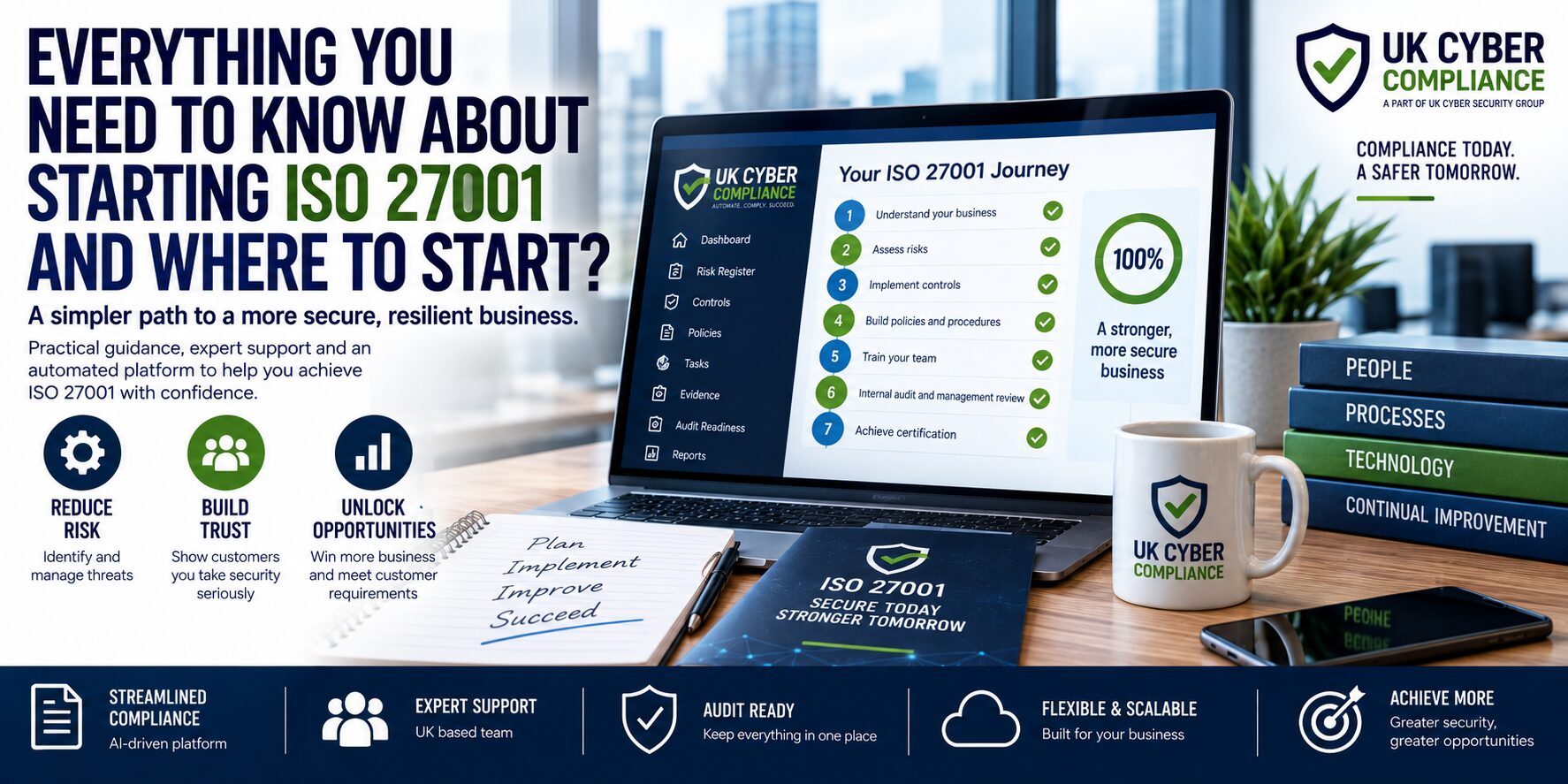
Everything you need to know about starting ISO 27001 and where to start?
Starting ISO 27001 can look complicated when you first see the standard. There are risks to assess, controls to consider, policies to prepare, responsibilities to assign, audits to complete and evidence to gather. The easiest way to approach it is to stop thinking of ISO 27001 as one large certification project and instead build the Information Security Management System, commonly called an ISMS, in a logical order.
ISO/IEC 27001:2022 is the current international standard for information security management systems. ISO describes it as the world’s best-known ISMS standard and explains that it helps organisations establish, implement, maintain and continually improve a structured information security management system.
The standard uses a risk-based approach. This means you do not start by buying security technology or creating dozens of policies. You start by understanding your organisation, identifying what information needs protection, assessing what could go wrong and deciding which safeguards your business genuinely needs.
That approach makes ISO 27001 suitable for organisations with very different operations. A small professional consultancy may rely heavily on cloud applications and employee knowledge. A software provider may need stronger development, monitoring and availability controls. A manufacturer may depend on operational systems, suppliers and physical locations.
The management system should reflect the business.
UK Cyber Compliance provides ISO 27001 support through an automated and AI-driven platform designed to bring risk management, controls, documentation, tasks and audit preparation into one structured environment. Its current platform information describes AI-driven compliance, risk management and audit-ready documentation.
UK Cyber Compliance (a part of UK Cyber Security Group) provides these services and has a platform to make certification much easier and cheaper.
what is iso 27001
ISO 27001 is the commonly used name for ISO/IEC 27001:2022, the international requirements standard for information security management systems.
An ISMS provides the framework that an organisation uses to manage information security consistently.
Rather than treating cyber security as the responsibility of the IT department alone, ISO 27001 brings together leadership, people, business processes, suppliers, physical security, technology, risk management, internal audit and continual improvement.
The standard centres on protecting confidentiality, integrity and availability.
Confidentiality means information only reaches authorised people and systems.
Integrity means information remains accurate, complete and trustworthy.
Availability means authorised users can access information and services when they need them.
ISO states that an ISMS meeting ISO/IEC 27001 uses risk management to protect these principles and gives interested parties confidence that information security risks receive appropriate management.
For a business starting ISO 27001, this is the most important concept to understand. You are building a management system for protecting information, not simply collecting documents for an auditor.
Decide why you want ISO 27001 before doing anything else
Start with the business reason.
Why does your organisation want certification?
A customer may have requested it.
A tender may require it.
A larger organisation may expect suppliers to provide recognised information security assurance.
Management may want a stronger internal security framework.
The business may be entering a sector where information security forms an important part of supplier due diligence.
Understanding the reason helps determine the scope, priorities and resources for the project.
If one customer service drives the requirement, the business may initially focus certification around the people, systems and processes that support that service.
If management wants organisation-wide assurance, a broader scope may make more sense.
Do not start writing policies until you understand the commercial and security objectives behind the project.
Get leadership involved from the beginning
ISO 27001 cannot operate effectively as an isolated IT exercise.
Senior management needs to support the ISMS because information security decisions affect resources, risk, employees, suppliers and business priorities.
Identify a senior sponsor.
Make sure leadership understands why the business seeks certification and what will need to happen.
Management will eventually need visibility of information security objectives, important risks, audit results, incidents, corrective actions and improvement activity.
Leadership involvement also makes it much easier to obtain cooperation from other departments.
Human resources may need to improve joiner and leaver processes.
Procurement may need supplier security assessments.
Managers may need to review user access.
Technical teams may need to improve controls.
Employees may need training.
A clear management mandate prevents ISO 27001 from becoming “the IT person’s project”.
Start with a gap review
Before creating anything new, find out what your organisation already does.
Most businesses are not starting from zero.
You may already have:
Information security policies
Multi-factor authentication
Endpoint protection
Backups
Access controls
Supplier contracts
Employee onboarding processes
Incident reporting
Cyber Essentials certification
Business continuity arrangements
Security monitoring
A gap review compares existing practices with ISO 27001 requirements and identifies what still needs attention.
UK Cyber Compliance’s current guidance explains that ISO 27001 implementation needs a defined scope, leadership support, risk assessment, risk treatment, suitable controls, documented information, internal audit, management review, corrective action and external assessment.
A good gap review prevents unnecessary work.
Do not replace an effective existing process simply because it was not originally designed for ISO 27001.
Adapt what already works.
Define the ISMS scope early
Scope defines what your certified ISMS covers.
This deserves careful thought because almost every later activity depends on it.
A scope may cover an entire organisation or a clearly defined part of it.
Consider the services you provide, locations you operate, information you handle, systems you use, employees involved and suppliers you depend upon.
Suppose a company wants certification for a hosted software platform.
The scope may need to include development, technical support, cloud infrastructure, customer data, relevant employees, identity services, critical suppliers and management processes.
Excluding an important dependency simply because another provider operates it can produce an unrealistic scope.
Keep the wording clear enough for a customer to understand what certification actually covers.
Understand your organisation and its interested parties
ISO 27001 expects businesses to understand the context in which the ISMS operates.
Think about the internal and external factors that affect information security.
These might include customer expectations, contractual obligations, legal duties, cloud dependency, remote working, supply-chain relationships, business growth and technology changes.
You also need to identify relevant interested parties.
Examples could include customers, employees, suppliers, regulators, shareholders, partners and certification bodies.
Then ask what information security requirements these parties create.
A customer contract may require confidentiality.
A regulator may expect protection of personal information.
An employee needs secure access to systems.
A supplier relationship may create service availability concerns.
These requirements help shape the ISMS.
Understand the 2024 amendment
The current ISO/IEC 27001:2022 standard also has Amendment 1:2024, which introduced climate action changes to management system requirements. ISO confirms that this amendment applies to ISO/IEC 27001:2022.
Organisations starting their ISMS should therefore work from the current standard and applicable amendment rather than relying solely on old implementation material built around the previous 2013 edition.
This matters particularly if you find older templates online.
A document being labelled “ISO 27001” does not necessarily mean it reflects the current requirements.
Build your information security risk method before assessing risks
Risk management sits at the centre of ISO 27001.
Before creating a risk register, decide how the organisation will assess risk consistently.
You need a method for evaluating likelihood and impact.
Likelihood considers how realistically an event could happen.
Impact considers what the organisation could suffer if it happened.
The organisation also needs risk acceptance criteria.
These criteria determine which risks management can tolerate and which risks require further treatment.
The method should be easy enough for risk owners to understand.
A complicated mathematical system gives little benefit if managers cannot apply it consistently.
UK Cyber Compliance’s current risk assessment guidance describes a structured method involving likelihood, impact, acceptance criteria, risk owners, treatment and residual risk.
Identify realistic information security risks
Once the method is agreed, start identifying risks.
Avoid vague entries such as “phishing” or “ransomware”.
Describe complete scenarios.
For example:
An employee could respond to a convincing phishing message and disclose Microsoft 365 credentials, allowing an attacker to access company email and confidential customer information.
A cloud hosting provider could suffer an extended service failure that prevents customers from accessing the company’s platform.
An employee could accidentally share confidential information with an unauthorised external recipient.
A critical supplier could suffer a cyber incident that disrupts a service the organisation depends upon.
Complete scenarios make impact and likelihood easier to assess.
They also make treatment decisions clearer.
Assign risk owners
Each meaningful risk should have an owner.
The risk owner should understand the business consequences and have enough authority to make or escalate decisions.
IT does not need to own every information security risk.
A finance director may own a risk connected with financial systems.
An operations manager may own a service availability risk.
Human resources may understand the impact of employee information exposure.
The IT or security team can provide technical advice, but risk ownership should sit with the person who understands the business impact.
This is one of the points where ISO 27001 becomes a business management framework rather than an IT checklist.
Assess existing controls before creating new ones
Before deciding that a risk needs another safeguard, identify what already protects the organisation.
A risk involving account compromise might already have several controls:
Multi-factor authentication
Restricted administrator access
Email filtering
Security awareness
Login monitoring
Incident response
Existing controls influence the current risk level.
Do not give a control credit merely because a policy says it should exist.
Check that it actually operates.
A planned MFA project is not the same as MFA protecting every relevant account today.
Evidence becomes important from this point onwards.
Decide what risks need treatment
Compare each assessed risk against the acceptance criteria.
If the risk exceeds the approved threshold, the organisation needs treatment.
Treatment may involve strengthening controls.
For example, an account compromise risk might lead to stronger authentication, reduced administrator access, improved monitoring and employee awareness.
A supplier risk could lead to better due diligence, stronger contracts, continuity planning or alternative suppliers.
Treatment should respond to the actual risk rather than copying generic security recommendations.
Understand residual risk
Security controls rarely remove all risk.
Residual risk means the exposure that remains after treatment.
Suppose a company identifies a high risk of Microsoft 365 account compromise.
Management introduces MFA, Conditional Access, better monitoring and stronger administrator controls.
Those measures may reduce the likelihood significantly.
The organisation then reassesses the remaining exposure.
If the residual risk falls within the approved acceptance criteria, the relevant risk owner can accept it.
If it remains too high, further treatment may be necessary.
This gives the ISMS a structured decision-making process.
Understand Annex A before trying to answer it
ISO/IEC 27001:2022 Annex A contains 93 information security controls.
UK Cyber Compliance’s current Annex A guidance confirms that these controls sit across organisational, people, physical and technological areas.
Do not begin ISO 27001 by opening Annex A and attempting to implement all 93 controls automatically.
Risk treatment comes first.
The organisation determines the controls it needs and then compares those decisions with Annex A to make sure it has not overlooked relevant safeguards.
Controls may address areas such as access management, supplier security, cloud services, incidents, employee awareness, physical protection, backups, logging, vulnerabilities, networks and secure development.
Some Annex A controls may not be necessary for a particular scope.
Others may be essential.
The business should be able to explain why.
Build the Statement of Applicability
The Statement of Applicability, commonly called the SoA, records the organisation’s control decisions.
This document becomes one of the most important parts of the ISMS.
It should show which controls the organisation needs, why it needs them, whether they have been implemented and why any Annex A controls have been excluded.
UK Cyber Compliance describes the SoA as a practical connection between security risks, legal duties, customer expectations, supplier requirements and internal controls.
Do not treat it as a document to complete at the end.
Build it alongside risk treatment.
If your risk register identifies account compromise as important, the SoA should show relevant authentication and access controls.
If supplier dependency creates significant risk, the SoA should reflect relevant supplier controls.
The documents should agree with each other.
Create policies that reflect reality
ISO 27001 needs documented information, but more paperwork does not automatically mean better compliance.
Create policies that explain what the business genuinely expects people to do.
Useful policy areas may cover:
Information security
Access control
Acceptable use
Incident management
Supplier security
Remote working
Backup
Business continuity
Information classification
Secure development where relevant
Avoid copying a generic policy that describes controls your business does not operate.
Auditors can compare written policy with actual practice.
If the policy says access receives quarterly review, the organisation should be able to show completed quarterly reviews.
Policies should describe the business, not an imaginary perfect organisation.
Make information security objectives measurable
ISO 27001 requires information security objectives.
These objectives should connect with business need and information security risk.
For example, an organisation may want to increase MFA coverage, reduce overdue vulnerabilities, improve supplier reviews or strengthen recovery testing.
A useful objective answers basic questions:
What are we trying to achieve?
Who owns it?
How will we measure progress?
When will management review it?
A vague objective such as “improve security” gives management little useful information.
A measurable objective makes progress visible.
Train employees before the auditor asks questions
Employees play a major role in an ISMS.
They should understand the information security rules relevant to their work.
Training might address phishing, password security, authentication, document handling, external sharing, remote working and incident reporting.
Managers need awareness of their responsibilities.
Technical employees may require deeper specialist competence.
Control owners need to understand how their controls work and what evidence they should maintain.
The latest UK Government Cyber Security Breaches Survey found that only 19 per cent of businesses reported cyber security training or awareness activity during the previous 12 months.
That gap demonstrates why a structured training approach can add real value.
Start gathering evidence early
One of the biggest mistakes organisations make is waiting until shortly before the certification audit to think about evidence.
Evidence should arise naturally while the ISMS operates.
Examples include completed access reviews, training records, supplier assessments, backup tests, incident records, monitoring output, risk approvals, vulnerability remediation, internal audit findings and management review records.
UK Cyber Compliance’s current evidence guidance emphasises the difference between a policy and evidence of operation. A backup policy explains what should happen, while recovery testing demonstrates that the process actually works.
Create an evidence structure early.
You will make audit preparation much easier.
Integrate ISO 27001 into existing business processes
Certification becomes much easier to maintain when security becomes part of normal work.
Connect employee onboarding with account creation and awareness.
Connect employee departures with account removal.
Connect procurement with supplier security.
Connect project management with risk assessment.
Connect technology changes with security review.
Connect management meetings with information security performance.
The strongest ISMS does not operate as a separate compliance department.
It becomes part of how the organisation runs.
Complete your controls before claiming they work
A control can appear in the SoA before implementation has finished, but the status needs to remain accurate.
Do not mark something as fully implemented because a project has started.
If management plans to introduce stronger logging next month, the current risk assessment should reflect the controls operating today.
Once the new safeguard operates and evidence demonstrates effectiveness, reassess the risk.
This creates honest records and prevents management from underestimating exposure.
Perform internal audit
Before external certification, the organisation needs internal audit activity.
Internal audit checks whether the ISMS meets the organisation’s requirements and the standard’s requirements.
The auditor should look beyond documents.
Test whether processes actually operate.
Select an employee who recently left. Was access removed properly?
Select a supplier. Did security review take place?
Select a risk. Does the treatment evidence support the residual score?
Select a control. Can the owner explain it and provide evidence?
Internal audit gives the business an opportunity to identify weaknesses before the certification body does.
Treat findings as useful information.
Hold management review
After the ISMS has operated and internal audit has taken place, senior management should formally review the system.
Management should consider meaningful information such as:
Important risks
Information security objectives
Audit findings
Incidents
Corrective actions
Changes affecting the organisation
Supplier issues
Resource requirements
Improvement opportunities
The meeting should result in decisions where appropriate.
Management review should never become a document created simply because certification requires one.
It gives leadership an opportunity to determine whether the ISMS still supports the organisation.
Correct weaknesses before certification
Internal audit may identify nonconformities or improvement opportunities.
Address significant weaknesses before the external assessment.
Do not simply close an issue because someone completed a task.
Check whether the action solved the underlying problem.
For example, if an audit finds that former employees retain access, removing one account fixes the immediate issue.
The stronger action asks why the process failed and improves employee departure procedures so the same weakness does not recur.
This is how ISO 27001 builds continual improvement.
Choose the certification body carefully
ISO develops the standard, but ISO does not certify individual organisations. Independent certification bodies carry out certification. ISO also notes that certification from an accredited conformity assessment body can provide another layer of confidence because the certifier’s competence has received independent confirmation.
In the UK, check whether your customer, tender or supply chain expects certification from a UKAS-accredited certification body.
This distinction can be commercially important.
Ask the certification body about scope, audit process, sector experience and expected evidence before scheduling the audit.
You do not need to wait until every detail has finished before beginning that conversation.
Early engagement can help you plan realistically.
What is ISO 27001 Certification?
ISO 27001 certification provides independent confirmation that an organisation operates an ISMS that meets ISO/IEC 27001 requirements within the stated scope.
Certification does not mean the organisation can never experience a security incident.
No credible framework can promise that.
It demonstrates that the organisation manages information security using a structured system.
ISO states that certification can help demonstrate to customers and stakeholders that an organisation is committed and able to manage information securely.
This assurance can support customer confidence, supplier due diligence and tender responses.
The certificate should represent a working system, not a collection of policies prepared shortly before an audit.
ISO 27001 Certification Levels
ISO 27001 does not use official bands such as bronze, silver or gold.
An organisation either meets the certification requirements for its defined ISMS scope or it does not.
Security maturity can still vary between certified businesses.
A smaller organisation may operate a straightforward but effective ISMS.
A mature organisation may have automated monitoring, extensive supplier assurance, sophisticated security metrics and many years of audit information.
Both may hold certification to the same standard.
The difference is maturity rather than a formal certification band.
Businesses should therefore be cautious when they see marketing material suggesting official ISO 27001 achievement tiers that do not exist within the standard.
How the Certification Works
Once your ISMS is ready, the certification process normally involves an initial assessment followed by a deeper assessment of implementation and effectiveness.
UK Cyber Compliance’s current audit guidance describes the certification route as an initial assessment in two stages, followed by a certification decision and continuing assessment activity.
The first stage commonly looks at readiness and key ISMS information.
An auditor may review scope, the risk methodology, risk assessment, Statement of Applicability, policies, internal audit and management review.
The second stage goes deeper into operation.
The auditor can interview employees, inspect records and test whether controls work as described.
The business needs evidence showing that the ISMS operates.
Certification therefore depends on far more than having the correct policy documents.
After successful certification, the organisation continues operating, reviewing and improving the management system.
Do not stop when you receive the certificate
ISO 27001 continues after certification.
Employee roles change.
New suppliers appear.
Technology changes.
Customer requirements develop.
New vulnerabilities emerge.
Security incidents create lessons.
The organisation should continue risk assessment, internal audit, management review and improvement activity.
The best ISMS gets easier to operate over time because information security becomes part of everyday business processes.
A company should not need to rebuild its security documentation shortly before every audit.
The required evidence should already exist because people use the processes throughout the year.
Current UK cyber figures show why structured risk management matters
The UK Government’s Cyber Security Breaches Survey 2025 to 2026 found that 43 per cent of businesses identified a cyber security breach or attack during the previous 12 months. That equates to approximately 612,000 UK businesses.
Reported incidence increased with company scale. The survey found that 65 per cent of medium businesses and 69 per cent of large businesses identified a breach or attack. Small businesses reported 46 per cent.
Despite that exposure, only 30 per cent of businesses reported conducting a cyber security risk assessment during the previous year. Only 18 per cent carried out a cyber security vulnerability audit.
These figures help explain the practical value of ISO 27001.
The standard gives organisations a repeatable structure for understanding risk before something goes wrong.
Small businesses should keep ISO 27001 proportionate
A smaller organisation does not need unnecessary bureaucracy.
ISO itself publishes dedicated guidance for SMEs and explains that the standard can adapt to the needs and constraints of smaller organisations.
A small business may have:
A focused scope
A manageable risk register
A concise policy set
Straightforward objectives
A simple evidence structure
Clear management ownership
The sophistication of the process should reflect the business.
What matters is whether the ISMS meets the requirements and operates effectively.
A complicated system that nobody understands provides less value than a clear and proportionate one.
Who needs iso 27001 certification
ISO 27001 can benefit any organisation that depends on information or needs to demonstrate strong security governance.
This can include software companies, professional services, managed service providers, healthcare suppliers, manufacturers, charities, technology businesses, financial organisations, public-sector suppliers and businesses operating within demanding supply chains.
ISO states that the benefits of ISO/IEC 27001 extend across economic sectors, including private, public and not-for-profit organisations.
Certification often becomes particularly valuable when customers ask security questions repeatedly.
Instead of providing only internal claims about security, the organisation can demonstrate that an independent certification body has assessed its management system.
Start with business information rather than security tools
Many organisations begin cyber security discussions by asking which products they need.
ISO 27001 encourages a better question:
What information and services need protection?
Identify customer information, employee records, financial information, intellectual property, authentication information, contracts, business systems and other important assets.
Then identify the systems, employees and suppliers that support them.
This gives risk assessment a real business foundation.
A cloud service matters because of the information and service it supports, not simply because it appears on an IT inventory.
Understand legal and contractual requirements
Your ISMS should take account of applicable legal, regulatory and contractual responsibilities.
Depending on the organisation, these may involve data protection, employment responsibilities, customer contracts, intellectual property, sector rules or specific security obligations.
Create a way to identify and review these requirements.
Do not assume an old compliance list remains correct forever.
The business may enter a new market, sign a new contract or begin handling different information.
Relevant requirements should feed into control selection and risk management.
Understand supplier dependency from the start
Modern organisations rely heavily on third parties.
Cloud hosting, Microsoft 365, payroll, software, telecommunications, managed IT and specialist security services can all affect information security.
The government survey found that only 15 per cent of businesses formally reviewed cyber risks from immediate suppliers, while just 6 per cent reviewed their wider supply chain.
ISO 27001 gives businesses a reason to understand these dependencies more systematically.
Identify critical suppliers early.
Ask what information they access, what happens if their service fails and what assurance you need from them.
Supplier security becomes much easier when built into procurement rather than added later.
Do not confuse ISO 27001 with Cyber Essentials
The two can complement each other, but they serve different purposes.
Cyber Essentials focuses on a technical baseline designed to reduce common cyber threats.
ISO 27001 provides a much wider management framework covering information security risk, leadership, suppliers, employees, business processes, physical controls, technology, internal audit and continual improvement.
A business may hold both.
Cyber Essentials can provide useful technical foundations.
ISO 27001 adds structured governance around the broader information security programme.
Existing Cyber Essentials work may therefore support your starting point rather than needing to be recreated.
Create a realistic project plan
ISO 27001 becomes much more manageable when broken into clear work areas.
A sensible sequence is:
Understand why certification matters.
Secure leadership support.
Complete a gap review.
Define scope.
Identify interested parties and requirements.
Create the risk methodology.
Complete risk assessment.
Agree risk treatment.
Review Annex A.
Build the Statement of Applicability.
Create or update policies.
Set objectives.
Implement controls.
Train employees.
Gather operational evidence.
Complete internal audit.
Hold management review.
Address weaknesses.
Proceed to external certification.
The individual activities overlap, but this order provides a clear route.
Avoid common starting mistakes
The first common mistake involves downloading a complete ISO 27001 document pack and changing the company name.
The second involves starting with Annex A before understanding risk.
Another mistake involves giving responsibility entirely to IT.
Businesses can also underestimate evidence and assume policies alone demonstrate compliance.
Other weaknesses include unclear scope, generic risks, poor leadership involvement, missing risk owners and controls that exist only on paper.
Build the ISMS around how the organisation genuinely works.
That approach produces stronger security and makes the audit easier.
Which UK-based firms offer ISO 27001 consultancy services?
UK organisations can obtain ISO 27001 support from information security consultancies, managed service providers, compliance specialists, audit professionals and platform-led services.
UK Cyber Compliance provides ISO 27001 support through an automated and AI-driven platform.
Its current platform offers AI-driven compliance, risk management, control tracking and audit-ready documentation.
Its ISO 27001 guidance also covers scope, risk assessment, risk treatment, Annex A, the Statement of Applicability, evidence and audit preparation.
A useful provider should help your organisation understand the management system rather than simply handing over documents.
The business should remain able to explain its scope, risks, controls and evidence to an auditor.
Consultancy and software should make that process clearer.
How UK Cyber Compliance can help you get started
One of the hardest parts of starting ISO 27001 is knowing what to do next.
Traditional projects can spread information across spreadsheets, shared folders, emails and separate task lists.
That creates confusion.
A risk may sit in one spreadsheet.
A related control may appear somewhere else.
Evidence can become difficult to locate.
UK Cyber Compliance provides a central platform that brings ISO 27001 activity together. Its current information describes guided risk assessment, residual risk tracking, control management, real-time compliance visibility, AI-powered documentation and audit-ready reporting.
This helps organisations see what has been completed and what still needs attention.
Automation can reduce administration.
AI-driven assistance can help organise and draft compliance information.
Human judgement still remains essential.
Management decides the business scope.
Risk owners determine business impact.
Control owners operate safeguards.
Auditors verify whether the system works.
Where should you start today?
If your business has decided to pursue ISO 27001, the first practical activity should not be writing every policy.
Start with four things.
Confirm why the organisation wants certification.
Identify a senior sponsor.
Draft the proposed ISMS scope.
Complete an initial gap review.
Once these foundations exist, build the risk methodology and begin understanding the information, services, systems, people and suppliers that need protection.
From there, risk assessment drives treatment.
Treatment drives control selection.
Controls feed the Statement of Applicability.
Policies support the controls.
Operational activity creates evidence.
Internal audit tests the system.
Management review confirms leadership oversight.
External certification then independently assesses the completed ISMS.
This order makes ISO 27001 much easier to understand.
ISO/IEC 27001:2022 gives organisations a recognised framework for establishing, implementing, maintaining and continually improving information security.
UK Cyber Compliance provides an automated and AI-driven platform designed to help UK businesses follow that journey in a structured way, bringing risk, controls, policies, actions and audit readiness together.
The key is to start with the business rather than the paperwork. Understand what you need to protect, why it matters and what could go wrong. Once those foundations are clear, the rest of the ISO 27001 process becomes a logical sequence of risk decisions, controls, evidence and continual improvement.
UK Cyber Compliance is here to help
For more information, please do get in touch.
Please check out our Free Cyber Insurance
Other blog posts, Your ISO 27001 Questions Answered, Get ISO 27001 Certified ,
If you would like to know more, do get in touch as we are happy to answer any questions. Looking to improve your cybersecurity but not sure where to start? Begin by getting certified in Cyber Essentials, the UK government’s scheme that covers all the technical controls that will provide the protection that you need to help guard against criminal attacks.