How easy is it to get ISO 27001 certification using an automated service?
Getting ISO 27001 certification has traditionally involved risk assessments, policies, spreadsheets, security controls, evidence gathering and external audits. For many UK businesses, the amount of administration can make the process feel complicated before they have even started.
Automated compliance services are changing that experience.
Instead of managing everything through disconnected documents, an automated ISO 27001 platform can guide organisations through the requirements, track progress, generate draft documentation and bring important information together in one place.
Artificial intelligence can make the process more efficient by helping organisations prepare policies, identify potential gaps and organise the information needed to demonstrate compliance.
However, automation does not remove the fundamental requirements of ISO 27001. Your organisation must still understand its information security risks, implement appropriate controls and demonstrate that its Information Security Management System, commonly called an ISMS, operates effectively.
The current standard remains ISO/IEC 27001:2022, supported by Amendment 1:2024 concerning climate action considerations.
According to the International Organization for Standardization, ISO 27001 provides requirements for establishing, implementing, maintaining and continually improving an information security management system.
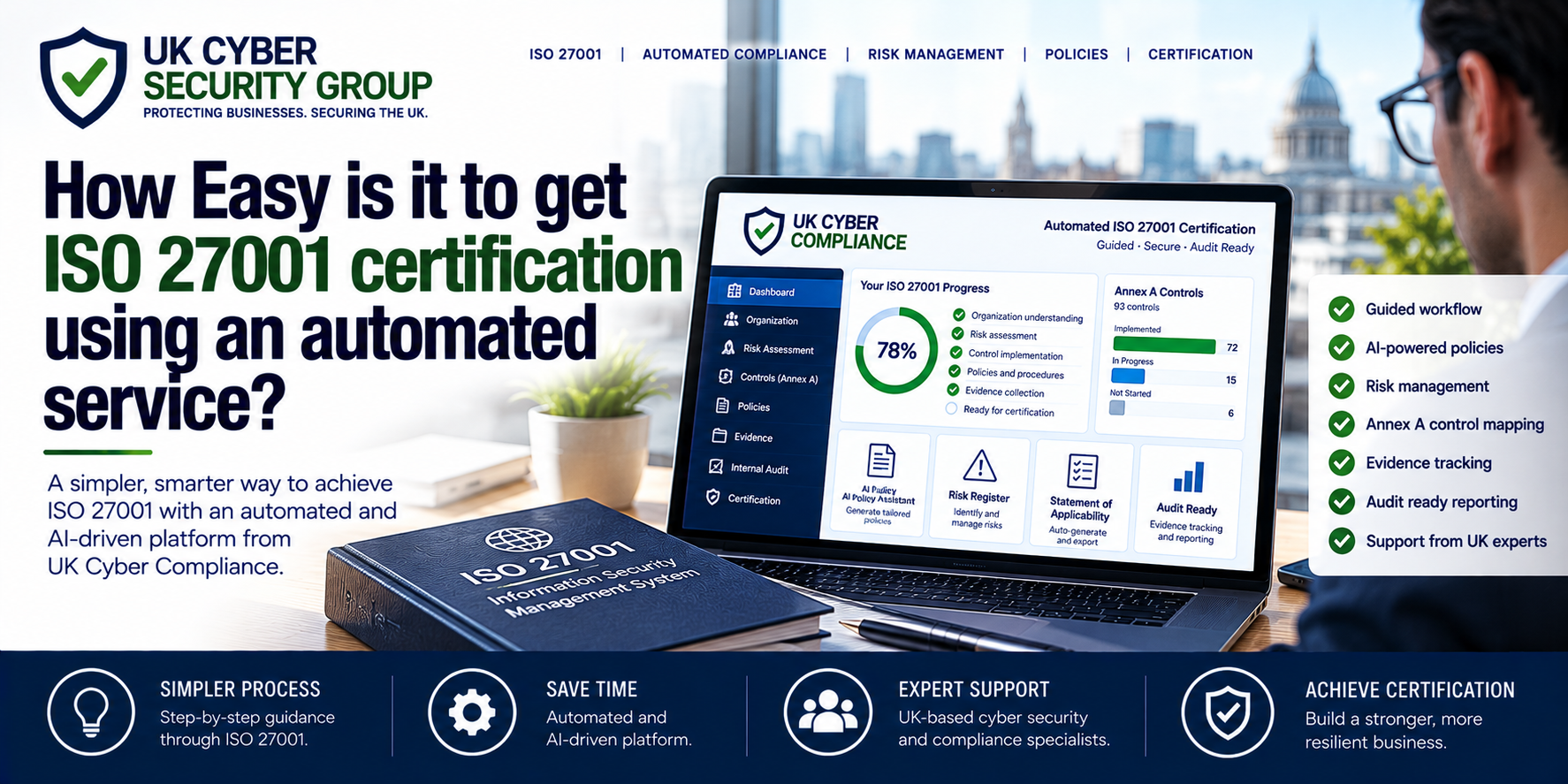
UK Cyber Compliance offers an automated and AI-driven platform designed to simplify this journey. Its guided workflows, intelligent risk assessments, AI-supported policy generation, control management and audit-ready reporting can help businesses reduce unnecessary administration.
UK Cyber Compliance (a part of UK Cyber Security Group) provides these services and has a platform to make certification much easier and cheaper.
Is ISO 27001 certification easier with automation?
Yes. An automated service can make ISO 27001 preparation considerably easier, particularly for organisations without a dedicated compliance department.
Traditional implementation often relies on several people maintaining separate spreadsheets, documents and task lists.
Risk assessments may sit in one spreadsheet.
Policies may sit in shared folders.
Control records may exist in another system.
Evidence might arrive through email.
Management then needs to bring everything together before the certification audit.
This approach can work, but it often creates unnecessary administration and confusion.
An automated platform brings these activities together.
When the risk assessment identifies a security concern, the platform can help connect that risk with the appropriate treatment action, control owner, supporting documentation and evidence.
Managers can then see which activities are complete and which still need attention.
Automation makes managing the work easier. It does not guarantee certification or replace the independent audit.
What is iso 27001
ISO 27001 is the international requirements standard for information security management systems.
An ISMS helps organisations protect information through structured risk management, governance, policies, processes and technical controls.
The standard focuses on three fundamental principles.
Confidentiality means protecting information against unauthorised access or disclosure.
Integrity means keeping information accurate and preventing unauthorised changes.
Availability means ensuring authorised people can access information and services when needed.
ISO 27001 applies to more than computers.
An effective ISMS can cover employees, suppliers, offices, cloud services, physical information, business processes and external organisations that affect information security.
The standard uses a risk-based approach, so the organisation needs to understand its own circumstances before selecting appropriate safeguards.
This flexibility makes automated compliance especially useful. A guided platform can help organisations work through the requirements in a logical order rather than expecting employees to interpret everything independently.
What is ISO 27001 Certification?
ISO 27001 certification provides independent assurance that an organisation’s ISMS meets the requirements of ISO/IEC 27001 within its defined scope.
ISO publishes the standard but does not issue organisational certificates.
An independent certification body conducts the assessment and makes the certification decision.
In the UK, organisations commonly seek certification through a certification body accredited by the United Kingdom Accreditation Service, known as UKAS.
UKAS accredits organisations that provide independent certification against information security standards, including ISO 27001.
The distinction between compliance support and certification matters.
An automated platform can help your business prepare for certification by organising risks, policies, controls and evidence.
It cannot independently approve its own implementation work as an accredited certification audit.
The certification body still needs to assess the organisation’s management system objectively.
Who needs iso 27001 certification
ISO 27001 can benefit organisations across almost every sector.
Technology businesses, managed service providers, professional services companies, financial organisations, healthcare providers, charities, education providers and public-sector suppliers may all find certification valuable.
Certification becomes particularly useful when customers require independent security assurance.
A business supplying a large organisation may encounter ISO 27001 requirements during procurement.
Another company may seek certification to demonstrate that it manages sensitive information responsibly.
An organisation experiencing rapid growth may want a structured approach to security governance.
Smaller companies can also benefit.
ISO 27001 does not require every business to employ a large internal security team.
The management system should reflect the organisation’s operations, risks and certification scope.
Automated platforms can help smaller businesses manage the requirements without creating unnecessary administrative complexity.
Why traditional ISO 27001 implementation can feel difficult
The difficulty often comes from organising the work rather than understanding the basic purpose of the standard.
ISO 27001 contains management system requirements covering organisational context, leadership, planning, support, operation, performance evaluation and improvement.
An organisation must also determine the information security controls necessary to manage identified risks.
This creates several connected activities.
The ISMS scope affects which business operations need assessment.
Risk assessment affects treatment decisions.
Treatment decisions influence control selection.
Control selection affects the Statement of Applicability.
The selected controls need implementation and supporting evidence.
Internal audits then examine whether these arrangements work.
Managing those relationships manually can become time-consuming.
An automated platform can help keep the information connected and reduce the need to repeatedly copy data between documents.
A guided platform helps businesses follow the correct order
One of the biggest advantages of an automated service is structure.
A business starting ISO 27001 for the first time may not know whether to begin with policies, risks, assets or security controls.
A well-designed compliance platform can guide users through the work in a logical sequence.
This reduces the risk of creating documentation before the organisation understands what it needs.
For example, writing an Access Control Policy before reviewing administrator privileges could lead to a policy that does not match reality.
Likewise, selecting Annex A controls before assessing risk may create unnecessary work.
A structured workflow helps the organisation understand its requirements, make decisions and then prepare the relevant documentation.
A practical automated route to ISO 27001 certification
Businesses using an automated compliance platform can organise certification preparation around the following stages:
- Define the organisation. Record essential business information, activities, locations, responsibilities and services.
- Identify interested parties. Understand relevant customer, employee, supplier, contractual and regulatory requirements.
- Establish the ISMS scope. Determine which functions, services, information and supporting operations the certification will cover.
- Set information security objectives. Identify meaningful goals that support the organisation’s security priorities.
- Define risk assessment criteria. Establish how likelihood, impact and risk acceptance will be assessed.
- Complete the risk assessment. Identify credible risks to confidentiality, integrity and availability.
- Plan risk treatment. Decide which risks require action and assign responsibility for reducing them.
- Determine necessary controls. Select safeguards that address the identified risks and compare them with Annex A.
- Prepare the Statement of Applicability. Record necessary controls, implementation status and justification for relevant exclusions.
- Prepare policies and operating records. Use guided templates and AI assistance while ensuring the content reflects the actual organisation.
- Gather evidence and monitor progress. Connect control implementation with relevant records and track outstanding actions.
- Complete internal audit and management review. Evaluate the ISMS, address weaknesses and prepare for independent certification.
Automation can support every stage, but accountable employees and management must make the important decisions.
Make the ISMS scope easier to understand
Defining scope is one of the first significant decisions in ISO 27001.
The scope identifies the organisational boundaries of the management system.
A small company might include its complete operation.
A larger organisation may define certification around particular services or business functions.
The important point is that the scope accurately reflects the activities and dependencies relevant to the ISMS.
An automated service can guide users through recording locations, functions, systems, suppliers and services.
It can also help maintain the scope information as the organisation changes.
However, the business still needs to decide what genuinely falls within the management system.
An artificially narrow scope may create problems during the certification audit.
Interested parties become easier to manage
ISO 27001 expects organisations to understand relevant interested parties and their information security requirements.
These may include customers, regulators, employees, suppliers, business partners and other organisations.
A traditional approach might involve maintaining a stakeholder spreadsheet and updating it manually.
An automated platform can centralise the information and associate relevant requirements with the appropriate business functions.
For example, a customer may require particular confidentiality arrangements.
A contract may specify incident notification obligations.
An external supplier may create security dependencies.
Recording those requirements in one place makes it easier to understand how they affect the ISMS.
Risk assessment becomes less complicated
Risk assessment is central to ISO 27001.
An organisation needs a consistent method for identifying, analysing and evaluating information security risks.
That includes defining likelihood, impact and risk acceptance criteria.
Without guidance, businesses may struggle to produce meaningful risk records.
Generic entries such as “cyber attack” or “data breach” often fail to explain the specific business exposure.
An automated platform can guide users towards more useful risk descriptions.
For example, an organisation might identify the possibility of unauthorised access to customer information following compromised cloud credentials.
The system can then help organise the likelihood, impact, existing controls, risk owner and treatment decision.
UK Cyber Compliance describes its platform as providing guided risk assessment and residual risk tracking through a structured process.
This can make assessments easier to understand and review.
AI can support risk analysis without replacing judgement
Artificial intelligence can help identify possible weaknesses, suggest relevant considerations and organise information.
However, AI does not automatically know the full circumstances of your business.
It may not know which customer contracts apply.
It may not understand unusual supplier dependencies.
It cannot decide independently which business risks management is willing to accept.
Your organisation therefore needs to review AI-generated suggestions.
Risk owners should confirm that assessments accurately represent the environment.
Senior management should approve risk acceptance decisions where appropriate.
Used correctly, AI becomes a useful assistant rather than an uncontrolled decision-maker.
Annex A becomes easier to navigate
ISO/IEC 27001:2022 Annex A contains 93 information security controls.
The UKAS technical guidance confirms that the controls are arranged across four areas: organisational, people, physical and technological controls.
Businesses sometimes assume they must implement every control in exactly the same way.
That is not how ISO 27001 works.
The organisation first determines which controls are necessary through risk treatment and applicable requirements.
It then compares those controls with Annex A to check that nothing necessary has been overlooked.
An automated platform can help users navigate the controls, identify relevant requirements and record implementation progress.
This is particularly helpful for organisations that lack extensive experience with the standard.
Automating the Statement of Applicability
The Statement of Applicability, often called the SoA, is one of the most important ISO 27001 records.
It identifies the organisation’s necessary controls, explains why they are necessary, records implementation status and justifies exclusions from Annex A.
Creating the SoA manually can involve copying information from several risk and control records.
An automated platform can reduce this work by keeping the information connected.
When a risk treatment decision identifies a necessary control, that information can support the SoA.
Control owners can update implementation progress.
Relevant documents and evidence can remain associated with the control.
UK Cyber Compliance states that its platform supports generating and exporting Statement of Applicability records alongside risk reports and audit-ready evidence packs.
The business must still review the SoA to ensure the justifications and implementation claims remain accurate.
AI-powered policy generation reduces repetitive writing
Policy preparation can consume a significant amount of time during ISO 27001 implementation.
Organisations may need policies addressing information security, access control, acceptable use, supplier security, incidents, backup, business continuity and other relevant areas.
A traditional approach might involve writing each document from scratch or adapting a collection of templates.
AI-powered policy generation can accelerate the drafting process.
UK Cyber Compliance describes its platform as generating draft information security policies tailored to the organisation’s controls and risk profile.
That can reduce repetitive writing and help maintain consistency across related documents.
However, every policy still needs appropriate review.
A policy should describe what the organisation actually does.
If an AI-generated document says that administrator access receives monthly review, somebody needs to confirm that the process exists and operates at that frequency.
A convincing policy cannot replace an ineffective control.
Real-time progress tracking gives management visibility
One of the frustrating parts of manual compliance is not knowing how much work remains.
Different teams may update separate records.
Managers may discover overdue actions only shortly before the external audit.
A live compliance dashboard can make progress much easier to understand.
It can show completed requirements, outstanding actions, assigned owners and areas needing attention.
Management can use this information during regular meetings.
Control owners can identify their next tasks.
The organisation can focus its resources where they matter most.
UK Cyber Compliance lists real-time progress tracking and a unified dashboard among its platform features.
These functions can help businesses manage ISO 27001 as an organised project rather than a collection of disconnected responsibilities.
Evidence collection becomes more efficient
ISO 27001 certification requires evidence that the ISMS operates effectively.
Policies alone are not enough.
An auditor may ask for completed access reviews, risk assessments, supplier assessments, training records, incident records, backup test results or other evidence.
When these records sit across different systems, gathering them can become difficult.
A compliance platform can provide a central place to track supporting evidence and connect it with the relevant requirement.
This can reduce the work required before internal and external audits.
It also makes it easier to identify missing evidence early.
The strongest evidence comes from normal business activity, not from creating records solely for audit day.
Supplier security can become easier to manage
Modern businesses depend heavily on external providers.
Cloud services, managed IT support, software vendors and other suppliers can affect information security.
ISO 27001 expects organisations to consider relevant supplier risks and determine appropriate controls.
An automated platform can help record supplier information, assessments, responsibilities and review actions.
This is valuable because supplier security often receives insufficient attention.
The UK Government’s Cyber Security Breaches Survey 2025/2026 found that only 15 per cent of businesses reviewed cyber risks associated with immediate suppliers, while 6 per cent reviewed their wider supply chains.
A structured approach can help organisations address these gaps more consistently.
Automation can simplify security objectives
Information security objectives help organisations measure progress.
An objective might focus on reducing overdue security actions, improving employee awareness, completing supplier reviews or strengthening incident response.
Without a central system, tracking objectives can become another manual reporting task.
An automated platform can link objectives with owners, actions, evidence and performance information.
Management can then see whether the organisation is achieving its intended outcomes.
The platform may also help identify recurring problems or actions that consistently miss their targets.
The value comes from using that information to make decisions rather than simply collecting statistics.
Internal audits still require independent judgement
An automated service can make internal audit preparation easier.
It can organise requirements, present evidence, identify missing records and help track findings.
However, an internal audit still needs an objective evaluation of the ISMS.
The auditor must determine whether processes conform to the organisation’s requirements and ISO 27001.
This involves reviewing actual records, interviewing relevant people and considering whether controls operate.
AI can assist with organising evidence and drafting audit questions.
It cannot replace the need for a competent and sufficiently impartial auditor.
Businesses should treat automation as support for the internal audit process rather than a substitute for it.
Management review becomes more useful
ISO 27001 requires senior management to review the ISMS at planned intervals.
The review considers performance, significant risks, audit results, changes, objectives, resources and improvement opportunities.
A central compliance platform can make this easier by providing current information.
Instead of collecting reports manually from several departments, management can review a consolidated view of the ISMS.
This allows more time for meaningful decisions.
A good management review should consider what is working, what needs improvement and whether additional resources are necessary.
The meeting still needs genuine management involvement.
Automation can prepare information, but senior leaders remain responsible for decisions.
How the Certification Works
The formal certification process normally involves two main audit stages.
Stage 1 examines the organisation’s readiness for certification.
The auditor reviews the scope, key documented information, management system arrangements and whether the organisation appears prepared for the full assessment.
Stage 2 examines implementation and effectiveness.
The auditor may interview employees, examine risk records, test the relationship between controls and evidence, and review whether documented processes operate in practice.
An automated platform can make both stages easier to prepare for by keeping important information organised and current.
However, an independent certification body conducts the formal audit and decides whether certification should be awarded.
UK certification provider NQA explains that its initial certification process includes two mandatory assessment stages. It also requires applicants on its route to demonstrate that the management system has operated for at least three months and completed management review and a full internal audit cycle.
Individual arrangements should always be confirmed with the chosen certification body.
ISO 27001 Certification Levels
ISO 27001 does not use official bronze, silver, gold or similar certification levels.
An organisation defines the scope of its ISMS and demonstrates conformity with the requirements of ISO/IEC 27001.
The certification process does include different audit stages.
Initial certification normally involves Stage 1 and Stage 2.
Successful certification then leads to surveillance activity and later recertification.
NQA describes a three-year certification cycle with surveillance audits during the first two years and recertification in the third year.
An automated platform can support the organisation throughout this cycle.
It helps maintain records, monitor changes and keep evidence organised after the initial certificate has been awarded.
Automation does not remove the need for an accredited certification body
This distinction is particularly important for UK businesses.
Some compliance platforms describe their service as automated ISO 27001 certification.
In practice, the platform normally supports preparation, implementation, compliance management and audit readiness.
The independent certification process remains separate.
For UKAS-accredited certification, the certification body must hold appropriate accreditation for ISO/IEC 27001.
The UKAS accredited organisation directory allows businesses to check the accreditation status and scope of certification providers.
When choosing an automated service, confirm how the platform supports the certification journey and how the independent audit will take place.
A platform that simplifies preparation can be extremely useful without claiming to replace the certification body.
What an automated service cannot do
Automation can reduce paperwork and improve organisation, but it has practical limits.
It cannot guarantee that your employees follow security procedures.
It cannot automatically prove that a supplier meets every contractual requirement.
It cannot accept business risks without appropriate management authority.
It cannot replace the need to implement security controls.
It cannot guarantee that an independent auditor will find no nonconformities.
These responsibilities remain with the organisation.
For example, a platform can generate a Backup Policy, but your business still needs appropriate backups and recovery evidence.
It can track employee security training, but staff still need to understand their responsibilities.
It can identify an overdue risk treatment action, but somebody must complete that action.
The most effective approach combines technology with human accountability.
How much time can automation save?
Automation can reduce manual administration significantly, but there is no universal figure that applies to every organisation.
The time saved depends on the business, the existing security arrangements, the platform’s capabilities and the quality of the information entered.
A company with good security governance may already have most of the operational evidence it needs.
Another business may need to create new processes, improve technical controls and train employees.
Automation can accelerate documentation, tracking, reporting and coordination.
It cannot eliminate the time needed to operate the ISMS and demonstrate effectiveness.
UK Cyber Compliance promotes AI-powered automation as a way to reduce the time and complexity involved in ISO 27001 preparation.
Businesses should assess those potential benefits against their own circumstances rather than assume every certification project will follow the same timetable.
ISO 27001 and real UK cyber security risks
The value of ISO 27001 goes beyond completing an audit.
The UK Government’s Cyber Security Breaches Survey 2025/2026 reported that 43 per cent of UK businesses identified a cyber security breach or attack during the previous twelve months.
That represents approximately 612,000 businesses.
The figure increased to 65 per cent among medium businesses and 69 per cent among large businesses.
Only 30 per cent of businesses reported carrying out a cyber security risk assessment during the previous twelve months.
The survey also found that only 25 per cent of businesses had a formal incident response plan.
These findings show why structured information security management remains important.
An automated ISMS platform can make ongoing risk reviews, assigned actions and compliance monitoring easier to manage.
The objective should not be merely to obtain a certificate.
It should be to establish better security governance that supports the organisation’s long-term resilience.
Is an automated ISO 27001 service suitable for small businesses?
Automated compliance can be especially attractive to smaller organisations.
A small business may not employ a full-time information security manager.
Responsibilities often sit with directors, IT managers, operations staff or external support providers.
Traditional consultancy-led implementation can place considerable administrative demands on those employees.
A guided platform can give the business a clearer route.
It can explain the next requirement, capture information, generate draft documentation and show what remains outstanding.
Management can spend more time making decisions and less time maintaining administrative records.
However, smaller businesses should still seek appropriate professional support when requirements become complex.
A platform works best when users understand their responsibilities and can obtain expert help where needed.
Which UK-based firms offer ISO 27001 consultancy services?
UK organisations can obtain ISO 27001 assistance through specialist cyber security consultancies, information security management consultants, managed service providers and automated compliance services.
The most suitable option depends on the organisation’s experience and available resources.
A consultancy may provide direct assistance with defining scope, risk assessment, control selection, internal audit readiness and management review.
An automated service can provide structured workflows, documentation, evidence tracking and ongoing visibility.
Some organisations benefit from combining both approaches.
UK Cyber Compliance offers an automated and AI-driven ISO 27001 platform backed by compliance guidance and access to professional support.
Its published features include intelligent risk assessment, policy generation, control coverage, real-time progress tracking and audit-ready reporting.
This combination can help businesses manage the certification journey without relying entirely on manual spreadsheets and documents.
Why choose UK Cyber Compliance for automated ISO 27001 support?
UK Cyber Compliance focuses on making information security compliance easier to manage.
Its automated platform brings together several important parts of the ISMS.
Risk assessments can connect with treatment decisions.
Controls can connect with the Statement of Applicability.
Policies can reflect the organisation’s security requirements.
Evidence can remain associated with relevant controls.
Management can monitor progress through a central dashboard.
The platform also provides AI-powered assistance with policy drafting and guided compliance activities.
As part of UK Cyber Security Group, UK Cyber Compliance can draw on wider cyber security and compliance expertise.
The main benefit is a more organised approach to implementation.
Instead of trying to understand every requirement independently, businesses can work through a guided process while maintaining ownership of the final decisions.
Avoid common mistakes when using automation
Automated compliance platforms are powerful tools, but poor inputs can still produce poor results.
A common mistake is accepting generated policies without reviewing them.
Another is entering generic risks that do not reflect the organisation.
Some businesses mark controls as implemented before obtaining evidence.
Others treat the progress dashboard as proof of certification readiness without checking how processes operate.
Avoid those mistakes.
Review the information entered into the platform.
Make sure every important risk has an appropriate owner.
Check that policies match operational practice.
Retain evidence of implemented controls.
Verify that completed tasks genuinely meet the relevant requirements.
Use internal audit to challenge the information rather than simply confirm that the platform shows completion.
A well-managed platform can simplify ISO 27001, but accuracy remains essential.
Keep ISO 27001 manageable after certification
Certification is not the end of the ISMS journey.
Information security risks change as the business develops.
New employees join.
Suppliers change.
Technology evolves.
Customer requirements become more demanding.
A new service may create different security dependencies.
The organisation therefore needs ongoing risk assessment, control review, monitoring, internal audit and management review.
This is another area where automation can provide lasting value.
A central platform can help maintain current documentation, track overdue actions and prepare evidence for future surveillance audits.
The result can be a more sustainable ISMS that remains part of normal business operation.
Is automated ISO 27001 certification really easier?
For many organisations, the answer is yes.
Automation can remove much of the unnecessary administration associated with ISO 27001.
It can provide a clear route through the requirements, reduce repetitive document preparation, connect risks with controls and make evidence easier to retrieve.
AI can also support policy drafting and help organisations identify areas needing attention.
However, successful certification still depends on a genuine management system.
The organisation needs to understand its information security risks, implement appropriate controls, maintain evidence, conduct internal audits and involve senior management.
An independent certification body then examines whether the ISMS meets ISO/IEC 27001.
That balance is important.
Automation makes the work easier to organise.
Employees and management make the system effective.
UK Cyber Compliance brings these activities together through an automated and AI-driven ISO 27001 platform that helps businesses manage risk assessments, controls, policies, documentation, evidence and certification preparation.
For UK businesses looking for a simpler route to ISO 27001, the aim should be straightforward: reduce unnecessary paperwork, maintain clear responsibilities, follow a guided process and build an ISMS that genuinely works.
With the right automation and professional support, ISO 27001 can become far more manageable, particularly for organisations that want reliable information security governance without creating excessive administration.
The greatest benefit is not simply reaching certification.
It is creating an information security management system that the business can understand, operate and continually improve.
UK Cyber Compliance is here to help
For more information, please do get in touch.
Please check out our Free Cyber Insurance
Other blog posts, Your ISO 27001 Questions Answered, Get ISO 27001 Certified ,
If you would like to know more, do get in touch as we are happy to answer any questions. Looking to improve your cybersecurity but not sure where to start? Begin by getting certified in Cyber Essentials, the UK government’s scheme that covers all the technical controls that will provide the protection that you need to help guard against criminal attacks.