How quickly can I get ISO 27001 certification using an automated service?
How quickly can a business achieve ISO 27001 certification? It is one of the first questions organisations ask when they decide to strengthen their information security and demonstrate compliance with an internationally recognised standard.
The answer depends on how prepared the organisation already is, how effectively it manages information security and whether it uses a structured approach to certification.
For many businesses, the traditional ISO 27001 process can feel complicated. Risk assessments, policies, security controls, evidence gathering, internal audits and management reviews all need attention before an independent certification body can complete the external assessment.
An automated and AI-driven compliance platform can make this process considerably easier.
Instead of managing numerous spreadsheets, policy documents and email conversations, businesses can work through guided compliance requirements, track progress and manage information security activities through one online platform.
UK Cyber Compliance provides an automated and AI-driven ISO 27001 platform designed to simplify risk assessment, policy generation, control management, documentation and audit preparation.
UK Cyber Compliance (a part of UK Cyber Security Group) provides these services and has a platform to make certification much easier and cheaper.
However, there is an important distinction between preparing for ISO 27001 certification and receiving the certificate itself.
An automated platform can accelerate preparation, but an independent certification body must still conduct the necessary audits and make the certification decision.
The current international standard is ISO/IEC 27001:2022, supported by Amendment 1:2024 concerning climate action considerations.
The International Organization for Standardization confirms that ISO 27001 provides requirements for establishing, implementing, maintaining and continually improving an Information Security Management System.
How long does ISO 27001 certification normally take?
There is no universal certification timescale that applies to every organisation.
Some businesses already operate effective security controls, maintain detailed records and follow established management processes.
Others have little formal information security governance and need to build their Information Security Management System from the beginning.
These organisations naturally require different levels of preparation.
UK certification body NQA explains that experienced, well-managed organisations can sometimes achieve certification within two to three months, while projects taking six months or longer are not uncommon.
NQA also requires applicants using its certification route to demonstrate that their management system has operated for at least three months and completed management review and a full internal audit cycle before certification assessment progresses.
These points are important when planning your certification journey.
A business with an existing, operational ISMS may progress more quickly than one establishing its management system for the first time.
An automated service can reduce preparation work considerably, but it cannot remove legitimate audit requirements or guarantee that certification will happen within a particular number of weeks.
You can review the assessment arrangements through NQA’s ISO 27001 certification guidance.
The fastest route begins with understanding what you already have
Before writing policies or completing questionnaires, review your existing security arrangements.
You may already have many of the controls required for ISO 27001.
For example, your business might use multi-factor authentication, managed endpoint protection, automated backups, employee security awareness training and documented access control processes.
You may already maintain supplier contracts, employment procedures, asset records and incident response arrangements.
These existing practices can provide a strong starting point.
The first task should therefore be a gap assessment.
Compare your current arrangements against ISO/IEC 27001:2022 and identify what already works, what needs improvement and what remains missing.
An automated compliance platform can help organise this assessment and turn the findings into a manageable action plan.
This avoids recreating documents or processes that already meet the business requirements.
what is iso 27001
ISO 27001 is the international requirements standard for an Information Security Management System, commonly called an ISMS.
The standard helps organisations manage information security through a structured approach to risk, governance, policies, processes and controls.
Its main purpose is to protect three fundamental information security principles.
Confidentiality means information should only reach authorised people.
Integrity means information should remain accurate and protected against unauthorised alteration.
Availability means authorised people should be able to access information and services when needed.
ISO 27001 covers much more than IT equipment.
The standard considers employees, customers, suppliers, business processes, cloud services, physical security, information handling and management responsibilities.
An organisation needs to understand its information security risks and determine suitable controls to address those risks.
The flexibility of this approach allows businesses to create an ISMS that reflects their actual activities rather than blindly adopting security arrangements designed for another company.
Automation can help guide users through these requirements without demanding extensive previous experience of the standard.
What is ISO 27001 Certification?
ISO 27001 certification provides independent confirmation that an organisation’s Information Security Management System meets the requirements of ISO/IEC 27001 within its defined scope.
ISO publishes the standard but does not certify individual organisations.
An independent certification body carries out the assessment.
For UK businesses seeking accredited certification, a certification body accredited by the United Kingdom Accreditation Service, known as UKAS, provides additional assurance concerning competence and impartiality.
UKAS identifies ISO/IEC 27006-1:2024 as the relevant specialist standard for bodies auditing and certifying information security management systems.
Businesses can verify accreditation through the UKAS accredited organisation directory.
An automated platform supports the work required to prepare for certification.
It can help manage tasks, risks, policies, controls and evidence.
However, the independent certification body still needs to examine the ISMS and determine whether the organisation satisfies the requirements.
Automation can dramatically simplify the preparation stage
Traditional ISO 27001 implementation frequently involves extensive manual administration.
An organisation may maintain a risk register in Excel, policies in Word, evidence in shared folders and outstanding actions in separate tracking systems.
Different employees then need to keep everything aligned.
A change to one risk may require updates to several documents.
When evidence changes, someone may need to update the relevant control records manually.
An automated platform can reduce this duplicated work.
For example, a risk assessment can connect directly with treatment actions, necessary controls and the Statement of Applicability.
Control owners can manage their responsibilities through a central system.
Management can review progress without requesting separate reports from every department.
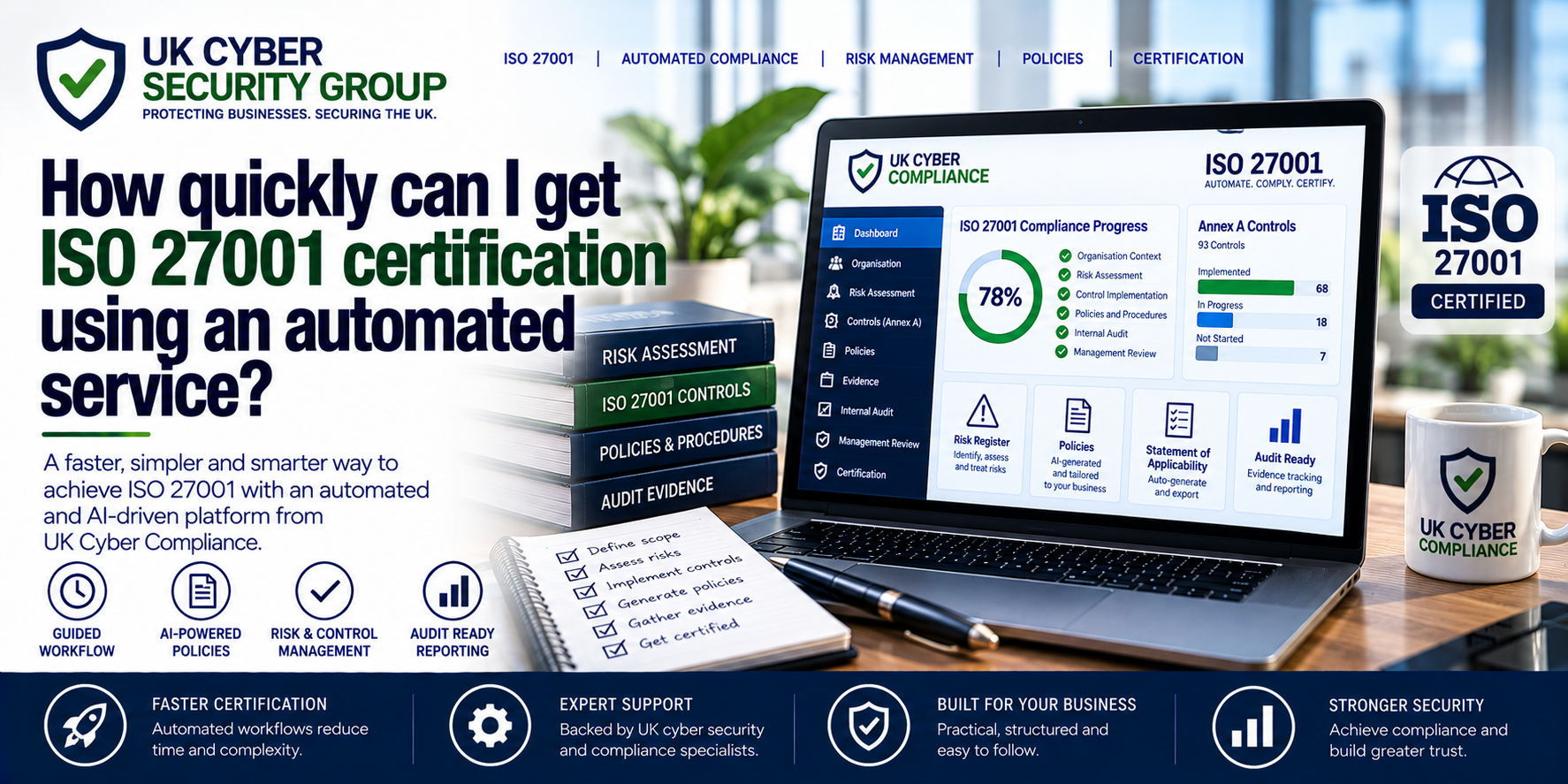
UK Cyber Compliance provides guided workflows, intelligent risk assessments, AI-supported policy generation, real-time progress tracking and audit-ready documentation through its platform.
These functions can reduce manual effort and help organisations maintain a consistent approach.
A structured workflow prevents unnecessary delays
Many organisations lose time because they tackle ISO 27001 requirements in the wrong order.
They begin writing policies before defining the certification scope.
They select security controls before assessing risks.
They prepare documents that have little relevance to their actual business.
Later, an auditor or consultant identifies the inconsistencies, creating additional work.
A guided platform can help prevent this.
The certification journey becomes easier when businesses follow a logical sequence:
- Understand the organisation and its activities.
- Identify interested parties and relevant requirements.
- Define the ISMS scope.
- Establish information security responsibilities and objectives.
- Define the risk assessment method and acceptance criteria.
- Complete the risk assessment and risk treatment planning.
- Determine necessary controls and prepare the Statement of Applicability.
- Establish relevant policies, processes and evidence.
- Complete internal audit and management review.
- Address weaknesses and proceed to external certification assessment.
This structured approach helps keep activities connected.
It also gives the organisation a clearer picture of what remains before it is ready for certification.
Defining the ISMS scope should happen early
The ISMS scope establishes what your certification covers.
It may include the entire organisation or defined services, business functions and supporting operations.
Getting the scope right early can prevent substantial rework.
For example, a technology company may want certification covering the development, hosting and support of a cloud application.
That scope may also depend on employees, cloud infrastructure, identity management, suppliers and supporting services.
An organisation should not exclude important dependencies simply because they create additional work.
An automated platform can guide users through identifying relevant locations, functions, services, information and business processes.
However, management still needs to approve a scope that accurately represents the organisation.
A clear scope also helps the certification body plan the external assessment.
Interested parties become easier to manage
ISO 27001 requires organisations to understand relevant interested parties and their information security requirements.
Interested parties can include customers, employees, regulators, suppliers, shareholders, insurers and business partners.
Their requirements may influence security controls, policies and management decisions.
For example, a customer contract might require particular confidentiality arrangements.
A supplier might create an important operational dependency.
A legal obligation could affect how the organisation processes personal information.
Recording this information manually can become difficult when business relationships change.
An automated platform can centralise interested party records and make them easier to update.
This helps businesses maintain current information rather than creating a register only for the initial audit.
Risk assessment is often one of the biggest tasks
Information security risk assessment sits at the centre of ISO 27001.
The organisation needs a consistent process for identifying, analysing and evaluating risks.
This involves understanding potential security events, estimating their likelihood, considering business impact and determining whether additional treatment is required.
Without guidance, risk assessment can become unnecessarily complicated.
A business may create hundreds of generic risks without identifying its most important exposures.
An automated platform can guide users towards meaningful assessments.
For example, a risk might involve compromised Microsoft 365 credentials allowing unauthorised access to confidential customer information.
The platform can help capture the threat, likelihood, impact, existing controls, risk owner and treatment decision.
UK Cyber Compliance includes guided risk assessment and residual risk tracking within its automated platform.
This can make the assessment process easier to understand and manage.
AI can help identify relevant security risks
Artificial intelligence can support risk assessment by suggesting potential weaknesses, organising information and helping users consider appropriate controls.
This can be valuable for businesses without a dedicated information security department.
However, AI-generated suggestions still need human review.
The organisation should confirm that each risk reflects its actual systems, information and business activities.
An AI platform may not know every contractual obligation, supplier dependency or operational concern affecting the company.
Risk owners therefore remain responsible for reviewing assessments.
Senior management must also approve significant risk acceptance decisions where appropriate.
AI can make the process more efficient, but the organisation must retain ownership of its information security decisions.
Annex A becomes easier with automation
ISO/IEC 27001:2022 contains 93 Annex A controls arranged across four areas.
These cover organisational, people, physical and technological security.
The controls provide a reference set that organisations use when determining appropriate information security measures.
However, businesses do not automatically need to implement every Annex A control in exactly the same way.
The organisation determines its necessary controls through risk treatment and then compares those controls with Annex A to check that it has not overlooked anything relevant.
An automated platform can make this process easier.
It can help track control applicability, implementation, ownership and supporting evidence.
This reduces the difficulty of maintaining separate manual control records.
The Statement of Applicability should not become a bottleneck
The Statement of Applicability, commonly known as the SoA, is one of the most important ISO 27001 documents.
It records the controls considered necessary, explains why they apply, identifies implementation status and justifies relevant exclusions from Annex A.
Creating the SoA manually can take considerable effort.
Organisations may need to review risk records, treatment decisions, controls and documentation before completing it.
A platform that connects those activities can reduce duplication.
UK Cyber Compliance supports the generation and export of Statement of Applicability records, alongside risk reports and audit-ready evidence.
The business should still review the resulting document carefully.
The SoA needs to reflect the real security arrangements, not simply information entered into a system.
AI-generated policies can reduce weeks of administrative work
Policy preparation often forms a significant part of ISO 27001 implementation.
Organisations may need documents addressing access control, acceptable use, supplier security, incident management, information handling, business continuity and other relevant areas.
Writing these documents manually can take time.
AI-assisted policy generation can accelerate the initial drafting process.
Rather than starting with a blank document, the organisation can prepare a draft based on its security requirements and control decisions.
UK Cyber Compliance includes AI-powered policy generation tailored to organisational controls and risk information.
However, every policy needs appropriate review.
A generated document must match the way the business operates.
For example, a policy should not claim that administrators complete monthly access reviews if nobody performs those reviews.
Automation helps prepare the documentation, but employees must implement the processes.
Evidence gathering becomes far more manageable
An ISO 27001 auditor will not simply examine whether policies exist.
The auditor also needs evidence that the management system operates.
Useful evidence can include access reviews, employee training records, supplier assessments, security incident records, backup tests, risk treatment decisions and management meeting records.
Traditional evidence gathering often involves searching shared drives and asking employees for missing information.
A central compliance platform can reduce that effort.
It can help connect records with the corresponding requirements and controls.
Managers can see where evidence remains incomplete.
Control owners can identify outstanding actions before the external audit.
The strongest evidence comes from normal business activities rather than hurried preparations shortly before certification.
Real-time tracking keeps the project moving
One of the biggest benefits of an automated platform is visibility.
Manual implementation can make it difficult to understand whether the organisation is genuinely ready for certification.
Different departments may work at different speeds.
Some employees may complete tasks without informing the ISMS manager.
Other actions may remain overdue because ownership is unclear.
A live progress dashboard provides a more organised approach.
Managers can identify incomplete requirements, review responsibilities and monitor important actions.
UK Cyber Compliance promotes real-time compliance tracking and a unified dashboard as part of its platform.
This helps businesses focus attention on outstanding work rather than repeatedly preparing progress reports.
How the Certification Works
The formal ISO 27001 certification process normally contains two initial audit stages.
Stage 1 focuses on readiness.
The certification auditor reviews the ISMS scope, required documented information, risk arrangements and whether the organisation appears ready for a full assessment.
Stage 2 examines implementation and effectiveness.
The auditor may interview employees, review operational records, examine risk treatment decisions and check whether information security controls operate as described.
Following a successful audit, the certification body completes its independent certification decision.
An automated platform can help the organisation prepare for both stages.
It can organise evidence, show outstanding tasks and provide current risk and control information.
However, the certification body still controls the external assessment and certification decision.
That is why no automated service should promise that completing a dashboard automatically guarantees certification.
How long should the ISMS operate before external audit?
An important timing issue involves demonstrating that your Information Security Management System genuinely operates.
The external auditor needs more than newly written policies.
They need evidence that the organisation has carried out relevant activities.
These may include risk assessment, risk treatment, employee awareness, operational monitoring, internal audit and management review.
Some certification bodies set specific readiness expectations.
For example, NQA requires organisations using its certification route to demonstrate that their management system has operated for a minimum of three months and completed management review and a full internal audit cycle.
This is a requirement of that provider’s assessment process, not a universal promise that every business can receive certification three months after starting.
The practical point is straightforward.
Start operating the ISMS as soon as its processes are ready.
Do not wait until every document looks perfect before establishing useful security practices and retaining evidence.
Can ISO 27001 certification happen within three months?
It can be possible in certain circumstances.
A business with established security processes, experienced employees and a well-managed ISMS may already have much of the required evidence.
If the organisation can complete any remaining implementation work promptly and the certification body has suitable availability, a relatively short project may be realistic.
However, businesses starting entirely from scratch should not assume that three months will always be sufficient.
They may need to establish risk management processes, create policies, improve controls, complete training and demonstrate ongoing ISMS operation.
Internal audit and management review also need time.
Automation can reduce the administration associated with these activities, but the organisation still needs to perform them.
The most reliable way to estimate your timescale is to carry out an initial gap assessment and discuss the external audit arrangements with the chosen certification body.
What could make certification take six months or longer?
Several factors can extend the project.
A business may have an unclear certification scope.
Its risk assessment process may not yet exist.
Important security controls may require improvement.
Employees may lack clearly assigned responsibilities.
Supplier security records might be incomplete.
Management may need to approve significant resources or risk decisions.
The organisation might also discover that existing policies do not match its actual working practices.
In addition, external audit availability and corrective action following audit findings can affect completion.
NQA notes that projects lasting six months or longer are not uncommon.
Using an automated platform can reduce delays related to documentation, coordination and reporting.
It cannot eliminate genuine security weaknesses or the time required to address them.
Internal audit should happen before Stage 1 readiness becomes an issue
Internal audit is a mandatory part of ISO 27001.
The organisation needs to examine whether its ISMS meets the standard and its own information security requirements.
This should involve reviewing real evidence.
An internal auditor may inspect risk records, sample access reviews, examine supplier assessments and check whether employees understand relevant responsibilities.
Findings should lead to corrective actions where necessary.
An automated platform can make this easier by organising evidence and tracking audit findings.
However, the audit still requires appropriate objectivity and competence.
A well-run internal audit can identify issues before the external certification body does, potentially preventing avoidable delays.
Management review can be quicker when evidence is organised
ISO 27001 also requires senior management to review the ISMS.
The review should consider performance, significant risks, objectives, audit findings, changes, resources and opportunities for improvement.
When information sits across multiple spreadsheets and systems, preparing for the meeting can be time-consuming.
An automated compliance platform can bring relevant information into one environment.
Management can review current risks, control status and outstanding actions more easily.
The meeting can then focus on decisions rather than administrative reporting.
Senior leaders remain responsible for the resulting decisions and actions.
ISO 27001 Certification Levels
ISO 27001 does not have formal bronze, silver, gold or similar certification levels.
An organisation defines its ISMS scope and demonstrates conformity with the requirements of ISO/IEC 27001.
The formal assessment process normally includes Stage 1 and Stage 2.
Following successful certification, organisations remain subject to surveillance audits and later recertification.
Many accredited certification arrangements operate through a three-year cycle, with surveillance activity during the period and recertification before the next cycle begins.
An automated platform can help businesses maintain evidence between audits.
This means its value continues after the initial certificate has been awarded.
Who needs iso 27001 certification
ISO 27001 can benefit organisations across almost every industry.
Businesses that manage sensitive information, provide technology services, process customer data or supply organisations with demanding security requirements may find certification particularly useful.
Examples include technology providers, professional services firms, financial organisations, healthcare providers, education providers, charities, managed service providers and public-sector suppliers.
Certification may become commercially important when customers or procurement frameworks require independent assurance.
It can also help senior management establish consistent security governance.
An organisation does not have to seek certification simply because it uses ISO 27001 principles.
However, external certification provides independent confirmation of the ISMS within its defined scope.
Automated services can make preparation more accessible to smaller businesses that lack extensive internal compliance resources.
Why ISO 27001 matters to UK businesses
Cyber security remains a significant business concern.
The UK Government’s Cyber Security Breaches Survey 2025/2026 found that 43 per cent of UK businesses identified a cyber security breach or attack during the previous twelve months.
This represented approximately 612,000 businesses.
The figure increased to 65 per cent among medium businesses and 69 per cent among large businesses.
The same government research found that only 30 per cent of businesses conducted a cyber security risk assessment during the previous twelve months.
Just 25 per cent had a formal incident response plan.
These findings demonstrate why structured information security management is valuable.
ISO 27001 helps organisations identify risk, establish responsibilities, operate security controls and respond when weaknesses appear.
Automated platforms can support those activities by making the ISMS easier to maintain.
The full figures appear in the UK Government Cyber Security Breaches Survey 2025/2026.
Which UK-based firms offer ISO 27001 consultancy services?
UK organisations can obtain ISO 27001 assistance from information security consultancies, compliance specialists, managed security providers and technology-led compliance services.
When choosing support, consider whether the provider can help with ISMS scope, risk assessment, control selection, the Statement of Applicability, policies, evidence and audit preparation.
Traditional consultancy can provide valuable expert advice.
An automated platform can reduce repetitive administration.
Some organisations may benefit from combining both approaches.
UK Cyber Compliance provides an automated and AI-driven platform alongside access to compliance guidance and expert support.
Its website describes structured workflows, intelligent risk assessment, AI-supported policy generation, real-time progress tracking and audit-ready reporting.
This combination can help organisations work towards certification while maintaining clearer visibility of their responsibilities and progress.
Choose the certification body before the project is finished
One way to prevent avoidable delays is to identify your preferred certification body early.
The certification body needs to understand your business, ISMS scope, operational complexity and relevant locations.
It can then explain the assessment arrangements and available audit dates.
Do not wait until every task is complete before making initial enquiries.
However, keep the distinction between consultancy and independent certification clear.
The certification body must carry out an impartial assessment.
For organisations seeking UKAS-accredited certification, verify the provider’s current accreditation scope through the UKAS directory.
Early planning does not guarantee a shorter audit, but it can prevent completed preparation from sitting idle while the organisation looks for an assessor.
Automation works best when people remain accountable
Artificial intelligence can assist with documentation and compliance administration.
It can suggest risks, draft policies, organise evidence and identify incomplete records.
However, people still need to make important decisions.
Management must approve relevant policies.
Risk owners need to understand and accept residual risks.
Control owners must implement safeguards.
Employees need to follow procedures.
Internal auditors must examine conformity objectively.
The external certification body must make the final certification decision.
Automation should strengthen accountability rather than obscure it.
A dashboard showing that every control is complete has limited value if the real environment does not support those claims.
Avoid shortcuts that create audit delays
Businesses pursuing rapid ISO 27001 certification sometimes make the process harder by rushing.
Common problems include adopting generic policies without reviewing them, entering unrealistic risks, marking controls as implemented without evidence and leaving internal audit until the last moment.
These shortcuts can create more work later.
An external auditor may discover that the organisation’s written procedures do not reflect actual behaviour.
Missing evidence can also create nonconformities.
A better approach is to complete each requirement properly as you progress.
Use automation to reduce administrative effort, but verify the quality of the information.
Address weaknesses early.
Keep management involved.
Maintain evidence as activities happen.
This often provides a smoother route than attempting to compress everything into the final weeks before certification.
Keep certification manageable after the first audit
ISO 27001 certification should not become a one-time project.
The business needs to continue operating its ISMS after receiving the certificate.
Information security risks change.
New systems appear.
Employees join and leave.
Suppliers change.
Customers create new requirements.
The organisation therefore needs ongoing risk assessment, monitoring, internal audit, management review and improvement.
An automated platform can support these activities throughout the certification cycle.
It can help manage current records, remind owners about outstanding actions and maintain an organised evidence trail for future surveillance audits.
This reduces the risk of rebuilding the ISMS each year.
A practical checklist for achieving certification more quickly
Before arranging your external audit, ask the following questions:
Have we defined a clear ISMS scope?
Do we understand relevant interested parties?
Has senior management approved the Information Security Policy?
Have we established risk assessment criteria?
Have we completed meaningful risk assessments?
Are risk owners assigned?
Have we determined appropriate risk treatment actions?
Is the Statement of Applicability accurate?
Have necessary controls been implemented?
Do our policies reflect how the organisation actually operates?
Can we demonstrate appropriate employee competence and awareness?
Are information security objectives monitored?
Do we have evidence that key processes operate?
Have we completed internal audit?
Has senior management completed management review?
Have significant findings received corrective action?
Does the certification body have the information needed to plan the assessment?
Can we retrieve important evidence quickly?
If several answers remain uncertain, strengthen those areas before proceeding.
Automation can help identify incomplete requirements, but the organisation should verify that the underlying work has genuinely happened.
What is the quickest realistic route to ISO 27001 certification?
The quickest realistic route depends on how much of the ISMS already exists.
For an organisation with mature security arrangements, automation can make it easier to organise existing evidence, complete outstanding documentation and prepare for the independent audit.
For a business beginning from scratch, the platform can provide a clear project structure and reduce the time spent interpreting requirements.
However, the organisation still needs sufficient time to operate the ISMS and demonstrate effectiveness.
The certification body also needs to complete the required assessment and independent certification decision.
The most efficient approach is therefore to:
Start with a clear scope.
Review existing security arrangements.
Use a guided compliance process.
Make risk assessment meaningful.
Generate and review relevant documentation.
Connect controls with evidence.
Assign responsibilities.
Complete implementation work.
Operate the management system.
Carry out internal audit and management review.
Engage the certification body early.
This approach removes much of the confusion that traditionally makes ISO 27001 feel difficult.
UK Cyber Compliance makes the journey easier to manage
UK Cyber Compliance provides an automated and AI-driven platform that helps businesses organise ISO 27001 compliance from initial preparation through audit readiness.
The platform supports risk assessment, risk treatment, policy generation, control management, the Statement of Applicability, progress tracking and evidence reporting.
Instead of relying entirely on manual spreadsheets and disconnected documents, organisations can work through a structured online process.
UK Cyber Compliance also provides access to specialist support for businesses that need assistance understanding the requirements.
The combination of guided automation and professional knowledge can make ISO 27001 certification preparation considerably easier.
Visit UK Cyber Compliance to explore the platform and its ISO 27001 capabilities.
Get certified efficiently without compromising security
How quickly can you achieve ISO 27001 certification using an automated service?
For a well-prepared organisation, certification may be achievable within a few months, subject to the requirements and availability of the chosen certification body.
For a business starting from scratch, the process may take considerably longer.
Automation can accelerate documentation, organise risks and controls, reduce repeated administrative work and make audit preparation easier.
It cannot remove the need for a working ISMS, reliable evidence, internal audit, management review or independent certification assessment.
The real advantage comes from making the process more organised.
UK Cyber Compliance helps businesses work through ISO 27001 using an automated and AI-driven platform that brings information security requirements together in one place.
By reducing unnecessary administration and providing clearer visibility of progress, organisations can spend more time strengthening security and less time managing paperwork.
The fastest route is not necessarily the one with the fewest documents or the shortest project plan.
It is the route that gets the organisation genuinely ready for certification with the least unnecessary work.
When your ISMS operates effectively, your risks are understood, your controls are supported by evidence and management remains involved, the external audit becomes a more straightforward verification of work already completed.
That is where automated ISO 27001 compliance delivers its greatest value: helping businesses reach certification readiness efficiently while building information security practices that continue to benefit the organisation long after the certificate arrives.
UK Cyber Compliance is here to help
For more information, please do get in touch.
Please check out our Free Cyber Insurance
Other blog posts, Your ISO 27001 Questions Answered, Get ISO 27001 Certified ,
If you would like to know more, do get in touch as we are happy to answer any questions. Looking to improve your cybersecurity but not sure where to start? Begin by getting certified in Cyber Essentials, the UK government’s scheme that covers all the technical controls that will provide the protection that you need to help guard against criminal attacks.