
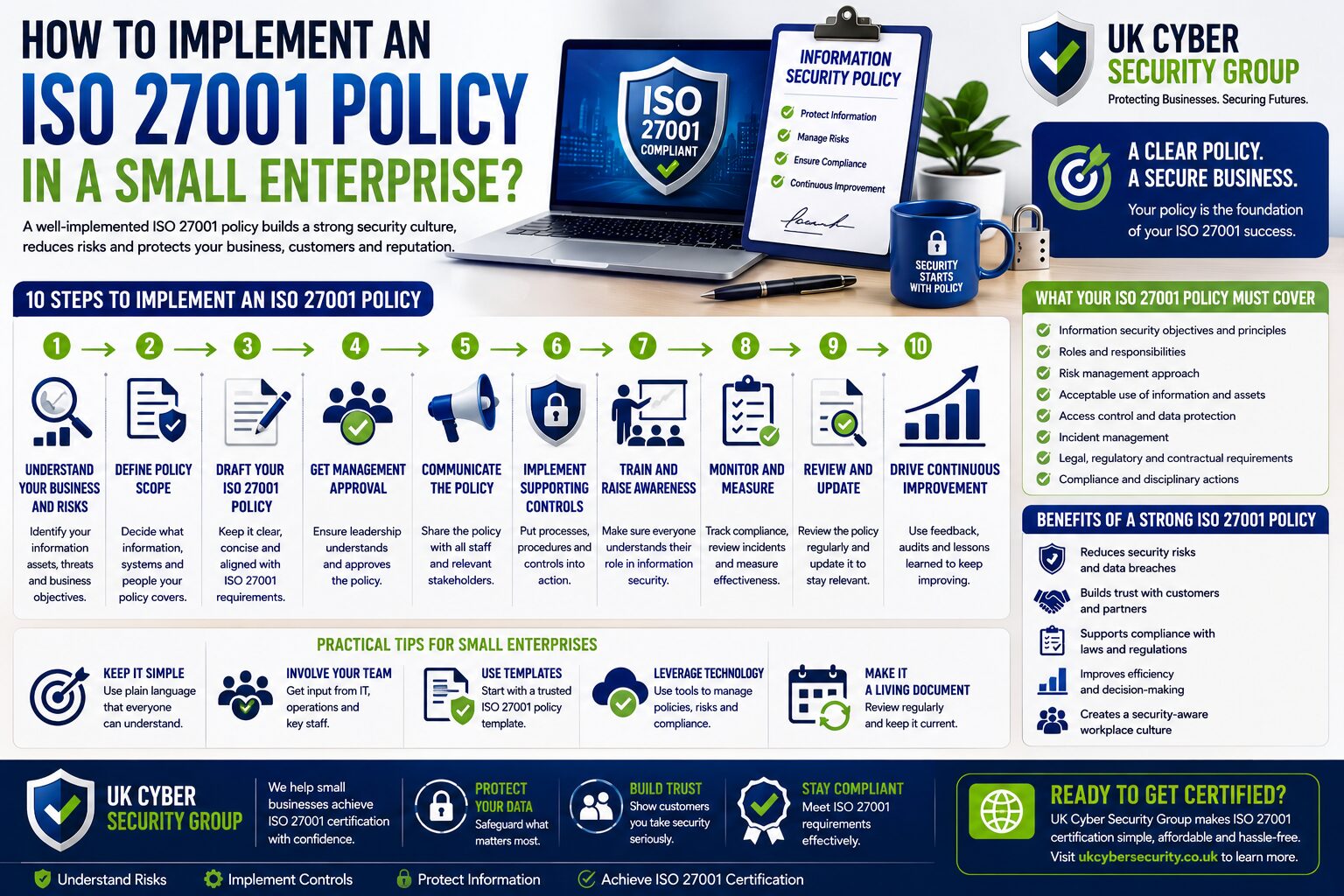
How to implement an ISO 27001 policy in a small enterprise?
Implementing an ISO 27001 policy in a small enterprise is a practical exercise in aligning people, processes and technology to protect the information that matters most to your business. This guide explains what a policy should achieve, how to build it step by step, the governance and evidence you will need for certification, and sensible, low-friction ways to maintain the standard over time. It also covers the common questions small business leaders ask when beginning the journey and points to how automation and platform-driven services can accelerate delivery.
UK Cyber Compliance (a part of UK Cyber Security Group) provides these services and has a platform to make certification much easier and cheaper.
Why an ISO 27001 policy matters for a small enterprise An ISO 27001 policy formalises the organisation’s commitment to information security. For a small enterprise, the policy is not an academic exercise: it establishes clear responsibilities, defines acceptable use, sets the parameters for risk management and enables consistent decision-making during incidents. Adopting a concise, practical policy helps reduce the probability of avoidable breaches and demonstrates due care to customers, partners and prospective clients.
Industry context and relevant statistics
- Surveys of UK small and medium enterprises consistently show that a significant proportion face cyber incidents every year, often with operational and financial impact. A large share of these incidents are opportunistic and can be mitigated by basic controls combined with clear policies.
- Organisations that adopt a formal information security management system (ISMS) often report faster recovery and more structured incident handling, which reduces downtime and reputational damage.
- Procurement teams and larger clients increasingly expect suppliers to evidence sound information security governance as part of supplier assurance and audit processes.
Core concepts to get right before writing the policy
Start with purpose and scope A policy should begin by stating its purpose and scope. For a small enterprise, keep the scope realistic: identify the information assets in scope (for example, client data, employee records and commercial IP), the supporting systems (cloud services, laptops, mobile devices) and the business processes that handle that information. Limiting scope to what you actually control makes the policy manageable.
Define roles and responsibilities Assign ownership for information security at an appropriate level. In small enterprises this is often a business owner, operations lead or IT manager. The policy should name the person(s) responsible for the ISMS, for incident response coordination and for user awareness. Where external suppliers manage services, the policy should require them to meet specified security expectations.
Link to business objectives Make the policy business-focused: link information security to continuity of services, regulatory compliance, customer trust and competitive advantage. This framing helps secure leadership commitment and budget for necessary controls.
Essential policy elements and what they mean
Statement of intent A brief declaration from senior management that the organisation will protect the confidentiality, integrity and availability of information. This statement is critical because auditors seek evidence of senior buy-in.
Risk management approach Describe how the enterprise will identify, assess and treat information risks. For small organisations, a pragmatic risk register with clear acceptance criteria and treatment plans is usually sufficient. The policy should define risk appetite and the frequency of risk reviews.
Asset inventory and classification Require a register of information assets with owners and classification labels (for example: public, internal, restricted). Even a simple spreadsheet that lists systems, data and owners provides vital traceability and supports protection decisions.
Access control principles Set rules for user access, privileged accounts and remote access. Mandate multi-factor authentication for external access where feasible, and require unique user accounts rather than shared credentials. Define minimum password or passphrase expectations in a way that aligns with current best practice for small organisations.
Operational controls Cover patching, antivirus/endpoint protection, secure configuration, backups and secure disposal. The policy should set expectations (for example: patching windows and backup frequency) and reference the operational procedures that implement these expectations.
Third-party management Require due diligence for suppliers who handle or access your information. Include contractual clauses or proof of equivalent assurances from cloud providers, managed service providers and other partners.
Incident response and reporting Define what constitutes an incident, who must be notified, how incidents are recorded and the timeline for internal escalation. Include a link to a simple incident response plan that identifies immediate containment steps and recovery responsibilities.
Training and awareness Specify minimum training expectations for staff (for example, mandatory awareness at onboarding and periodic refreshers). For small businesses, short, role-focused training is effective and reduces disruption.
Monitoring, measurement and improvement Set basic metrics to show the ISMS is working: number of incidents, patch compliance rates, results of internal checks, and supplier compliance. Define an annual management review to evaluate performance and identify continual improvement actions.
Document control and records Define how policies, procedures and logs are stored and protected. Even for small firms, maintaining version control and access restrictions to policy documents is important evidence for auditors.
Step-by-step approach to drafting the policy
- Prepare a one-page summary first Draft a concise policy summary that can be read and endorsed quickly by senior leadership. This should include purpose, scope, named owner and a short statement of intent.
- Expand into a structured document Use clear sections for risk, governance, operational controls, third parties, incident handling and monitoring. Keep language direct: avoid jargon and long paragraphs.
- Map policy statements to procedures For each policy requirement, reference the operational procedure that implements it. Auditors will expect to see how policy maps to practice.
- Validate with stakeholders Review the draft with the person responsible for IT, HR and any key suppliers. This ensures the policy reflects reality and is achievable.
- Obtain formal approval Secure written endorsement from senior management. For small enterprises, an email or signed record is adequate.
- Communicate to staff Publish the policy in the staff handbook or intranet and ensure new hires read and acknowledge it.
Practical examples of policy wording (short, useful templates)
Statement of intent (example) “The management of [Company Name] is committed to protecting the confidentiality, integrity and availability of the information it holds. We will implement and maintain an information security management system proportionate to our business needs and risks.”
Access control (example) “User access will be granted on the principle of least privilege. All remote logins require multi-factor authentication where supported by the service. System administrators will use dedicated privileged accounts and will not use these accounts for routine tasks.”
Incident response (example) “All information security incidents must be reported immediately to the ISMS owner. Incidents will be recorded and investigated. Containment and recovery actions will be taken to restore services and preserve evidence.”
Operationalising the policy: turning words into practice
Simple, repeatable processes Translate policy requirements into short procedures: how to onboard a user securely, how to apply patches, how to perform backups and how to record incidents. Small enterprises benefit from short checklists that deliver consistency.
Leverage automation where possible Use cloud provider tooling and managed services to centralise logging, patching and device management. Automation reduces human error and produces audit trails that support certification.
Evidence collection for certification Auditors will look for records that show the policy is followed: signed policy document, asset register, access logs, patch and backup records, supplier agreements, training attendance and incident logs. Keep these records organised and readily accessible.
Governance and continual improvement
Management review Hold a regular management review—typically annually—to assess ISMS performance, review incidents, consider changes in the business environment and set improvement actions. For small enterprises this can be a concise standing item in a leadership meeting.
Internal audits and checks Perform periodic internal checks against the policy and procedures. These do not need to be complex; a simple checklist-based review with corrective actions is effective.
Change control Require review of security implications for significant changes, such as adopting new cloud services or sharing data with a new partner. The policy should mandate a simple risk assessment step before change approval.
How certification interacts with the policy
The policy is central to ISO 27001 certification because it expresses the organisation’s approach to risk and control. Certification auditors will assess whether the policy exists, whether it is approved by leadership, and whether operational evidence shows the policy is being followed.
Where to be realistic Small enterprises should avoid over-engineering. The purpose of the policy is to make security repeatable and auditable, not to create onerous paperwork. Keep the document focused on what the business actually does and can sustain.
Other questions answered
- Who needs iso 27001 certification Any organisation that wants to demonstrate a systematic approach to information security, meet contractual or regulatory expectations, or reduce information risk can benefit from certification. For small enterprises, certification is often pursued when clients require it, when sensitive data is processed, or where management wants structured risk governance.
- What is ISO 27001 Certification? It is an independent, formal assessment that verifies an organisation operates an ISMS that meets the ISO/IEC 27001 standard. Certification shows that the organisation has processes to identify risks, implement controls and continually improve its information security posture.
- ISO 27001 Certification Levels The standard itself does not define multiple “levels” of certification in the same way as some other schemes. Certification is typically binary: you either hold a valid certificate or you do not. However, organisations may demonstrate maturity by the breadth of the scope, the depth of implemented controls and the evidence of continual improvement.
- How the Certification Works Certification is performed by accredited certification bodies. The process usually involves an initial assessment of your ISMS documentation, followed by an on-site or remote audit to verify that procedures and controls are operating as claimed. After any necessary corrective actions, the certification body issues a certificate valid for a set period, with annual surveillance audits and a periodic recertification.
- what is iso 27001 It is an international standard that specifies requirements for establishing, implementing, maintaining and continually improving an information security management system. The standard is risk-based and adaptable to organisations of any size.
- Which UK-based firms offer ISO 27001 consultancy services? A range of UK consultancies provide support to implement ISO 27001, from small specialist practices to larger professional services firms. They offer gap analysis, policy drafting, technical remediation support and assistance with preparing for audits. Many consultants also mirror common patterns across sectors to help small enterprises adopt pragmatic solutions.
Practical timeline and activities for a small enterprise
Week 1–2: Scoping and policy draft
- Define scope, appoint ISMS owner and draft the one-page policy summary.
Week 3–6: Asset register and risk assessment
- Create a simple asset register, perform a risk assessment and record high-priority treatments.
Week 6–10: Implement core controls and procedures
- Apply the most urgent technical controls: patching, backups, access management and endpoint protection. Draft operational procedures and training materials.
Week 10–14: Evidence collection and internal review
- Assemble records, perform an internal check and finalise policy wording. Management endorsement and staff communication.
Week 14+: Certification readiness and audit
- Choose a certification body, submit documentation and prepare for audit. Address any minor corrective actions arising from the audit.
Common pitfalls and how to avoid them
Pitfall: Over-ambitious scope
- Keep the initial scope manageable. Expanding scope later is possible but can slow delivery.
Pitfall: Policy without practice
- Ensure each policy statement maps to a procedure and evidence. Auditors expect operational reality to match documentation.
Pitfall: Lack of leadership sign-off
- Secure senior management endorsement early. This prevents disputes over resource allocation later.
Pitfall: Poor evidence organisation
- Use a single repository for records and name files clearly. Auditors appreciate structured, accessible evidence.
How automation and platform services help Platform-driven services can streamline document templates, automate evidence gathering (logs, patch reports, MFA status) and provide guided workflows for risk assessments and corrective actions. For small enterprises with limited security resource, these platforms reduce the time to certification and lower the administrative burden.
Maintaining the policy over time
Make it living and proportionate Update the policy after material changes in the business or after incidents. Ensure staff know where the policy lives and how to access changes.
Keep records of reviews and training Maintain a short log of policy reviews, management decisions and training attendance. These simple records reassure auditors and partners.
Use the policy as a business enabler A clear policy helps demonstrate to clients and partners that the enterprise treats information security seriously, which can open doors to new contracts and reduce procurement friction.
Final checklist before seeking certification
- One-page policy signed by senior management.
- Scope statement and asset register.
- Risk assessment and treatment plan with owners and dates.
- Evidence of operational controls: patching, backup, access control, endpoint protection.
- Supplier agreements or evidence of supplier assurances.
- Incident log and incident response procedure.
- Training records and internal check results.
UK Cyber Compliance is here to help
For more information, please do get in touch.
Please check out our Free Cyber Insurance
Other blog posts, Your ISO 27001 Questions Answered, Get ISO 27001 Certified ,
If you would like to know more, do get in touch as we are happy to answer any questions. Looking to improve your cybersecurity but not sure where to start? Begin by getting certified in Cyber Essentials, the UK government’s scheme that covers all the technical controls that will provide the protection that you need to help guard against criminal attacks.