UK Cyber Compliance is the best way to achieve ISO 27001 certification
Achieving ISO 27001 certification has traditionally been a demanding process for many businesses. Organisations often face extensive documentation, complex risk assessments, unfamiliar terminology and considerable administrative work before they are ready for an independent certification audit.
For smaller businesses, these challenges can be particularly frustrating.
Many organisations understand the importance of protecting customer information, maintaining secure systems and demonstrating good cyber security practices. However, turning those intentions into a structured Information Security Management System (ISMS) can feel overwhelming.
This is where UK Cyber Compliance offers a smarter approach to ISO 27001 certification preparation.
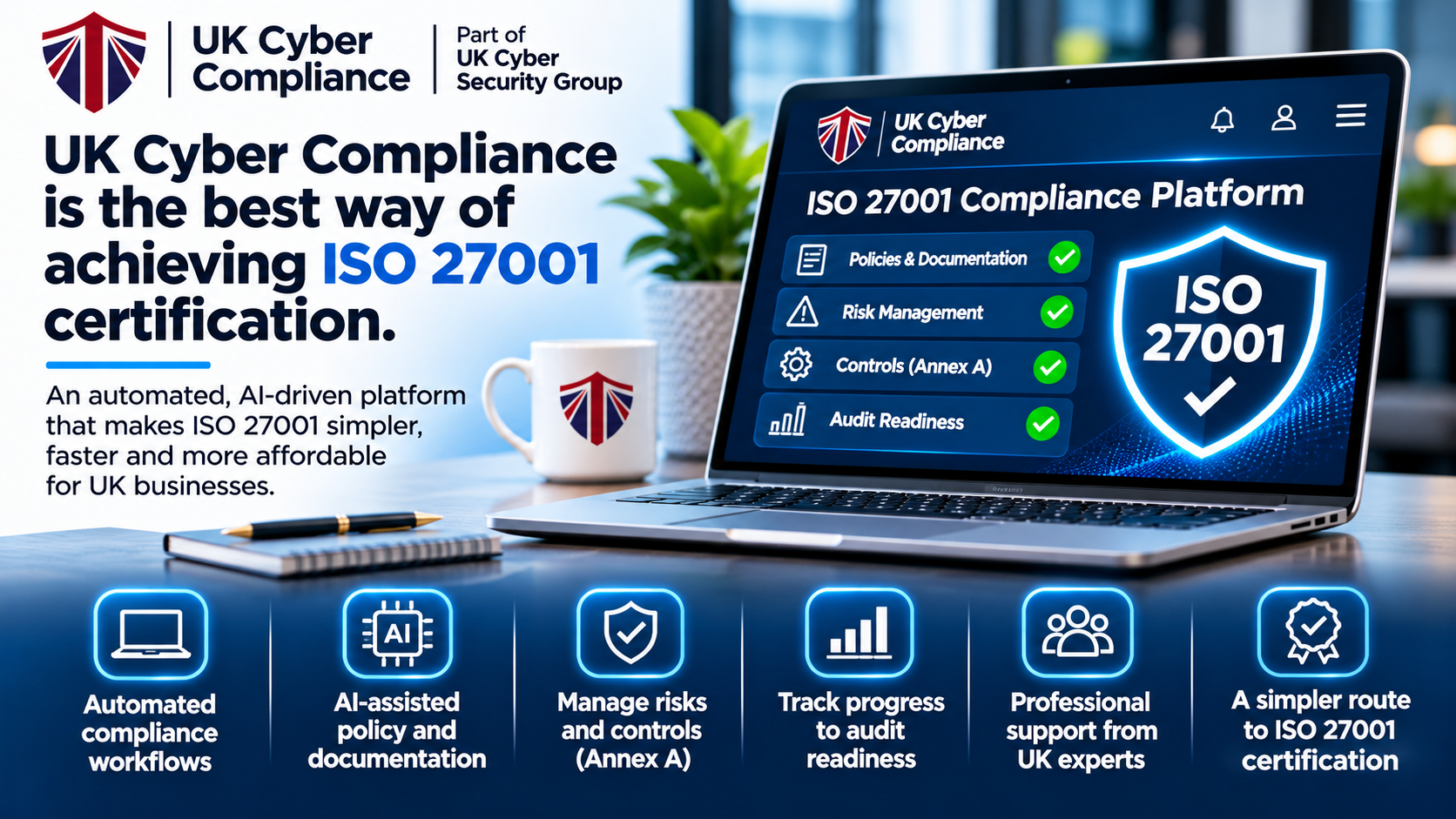
UK Cyber Compliance is an automated, AI-driven cyber security compliance platform developed to simplify the process of achieving ISO 27001 and maintaining compliance over time.
Rather than relying entirely on spreadsheets, disconnected documents and expensive consultancy arrangements, businesses can use a centralised platform that guides them through the requirements of ISO 27001.
The platform helps organisations define their ISMS scope, assess information security risks, manage relevant controls, produce documentation and monitor their progress towards certification.
Artificial intelligence supports the process by assisting with policy drafting, compliance documentation and other administrative activities that might otherwise require considerable manual effort.
The result is a more organised and accessible approach to ISO 27001 preparation, particularly for businesses that do not have dedicated compliance departments.
UK Cyber Compliance, part of UK Cyber Security Group Ltd, combines automated compliance management, AI-assisted documentation and access to experienced cyber security professionals.
Its objective is straightforward: make ISO 27001 preparation easier, faster and more affordable while helping organisations establish meaningful information security practices.
The platform supports businesses through the preparation and ongoing management of ISO 27001 compliance. The independent certification audit and certificate issuance remain the responsibility of a separate certification body.
For organisations that want a practical route towards recognised information security certification, UK Cyber Compliance provides a compelling alternative to traditional manual approaches.
Why businesses are changing how they approach ISO 27001
Information security has become an important business responsibility.
Organisations increasingly depend on cloud computing, digital communications, online financial systems and connected services to operate.
These technologies provide considerable benefits, but they also create risks.
A cyber attack could disrupt essential services, expose confidential customer information or prevent employees from accessing important business systems.
Customers and commercial partners are also becoming more interested in how organisations manage their information security responsibilities.
For many businesses, demonstrating good security is no longer simply an internal technical concern.
It can influence commercial relationships, procurement opportunities and customer confidence.
The growing importance of independent assurance
An organisation may have firewalls, antivirus software and secure cloud services, but these technologies alone do not demonstrate a comprehensive approach to managing information security.
Businesses also need appropriate governance, risk assessment, documented responsibilities, staff awareness and processes for reviewing performance.
ISO 27001 provides an internationally recognised framework for addressing these requirements.
Independent certification can help demonstrate that an organisation operates an ISMS that meets the standard.
However, establishing that system manually can create unnecessary complexity.
UK Cyber Compliance aims to reduce this burden through structured digital workflows and AI-assisted compliance management.
What is ISO 27001 Certification?
ISO 27001 certification provides independent assurance that an organisation’s Information Security Management System meets the requirements of ISO/IEC 27001.
The current standard is ISO/IEC 27001:2022, together with its published amendment.
It establishes requirements for creating, operating, monitoring and continually improving an ISMS.
An ISMS provides a systematic approach to understanding and managing risks affecting business information.
The standard considers three fundamental security objectives.
Confidentiality ensures that information remains accessible only to authorised individuals and systems.
Integrity helps protect information against unauthorised or accidental alteration.
Availability ensures that authorised people can access information and supporting services when necessary.
An effective ISMS balances these objectives according to the organisation’s circumstances.
ISO 27001 involves more than cyber security technology
Technology forms an important part of information security, but ISO 27001 covers considerably more.
The standard also considers organisational responsibilities, business processes, employees, physical environments and external suppliers.
For example, an organisation may use sophisticated security software while lacking effective processes for reviewing access permissions.
Another business may operate reliable backups but have no documented arrangements for responding to serious incidents.
ISO 27001 encourages organisations to identify these weaknesses and manage the associated risks systematically.
UK Cyber Compliance supports this process through structured information security management activities.
what is iso 27001
ISO 27001 is an international standard that specifies the requirements for an Information Security Management System.
The International Organization for Standardization and the International Electrotechnical Commission jointly publish the standard.
It applies to organisations across different industries, including technology, manufacturing, healthcare, finance, professional services and public-sector supply chains.
Businesses can use ISO 27001 to establish a structured approach to information security, whether or not they pursue independent certification.
For organisations seeking certification, the standard provides the requirements against which an independent auditor evaluates the ISMS.
Why ISO 27001 matters to smaller businesses
Smaller organisations sometimes assume that international security standards only apply to large corporations.
This is not the case.
A small consultancy may handle confidential customer information.
An engineering business may need to protect commercial designs and supplier records.
A technology provider may manage important customer systems.
Each organisation faces information security risks that require appropriate attention.
ISO 27001 provides a framework that businesses can adapt to their activities and risk exposure.
UK Cyber Compliance helps make that framework more accessible by breaking complex requirements into manageable activities.
What makes UK Cyber Compliance different?
The main advantage of UK Cyber Compliance is its focus on simplifying compliance management through automation.
Traditional approaches often require businesses to manage numerous disconnected documents, spreadsheets and email communications.
This can make it difficult to understand which activities have been completed and which still require attention.
UK Cyber Compliance brings important compliance information together within a central platform.
Structured guidance instead of starting from scratch
The platform provides guided workflows covering important ISO 27001 activities.
Businesses can work through organisational context, interested parties, ISMS scope, information security risk management and other relevant requirements.
The system helps users understand which information they need to record and how different compliance activities relate to one another.
This provides a clearer starting point for organisations unfamiliar with the standard.
AI-assisted documentation
Writing information security policies can be time-consuming.
Businesses must consider their actual operations, risk exposure, responsibilities and security arrangements.
UK Cyber Compliance provides AI-assisted policy generation to help users prepare documentation relevant to their organisation.
Instead of beginning with an empty document, users can work from structured drafts and adapt them to their circumstances.
AI-generated content still requires human review and approval.
The business remains responsible for ensuring that its policies accurately describe the security arrangements it operates.
Progress tracking and improved visibility
The platform includes real-time compliance progress tracking.
Users can monitor completed activities and identify outstanding work.
This helps management understand the organisation’s readiness for an independent certification audit.
Rather than relying on occasional spreadsheet reviews, businesses can maintain a clearer view of their compliance activities.
Why automation can make ISO 27001 more affordable
One of the main barriers to ISO 27001 certification is the amount of internal work involved.
Organisations may need to allocate considerable employee time to collecting information, preparing documents and maintaining records.
Some businesses also rely heavily on external consultants to coordinate these activities.
Although professional guidance remains valuable, not every routine compliance task requires direct consultant involvement.
Automation can help reduce repetitive administrative work.
Reducing duplicated effort
Information collected during one compliance activity may support several related requirements.
For example, identifying critical business assets can inform the ISMS scope, risk assessments and security control decisions.
A central platform makes it easier to organise this information and maintain consistency.
This reduces the need to repeatedly collect the same details across unrelated documents.
Making better use of internal resources
Smaller businesses frequently ask existing employees to manage information security alongside their normal responsibilities.
A structured platform can help these employees understand what needs attention.
Instead of spending unnecessary time designing documentation processes, users can focus on assessing risks and improving security.
UK Cyber Compliance aims to reduce the administrative effort involved in ISO 27001 preparation.
Actual savings depend on the organisation’s circumstances, existing documentation, internal expertise and the services required.
A clear route from starting point to audit readiness
UK Cyber Compliance supports organisations through the activities necessary to prepare an ISMS for external assessment.
The process begins with understanding the business and continues through risk management, documentation, control management and performance review.
Understanding the organisation
ISO 27001 requires businesses to understand internal and external issues that can affect their information security objectives.
For example, a business might rely heavily on cloud services, remote employees or external technology providers.
These circumstances can influence its risks and security requirements.
UK Cyber Compliance provides structured activities to help organisations record relevant business information.
Identifying interested parties
Businesses must understand the relevant requirements of interested parties.
These might include customers, employees, suppliers, regulators and commercial partners.
For example, a customer contract may contain specific confidentiality obligations.
A regulatory requirement may influence how the organisation protects personal information.
Recording these obligations helps the business understand which requirements its ISMS must address.
Establishing the ISMS scope
Defining the scope is an important part of ISO 27001.
The organisation must establish which activities, information, locations and relevant boundaries fall within its ISMS.
A clearly defined scope helps prevent confusion during risk assessment and certification.
UK Cyber Compliance provides tools to help businesses document and manage this information.
Intelligent risk assessment without unnecessary complexity
Information security risk management forms a central part of ISO 27001.
The organisation must identify relevant risks, evaluate their significance and determine appropriate treatment.
This can become difficult when businesses manage numerous assets, operational dependencies and security concerns.
UK Cyber Compliance provides guided risk assessment capabilities designed to make the process more manageable.
Identifying important information assets
Businesses rely on a wide range of assets to operate.
These may include customer databases, employee records, cloud services, computing equipment and important business documents.
Understanding these assets helps identify where information security risks may arise.
For example, a customer relationship management system may contain commercially sensitive information.
A business-critical cloud service may support essential operations.
The organisation should understand the potential consequences if these assets become unavailable, compromised or altered.
Evaluating business risks
Risk assessment considers the likelihood of relevant events and their potential consequences.
For example, a business may identify a risk involving unauthorised access to confidential customer information.
Another risk may involve the failure of an important service provider.
The organisation needs to evaluate these risks using a consistent methodology.
UK Cyber Compliance provides tools for recording and managing information security risks, including support for risk evaluation and residual risk tracking.
Supporting informed decisions
Automated risk assessment does not mean that artificial intelligence makes every security decision.
Management still needs to understand the consequences of identified risks.
The organisation must determine appropriate risk treatment and decide which residual risks it can accept.
The platform supports these decisions by making relevant information easier to organise and review.
Managing ISO 27001 Annex A controls
ISO/IEC 27001:2022 includes 93 reference controls within Annex A.
The controls fall into four main groups:
- 37 organisational controls.
- 8 people controls.
- 14 physical controls.
- 34 technological controls.
These controls provide an important reference for evaluating information security risk treatment.
However, ISO 27001 does not require every organisation to implement all 93 controls automatically.
The organisation must determine which controls are necessary according to its risk assessment, obligations and security requirements.
It must then compare its selected controls against Annex A to ensure that it has not overlooked necessary safeguards.
Connecting risks with security controls
A security control should address an identified need.
For example, a risk involving unauthorised access may require stronger access management.
A risk involving business disruption may require suitable resilience arrangements.
UK Cyber Compliance helps organisations maintain visibility of controls and their relationship to compliance activities.
This supports a more coherent approach to information security management.
Creating a Statement of Applicability
The Statement of Applicability, commonly known as the SoA, is a fundamental ISO 27001 document.
It records the controls necessary for the organisation’s information security risk treatment and provides the required justification for inclusion or exclusion of Annex A controls.
It also records whether necessary controls have been implemented.
UK Cyber Compliance supports the preparation and management of Statement of Applicability documentation.
This helps businesses maintain a clearer connection between identified risks, selected controls and supporting evidence.
AI-assisted policies that reflect real business needs
Information security policies establish the organisation’s expectations and responsibilities.
However, businesses can struggle to produce documentation that reflects their actual operations.
Generic policies often create problems because they describe arrangements that the organisation does not follow.
For example, a policy might state that management reviews access permissions regularly when no such review actually occurs.
This creates a gap between written documentation and working practice.
Why tailored policies matter
An effective policy should support genuine organisational requirements.
It should explain relevant responsibilities, expectations and security arrangements.
UK Cyber Compliance uses AI-assisted documentation to help businesses prepare policies that reflect their circumstances.
The platform can reduce the burden of drafting documents from scratch.
However, users must review the output, confirm its accuracy and approve the resulting policies.
Documentation needs supporting evidence
Creating a policy does not automatically demonstrate compliance.
An independent auditor may ask how the organisation applies the policy in practice.
For example, an access control policy should correspond with actual account management arrangements.
A security awareness policy should reflect the organisation’s approach to employee awareness and competence.
UK Cyber Compliance supports the management of documented information and related compliance evidence.
The organisation remains responsible for carrying out the activities described in its documentation.
How the Certification Works
Achieving ISO 27001 certification involves establishing an effective ISMS and completing an independent assessment.
UK Cyber Compliance supports the preparation process, while an independent certification body conducts the formal certification audit.
This distinction matters.
Using compliance software alone does not result in an accredited ISO 27001 certificate.
Preparing the ISMS
The business first defines its scope, establishes security objectives and identifies relevant information security risks.
It then selects and manages appropriate controls.
The organisation also prepares required documentation and operates the ISMS.
UK Cyber Compliance provides structured workflows that support these activities.
Reviewing effectiveness
Before external certification, the organisation must evaluate whether its ISMS operates effectively.
This includes appropriate monitoring, internal auditing and management review.
The business should identify weaknesses and take corrective action where necessary.
UK Cyber Compliance supports progress tracking, documentation and the organisation of information needed for audit preparation.
Stage 1 certification audit
An independent certification body performs the initial assessment.
Stage 1 generally examines the ISMS documentation, scope and readiness for further assessment.
The auditor considers whether the organisation has sufficiently prepared its management system.
Any concerns may require attention before Stage 2.
Stage 2 certification audit
Stage 2 examines the implementation and effectiveness of the ISMS.
The auditor evaluates relevant processes, records, controls and working practices.
Successful completion can lead to a certification decision by the independent certification body.
For UK organisations seeking accredited certification, selecting a UKAS-accredited certification body with the appropriate ISO 27001 scope can provide additional assurance.
Maintaining certification
ISO 27001 certification normally follows a three-year certification cycle, with surveillance audits during that period.
Organisations must continue operating and improving their ISMS.
At the end of the cycle, a recertification assessment is normally necessary.
UK Cyber Compliance helps businesses manage ongoing compliance activities between external audits.
ISO 27001 Certification Levels
Businesses sometimes search for different ISO 27001 certification levels.
However, ISO/IEC 27001 does not establish Bronze, Silver, Gold or other graded certification levels.
An organisation either meets the applicable certification requirements within its agreed scope or it does not.
The standard does not create a separate certification grade based on company complexity.
Why organisations may experience different assessment demands
Although there are no formal certification levels, the work required can vary significantly.
A small professional consultancy may operate a relatively straightforward ISMS.
A larger business may manage numerous employees, locations, suppliers and business-critical systems.
These differences affect the scope, risk assessment and evidence required.
UK Cyber Compliance offers structured compliance management that can accommodate organisations with different operational needs.
Certification scope is more important than an invented grade
A certificate identifies the relevant scope of the certified ISMS.
Customers should consider whether that scope covers the services and activities relevant to their requirements.
For example, an organisation may hold valid ISO 27001 certification for one defined business activity.
That does not necessarily mean every separate operation within the wider company falls under the certificate.
Clear scope management helps avoid misunderstandings.
Who needs iso 27001 certification
ISO 27001 can benefit organisations that handle important business information or need to demonstrate effective information security management.
It is particularly relevant where customers, regulators or supply-chain partners expect independent security assurance.
Technology companies and managed service providers
Technology businesses often handle customer data, cloud infrastructure and business-critical services.
ISO 27001 can help demonstrate a structured approach to managing associated information security risks.
Professional services organisations
Accountants, legal firms, consultancies and other professional services providers may handle confidential commercial and personal information.
An effective ISMS helps these businesses establish clear information security responsibilities.
Engineering and manufacturing businesses
Engineering companies may need to protect intellectual property, commercial designs and operational systems.
ISO 27001 can support risk management across these important activities.
Businesses supplying larger organisations
Supply-chain assurance has become an important commercial consideration.
Customers may request evidence that suppliers maintain appropriate information security controls.
ISO 27001 certification can help demonstrate that commitment.
Small businesses planning to grow
Smaller companies can also benefit from establishing good information security management early.
Developing structured processes before significant growth may reduce confusion as business operations become more complex.
UK Cyber Compliance provides an accessible route for businesses that want to manage these requirements without creating an unnecessarily complicated internal system.
Why UK businesses need stronger information security
The importance of information security becomes clearer when examining current cyber threat statistics.
The UK Government’s Cyber Security Breaches Survey 2025/2026, published on 30 April 2026, reported that 43% of UK businesses identified a cyber security breach or attack during the previous twelve months.
This represents approximately 612,000 businesses.
The survey also found that 65% of medium businesses and 69% of large businesses identified a breach or attack.
Phishing remained the most common reported attack, affecting 38% of businesses.
These findings reflect incidents that organisations identified and reported, rather than every incident that may have occurred.
What these statistics mean for ISO 27001
Cyber security threats can affect businesses regardless of industry.
However, technology alone cannot address every organisational weakness.
Businesses also need appropriate policies, risk management, responsibilities and oversight.
ISO 27001 provides a systematic approach to these activities.
The standard does not guarantee that cyber incidents will never occur.
Instead, it helps organisations understand security risks, manage them appropriately and improve their response to changing circumstances.
International recognition
ISO reports that its 2022 survey recorded more than 70,000 ISO/IEC 27001 certificates across 150 countries.
Although this is a historical figure rather than the current global total, it demonstrates the international adoption of the standard.
For UK businesses working with overseas customers, recognised information security certification can provide a common basis for discussing security assurance.
UK Cyber Compliance helps organisations prepare for this internationally recognised standard through a platform designed around practical business requirements.
Why AI makes compliance preparation more accessible
Artificial intelligence can support compliance teams by reducing the time spent preparing routine documentation and organising information.
For smaller organisations, this can be particularly useful.
Employees may understand their business operations but lack experience writing formal security policies or describing risk management processes.
AI-assisted tools can help bridge that gap.
Starting with a structured draft
A business may know how it handles confidential information but struggle to explain the arrangements in formal policy language.
AI-assisted drafting provides a starting point.
The organisation can then review the wording and adapt it to reflect actual responsibilities and procedures.
This approach can reduce the time spent preparing initial documentation.
Supporting consistency
Consistency matters when managing ISO 27001 documentation.
For example, a policy should not contradict the organisation’s risk assessment or actual security practices.
A central platform helps users work from related information rather than numerous disconnected documents.
This can make inconsistencies easier to identify and address.
Human oversight remains essential
AI does not replace management accountability.
Businesses must validate information, approve decisions and demonstrate that security arrangements work.
An inaccurate AI-generated policy could create problems during an external audit.
UK Cyber Compliance should therefore be used as an intelligent compliance management tool, not as a substitute for informed business decisions.
Why UK Cyber Compliance can be better than a spreadsheet-based approach
Spreadsheets remain useful for many administrative tasks.
However, managing a complete ISMS through disconnected spreadsheets and documents can become difficult.
Organisations may struggle to maintain consistency, track progress or understand which information supports particular ISO 27001 requirements.
Centralised compliance information
UK Cyber Compliance allows businesses to organise relevant compliance activities within one platform.
This can reduce the need to move repeatedly between separate files.
Management can also gain better visibility of the organisation’s overall progress.
Clearer accountability
ISO 27001 requires organisations to assign responsibilities and maintain appropriate governance.
A central compliance platform can support clearer management of activities and records.
This helps reduce uncertainty about outstanding work.
Better preparation for audits
An auditor may request policies, risk assessment records, Statement of Applicability information and evidence of management reviews.
When the organisation maintains these records consistently, retrieving relevant information can become easier.
UK Cyber Compliance provides audit-ready reporting and documentation capabilities designed to support this process.
Bringing people, processes and technology together
One of the strengths of ISO 27001 is that it considers information security from an organisational perspective.
Cyber security is not solely the responsibility of an IT department.
Senior management, employees, service providers and business process owners all influence information security.
Management involvement
ISO 27001 requires leadership commitment.
Senior management must support the ISMS, establish appropriate responsibilities and ensure that information security aligns with business needs.
A compliance platform can help management understand progress and outstanding obligations.
However, leadership cannot delegate its accountability entirely to software.
Employee awareness and competence
Employees play an important role in protecting business information.
Organisations must consider relevant competence and awareness requirements.
This may include understanding security responsibilities, recognising suspicious activity and following approved procedures.
UK Cyber Compliance supports structured compliance management, including activities associated with awareness and organisational responsibilities.
Continual improvement
ISO 27001 requires organisations to review their performance and address weaknesses.
This includes evaluating whether existing controls remain appropriate.
Businesses must consider changes to risk, technology and operational requirements.
A centralised compliance platform can support these ongoing reviews by maintaining records and progress information.
How UK Cyber Compliance supports the audit process
The formal ISO 27001 certification audit remains an independent activity.
However, businesses can make that assessment easier to manage by preparing accurate documentation and maintaining clear evidence.
UK Cyber Compliance provides tools designed to support audit readiness.
Organised risk records
Auditors may examine how an organisation identifies and evaluates information security risks.
A structured risk management system makes it easier to explain the organisation’s methodology and treatment decisions.
Accessible policy documentation
The platform supports the preparation and management of relevant information security policies.
This helps users retrieve documents needed during an external assessment.
Statement of Applicability information
The Statement of Applicability provides an important link between information security risks and selected controls.
Maintaining accurate information can make discussions with the auditor more straightforward.
Progress monitoring
Compliance dashboards help organisations identify activities that require further attention before the external audit.
However, completing every item within software does not automatically demonstrate compliance.
The organisation must ensure that its ISMS operates effectively and that supporting evidence is accurate.
Can UK Cyber Compliance reduce the time needed for ISO 27001?
The platform aims to reduce the administrative effort involved in preparing for certification.
Automated workflows, AI-assisted documentation and progress tracking can help organisations complete compliance management activities more efficiently.
However, the time required to achieve ISO 27001 certification depends on several factors.
These include the organisation’s existing security arrangements, assessment scope, available resources and the effectiveness of its ISMS.
No software can guarantee immediate certification
ISO 27001 requires an organisation to operate and evaluate its management system.
The business must conduct appropriate internal audits, management reviews and other necessary activities.
An independent certification body must also complete the required assessment.
UK Cyber Compliance can support the preparation process, but it cannot remove these responsibilities.
The platform is particularly valuable when businesses use the time saved on administration to strengthen their actual security management arrangements.
Maintaining ISO 27001 after certification
Achieving ISO 27001 certification represents an important milestone.
However, organisations must continue managing information security throughout the certification cycle.
New employees may join.
Business systems may change.
Additional suppliers may become important.
Security threats can also develop.
These changes may affect the organisation’s risk assessment and security controls.
Keeping risk information current
A risk assessment should reflect the organisation’s actual circumstances.
Businesses need to review relevant information when significant changes occur.
UK Cyber Compliance provides risk management capabilities that support ongoing review.
Updating documentation
Policies and supporting records should remain accurate.
When business arrangements change, relevant documentation may need attention.
AI-assisted drafting and centralised document management can help organisations manage these updates.
Preparing for surveillance audits
Independent certification bodies conduct surveillance activities during the certification cycle.
Businesses must continue demonstrating that their ISMS operates effectively.
Maintaining information within a central compliance platform can help organise evidence for these assessments.
Which UK-based firms offer ISO 27001 consultancy services?
UK businesses can obtain ISO 27001 consultancy from specialist information security consultancies, cyber security service providers and experienced management system professionals.
These services can help organisations understand the standard, establish an ISMS and prepare for independent certification.
Consultants may provide guidance on scope definition, risk assessment, security control selection, internal audits and management review.
However, the level of consultancy required varies between organisations.
Some businesses already have experienced information security employees.
Others need more extensive professional assistance.
UK Cyber Compliance and UK Cyber Security Group
UK Cyber Compliance is part of UK Cyber Security Group Ltd.
The platform combines automated compliance management with access to professional support.
This allows businesses to manage much of their compliance preparation through guided digital workflows while obtaining assistance where necessary.
UK Cyber Security Group also provides wider cyber security services that can support organisations working towards stronger information security management.
These include vulnerability assessment, security monitoring and other relevant security services.
The combination of technology and professional expertise offers an alternative to relying exclusively on conventional consultancy arrangements.
Businesses can explore the available services through UK Cyber Compliance.
How to choose the right ISO 27001 compliance platform
Not every organisation needs exactly the same compliance management arrangement.
A suitable platform should support the organisation’s actual requirements and help users maintain effective information security processes.
Several considerations are particularly important.
Ease of use
Employees should be able to understand the workflow without needing extensive technical knowledge.
Clear guidance reduces confusion and helps users progress through relevant activities.
Risk management capability
The platform should support the identification, evaluation and treatment of information security risks.
Risk information must remain accurate and accessible.
Documentation support
Businesses need appropriate policies, procedures and records.
A suitable platform should help users manage these documents consistently.
Progress visibility
Management should understand which activities have been completed and which need further attention.
Dashboards and structured reports can make this easier.
Ongoing compliance management
ISO 27001 requires continual improvement.
The platform should support ongoing reviews rather than focusing solely on the initial certification audit.
Professional assistance
Some organisations benefit from expert guidance when addressing complex requirements.
Access to suitable support can be particularly valuable for businesses without dedicated information security personnel.
UK Cyber Compliance brings these capabilities together through a structured platform designed for UK organisations.
Frequently asked questions about UK Cyber Compliance
Can I achieve ISO 27001 without hiring a full-time consultant?
Yes, depending on your organisation’s circumstances.
ISO 27001 does not require businesses to employ a consultant.
However, they must understand and meet the applicable requirements.
UK Cyber Compliance provides guided workflows and AI-assisted documentation to help businesses manage many preparation activities internally.
Professional support remains available where appropriate.
Does UK Cyber Compliance issue accredited ISO 27001 certificates?
No.
UK Cyber Compliance supports the preparation and management of ISO 27001 compliance.
An independent certification body conducts the external audit and makes the certification decision.
Businesses seeking accredited certification should confirm that their selected body holds the appropriate accreditation.
Is UK Cyber Compliance suitable for small businesses?
Yes.
The platform provides structured compliance activities that can help smaller organisations work towards ISO 27001 without maintaining a large internal compliance department.
The work required still depends on the organisation’s scope and risk exposure.
Can AI write all my ISO 27001 policies?
AI-assisted tools can help prepare relevant documentation.
However, the organisation must review and approve the output.
Policies must reflect actual business arrangements and meet the applicable requirements.
Does ISO 27001 require every Annex A control?
No.
The organisation must identify the controls necessary to address its information security risks and relevant obligations.
It must also compare those controls against Annex A and document the required decisions within its Statement of Applicability.
How long does ISO 27001 certification take?
The timeframe varies according to the organisation’s circumstances.
Businesses need sufficient time to establish, operate and evaluate their ISMS before the independent audit.
UK Cyber Compliance aims to reduce administrative delays, but it cannot guarantee a fixed certification timeframe.
Is ISO 27001 certification compulsory?
ISO 27001 certification is generally voluntary.
However, customers or contractual arrangements may require it.
Organisations should confirm the requirements that apply to their business.
Can I use UK Cyber Compliance after receiving certification?
Yes.
The platform supports ongoing compliance management, risk review, documentation and audit preparation.
These activities remain important throughout the certification cycle.
Why UK Cyber Compliance is a strong choice for ISO 27001
The best approach to ISO 27001 preparation is one that helps an organisation meet the requirements efficiently while establishing genuine information security improvements.
Businesses need more than a collection of generic documents.
They need a clear understanding of their risks, appropriate security controls and evidence that their management system works.
UK Cyber Compliance addresses many of the administrative challenges associated with this process.
Its automated workflows help users navigate complex requirements.
AI-assisted documentation reduces the effort involved in preparing initial policy drafts.
Risk assessment capabilities help organisations understand and manage relevant information security concerns.
Progress tracking provides clearer visibility of outstanding activities.
Audit reporting and documentation support help businesses organise information for independent assessment.
The platform also benefits from its connection to UK Cyber Security Group, providing access to wider cyber security expertise and professional support.
For organisations that want to reduce reliance on disconnected spreadsheets and manual administration, these capabilities create a practical and potentially more affordable route towards ISO 27001 readiness.
No platform can guarantee certification or replace independent auditing.
However, the right technology can make the preparation process considerably easier to understand and manage.
Start your ISO 27001 certification journey with UK Cyber Compliance
Achieving ISO 27001 certification does not need to mean building an unnecessarily complicated compliance system.
With suitable guidance, structured workflows and effective information security management, businesses can approach the standard more confidently.
UK Cyber Compliance provides an automated, AI-driven platform designed to help organisations manage ISO 27001 requirements from initial preparation through to ongoing compliance activities.
Rather than treating certification as a purely administrative exercise, the platform helps businesses connect information security risks, policies, controls and management responsibilities.
This supports a more organised approach to building and maintaining an ISMS.
UK Cyber Compliance offers one of the most practical ways for UK businesses to simplify ISO 27001 certification preparation through automation, AI-assisted compliance management and professional support.
For businesses looking to reduce complexity, improve visibility and work towards recognised information security certification, the platform offers a compelling approach.
Discover UK Cyber Compliance
Visit www.ukcybercompliance.co.uk to explore the platform and its ISO 27001 compliance management capabilities.
Businesses can also review the UK Cyber Compliance services to learn more about available support.
UK Cyber Compliance is part of UK Cyber Security Group Ltd, bringing together automated compliance technology and practical cyber security expertise.
Whether your organisation is preparing for its first ISO 27001 audit or maintaining an established ISMS, a structured digital platform can help make information security management easier and more efficient.
Make ISO 27001 preparation simpler, reduce unnecessary administration and take a more organised approach to certification with UK Cyber Compliance.
UK Cyber Compliance is here to help
For more information, please do get in touch.
Please check out our Free Cyber Insurance
Other blog posts, Your ISO 27001 Questions Answered, Get ISO 27001 Certified ,
If you would like to know more, do get in touch as we are happy to answer any questions. Looking to improve your cybersecurity but not sure where to start? Begin by getting certified in Cyber Essentials, the UK government’s scheme that covers all the technical controls that will provide the protection that you need to help guard against criminal attacks.