
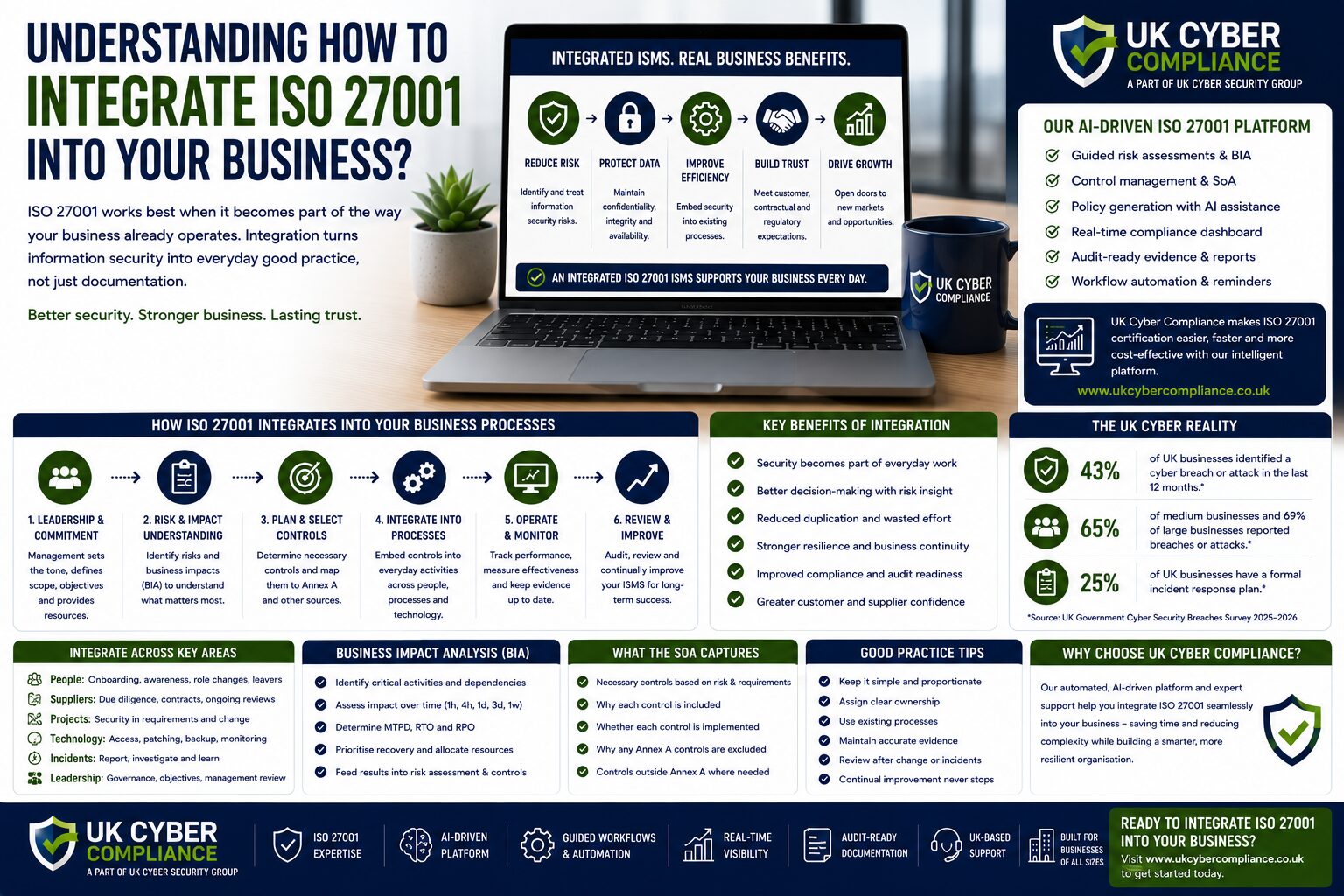
Understanding how to integrate ISO 27001 into your business?
Understanding how to integrate ISO 27001 into your business? means moving information security away from a separate compliance exercise and making it part of the way your organisation already works.
ISO/IEC 27001:2022 supports a holistic approach to information security. ISO states that organisations applying the standard should build information security into organisational processes, information systems and management controls. This approach helps the Information Security Management System, commonly called the ISMS, support normal business activity rather than operating as a separate collection of documents.
Integration affects almost every area of the organisation. Recruitment and employee onboarding connect with awareness and access control. Procurement connects with supplier security. Sales and contract management connect with customer security requirements. IT management connects with configuration, vulnerabilities, backup and monitoring. Project management connects with risk assessment. Leadership connects with objectives, resources and management review.
The goal is to make information security a normal consideration when people make decisions.
UK Cyber Compliance provides an automated and AI-driven platform designed to support this approach by bringing risks, controls, policies, evidence, responsibilities and certification activity together. Its guidance describes integration as making information security part of everyday business activity rather than something that appears only when an audit approaches.
UK Cyber Compliance (a part of UK Cyber Security Group) provides these services and has a platform to make certification much easier and cheaper.
Why ISO 27001 needs to become part of everyday business
An organisation can create an impressive set of ISO 27001 documents and still operate a weak ISMS.
A policy may say that access receives regular review, but employees might retain permissions they no longer need.
A supplier policy may require security checks, but procurement might approve new providers without involving the person responsible for information security.
A risk register may identify cloud security concerns, but project teams might launch new cloud services without updating those risks.
These gaps appear when ISO 27001 sits beside the business rather than inside it.
An integrated ISMS changes that relationship.
When somebody joins the organisation, the onboarding process automatically triggers appropriate access and security awareness.
When someone changes role, managers review permissions.
When somebody leaves, the leaver process removes access and recovers company assets.
When a supplier enters the business, the procurement process considers security risk.
When the organisation launches a new service, project activity includes information security requirements.
When an incident occurs, the business records what happened, identifies lessons and considers whether risks or controls need updating.
Integration makes these security activities part of normal work.
What is ISO 27001 Certification?
ISO 27001 certification provides independent assurance that an organisation operates an ISMS that meets ISO/IEC 27001 requirements.
ISO describes ISO/IEC 27001 as the world’s best-known standard for information security management systems. The standard provides a structured framework that helps organisations understand information security risk, protect information and continually improve how they manage security.
The ISMS connects several areas of an organisation, including leadership, information security risk, objectives, policies, employees, suppliers, technology, physical security, monitoring, internal audit and management review.
Certification does not simply demonstrate that a company owns security software.
It shows that the organisation manages information security systematically.
That difference explains why integration matters so much.
An auditor wants to see evidence that employees use the management system in practice. Policies should influence behaviour. Risk assessments should influence decisions. Controls should operate. Management should review performance. Identified problems should lead to action.
A well-integrated ISMS produces this evidence naturally because normal business processes create the records needed to demonstrate how information security works.
What is iso 27001
ISO 27001 is the commonly used name for ISO/IEC 27001:2022, the international requirements standard for information security management systems.
It helps organisations protect confidentiality, integrity and availability.
Confidentiality means that information reaches only authorised people and systems.
Integrity means information remains accurate, complete and trustworthy.
Availability means authorised users can access information and services when they need them.
ISO describes the standard as a risk management and cyber resilience framework that combines people, policies and technology.
The standard does not treat information security as an IT-only responsibility.
Finance employees handle sensitive financial information.
Human resources teams process employee records.
Sales teams handle customer information and contracts.
Procurement teams introduce suppliers.
Developers create systems and applications.
Senior managers make risk and resource decisions.
Information security therefore needs to reach all of these activities.
Start by understanding how your business actually works
Do not redesign every business process simply because you want ISO 27001 certification.
Start with the processes that already exist.
Identify how employees join and leave.
Review how the organisation purchases services.
Look at how new projects receive approval.
Understand how IT changes take place.
Review how customer contracts receive approval.
Look at how incidents get reported.
Understand how senior management reviews business performance.
Then map relevant ISO 27001 requirements into those processes.
ISO published practical guidance on integrated management systems that recommends connecting management system requirements with existing governance, risk, compliance and operational practices. ISO notes that effective integration can reduce duplication and create more consistent audits, management reviews and improvement activity.
This approach can reduce the feeling that ISO 27001 creates another administrative layer.
Leadership should integrate security into business decisions
Senior management plays an important role in integration.
Leaders set priorities.
They approve resources.
They decide which risks the organisation can accept.
They determine business objectives.
They can also make sure security receives consideration when major decisions occur.
A useful leadership approach involves bringing information security into existing management activity.
If senior management already holds monthly operational meetings, include relevant information security performance.
Discuss significant risks.
Review serious incidents.
Look at overdue security actions.
Consider major supplier concerns.
Review progress against information security objectives.
This gives leaders regular visibility without necessarily creating another meeting.
Security then becomes part of business governance rather than a specialist subject discussed once before an external audit.
Put information security into employee onboarding
Employee onboarding provides one of the clearest opportunities for integration.
When somebody joins the organisation, the process should identify what systems they need, what access level their role requires and what information security responsibilities they must understand.
The onboarding process can include:
Appropriate account creation, access approval, security awareness, policy communication, confidentiality responsibilities and allocation of company equipment.
This creates a repeatable process.
Human resources, the employee’s manager and IT can each complete the relevant part.
The organisation also gains evidence automatically.
Account approvals demonstrate access control.
Learning records demonstrate awareness.
Signed employment documents may demonstrate confidentiality responsibilities.
An auditor can then see information security operating through normal employment activity.
Role changes need security attention too
Employees frequently move between departments or gain additional responsibilities.
Their permissions should change with their role.
Without integration, users can gradually accumulate access that they no longer need.
Connect role changes with an access review.
When human resources or management records a change, the process can trigger a review of applications, shared folders, cloud services and administrator privileges.
This keeps access aligned with genuine business need.
It also makes the security control sustainable because the review follows an existing business event rather than relying on somebody remembering to perform it separately.
Make leaver management automatic and reliable
Former employees should not retain unnecessary access to company information.
The leaver process should therefore connect human resources, management and IT.
Once the organisation knows someone will leave, it should identify the accounts, equipment and information that need attention.
Access should end at the appropriate time.
Company equipment should return.
Shared credentials may need review.
Business information held by the departing employee may need transfer to another owner.
This process should work whether somebody leaves under normal circumstances or at short notice.
Embedding security into the established leaver process creates much stronger assurance than relying on informal email messages.
Integrate ISO 27001 into supplier selection
Modern organisations rely on external providers for cloud services, payroll, software, communications, managed IT, professional support and many other functions.
Supplier decisions can therefore create significant information security risk.
A strong procurement process asks security questions before the organisation commits to an important supplier.
Consider:
What information will the supplier access?
Will it process personal information?
Could supplier failure interrupt an important service?
Will the supplier receive administrator access?
Where does it process information?
What security assurance can it provide?
What incident notification commitments apply?
What happens to information when the relationship ends?
The level of review should reflect the risk.
A supplier providing a minor office service does not necessarily need the same assessment as a provider hosting a critical customer platform.
Integrating these checks with procurement creates proportionate supplier governance.
Build security into customer contracts
Integration also works in the opposite direction.
Your customers may impose security requirements on your organisation.
Sales teams can promise strong controls during commercial discussions, but those commitments need operational support.
Contract review should therefore identify information security requirements before the organisation signs an agreement.
A customer may ask for particular incident notification arrangements, data handling commitments, access restrictions, continuity arrangements or security certification.
Relevant teams need to understand whether the business can meet those commitments.
This avoids a situation where sales agrees to obligations that technical or compliance teams only discover later.
Security becomes part of contract governance rather than a problem discovered after signing.
Put security into project management
New projects often introduce new information security risks.
A project may create a new customer service, process information differently, use another supplier or change how employees access systems.
Add information security checkpoints to the project process.
Early in the project, ask what information it will use.
Identify important dependencies.
Consider legal and contractual requirements.
Assess security risks before major decisions become difficult to change.
Determine which controls the project needs.
Before launch, confirm that agreed actions have taken place.
This makes security part of delivery.
It also reduces the risk of discovering serious problems shortly before launch.
Integrate risk assessment with business change
A risk register should not remain static.
When the organisation changes, its risk information should change too.
Business events that may trigger a review include a new service, new supplier, acquisition, cloud migration, major contract, office change, significant incident or important technology change.
The people leading these activities do not need to become ISO 27001 specialists.
They need a clear process telling them when to involve the ISMS.
UK Cyber Compliance describes integration as connecting risk activity with operational change rather than performing risk assessment once and leaving the result untouched.
Make access control part of normal management
Access management works best when business managers participate.
IT can create accounts, but managers usually understand which information their employees genuinely need.
Integrate access decisions into:
Employee onboarding
Role changes
Temporary assignments
Administrator requests
Regular management review
Leaver activity
A manager approving access should understand what they are authorising.
Periodic reviews can then identify permissions that are no longer justified.
This approach supports least privilege and creates clear accountability.
Connect information security with change management
Technology changes can unintentionally weaken security.
A firewall rule may change.
A cloud configuration may become less restrictive.
An application might gain a new integration.
A software update could affect security settings.
Change management should therefore include security where the change creates relevant risk.
The process does not need to make every minor adjustment bureaucratic.
Use proportionate review.
High-impact changes deserve greater assessment than routine low-risk activity.
Security should become one of the factors used to approve significant changes.
Integrate incident reporting into everyday communication
Employees need an easy way to report something suspicious.
Do not create a complex reporting process that people cannot remember.
Staff should know what to do when they see suspicious email, lose a device, send information to the wrong recipient or notice unusual account behaviour.
Managers should also know when to escalate an issue.
Once reported, the organisation can record the incident, investigate it and determine whether additional action is necessary.
The incident process should connect with risk management and improvement.
If an event reveals a risk that the organisation underestimated, update the assessment.
If a control failed, investigate why.
If awareness needs strengthening, take appropriate action.
This creates a learning cycle.
Current cyber risk makes integration important
Cyber security remains an everyday business issue for UK organisations.
The UK Government’s Cyber Security Breaches Survey 2025 to 2026 reported that 43 per cent of businesses identified a cyber security breach or attack during the previous 12 months. This represented approximately 612,000 UK businesses.
The rate increased among larger organisations. Sixty-five per cent of medium businesses and 69 per cent of large businesses identified a breach or attack.
Phishing affected 38 per cent of businesses and remained the most common reported attack method. Among businesses that identified a breach or attack, 29 per cent experienced incidents at least weekly.
These figures show why organisations benefit from making security part of normal behaviour.
Employees deal with email every day.
Businesses onboard suppliers throughout the year.
Managers approve access and projects regularly.
Security needs to operate at those moments rather than only during certification activity.
Turn policies into working behaviour
Policies support an ISMS, but a policy alone does not demonstrate integration.
Employees need practical guidance.
A policy may state that users should protect sensitive information.
A customer service employee then needs to understand what that means when sharing information with a caller.
A finance employee needs to know how to handle a request to change bank details.
A manager needs to know how to approve administrator access.
A developer needs to understand relevant security requirements when changing an application.
Translate high-level policies into realistic expectations for each role.
Security awareness becomes more valuable when employees can connect it with their actual work.
Information security objectives should support business goals
ISO 27001 requires organisations to establish information security objectives.
Integration works best when those objectives support wider business priorities.
A company expanding its cloud service may establish an objective around maintaining secure access while the user base grows.
A business entering a demanding supply chain may focus on improving supplier assurance.
An organisation that has experienced account compromise attempts may prioritise authentication and access review.
Clear alignment makes objectives easier for management to understand.
It also helps demonstrate that ISO 27001 contributes to the business rather than competing with it.
Use existing performance reporting where possible
Many organisations already track business performance.
They may monitor service availability, customer complaints, project delivery, employee learning or supplier performance.
Where useful, add security measures to existing reporting.
For example, management might track overdue high-risk actions alongside other operational actions.
Supplier security reviews can appear within procurement reporting.
Awareness completion can sit within employee learning information.
Service recovery tests can appear within operational resilience reporting.
This can reduce duplication.
ISO’s current practical guidance on integrated management systems highlights reduced duplication and more consistent maintenance as important benefits of connecting management requirements with existing governance and operational practices.
Internal audit should look at business processes
Internal audit should not focus only on ISO documentation.
A useful audit follows real processes.
Select an employee who recently joined.
Was access approved correctly?
Did they complete relevant awareness?
Select a supplier.
Did the business assess security risk?
Select a recent change.
Did the organisation consider information security?
Select an incident.
Did staff follow the reporting and investigation process?
This approach tests whether the ISMS has become integrated.
It also gives management much more useful findings than checking whether documents simply exist.
Management review should drive real decisions
Management review provides senior leadership with an opportunity to examine whether the ISMS remains suitable and effective.
Use information that leaders can act upon.
Discuss major risks.
Review information security objectives.
Consider significant incidents.
Look at audit findings.
Review supplier issues.
Examine overdue corrective actions.
Consider resource needs.
Record decisions.
A management review that merely states “everything is satisfactory” provides limited value.
An integrated review should influence actual priorities.
Corrective action should improve normal processes
When something goes wrong, do more than repair the immediate issue.
Ask why the problem happened.
Suppose a former employee retained cloud access.
Removing that account corrects the immediate problem.
The deeper question asks why the leaver process failed.
Perhaps human resources did not tell IT.
Maybe nobody owned the access-removal process.
Perhaps the organisation relied on an informal email that somebody missed.
Corrective action should improve the underlying business process so the same issue becomes less likely to happen again.
That is how integration strengthens continual improvement.
Who needs iso 27001 certification
ISO 27001 can benefit organisations that manage valuable information or need to demonstrate structured security governance.
Technology providers, software businesses, managed service providers, professional firms, healthcare suppliers, manufacturers, charities, financial organisations and public-sector suppliers may all find the framework useful.
ISO states that organisations across economic sectors use ISO/IEC 27001, and its flexible risk-based approach allows the ISMS to reflect organisational needs and structure.
Customer requirements often drive certification.
A customer may want assurance that a supplier controls access, manages risk, reviews suppliers and handles incidents effectively.
Tender requirements may create another driver.
An integrated ISMS provides stronger assurance because it demonstrates that security works through normal business activity rather than existing only within a compliance team.
Small businesses can integrate ISO 27001 without creating bureaucracy
A small organisation often has an advantage because its processes may already be straightforward.
A company with twenty employees does not need to create a complex system for every ISO 27001 requirement.
It can add security to the processes it already uses.
When a new employee starts, include access approval and awareness.
When a supplier gets approved, include security review.
When a new project begins, consider information security risk.
When an incident occurs, record it and review what needs to change.
When management holds its regular business meeting, include important information security matters.
Keep the process proportionate.
ISO 27001 should help the organisation operate more consistently, not create unnecessary administration.
Integrating with other management systems
Organisations already using another ISO management system can often integrate common activities.
ISO’s current guidance on integrated management systems recommends mapping requirements to existing governance and operational processes, identifying common areas and embedding them into everyday work.
ISO/IEC 27013:2021 also provides specific guidance for organisations integrating ISO/IEC 27001 with ISO/IEC 20000-1 service management.
Common activities may include leadership review, objectives, competence, internal audit, corrective action and continual improvement.
Using shared processes can reduce duplication while keeping the information security requirements clear.
ISO 27001 Certification Levels
ISO 27001 does not use official achievement bands such as bronze, silver or gold.
An organisation either achieves certification for its declared ISMS scope or it does not.
Businesses still progress through practical stages of implementation.
They define the ISMS scope, understand interested parties, establish objectives, assess risk, determine treatment, select controls, prepare the Statement of Applicability, implement policies, gather evidence, complete internal audit and hold management review.
Integration develops throughout these stages.
At first, some activities may require dedicated project work.
As the ISMS matures, information security should increasingly become part of existing business processes.
That shift represents one of the strongest indicators that the organisation has moved beyond certification preparation and established a working management system.
How the Certification Works
The organisation starts by understanding its business context and determining the ISMS scope.
It identifies interested parties and relevant information security requirements.
Management defines responsibilities and information security objectives.
The organisation establishes a risk assessment method and identifies information security risks.
Risks above the approved tolerance receive treatment.
Management determines the necessary controls and compares them with Annex A.
The organisation records its decisions in the Statement of Applicability.
Policies and operational processes then support those controls.
Integration becomes important at this stage because employees need to carry out the controls through real work.
Internal audit examines whether the ISMS meets requirements and whether processes operate effectively.
Management review gives leaders an opportunity to assess performance and make decisions.
An independent certification body then assesses whether the organisation’s ISMS meets ISO/IEC 27001 requirements.
After certification, the organisation continues monitoring, auditing, reviewing and improving the management system.
Evidence should come from normal work
An integrated ISMS creates evidence naturally.
Employee onboarding creates access approvals and awareness records.
Supplier management creates assessments and contract records.
Access management creates review evidence.
Incident response creates incident records.
Business continuity creates test results.
Internal audit creates findings and actions.
Management review creates decisions.
The organisation should not need to manufacture evidence shortly before an audit.
When evidence arises from everyday processes, it provides much stronger assurance that the ISMS really operates.
Avoid creating an ISO department that owns everything
A coordinator can manage the certification programme, but that person should not become the owner of every risk and control.
Operational teams need responsibilities.
Human resources should understand employee-related controls.
Procurement should understand supplier security.
IT should understand technical controls.
Managers should understand access approval.
Senior leaders should understand significant risk.
A central compliance team can provide guidance and oversight.
Integration succeeds when information security responsibility reaches the parts of the organisation that actually control the relevant activity.
Which UK-based firms offer ISO 27001 consultancy services?
UK organisations can obtain ISO 27001 support from information security consultancies, managed service providers, compliance specialists, internal audit professionals and platform-led services.
UK Cyber Compliance provides ISO 27001 support through an automated and AI-driven platform that helps organisations manage risks, controls, policies, actions, evidence and audit readiness.
Its current guidance on integrating the ISMS describes the aim as placing information security into onboarding, supplier management, access control, incidents, risk review, business change and management activity.
A capable provider should help your organisation build processes that employees can continue using after certification.
The objective should not be dependence on a consultant.
The business should understand how its ISMS operates and who owns each responsibility.
How UK Cyber Compliance supports business integration
Managing ISO 27001 through disconnected spreadsheets, email messages and shared folders can make integration more difficult.
People may not know which actions they own.
Evidence may become difficult to locate.
Risk information may not stay connected with controls.
Management may struggle to see progress.
UK Cyber Compliance provides a centralised platform intended to bring these activities together. Its published guidance describes a platform-led approach that helps organisations manage risks, controls, policies, evidence, actions, owners and ongoing compliance in one place.
This can help businesses connect information security with normal processes instead of treating certification as a separate document exercise.
Automation can reduce repetitive administration.
AI-driven support can help users work through compliance requirements.
Human judgement still matters.
Management decides risk appetite.
Business owners understand operational impact.
Control owners operate safeguards.
Leaders approve resources and significant decisions.
Technology supports those responsibilities rather than replacing them.
A practical integration checklist
Before an ISO 27001 audit, ask whether your organisation can demonstrate the following:
- Senior leaders discuss information security as part of normal governance.
- Employee onboarding includes appropriate access and security awareness.
- Role changes trigger permission reviews.
- Leavers lose access through a reliable process.
- Supplier approval considers information security risk.
- Customer contract review identifies security commitments.
- New projects consider information security before launch.
- Significant technology changes trigger appropriate security review.
- Risk assessments receive updates when the business changes.
- Access decisions involve appropriate managers.
- Employees have a simple route for reporting security incidents.
- Incident findings feed back into risk and improvement activity.
- Policies translate into practical employee behaviour.
- Information security objectives support business priorities.
- Performance reporting gives management useful security information.
- Internal audits test real processes rather than documents alone.
- Management review leads to recorded decisions and actions.
- Corrective action improves the underlying business process.
- Control owners understand their responsibilities.
- Audit evidence arises from everyday business activity.
If many of these activities only happen shortly before the certification audit, the ISMS probably needs deeper integration.
Make ISO 27001 part of how the business operates
Understanding how to integrate ISO 27001 into your business? means changing the question from “What documents do we need for certification?” to “How should information security work inside the organisation every day?”
Start with the processes you already use.
Add security responsibilities to employee onboarding and leavers.
Connect supplier security with procurement.
Connect customer obligations with contract review.
Connect information security risk with projects and change.
Connect access control with management approval.
Connect incidents with learning and corrective action.
Connect security objectives with business performance.
Connect internal audit with real operational activity.
Connect management review with real leadership decisions.
ISO itself describes ISO/IEC 27001 as a holistic framework in which information security becomes part of organisational processes, information systems and management controls.
That is where much of the practical value lies.
A deeply integrated ISMS is easier for employees to understand because security follows familiar processes. It gives management better visibility because information security appears within normal governance. It provides auditors with stronger evidence because records come from genuine operations.
UK Cyber Compliance supports this approach through an automated and AI-driven platform designed to connect the activities required for ISO 27001 and make them easier to manage across the business.
When ISO 27001 becomes part of the way people join the organisation, select suppliers, approve access, run projects, manage incidents, review risk and make management decisions, certification stops being an isolated compliance exercise. It becomes a practical information security management system that supports the organisation throughout the year.
UK Cyber Compliance is here to help
For more information, please do get in touch.
Please check out our Free Cyber Insurance
Other blog posts, Your ISO 27001 Questions Answered, Get ISO 27001 Certified ,
If you would like to know more, do get in touch as we are happy to answer any questions. Looking to improve your cybersecurity but not sure where to start? Begin by getting certified in Cyber Essentials, the UK government’s scheme that covers all the technical controls that will provide the protection that you need to help guard against criminal attacks.