
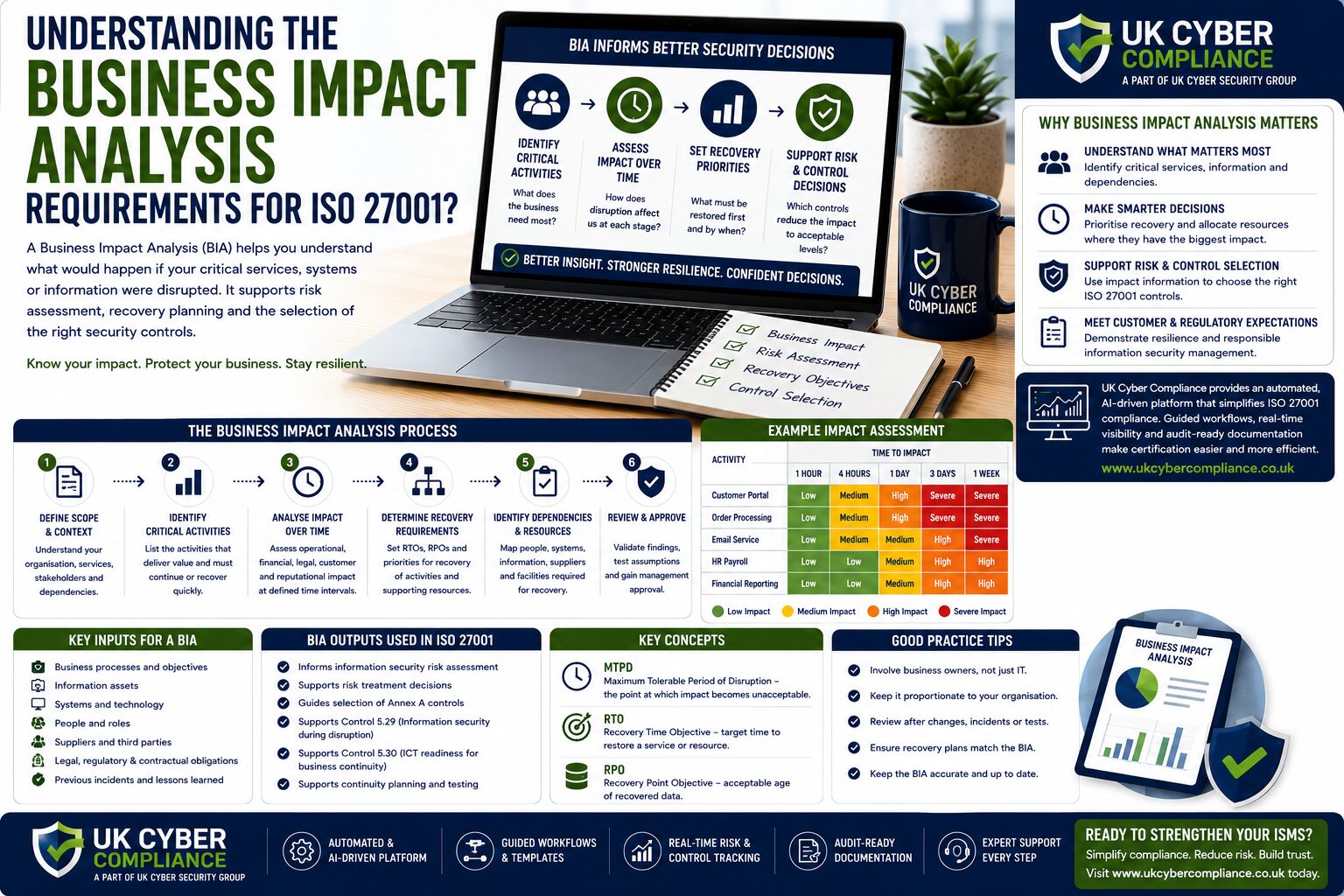
Understanding the Business Impact Analysis requirements for ISO 27001?
Understanding the Business Impact Analysis requirements for ISO 27001? starts with an important point that often causes confusion. ISO/IEC 27001:2022 does not explicitly state that every organisation must create a document called a Business Impact Analysis, usually shortened to BIA. However, the standard does require organisations to understand information security risk, assess potential consequences, determine appropriate controls and plan how information security will continue during disruption.
For many organisations, a structured BIA provides one of the clearest ways to support those requirements.
A BIA examines what would happen to the business if an important service, system, supplier, process or information asset became unavailable, unreliable or compromised. It considers how quickly the disruption would cause harm, which activities need priority and what resources the organisation needs to recover.
ISO/TS 22317:2021 provides dedicated international guidance for creating and maintaining a formal BIA process. It covers identifying priority activities, dependencies, recovery requirements and management approval. ISO confirms that the guidance applies to organisations of any scale or sector and can be adapted to their own needs and constraints.
For ISO 27001, this information can support risk assessment, risk treatment, continuity controls, ICT recovery and management decisions. It can also help the organisation explain why certain services need stronger protection than others.
UK Cyber Compliance helps organisations manage this work through its automated and AI-driven ISO 27001 platform. UK Cyber Compliance (a part of UK Cyber Security Group) provides these services and has a platform to make certification much easier and cheaper. Its existing ISO 27001 guidance describes BIA as a structured way to understand how disruption affects important services, systems, people, customers, suppliers and information.
Is a Business Impact Analysis mandatory for ISO 27001?
This deserves a clear answer.
ISO/IEC 27001:2022 does not explicitly require every organisation to maintain a document with the title Business Impact Analysis.
That differs from ISO 22301, the international standard for business continuity management, where BIA forms an explicit part of the business continuity process. ISO guidance for ISO 22301 explains that organisations undertake business impact analysis to understand the effects of disruption and use the results to inform continuity strategy.
ISO 27001 takes a risk-based information security approach.
Its requirements expect the organisation to consider the consequences associated with information security risks and determine appropriate treatment. Annex A also includes controls concerned with information security during disruption and ICT readiness for business continuity.
A BIA therefore becomes highly useful where availability, resilience and recovery matter to the ISMS.
For many businesses seeking certification, creating a structured BIA provides clear evidence that management understands:
Which activities matter most
How long disruption can continue before serious harm occurs
Which technology supports priority activities
Which suppliers create critical dependencies
How much information loss the organisation can tolerate
Which services need recovery first
What information security controls support continuity
The organisation may call this process a BIA, impact assessment, operational resilience review or another internally understood term. The important point is that the information exists, remains accurate and supports the ISMS.
What is ISO 27001 Certification?
ISO 27001 certification provides independent assurance that an organisation operates an Information Security Management System that meets ISO/IEC 27001 requirements.
An ISMS creates a structured approach to managing information security through leadership, risk assessment, controls, policies, employees, suppliers, technology, monitoring, internal audit, management review and continual improvement.
The standard focuses on confidentiality, integrity and availability.
Confidentiality means information remains accessible only to authorised people and systems.
Integrity means information remains accurate, complete and trustworthy.
Availability means authorised users can obtain information and services when they need them.
A BIA has an especially strong connection with availability because it helps the organisation understand the effect of disruption over time.
However, a good ISO 27001-focused BIA should not consider availability alone.
Loss of confidentiality can also create serious business impact.
For example, exposure of customer records may create contractual, regulatory and reputational consequences even when every system remains available.
Loss of integrity can be equally serious. Incorrect financial records, altered customer information or unauthorised system changes may allow the organisation to continue operating while producing unreliable results.
A useful BIA therefore considers all three information security principles where appropriate.
What is iso 27001
ISO 27001 is the commonly used name for ISO/IEC 27001:2022, the international requirements standard for information security management systems.
The standard helps organisations identify information security risks and select appropriate treatment based on business need.
It does not assume that every organisation faces the same risks.
A cloud software provider may depend heavily on service availability, customer data and external infrastructure.
A professional consultancy may depend more heavily on confidentiality, employee access and cloud document services.
A manufacturer may rely on production technology, suppliers and operational systems.
A healthcare supplier may have particularly serious consequences associated with information availability and accuracy.
The BIA helps translate these differences into practical priorities.
Start with the ISMS scope
Before completing a BIA, understand what your ISO 27001 ISMS covers.
The scope might include the whole organisation or a defined service, department or business function.
Identify the activities that support that scope.
For example, an organisation providing a managed cloud service might rely on:
Customer support
Cloud hosting
Identity services
Network connectivity
Technical employees
Monitoring
Backup
Development
Key suppliers
Customer records
Management processes
The BIA should focus on the activities and dependencies that genuinely support the certified operation.
Avoid assessing unrelated business activity simply because it appears elsewhere in the organisation.
At the same time, do not exclude a critical dependency because another company provides it.
A cloud provider can remain essential to your service even though it sits outside your direct organisational boundary.
Identify the services the business cannot easily operate without
A useful BIA begins with business activity rather than technology.
Ask what your organisation actually delivers.
This may include:
Customer support
Managed services
Order processing
Payment processing
Professional services
Customer portals
Production
Logistics
Employee administration
Security monitoring
Contract management
For each activity, identify what happens if it stops.
Some functions may tolerate disruption for several days without serious harm.
Others may become critical within minutes or hours.
That distinction allows the organisation to prioritise recovery rationally.
Identify the process owner
Every important activity should have someone who understands its business value.
The process owner can help answer questions such as:
What does this activity deliver?
Who depends on it?
When does disruption become serious?
Which systems support it?
Which employees are necessary?
Which suppliers does it rely on?
What information does it use?
What alternative working arrangements exist?
The security team should not answer all of these questions alone.
Business owners often understand the real operational consequences far better than technical teams.
Assess how impact develops over time
One of the most valuable parts of a BIA involves understanding how disruption becomes more damaging over time.
A service may cause little concern after ten minutes but become serious after four hours.
Another process may remain manageable for a day but become critical after three days.
Consider several time points.
For example:
After one hour
After four hours
After one working day
After two working days
After one week
You do not have to use these exact periods.
Choose time points that make sense for your organisation.
The purpose is to understand when the consequences become unacceptable.
This information can support recovery priorities and technology requirements.
Consider operational impact
Operational impact measures how disruption affects the organisation’s ability to perform its normal work.
Questions might include:
Can employees continue working?
Can customers receive the service?
Will another department stop operating?
Can a manual workaround continue?
How long can the workaround remain practical?
Will workloads build up?
Will recovery create a large backlog?
Operational analysis makes the BIA practical.
It moves the conversation away from simply saying that a system is “critical”.
Instead, management understands why it matters.
Consider customer impact
Customer consequences often drive recovery priorities.
Ask what customers experience when the activity becomes unavailable or unreliable.
Possible effects include:
Loss of service
Delayed support
Missed delivery commitments
Inability to access information
Incorrect information
Failed transactions
Contractual concerns
Loss of confidence
A customer-facing service may need a much shorter recovery target than an internal function.
The BIA should provide evidence for that distinction.
Consider legal and regulatory consequences
Disruption can create legal obligations as well as operational problems.
An unavailable system may prevent the organisation from meeting statutory obligations.
Lost information may affect record retention.
Compromised personal information may create data protection concerns.
An incident may trigger reporting duties.
A regulated business may also have sector-specific resilience requirements.
The BIA should identify relevant consequences rather than treating every interruption purely as an IT problem.
Where specialist legal interpretation is required, obtain appropriate professional advice.
Consider contractual impact
Contracts can influence acceptable downtime and recovery expectations.
Review important customer and supplier agreements.
They may contain commitments concerning:
Service availability
Incident notification
Recovery
Information retention
Security controls
Support response
Data protection
Continuity
Failure to meet those requirements may create commercial consequences even when the direct technical impact remains relatively small.
A BIA can help connect contractual commitments with continuity planning.
Consider financial impact in business terms
Financial consequences can arise in several ways.
The organisation may lose revenue.
Employees may become unable to work.
Recovery may require additional resources.
Customers may claim contractual remedies.
The business may need external specialist support.
Orders may stop.
Delayed operations can create knock-on losses.
You do not need false precision.
A reasonable banding method may provide enough information to compare activities.
The goal is prioritisation rather than producing an exact forecast of every possible loss.
Consider reputational consequences
Loss of customer confidence can outlast the technical incident.
Ask how customers, suppliers or partners might react if an important service remained unavailable or sensitive information became compromised.
Reputation can be difficult to quantify, so narrative descriptions can work well.
For example:
Limited effect with no external awareness
Customer complaints and short-term concern
Significant customer dissatisfaction
Loss of major accounts
Long-term damage to trust
The organisation should define descriptions that reflect its own business.
Consider confidentiality and integrity as well as downtime
Many BIAs focus almost entirely on service outages.
For ISO 27001, broaden the assessment where appropriate.
Ask what happens if confidential information becomes public.
Ask what happens if important data becomes inaccurate.
Consider a payroll system.
Loss of availability may delay salary processing.
Loss of confidentiality could expose employee financial information.
Loss of integrity could alter payment records.
The business consequences differ even though the same system sits at the centre of each scenario.
This approach helps the BIA support ISO 27001 risk assessment more effectively.
Map the systems supporting each activity
Once you understand the business activity, identify its supporting technology.
This may include:
Cloud services
Business applications
Identity platforms
Servers
Network services
Staff devices
Backup systems
Communication services
Security platforms
Do not start by calling every system critical.
Let the business activity determine technology priority.
A system becomes important because of what the organisation depends on it to do.
This distinction prevents IT teams from treating every application as equally urgent.
Identify information dependencies
Information can remain essential even when technology changes.
Identify important records and datasets supporting each activity.
Examples include:
Customer records
Contracts
Orders
Employee information
Financial information
Authentication information
Production records
Source code
Supplier details
Operational instructions
For each information set, consider the impact of loss, corruption, disclosure or unavailability.
This analysis can influence backup, access control, encryption and recovery decisions.
Identify people dependencies
Technology alone does not restore a business service.
Some processes depend on specialist employees.
Ask:
Which roles are essential?
Could another employee perform the work?
Does the organisation depend on one person?
Can staff work remotely?
Which permissions do they need?
Which knowledge exists only informally?
A BIA may reveal that the largest continuity weakness is not a server.
It may be reliance on one employee who holds critical operational knowledge.
The organisation can then consider appropriate treatment.
Identify supplier dependencies
Modern organisations often depend on external providers for essential services.
These may include cloud providers, managed IT companies, telecommunications services, payment processors, software providers and security services.
ISO/IEC 27031:2025 specifically recognises external services, including cloud providers, when considering ICT readiness for business continuity. ISO explains that the standard helps organisations prepare ICT to support business operations during disruption and recover within agreed timeframes.
Record which suppliers support priority activities.
Ask what would happen if the supplier became unavailable.
Consider whether alternatives exist.
Understand the supplier’s recovery commitments.
Check whether contracts support your own continuity objectives.
This analysis can uncover concentration risk where several critical services depend on the same external provider.
Understand Maximum Tolerable Period of Disruption
Business continuity practice often uses the Maximum Tolerable Period of Disruption, commonly shortened to MTPD.
It represents the point after which failure to resume an activity would create unacceptable consequences for the organisation.
ISO/TS 22317 includes MTPD within its structured BIA guidance and connects it with priority activities and recovery requirements.
The concept can help ISO 27001 organisations translate business impact into continuity requirements.
For example, management may determine that:
Email can remain unavailable for a limited period.
A customer transaction platform can tolerate far less disruption.
A monthly reporting process can wait longer.
These distinctions should influence recovery priorities.
Define Recovery Time Objectives where useful
Recovery Time Objective, commonly called RTO, represents the target time for restoring an activity or supporting resource after disruption.
The RTO should normally sit within the maximum tolerable disruption period.
Imagine that a customer service becomes unacceptable after eight hours of disruption.
Management may set a four-hour recovery target to create a reasonable margin.
Technology and continuity arrangements should then support that objective.
This gives technical teams a clear business requirement rather than telling them vaguely that recovery must happen “quickly”.
ISO/IEC 27031:2025 focuses specifically on preparing ICT to support continuity and restoring ICT services within agreed timeframes.
Consider Recovery Point Objectives
Recovery Point Objective, commonly called RPO, concerns acceptable information loss measured in time.
Imagine a database backup process.
If the last usable copy is four hours old, the organisation could lose four hours of changes.
Can the business tolerate that?
For some activities, yes.
For others, even a small amount of lost information could create significant problems.
The BIA helps management decide what level of information loss remains acceptable.
Technology teams can then design backup and replication arrangements around genuine business need.
Prioritise activities, not just applications
A common weakness involves producing a list of applications ranked as critical, important or normal.
That approach can miss the wider business picture.
A BIA should prioritise activities first.
Then identify what those activities need.
For example, customer support may require:
CRM access
Telephone services
Customer records
Authentication
Support employees
Internet connectivity
A single application does not deliver the service on its own.
Looking at the whole activity produces more realistic recovery planning.
Connect the BIA with ISO 27001 risk assessment
The BIA and information security risk assessment answer related but different questions.
Risk assessment asks what could happen, how likely it is and how serious the consequences could become.
BIA focuses heavily on what the business suffers when important activities, information or supporting resources become disrupted.
The BIA can therefore provide impact information for the risk assessment.
Suppose the risk register identifies ransomware affecting a customer platform.
The BIA already shows that prolonged loss of that service creates severe customer and contractual consequences.
Management can use that information when determining the risk impact rating.
This creates consistency.
Connect the BIA with risk treatment
Once management understands the business impact, it can choose more appropriate controls.
A service with a short recovery requirement may need stronger resilience.
Highly sensitive information may need stronger confidentiality controls.
Data that cannot tolerate significant loss may need more frequent protection.
A process with several external dependencies may require stronger supplier controls.
The BIA therefore helps justify information security investment.
It gives management a business reason for each decision.
Connect BIA findings with Annex A
Several Annex A controls can have a relationship with continuity and impact analysis.
Control 5.29 addresses information security during disruption.
Control 5.30 addresses ICT readiness for business continuity.
Other controls around backup, redundancy, supplier relationships, cloud services, incident management and information protection may also support continuity depending on the organisation’s risks.
Do not simply select every continuity-related control because you completed a BIA.
Use the findings to determine what your organisation actually needs.
The Statement of Applicability should then record the necessary controls and the reason for their inclusion.
Information security during disruption
Security controls should not disappear when the organisation experiences an incident.
A disruption can create pressure to bypass normal processes.
Employees may need temporary access.
Alternative systems may come into use.
Manual processes may replace automated ones.
External specialists may need urgent access.
The organisation needs to maintain an appropriate level of information security during these circumstances.
BIA findings can help identify which services need continuity arrangements and which security safeguards must remain effective throughout the disruption.
ICT readiness for business continuity
ICT readiness considers whether technology can support the business continuity objectives identified by management.
ISO/IEC 27031:2025 provides current international guidance specifically in this area. It addresses ICT readiness, disruption response, recovery and dependency on third-party services.
This guidance complements ISO 27001 and ISO 22301 rather than replacing either standard.
For organisations heavily dependent on digital services, ISO/IEC 27031 can provide useful additional structure around recovery planning.
Backup decisions should follow business requirements
A backup schedule should not exist simply because somebody selected a default setting.
BIA findings can help determine what information needs protection and how much data loss the business can tolerate.
For one system, a daily backup may provide sufficient protection.
Another may require much more frequent data protection.
The decision depends on business impact.
Recovery testing also matters.
A backup that cannot be restored provides little resilience.
The organisation should verify that important information can return within required recovery periods.
Test continuity assumptions
A BIA provides requirements.
Testing shows whether the organisation can meet them.
Useful exercises can include:
Restoring important information
Testing alternative communication routes
Simulating loss of a supplier
Running an incident exercise
Testing employee contact processes
Recovering a critical application
Checking remote working capability
Record the results.
Identify weaknesses.
Update recovery arrangements where necessary.
A strong ISMS learns from testing instead of assuming plans will work.
Keep the BIA current
A BIA becomes less valuable as the business changes.
Review it when the organisation:
Launches an important service
Changes a major supplier
Moves systems to another cloud platform
Opens another operational location
Acquires another company
Changes its ISMS scope
Introduces significant technology
Changes customer commitments
Experiences a serious incident
Changes important business processes
ISO/TS 22317 includes review of both the BIA process and BIA results within its guidance.
A regular review cycle also helps identify smaller changes that individual project teams may overlook.
Current UK cyber statistics show why continuity matters
The UK Government’s Cyber Security Breaches Survey 2025 to 2026 found that 43 per cent of businesses identified a cyber breach or attack during the previous 12 months. That represented approximately 612,000 UK businesses. Medium businesses reported 65 per cent, while large businesses reported 69 per cent.
The survey also found that only 25 per cent of businesses had a formal incident response plan. Only 39 per cent had assigned specific incident roles or responsibilities.
Business continuity planning also showed weakness. The survey reported a fall among small businesses in having a business continuity plan that covered cyber security, from 53 per cent in the previous period to 44 per cent in 2025 to 2026.
These figures demonstrate why understanding disruption before an incident happens has practical value.
An organisation that already knows which services matter most can make faster and more informed decisions when something goes wrong.
Who needs iso 27001 certification
ISO 27001 certification can benefit organisations that manage important information or need to demonstrate structured information security governance.
Technology companies, software providers, managed service providers, professional firms, healthcare suppliers, manufacturers, financial organisations, charities and public-sector suppliers may all gain value.
Customer requirements often drive certification.
A customer may want evidence that a supplier understands information security risk and has appropriate controls in place.
Tender requirements can create another reason.
Supply-chain assurance may also lead organisations towards ISO 27001.
A BIA becomes particularly valuable when service availability, resilience or recovery forms part of the customer relationship.
Small businesses can keep the BIA proportionate
A BIA does not need to become a huge project.
A small organisation may have only a handful of important business activities.
Start with those.
For each one, identify:
The owner
Business purpose
Critical information
Supporting systems
Important suppliers
Key employees
Impact of disruption
Time before impact becomes unacceptable
Recovery target
Acceptable information loss
Alternative arrangements
This may provide enough information to support ISO 27001 risk and continuity decisions.
ISO/TS 22317 explicitly allows organisations to adapt the BIA process to their own needs, objectives, resources and constraints.
ISO 27001 Certification Levels
ISO 27001 does not provide formal graded certification bands such as bronze, silver or gold.
An organisation either achieves certification for its defined ISMS scope or it does not.
Businesses still move through practical readiness stages.
They define the ISMS scope.
They understand interested parties.
They establish the information security risk methodology.
They complete risk assessment and treatment.
They select controls.
They prepare the Statement of Applicability.
They operate the controls and gather evidence.
They complete internal audit.
Management then reviews the ISMS before the external certification assessment.
A BIA can support several of these activities, particularly impact assessment, treatment prioritisation and continuity planning.
How the Certification Works
The organisation begins by understanding its business context and defining what the ISMS covers.
It identifies relevant interested parties and requirements.
Management establishes an information security risk assessment process.
The organisation identifies risks and evaluates their potential consequences.
Where a structured BIA provides value, it helps management understand the operational effect of disruption and determine priorities.
The organisation treats unacceptable risks and determines the controls required.
It compares necessary controls with Annex A and records the resulting decisions in the Statement of Applicability.
Control owners implement the measures and gather evidence.
The organisation completes internal audit and management review.
An independent certification body then assesses whether the ISMS meets ISO/IEC 27001 requirements.
The BIA can support the audit by demonstrating that continuity and recovery decisions follow business impact rather than arbitrary technical assumptions.
What an auditor may want to understand
An ISO 27001 auditor may not necessarily ask to see a document called “Business Impact Analysis”.
They may instead test the underlying information.
Questions might include:
How did you determine which systems require rapid recovery?
How do you know how long this service can remain unavailable?
How did you determine backup requirements?
Which business activities rely on this supplier?
How do your continuity plans support information security?
How do you maintain security during disruption?
How do recovery objectives relate to business requirements?
When did management last review these assumptions?
A clear BIA makes those questions much easier to answer.
Common BIA weaknesses
One common mistake involves asking the IT department to decide what the business considers critical.
Technical teams provide essential input, but business owners should define operational priorities.
Another weakness involves rating every process as critical.
If everything has the highest priority, the BIA has not helped management prioritise anything.
Other problems include:
No defined scope
No business owner
Ignoring confidentiality and integrity
Missing supplier dependencies
Recovery targets based on guesswork
No link with risk assessment
No connection with continuity controls
No management approval
No testing
Old information that no longer reflects operations
A useful BIA should drive real decisions.
Do not confuse BIA with risk assessment
The two activities overlap but serve different purposes.
Risk assessment examines uncertainty and considers both likelihood and impact.
BIA focuses on the consequences of disruption and how those consequences change over time.
For example, a BIA may show that losing access to the customer platform for one day would create severe consequences.
The risk assessment then considers how likely different events are to cause that outage.
Those events could include ransomware, cloud failure, configuration error or supplier disruption.
The BIA supplies valuable impact information.
The risk assessment combines that information with likelihood and existing controls.
Management should approve recovery priorities
Recovery priorities affect resources and customer commitments.
Senior management should understand the most important BIA findings.
Leaders should know:
Which services need the fastest recovery
Which dependencies create the most concern
Where recovery capability does not meet business need
Which suppliers support priority activity
Where information loss tolerance is particularly low
Which improvement actions need resources
Management approval helps turn the BIA from an operational worksheet into a business decision.
Internal audit can test BIA assumptions
Internal audit can review how the organisation uses impact information.
An auditor might select a critical service and ask:
Who determined its recovery requirement?
What evidence supports that requirement?
Which systems support it?
Does the recovery plan reflect the BIA?
Has the organisation tested recovery?
Do supplier arrangements support the objective?
Does the risk assessment use the same impact reasoning?
Does the Statement of Applicability contain relevant continuity controls?
This testing helps expose inconsistencies before the external audit.
Which UK-based firms offer ISO 27001 consultancy services?
UK organisations can obtain ISO 27001 support from information security consultancies, compliance specialists, managed service providers, internal audit professionals and platform-led services.
UK Cyber Compliance provides ISO 27001 support through an automated and AI-driven platform.
Its current BIA guidance describes business impact work as a structured way to understand how disruption affects important services, systems, people, customers, suppliers and information. It also explains how BIA outputs can feed into ISO 27001 risk assessment and control selection.
A capable provider should help the organisation understand its own business impact rather than simply give it a generic spreadsheet.
Useful support can include:
Defining BIA scope
Identifying priority processes
Creating impact criteria
Mapping dependencies
Setting recovery requirements
Connecting BIA results with risk assessment
Selecting continuity controls
Preparing audit evidence
Management should still own the final business priorities.
How UK Cyber Compliance can help manage BIA information
BIA information can become difficult to maintain when it sits in separate spreadsheets, risk documents, continuity plans and technical records.
UK Cyber Compliance provides a platform-led approach to ISO 27001 certification that can help organisations keep risk and business impact information connected.
Its current guidance specifically describes how BIA data can support risk assessment, treatment and control selection within ISO 27001.
A central approach can help organisations connect:
Business activities
Information assets
Risk
Impact
Dependencies
Controls
Recovery priorities
Owners
Evidence
Review activity
This makes the information easier to use during risk review, management meetings and audit preparation.
Automation can support administration, but business judgement remains essential.
The platform cannot decide how long your customers can tolerate an outage.
Process owners and management need to make that decision.
A practical BIA checklist for ISO 27001
Before your certification audit, ask whether the organisation can answer the following questions:
Have we defined what the BIA covers?
Have we identified important business activities within the ISMS?
Does each important activity have an owner?
Have we identified supporting information?
Have we identified supporting technology?
Have we identified employee dependencies?
Have we identified important suppliers?
Do we understand how disruption affects customers?
Have we considered legal and contractual consequences?
Have we assessed confidentiality impact where relevant?
Have we assessed integrity impact where relevant?
Have we assessed availability impact?
Do we understand how impact increases over time?
Have we identified when disruption becomes unacceptable?
Have we defined recovery targets where useful?
Have we considered acceptable information loss?
Do BIA results feed into our risk assessment?
Do treatment decisions reflect business impact?
Does the Statement of Applicability contain relevant controls?
Do our backup and recovery arrangements support business needs?
Have we tested important recovery assumptions?
Has management reviewed significant findings?
Do we update the BIA when important services or suppliers change?
If several answers remain unclear, strengthen the analysis before the external assessment.
Make business impact drive information security priorities
Understanding the Business Impact Analysis requirements for ISO 27001? means recognising that ISO 27001 does not explicitly demand a document bearing the BIA name, but it does require information security decisions to follow a structured understanding of risk and consequence.
A BIA provides a practical method for building that understanding.
It identifies the business activities that matter most.
It shows how disruption affects customers, operations, contracts and information.
It identifies technology, employees and suppliers that those activities depend upon.
It helps management establish recovery priorities.
It can support RTO and RPO decisions.
It gives risk owners stronger impact information.
It helps justify Annex A controls concerned with continuity, backup, suppliers and ICT readiness.
ISO/TS 22317:2021 provides dedicated guidance for organisations that want a formal and documented BIA process, while ISO/IEC 27031:2025 provides current guidance for ensuring ICT can support continuity and recovery objectives.
UK Cyber Compliance helps organisations connect this information with their wider ISO 27001 work through an automated and AI-driven platform.
When the organisation understands what disruption actually means to the business, it can spend security effort where it matters most, set realistic recovery expectations and demonstrate to an auditor that continuity decisions have a clear business basis.
UK Cyber Compliance is here to help
For more information, please do get in touch.
Please check out our Free Cyber Insurance
Other blog posts, Your ISO 27001 Questions Answered, Get ISO 27001 Certified ,
If you would like to know more, do get in touch as we are happy to answer any questions. Looking to improve your cybersecurity but not sure where to start? Begin by getting certified in Cyber Essentials, the UK government’s scheme that covers all the technical controls that will provide the protection that you need to help guard against criminal attacks.