
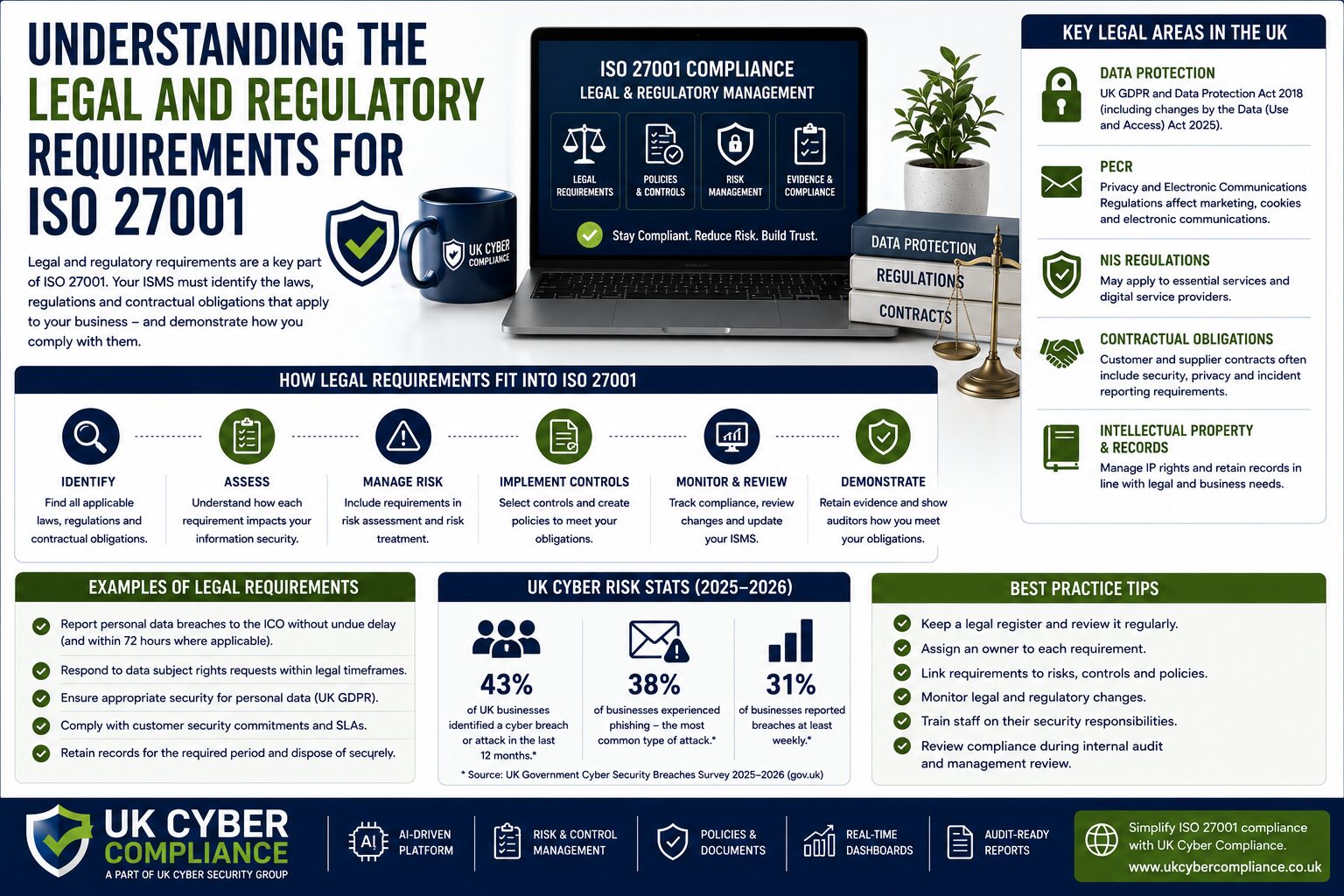
Understanding the Legal and Regulatory requirements for ISO 27001?
Understanding legal and regulatory requirements forms an important part of ISO 27001 because information security does not operate separately from the wider duties of a business. An organisation may need to protect personal information, maintain records, respect intellectual property, meet customer security commitments, manage supplier obligations and report certain incidents to regulators.
ISO/IEC 27001:2022 does not provide every organisation with one universal list of laws to follow. Instead, the organisation must identify the legal, statutory, regulatory and contractual requirements that apply to its own activities and information security responsibilities. Annex A control 5.31 specifically addresses the identification and management of these requirements, while related controls cover intellectual property rights, protection of records, privacy and protection of personally identifiable information.
For UK businesses, the relevant requirements can come from several sources. Data protection law affects most organisations that process personal information. Other obligations may arise through contracts, regulators, public-sector work, employment arrangements, supplier agreements, industry requirements and legislation that applies to particular services.
UK Cyber Compliance helps organisations organise these responsibilities as part of an Information Security Management System, commonly called an ISMS. UK Cyber Compliance (a part of UK Cyber Security Group) provides these services and has a platform to make certification much easier and cheaper. Its automated and AI-driven platform helps businesses manage risks, policies, controls, evidence, responsibilities and audit activity in one structured environment.
Legal compliance and ISO 27001 are closely connected
ISO 27001 gives organisations a structured framework for identifying information security obligations and demonstrating how they manage them.
The standard itself does not replace legislation. Holding ISO 27001 certification does not automatically prove compliance with every law that affects the organisation.
Instead, the ISMS gives the business a repeatable process for asking important questions:
Which laws apply to us?
Which regulators oversee our activities?
What security duties appear in customer contracts?
Which information must we retain?
Which information must we delete?
What incident reporting duties apply?
Which privacy requirements affect our systems?
What obligations do our suppliers need to meet?
Who owns each requirement?
Which controls support compliance?
What evidence demonstrates that we follow the requirement?
These questions help turn legal obligations into practical management activity.
An auditor will expect the organisation to understand its own obligations rather than simply copy a generic legal register from another business.
What is ISO 27001 Certification?
ISO 27001 certification provides independent assurance that an organisation operates an ISMS that meets the requirements of ISO/IEC 27001.
ISO describes ISO/IEC 27001 as the best-known international standard for information security management systems. It provides requirements for establishing, implementing, maintaining and continually improving an ISMS while using risk management to protect information.
The ISMS connects several areas of business activity, including:
Information security risk
Leadership
Policies
People
Access control
Suppliers
Physical security
Technology
Incident management
Legal requirements
Customer obligations
Internal audit
Management review
Corrective action
Continual improvement
Certification does not promise that an organisation will never experience a security incident. Instead, it demonstrates that the business manages information security through a structured system and can provide evidence that the system operates.
ISO develops the standard, while independent certification bodies carry out certification assessments. ISO itself does not issue ISO 27001 certificates.
what is iso 27001
ISO 27001 is the commonly used name for ISO/IEC 27001, the international standard that sets requirements for an information security management system.
The standard focuses on protecting confidentiality, integrity and availability.
Confidentiality means information remains accessible only to authorised people and systems.
Integrity means information remains accurate, complete and trustworthy.
Availability means authorised users can access information and services when they need them.
Legal and regulatory obligations can affect all three areas.
Data protection legislation may require appropriate security for personal information. Contracts may require specific access controls. Regulatory duties may set incident reporting expectations. Record-keeping laws may influence retention. Intellectual property law may affect the way employees use software, documents and creative material.
ISO 27001 helps the organisation bring these requirements into one management framework.
Where legal duties appear within ISO 27001
Legal and regulatory responsibilities influence several parts of the ISMS.
Annex A control 5.31 focuses directly on legal, statutory, regulatory and contractual requirements. ISO’s control reference also contains 5.32 for intellectual property rights, 5.33 for protection of records and 5.34 for privacy and protection of personally identifiable information.
These controls should not sit separately from the rest of the management system.
Legal requirements may influence:
The ISMS scope
Interested party requirements
Risk assessment
Risk treatment
Policies
Control selection
Supplier management
Retention
Incident response
Business continuity
The Statement of Applicability
Internal audit
Management review
The organisation should therefore treat legal compliance as a continuing management responsibility rather than a document created shortly before certification.
Start with interested parties
ISO 27001 asks organisations to understand the requirements of relevant interested parties.
These parties can include:
Customers
Employees
Regulators
Government bodies
Suppliers
Business partners
Shareholders
Insurers
Certification bodies
Each may create information security expectations.
A regulator may impose reporting obligations.
A customer may require encryption or multi-factor authentication.
An employee expects the organisation to protect personal records appropriately.
A supplier contract may define confidentiality and incident notification duties.
Understanding these requirements helps the business identify obligations before it selects controls.
Build a legal and regulatory register
One of the most practical ways to manage compliance involves creating a legal and regulatory register.
The standard does not require one particular document format, but a structured register can help an organisation demonstrate that it has identified and reviewed relevant requirements.
Useful fields may include:
Requirement name
Source of the requirement
Reason it applies
Business activity affected
Information affected
Responsible owner
Relevant policy
Relevant control
Evidence available
Review date
Changes identified
Actions required
Keep the register focused on requirements that genuinely affect the organisation.
Do not fill it with every cyber or privacy law you can find.
A UK software business, professional consultancy, healthcare supplier and essential service operator may face very different obligations.
A focused and maintained register gives stronger assurance than a large generic list.
UK data protection law will affect many organisations
For many UK businesses, data protection represents one of the most important legal areas connected with ISO 27001.
The current UK data protection framework includes the UK GDPR and Data Protection Act 2018. The Data (Use and Access) Act 2025 amended this framework but did not replace the UK GDPR, Data Protection Act 2018 or Privacy and Electronic Communications Regulations.
All provisions of the Data (Use and Access) Act 2025 had come into force by 19 June 2026.
A business maintaining an ISO 27001 legal register should therefore make sure that its data protection references reflect the current position rather than relying on documents prepared several years ago.
Security of personal information
The UK GDPR requires organisations to protect personal information using appropriate technical and organisational measures.
ICO guidance explains that the security principle requires organisations to consider risk analysis, organisational policies, physical safeguards and technical measures when deciding what protection is appropriate.
This aligns closely with ISO 27001.
Controls relating to access, authentication, encryption, backup, incident management, vulnerability management, physical security and supplier relationships may all support data protection responsibilities.
However, an organisation should avoid claiming that ISO 27001 certification automatically proves UK GDPR compliance.
The business must still understand what personal information it processes and which legal duties apply.
The Data Use and Access Act changed the UK framework
The Data (Use and Access) Act 2025 introduced several changes that UK organisations need to understand.
The ICO confirms that the Act amended areas such as subject access requests, data protection complaints, automated decision-making, research provisions and the way organisations assess some uses of personal information.
One particularly relevant change for organisations took effect on 19 June 2026. Businesses and other organisations now need a process for handling data protection complaints. The ICO states that organisations must acknowledge a complaint within 30 days and investigate and respond without undue delay.
This provides a good example of why ISO 27001 legal registers need regular review.
A register created in 2024 would not contain a requirement that became active in 2026 unless someone updated it.
Assign ownership for monitoring legal change rather than assuming that regulations remain static.
Personal data breach reporting needs a defined process
Security incidents can trigger legal obligations.
Under UK data protection law, organisations must report a personal data breach to the ICO without undue delay and, where the reporting threshold applies, within 72 hours of becoming aware of it.
Not every security event requires regulatory reporting.
The organisation needs a process for assessing incidents, understanding the information involved, evaluating potential harm and deciding whether notification requirements apply.
A strong ISO 27001 incident process can support this requirement by defining:
How employees report incidents
Who investigates them
Who assesses data protection implications
Who decides whether regulatory notification applies
How the organisation records decisions
How affected people receive information where required
How the business records corrective action
An auditor may examine incident records and compare them with the legal register, policies and response procedures.
PECR may create additional duties
The Privacy and Electronic Communications Regulations, commonly called PECR, can apply to organisations involved with electronic marketing, cookies and electronic communications.
The ICO explains that PECR covers matters including electronic marketing and certain obligations for public electronic communications services.
The Data (Use and Access) Act 2025 also amended PECR.
An organisation should identify whether PECR affects its services rather than automatically adding the regulations to a register without assessment.
Marketing teams, website owners, communications providers and compliance staff may all need to contribute to that decision.
NIS Regulations may affect essential and digital services
Some organisations face additional cyber security obligations under the Network and Information Systems Regulations 2018.
The regulations remain part of current UK law as of August 2026.
They apply within defined areas relating to essential services and certain digital services. Organisations that fall within the relevant regulatory framework should identify the appropriate competent authority, security expectations and incident responsibilities.
ISO 27001 can support a structured approach to those obligations because the ISMS already includes risk management, incident handling, supplier governance, monitoring and continual review.
Holding certification does not remove the organisation’s separate responsibilities under the regulations.
The Cyber Security and Resilience Bill is still progressing
UK cyber regulation continues to change.
As of 15 August 2026, the Cyber Security and Resilience (Network and Information Systems) Bill remains before Parliament. The Bill completed its Commons stages and received its second reading in the House of Lords on 14 July 2026. Lords committee stage is scheduled to begin on 1 September 2026.
The Bill proposes changes to the existing NIS framework, including wider cyber resilience requirements for important services and digital infrastructure.
Because it has not yet completed the parliamentary process, organisations should not treat its proposed measures as existing law.
Businesses that may fall within the future framework should monitor its progress and plan for potential changes.
This demonstrates why legal monitoring should form part of the ISMS rather than depend on a one-off exercise during certification.
Customer contracts can create binding security requirements
Legal and regulatory requirements do not come only from legislation.
Contracts can create important information security obligations.
A customer agreement may require:
Encryption
Restricted administrator access
Incident notification
Security assessments
Defined retention periods
Confidentiality
Business continuity
Supplier controls
Audit rights
Security certification
Recovery requirements
Data location commitments
The business should know which contracts contain security commitments.
Sales teams should also avoid agreeing to requirements that technical or operational teams cannot deliver.
A useful contract review process involves security staff before the organisation signs significant agreements.
This can prevent the business from making promises that its ISMS does not support.
Supplier contracts need the same attention
Suppliers can affect your ability to meet legal and contractual duties.
A cloud provider may host personal information.
A managed IT provider may hold administrator access.
A payroll provider may process employee records.
A software company may operate a service essential to your customers.
Your supplier assessment should consider both security risk and compliance obligations.
Relevant contracts may need provisions covering:
Confidentiality
Security responsibilities
Incident notification
Access
Data handling
Subcontractors
Service continuity
Return or deletion of information
Audit and assurance
Termination
An organisation remains responsible for understanding its own obligations even when another company performs part of the work.
Intellectual property needs active management
Annex A includes a specific control relating to intellectual property rights.
Businesses may hold intellectual property belonging to themselves, customers, employees, software publishers and external partners.
Relevant issues can include:
Software licensing
Copyright
Customer documents
Source code
Trademarks
Design material
Confidential methods
Research
Commercial information
The ISMS should help the organisation identify who owns important information and what restrictions apply to its use.
Policies, employment terms, supplier agreements and access controls can support these obligations.
Records need protection throughout their useful life
Annex A also contains a control for protection of records.
Many organisations must retain information for legal, regulatory, contractual or operational reasons.
Records may include:
Contracts
Employee records
Audit reports
Financial records
Security incidents
Customer information
Risk decisions
Training evidence
Supplier assessments
Management review records
The organisation should know how long it needs to retain important records and what happens when that period ends.
Keeping information indefinitely can create unnecessary risk.
Deleting records too early can also create legal or contractual problems.
A retention schedule helps teams apply consistent decisions.
Privacy requirements extend beyond access control
Privacy involves more than stopping attackers from accessing a database.
An organisation needs to consider why it collects personal information, how it uses that information, who receives it, how long it keeps it and what rights people have.
The ICO identifies lawfulness, fairness and transparency, purpose limitation, data minimisation, accuracy, storage limitation, security and accountability as the core UK GDPR principles.
ISO 27001 controls can support many security and governance activities connected with these principles.
The legal register should make clear which requirements come from law and which controls help the organisation fulfil them.
International data movement may create obligations
Cloud services can move information across national boundaries.
Businesses should understand where personal information goes and which legal transfer mechanism applies when UK data protection law restricts a transfer.
The Data (Use and Access) Act 2025 changed the wording and assessment approach around some international transfer requirements, so organisations should rely on current ICO guidance rather than older compliance documents.
Supplier reviews should therefore consider data location and international processing where relevant.
Do not assume that using a major cloud provider removes your responsibility to understand the arrangement.
Employment creates information security duties
Employees interact with some of the organisation’s most sensitive information.
Employment arrangements can therefore create confidentiality, privacy and information-handling responsibilities.
Relevant ISMS processes may include:
Background checks where justified
Confidentiality obligations
Employment terms
Acceptable use requirements
Security awareness
Remote working rules
Access approval
Role changes
Leaver processes
Return of equipment
Continued confidentiality after employment
The legal register can point towards employment law advice where necessary, while ISO 27001 provides the management structure for related security controls.
Sector requirements need individual assessment
Some businesses operate in sectors where additional regulation applies.
Examples may include:
Financial services
Health and social care
Telecommunications
Energy
Transport
Digital infrastructure
Government supply chains
Education
Defence
An ISO 27001 auditor will not expect a general consultancy to follow the same sector obligations as an essential service operator.
The organisation needs to determine what applies to its own operation.
This may require advice from legal professionals, regulators, trade bodies or specialist compliance advisers.
ISO 27001 provides the framework for managing requirements but does not replace specialist interpretation when the legal position becomes complex.
Link every important requirement to an owner
A legal register becomes much more useful when each important obligation has an owner.
Possible owners include:
Data Protection Officer
Information Security Manager
Operations Director
Human Resources Manager
IT Manager
Finance Director
Legal adviser
Compliance Manager
Supplier Manager
Senior management should make sure that responsibilities remain clear.
Avoid creating a legal register where every entry belongs to the same person simply because they manage ISO 27001.
Security compliance often needs cooperation across the business.
Link requirements to the risk assessment
Legal obligations should influence information security risk assessment.
Suppose the organisation processes a large amount of sensitive customer information.
A data breach could create operational, reputational, contractual and regulatory consequences.
The risk assessment should recognise those consequences.
Similarly, a supplier failure may become more serious when a contract requires a particular recovery commitment.
Legal and regulatory requirements therefore help the organisation understand impact.
This leads to stronger risk decisions because the business evaluates more than technical harm.
Link requirements to risk treatment
Once the organisation identifies a legal or contractual risk, it can decide how to treat it.
For example, a privacy requirement may lead to controls involving:
Access management
Authentication
Encryption
Information deletion
Supplier assurance
Logging
Incident handling
Awareness
Secure transfer
The business should select controls because they address identified needs, not merely because Annex A contains them.
The legal register, risk assessment and treatment plan should therefore support one another.
The Statement of Applicability should reflect legal needs
The Statement of Applicability, commonly called the SoA, records the controls the organisation has determined are necessary, their status and the reasoning behind control decisions.
Legal and regulatory duties can provide strong justification for including a control.
For example:
Privacy law may support privacy and access controls.
Contracts may support backup or resilience controls.
Intellectual property obligations may support information-handling controls.
Regulatory incident duties may support incident management controls.
Supplier requirements may support third-party security controls.
An auditor should be able to trace the logic.
The legal requirement leads to a risk or business need.
The organisation identifies a control.
The SoA records the decision.
Evidence demonstrates that the control operates.
Policies turn obligations into working rules
Legal requirements often need to appear in organisational policies and procedures.
Relevant documents may cover:
Information security
Data protection
Access control
Acceptable use
Incident management
Supplier security
Retention
Remote working
Business continuity
Information classification
Secure development
Staff responsibilities
Policies should explain what the organisation expects without becoming copies of legislation.
Employees need practical instructions rather than long extracts from legal documents.
The legal register can reference the source requirement, while policies explain how the organisation responds.
Evidence matters during audit
Auditors need more than statements that the organisation complies.
They look for evidence that processes operate.
Useful evidence can include:
Legal register reviews
Contract assessments
Privacy records
Incident logs
Access reviews
Supplier assessments
Retention records
Training records
Policy approvals
Management meeting records
Internal audit findings
Corrective actions
Regulatory correspondence where relevant
The evidence should match the requirement.
Avoid creating documents purely to increase the volume of audit material.
Relevant and current records provide stronger assurance.
Internal audit should examine legal requirements
Internal audit gives the organisation an opportunity to test whether legal and regulatory obligations remain properly managed.
An internal auditor may ask:
Is the legal register current?
Have relevant laws changed?
Does each requirement have an owner?
Do policies reflect the obligations?
Do staff understand their responsibilities?
Do contracts contain unexpected security commitments?
Are supplier obligations managed?
Does incident handling reflect reporting duties?
Does the SoA align with relevant requirements?
Can the organisation provide evidence?
Internal audit can identify gaps before the external certification audit.
It also helps prevent legal compliance from becoming a forgotten spreadsheet.
Management review should consider regulatory change
Senior management needs visibility of important legal and regulatory developments.
Management review can consider:
New legislation
Regulatory guidance
Major customer requirements
Contract changes
Security incidents
Supplier issues
Internal audit findings
Changes to risk
New services
Changes in information processing
The Cyber Security and Resilience Bill provides a current example of why this matters. Organisations that may enter the future framework should monitor its parliamentary progress rather than wait until new duties take effect.
Current cyber statistics reinforce the need for strong governance
The UK Government’s Cyber Security Breaches Survey 2025 to 2026 found that 43 per cent of businesses identified a cyber breach or attack during the previous 12 months. Medium businesses reported 65 per cent, while large businesses reported 69 per cent.
Phishing affected 38 per cent of UK businesses and remained the most commonly reported cyber attack. Among organisations that identified a breach or attack, 29 per cent of businesses experienced incidents at least weekly.
The same research found that only 25 per cent of businesses had a formal incident response plan.
These figures show why legal compliance and information security governance need to work together.
A business that faces regular cyber threats but lacks a clear incident process may struggle to meet reporting duties when a serious event occurs.
Who needs iso 27001 certification
ISO 27001 certification can benefit organisations that need to demonstrate structured information security management.
This may include:
Software businesses
Technology providers
Managed service providers
Professional firms
Healthcare suppliers
Financial organisations
Manufacturers
Charities
Public-sector suppliers
Cloud service providers
Government contractors
Certification often supports customer assurance and contractual requirements. ISO notes that certification can give customers confidence and that some sectors may also make certification a contractual or legal requirement.
Not every business has the same legal reason for seeking certification.
Some organisations pursue ISO 27001 because customers expect it.
Others use the framework to improve governance.
Some need stronger supplier assurance.
A regulated business may use the ISMS to help organise existing compliance responsibilities.
The reason should reflect the organisation’s real needs.
ISO 27001 Certification Levels
ISO 27001 does not provide formal achievement bands such as basic, intermediate or advanced certification.
An organisation either achieves ISO 27001 certification for its defined ISMS scope or it does not.
Businesses may progress through practical readiness stages, including:
Defining scope
Identifying interested parties
Recording legal obligations
Assessing risks
Treating risks
Selecting controls
Preparing the Statement of Applicability
Creating policies
Gathering evidence
Completing internal audit
Holding management review
Undergoing external assessment
A mature ISMS may develop considerably after certification, but this does not create an official higher certification band.
Customers should review the scope and current certificate rather than assume one ISO 27001 certificate covers every activity within a group.
How the Certification Works
The organisation begins by defining its business context, interested parties and ISMS scope.
It identifies legal, regulatory and contractual requirements that affect information security.
The business then establishes a risk assessment method and identifies relevant information security risks.
Risk treatment determines which controls and actions the organisation needs.
The business compares its selected controls with Annex A and prepares the Statement of Applicability.
Policies and processes support implementation.
Employees carry out the controls and retain suitable evidence.
Internal audit examines whether the ISMS meets requirements and operates effectively.
Management review allows senior leadership to assess performance, risks, legal developments, findings and improvement needs.
An independent certification body then assesses the ISMS against ISO/IEC 27001. ISO develops the standard but does not issue the certificate itself.
Certification demonstrates that the management system meets the standard within the stated scope. It does not replace an organisation’s responsibility to follow applicable law.
Which UK-based firms offer ISO 27001 consultancy services?
UK organisations can obtain ISO 27001 support from information security consultancies, compliance specialists, managed service providers and platform-led providers.
UK Cyber Compliance provides ISO 27001 support through an automated and AI-driven platform. Its current service helps businesses organise risks, policies, controls, evidence, responsibilities and audit activity within a structured compliance workflow.
A capable provider should help an organisation understand how legal and regulatory requirements connect with:
ISMS scope
Interested parties
Risk assessment
Risk treatment
Policies
Annex A controls
The Statement of Applicability
Supplier governance
Internal audit
Management review
Audit evidence
External support does not remove management responsibility.
The organisation still needs to understand its own legal obligations, and specialist legal advice may remain necessary where interpretation becomes complex.
How UK Cyber Compliance helps organise legal requirements
Legal compliance becomes difficult when requirements sit across contracts, spreadsheets, emails, policies and separate departmental records.
UK Cyber Compliance provides a central platform designed to simplify ISO 27001 compliance through guided workflows, expert support and AI-driven tools.
A structured platform can help organisations connect legal requirements with:
Risks
Controls
Owners
Policies
Evidence
Tasks
Review activity
Audit preparation
This relationship gives managers a clearer view of why a particular control exists.
For example, a control may support a legal obligation, customer requirement and information security risk at the same time.
Centralising the information makes those connections easier to demonstrate during an audit.
A practical legal and regulatory readiness checklist
Before an ISO 27001 certification audit, ask:
Have we identified the laws that affect information security?
Have we considered the UK GDPR and Data Protection Act 2018 where relevant?
Have we updated our records for the Data (Use and Access) Act 2025?
Do we understand current personal data breach reporting duties?
Does PECR affect any of our activities?
Do the NIS Regulations affect our organisation?
Are we monitoring regulatory changes that could affect us?
Have we reviewed customer contracts for security commitments?
Have we reviewed supplier agreements?
Do we understand intellectual property obligations?
Have we defined retention responsibilities?
Have we considered privacy requirements?
Do we understand international data movement where relevant?
Does each important requirement have an owner?
Have we linked requirements with risk assessment?
Does risk treatment reflect important obligations?
Does the Statement of Applicability support those decisions?
Do policies turn requirements into clear working rules?
Can we provide evidence that the controls operate?
Does internal audit review legal compliance?
Does management review consider changes?
Have we assigned responsibility for keeping the legal register current?
If several answers remain unclear, strengthen those areas before the external audit.
Keep legal requirements active within the ISMS
Understanding the Legal and Regulatory requirements for ISO 27001 means much more than creating a list of legislation.
The organisation needs to identify which requirements actually apply, understand how they affect information security and connect them with the rest of the ISMS.
Start with business context and interested parties.
Identify relevant laws, regulations and contracts.
Assign ownership.
Link requirements to risk assessment.
Select controls that address those obligations.
Record decisions in the Statement of Applicability.
Create practical policies.
Retain useful evidence.
Test the process through internal audit.
Review significant changes through management review.
UK law continues to change. The Data (Use and Access) Act 2025 is now fully in force, while the Cyber Security and Resilience Bill continues through Parliament as of August 2026.
UK Cyber Compliance provides an automated and AI-driven platform that helps organisations bring these activities together and maintain a clearer route towards ISO 27001 certification.
A business that understands its obligations and manages them through a working ISMS gains more than audit readiness. It creates clearer accountability, stronger information security decisions and a better foundation for meeting customer, regulatory and legal expectations over time.
UK Cyber Compliance is here to help
For more information, please do get in touch.
Please check out our Free Cyber Insurance
Other blog posts, Your ISO 27001 Questions Answered, Get ISO 27001 Certified ,
If you would like to know more, do get in touch as we are happy to answer any questions. Looking to improve your cybersecurity but not sure where to start? Begin by getting certified in Cyber Essentials, the UK government’s scheme that covers all the technical controls that will provide the protection that you need to help guard against criminal attacks.