
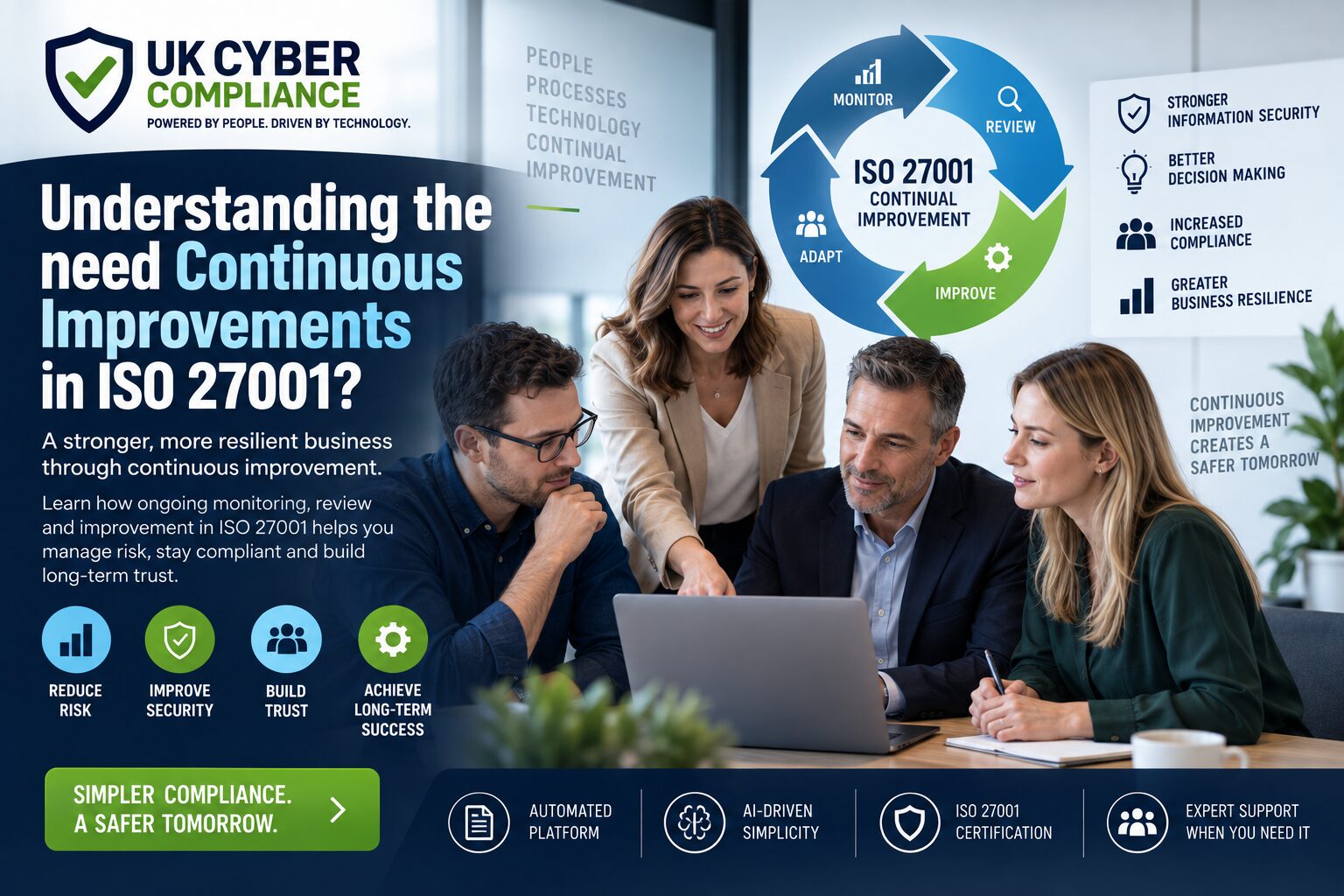
Understanding the need Continuous Improvements in ISO 27001?
Understanding the need Continuous Improvements in ISO 27001? starts with recognising that information security cannot remain static. Businesses change, technology develops, employees join and leave, suppliers change, new vulnerabilities appear and attackers adapt their methods. An Information Security Management System, commonly called an ISMS, needs to change with them.
ISO/IEC 27001:2022 makes this principle a formal requirement. Clause 10.1 requires an organisation to continually improve the suitability, adequacy and effectiveness of its ISMS. Clause 10.2 deals with nonconformities and corrective action, requiring organisations to respond to problems, determine why they occurred, take appropriate action and check whether that action worked.
Continual improvement does not mean constantly changing controls simply to demonstrate activity. It means using evidence to identify where information security can work better and then making sensible, proportionate changes.
Improvement may come from internal audits, management reviews, incidents, risk assessments, employee feedback, customer requirements, supplier issues, vulnerability findings, security monitoring or changes within the organisation.
UK Cyber Compliance helps organisations manage these activities through its automated and AI-driven ISO 27001 platform. The platform can bring risks, controls, policies, audits, corrective actions, objectives and supporting evidence together so organisations can track improvement activity rather than relying on disconnected spreadsheets and documents.
UK Cyber Compliance (a part of UK Cyber Security Group) provides these services and has a platform to make certification much easier and cheaper.
Why continual improvement sits at the heart of ISO 27001
ISO 27001 certification should never become a one-time project.
A company may achieve certification today with a strong security environment. Twelve months later, the organisation may use different cloud services, employ more people, operate from additional locations or handle more sensitive customer information.
The threat environment may also change.
A vulnerability that did not exist when the risk assessment took place could emerge later. Attackers may develop new phishing techniques. A supplier may suffer a security incident. A previously reliable security process may become ineffective as the organisation grows.
Continual improvement creates the mechanism for responding to these changes.
Instead of asking whether the organisation passed its last audit, management should ask whether the ISMS still works effectively today.
That change in mindset gives ISO 27001 much of its long-term value.
What is ISO 27001 Certification?
ISO 27001 certification provides independent assurance that an organisation operates an Information Security Management System that meets the requirements of ISO/IEC 27001.
The ISMS creates a structured method for managing information security through leadership, risk assessment, policies, controls, employee responsibilities, suppliers, technology, internal audits, management reviews and improvement.
ISO describes ISO/IEC 27001 as the world’s best-known information security management system standard. It helps organisations establish, implement, maintain and continually improve a systematic approach to information security risk.
Certification does not mean that an organisation will never suffer a cyber incident.
No security framework can make that promise.
Certification instead demonstrates that the organisation understands its information security responsibilities and operates a structured system for managing them.
Continual improvement strengthens this assurance because it demonstrates that management does not simply maintain the security position that existed at the original certification assessment.
The organisation learns, adapts and improves.
what is iso 27001
ISO 27001 is the commonly used name for ISO/IEC 27001:2022, the international requirements standard for information security management systems.
The standard helps organisations protect confidentiality, integrity and availability.
Confidentiality means that information remains accessible only to authorised people and systems.
Integrity means information remains accurate, complete and trustworthy.
Availability means authorised users can access information and services when they need them.
Information security improvement should support these three principles.
For example, strengthening multi-factor authentication may improve confidentiality.
Improving backup testing may strengthen availability.
Adding better change controls may help protect integrity.
The organisation should connect improvement activity with actual information security outcomes rather than creating changes purely to satisfy an auditor.
Clause 10.1 makes improvement an ongoing requirement
Clause 10.1 is short, but its importance extends across the whole ISMS.
It requires the organisation to continually improve the suitability, adequacy and effectiveness of the management system.
These three ideas deserve separate consideration.
Suitability
Suitability asks whether the ISMS still fits the organisation.
A security management system designed when a company had ten employees may no longer suit the same company after rapid expansion.
A business that moves from locally hosted systems to cloud services may also need different controls.
The same applies when the organisation changes suppliers, markets, working arrangements or customer commitments.
Adequacy
Adequacy asks whether the ISMS provides enough protection and governance.
The organisation may have access controls, but are they strong enough?
It may have an incident process, but does it cover the scenarios the business now faces?
It may conduct supplier assessments, but does the process reach the suppliers that create the greatest dependency?
Improvement means challenging whether existing measures remain sufficient.
Effectiveness
Effectiveness asks whether controls actually achieve the desired result.
A policy saying that access receives regular review has limited value if nobody performs the reviews.
A backup process has limited value if restoration repeatedly fails.
An awareness programme provides limited assurance when employees continue making the same security mistakes.
ISO 27001 expects organisations to look at results.
Continual does not necessarily mean constant
Businesses sometimes interpret continual improvement as an expectation to produce an improvement every week or month.
ISO 27001 does not require constant change for the sake of it.
Continual means recurring and sustained over time.
An organisation should have mechanisms that regularly identify improvement opportunities and respond when appropriate.
For example, a business may identify several opportunities during an internal audit, complete actions over the following months and then identify further improvements during management review.
Another organisation may detect an urgent security weakness and improve a control immediately.
The timing should reflect the importance of the issue.
Improvement should start with information
Strong improvement follows evidence.
Possible sources include:
Risk assessment results
Internal audit findings
External certification findings
Security incidents
Near misses
Vulnerability assessments
Penetration testing
Security monitoring
Employee feedback
Customer feedback
Supplier reviews
Management reviews
Information security objectives
Legal changes
Contractual requirements
Technology changes
Threat intelligence
Each source can reveal something about the effectiveness of the ISMS.
The organisation should then decide whether action would strengthen security or improve management of the system.
Internal audits provide a major source of improvement
Internal audit plays an important role in continual improvement because it checks whether the organisation follows its own processes and ISO 27001 requirements.
An internal auditor may discover that:
Access reviews happen inconsistently.
Risk records have become outdated.
Supplier reviews lack evidence.
Security training records contain gaps.
Backup restoration has not received recent testing.
Policies no longer match actual working practices.
These findings create opportunities to strengthen the ISMS.
The audit should not simply produce a report that management files away.
Someone should own each appropriate action.
Management should set realistic target dates and monitor progress.
Completed actions should also receive a review to confirm that they solved the original problem.
Management review turns findings into decisions
Management review provides another important improvement mechanism.
ISO 27001 requires leadership to review the ISMS at planned intervals.
The review should consider information that helps leaders understand whether the system remains effective.
Relevant information can include:
Audit findings
Security incidents
Information security objectives
Risk assessment results
Risk treatment activity
Changes affecting the ISMS
Stakeholder feedback
Monitoring results
Nonconformities
Corrective actions
Opportunities for improvement
Management can then decide where the organisation needs changes or additional resources.
A good management review creates actions.
It should not become a meeting where everybody agrees that information security remains satisfactory and then moves on.
Security incidents provide valuable lessons
An incident shows the organisation how controls perform under real pressure.
Consider a phishing attack that compromises an employee account.
The immediate response may involve resetting credentials, revoking sessions and investigating suspicious activity.
Continual improvement goes further.
Ask:
Why did the account become compromised?
Was multi-factor authentication operating?
Did the employee receive appropriate awareness?
Did security monitoring identify the incident quickly?
Could the attacker access sensitive information?
Did the employee know how to report suspicious activity?
Did incident response work efficiently?
What can prevent the same situation happening again?
The answers may lead to stronger authentication, improved awareness, Conditional Access, better monitoring or changes to incident procedures.
That is practical continual improvement.
The latest UK figures show why learning after incidents matters
The UK Government’s Cyber Security Breaches Survey 2025 to 2026 found that 43 per cent of businesses identified a cyber security breach or attack during the previous 12 months.
Among organisations that identified breaches or attacks, 61 per cent of businesses reported taking some action to prevent future incidents. People or training changes represented the most common action, reported by 31 per cent of businesses that took preventative action.
The survey also found that 57 per cent of businesses said they would carry out formal debriefs or discussions to record lessons after a cyber incident.
These findings demonstrate the principle behind ISO 27001 improvement.
An incident should produce more than recovery.
It should produce learning.
Clause 10.2 deals with nonconformity and corrective action
A nonconformity means that the organisation has not met a requirement.
That requirement could come from ISO 27001, the organisation’s own ISMS or another applicable commitment.
Clause 10.2 requires the organisation to respond appropriately when a nonconformity occurs.
The organisation should control and correct the problem where necessary and deal with its consequences.
Management then needs to examine why the issue occurred.
The business should determine whether similar problems exist elsewhere or could occur elsewhere.
Appropriate corrective action follows that analysis.
Finally, the organisation checks whether the corrective action worked and makes changes to the ISMS when necessary. ISO 27001 also requires documented information showing the nature of nonconformities, subsequent actions and the results of corrective action.
Correction and corrective action are different
Understanding this difference improves ISO 27001 management.
Imagine an internal audit identifies a former employee account that remains active.
Disabling the account corrects the immediate problem.
Corrective action asks why the account remained active.
Perhaps human resources did not notify IT.
Maybe the leaver checklist contained no access removal step.
Perhaps responsibility remained unclear.
Corrective action might therefore involve changing the leaver process so future departures automatically trigger account review and removal.
Correction fixes the visible issue.
Corrective action addresses the underlying cause.
ISO 27001 expects organisations to think at this deeper level.
Root cause analysis makes improvements stronger
Simply writing “human error” rarely provides enough insight.
Ask why the person made the mistake.
Suppose an employee shared sensitive information with the wrong external recipient.
Why did it happen?
Perhaps the employee misunderstood the sharing setting.
Why did they misunderstand it?
Maybe training did not cover external sharing.
Why did the system allow the sharing?
Perhaps the SharePoint site permitted external links when the business had no legitimate requirement for them.
The organisation might therefore improve both awareness and technical configuration.
Addressing causes rather than symptoms reduces recurrence.
Maintain a continual improvement register
ISO 27001 does not specifically require a document with this name, but many organisations find an improvement register useful.
The register can record:
Improvement reference
Source
Description
Reason
Related risk
Related control
Owner
Priority
Target date
Status
Supporting evidence
Effectiveness review
This gives management one clear place to monitor activity.
Small businesses can keep this process simple.
The important point involves ownership and follow-through rather than producing unnecessary administration.
Connect improvements with the risk register
Not every improvement requires a new risk entry.
However, many meaningful changes connect naturally with information security risk.
Suppose vulnerability monitoring identifies repeated delays in security updates.
The risk register may already contain a vulnerability exploitation risk.
The organisation could strengthen patch management as an improvement action.
Once the new process operates, management can reassess the risk.
This creates a clear relationship:
Risk identifies the concern.
Monitoring identifies weakness.
Improvement strengthens the control.
Evidence demonstrates implementation.
Risk reassessment measures the remaining exposure.
That connection makes the ISMS easier to manage and easier to audit.
Use information security objectives to demonstrate progress
Information security objectives provide another useful source of measurable improvement.
An organisation might establish objectives such as:
Increase MFA coverage.
Reduce overdue high-risk vulnerabilities.
Improve security awareness completion.
Reduce time needed to remove leaver access.
Increase successful backup restoration testing.
Complete supplier security reviews.
Reduce overdue risk treatment actions.
An objective should have enough definition for management to determine whether progress happened.
Avoid vague goals such as “improve cyber security”.
A measurable objective gives the organisation evidence that improvement activity produces results.
Metrics help management identify trends
Measurement does not need to become complicated.
Useful metrics can include:
Open security incidents
Time to close incidents
Overdue vulnerabilities
Patch compliance
MFA coverage
Training completion
Failed backup jobs
Successful recovery tests
Overdue risk actions
Outstanding audit findings
Guest accounts
Privileged accounts
Supplier reviews completed
The organisation should choose metrics that reflect its risks and priorities.
A smaller number of meaningful measures gives management more value than a huge dashboard that nobody uses.
Supplier reviews can reveal improvement opportunities
Many businesses now rely heavily on cloud providers, managed service providers and external software platforms.
Supplier security should therefore feed continual improvement.
A review may identify that a provider no longer meets expected security requirements.
A supplier incident may expose a dependency that management previously underestimated.
A contract review may identify weak notification requirements.
Another assessment may show that the business needs an alternative provider for continuity.
These findings should influence risk, controls and procurement processes.
The 2025 to 2026 UK Government survey found that only 15 per cent of businesses formally reviewed cyber risks from immediate suppliers and only 6 per cent looked at their wider supply chain.
For organisations pursuing ISO 27001, supplier assurance provides an important area for ongoing development.
Risk assessment itself needs improvement
A risk methodology should not remain unchanged simply because it passed the original audit.
Review whether it still gives management useful results.
Ask:
Do likelihood definitions remain clear?
Do impact ratings reflect actual business consequences?
Do employees understand the methodology?
Are risk owners involved?
Do acceptance criteria make sense?
Do residual ratings reflect operational controls?
Are treatment actions completed promptly?
Do major incidents reveal risks that the register missed?
A risk methodology that produces unrealistic scores needs adjustment.
Continual improvement applies to the management system as well as individual technical controls.
Use vulnerability audits to drive better security
The latest government survey found that only 18 per cent of UK businesses had conducted a cyber security vulnerability audit during the previous 12 months. Thirty per cent had conducted a cyber security risk assessment, while 32 per cent used tools designed for security monitoring.
These activities provide valuable improvement information.
A vulnerability assessment may identify outdated software.
Monitoring may identify suspicious authentication.
An audit may find excessive permissions.
A penetration test may identify weak external exposure.
The organisation should connect findings with owners and actions rather than treating the assessment itself as the end result.
Testing only creates security value when findings lead to appropriate decisions.
Learn from near misses as well as incidents
A near miss can reveal weakness without causing damage.
For example, an employee may recognise a convincing phishing message before entering credentials.
A supplier may nearly receive confidential information intended for somebody else.
A backup failure might occur on a system where another current backup remains available.
These events provide useful warnings.
Do not wait for actual harm before improving the process.
A mature organisation uses near misses as early indicators.
Employee feedback can improve the ISMS
The people performing everyday processes often identify weaknesses before management does.
An employee may notice that an access approval process takes too long.
Another person may find a policy confusing.
A technician might identify repeated manual work that creates errors.
A project manager may notice that security reviews happen too late in project delivery.
Give employees a way to suggest improvements.
This also helps build a stronger security culture because staff see information security as a shared business responsibility.
Customer feedback can change security priorities
Customers may introduce new security expectations.
A major customer may request stronger authentication.
Another may require shorter incident notification periods.
A tender could require certification or additional supplier assurance.
These requirements should feed into ISMS review.
The organisation needs to determine whether its existing controls remain suitable.
A growing company may discover that customer expectations become one of the strongest drivers for information security maturity.
Business growth should trigger ISMS review
Growth changes risk.
The organisation may employ more people.
It may hold more information.
It may work with larger customers.
It may add cloud platforms.
More suppliers may join the chain.
Additional offices or remote workers may change the security boundary.
The ISMS should respond.
Continual improvement helps make sure information security grows alongside the organisation rather than falling behind it.
Technology changes create new opportunities and risks
Businesses adopt technology quickly.
Cloud platforms, automation, AI services, collaboration applications and remote access can improve productivity.
They can also create new information security questions.
When the organisation changes important technology, review:
Access requirements
Information classification
Supplier risk
Data protection
Business continuity
Logging
Monitoring
Backup
Incident response
Employee competence
A technology project should not automatically inherit an old security model.
Improvement means adapting controls to the new environment.
Artificial intelligence deserves ongoing review
AI use provides a good example of why continual improvement matters.
The UK Government’s 2025 to 2026 survey found that around 31 per cent of businesses were using AI, actively adopting it or considering adoption. Among those organisations, only 24 per cent had cyber security practices aimed specifically at managing AI-related risk.
An organisation may therefore need to update:
Acceptable use policies
Information classification
Supplier reviews
Employee awareness
Data handling requirements
Risk assessments
Monitoring
Security objectives
Waiting until the next certification assessment would provide a poor response to a rapidly developing business change.
Who needs iso 27001 certification
ISO 27001 certification can benefit organisations that manage valuable information or need to demonstrate structured security governance.
Technology providers, software companies, managed service providers, professional firms, manufacturers, healthcare suppliers, charities, financial organisations and public sector suppliers may all benefit.
Customers often drive certification.
Larger organisations may ask suppliers to demonstrate information security controls before sharing information or awarding contracts.
Tender requirements can also create demand.
ISO 27001 can support these relationships by demonstrating that information security operates as a management system rather than a collection of disconnected technical measures.
Continual improvement strengthens this assurance because it shows that the organisation continues developing its security after the initial certificate.
ISO 27001 Certification Levels
ISO 27001 does not use official certification bands such as bronze, silver or gold.
An organisation either achieves certification for its defined ISMS scope or it does not.
Businesses can still demonstrate different degrees of security maturity.
One organisation may operate a relatively new ISMS with straightforward controls.
Another may have years of audit information, automated monitoring, mature supplier governance, sophisticated security metrics and deeply embedded risk processes.
Both may hold ISO 27001 certification.
The standard expects both organisations to continue improving their management systems.
Maturity can therefore develop significantly while the certification status itself remains the same.
UK Cyber Compliance also explains this distinction in its current guidance.
How the Certification Works
The organisation begins by defining the ISMS scope and understanding its business context.
It identifies interested parties and information security requirements.
Management establishes information security objectives.
The business completes information security risk assessment and treatment.
It determines necessary controls and prepares the Statement of Applicability.
Employees operate those controls and gather evidence.
The organisation monitors performance.
Internal audit checks whether the ISMS works as intended.
Management review examines results, risks, objectives, audit findings, changes and improvement opportunities.
The organisation responds to nonconformities and implements corrective actions.
An independent certification body then assesses the ISMS against ISO/IEC 27001.
Certification does not end this cycle.
The organisation continues monitoring, auditing, reviewing, correcting and improving throughout the life of the management system.
Corrective actions need owners and dates
An improvement without ownership can remain open indefinitely.
Assign a responsible person.
Set a realistic target.
Prioritise according to risk.
Review progress.
If the action becomes overdue, management should understand why.
For example, replacing unsupported technology may require significant planning.
That does not mean the organisation should ignore the risk.
Management may introduce temporary safeguards while the larger change progresses.
Clear ownership makes improvement accountable.
Check whether corrective action actually worked
Closing an action because someone completed the task does not necessarily prove success.
Suppose an audit finds repeated late removal of former employee accounts.
The organisation creates a new leaver checklist.
Three months later, review several recent departures.
Were accounts removed correctly?
Did managers follow the process?
Did IT receive notifications promptly?
If the same problem continues, the corrective action did not fully work.
Effectiveness review separates genuine improvement from administrative closure.
Do not confuse more controls with better security
Continual improvement does not mean continually adding controls.
Sometimes improvement means simplifying something.
An organisation may remove an ineffective manual process and replace it with automation.
It might consolidate several confusing policies.
Management may reduce unnecessary privileged accounts.
A team may remove an unused cloud service.
The business could improve a complicated incident process by creating one clear reporting route.
Better security often comes from making controls easier to understand and operate consistently.
Keep improvement proportional
A ten-person consultancy does not need the same governance machinery as a multinational business.
Small organisations can manage continual improvement effectively using a straightforward register, internal audit actions and management meetings.
The process should provide enough structure to:
Identify an issue.
Understand its importance.
Assign responsibility.
Complete the action.
Keep evidence.
Check effectiveness.
Large organisations may use workflow platforms and automated reporting.
Both approaches can satisfy the underlying objective when they work effectively.
Auditors expect evidence of movement
An auditor may ask what has improved since the previous assessment.
Good answers come from real activity.
For example:
MFA expanded to additional services.
Guest access reviews improved.
Backup testing became more frequent.
Supplier assurance became risk-based.
Security awareness now includes role-specific learning.
An incident exercise identified weaknesses that management corrected.
Risk acceptance received stronger senior approval.
Security monitoring expanded.
A policy became clearer after employee feedback.
The organisation reduced overdue vulnerabilities.
These examples demonstrate that the ISMS remains active.
Which UK-based firms offer ISO 27001 consultancy services?
UK organisations can obtain ISO 27001 support from information security consultancies, managed service providers, compliance specialists, internal audit professionals and platform-led providers.
UK Cyber Compliance provides ISO 27001 support through an automated and AI-driven compliance platform.
Its current continual improvement guidance explains how a central compliance platform can connect risks, controls, policies, audits, objectives, corrective actions and evidence. The platform can help organisations assign actions, monitor due dates, identify repeated issues and demonstrate progress during audits.
A capable adviser should help the organisation build an improvement process that works throughout the year.
The business should not become dependent on a consultant returning shortly before each audit to update documents.
Management and control owners should understand their responsibilities.
How UK Cyber Compliance supports continual improvement
Managing ISO 27001 through separate spreadsheets, shared folders and email can make improvement difficult to track.
A risk may appear in one file.
An audit finding may appear somewhere else.
The corrective action may sit in an email.
Evidence may remain on an employee’s computer.
Management may then struggle to see whether the issue received proper treatment.
UK Cyber Compliance provides a central platform that can help businesses bring these activities together.
Its current improvement guidance highlights functions such as logging findings and opportunities, assigning actions, connecting those actions with risks and controls, retaining completion evidence, identifying recurring issues and presenting progress to leadership.
Automation can reduce administrative effort.
AI can help organise information and support drafting activity.
People still need to make the important decisions.
Risk owners assess exposure.
Control owners operate safeguards.
Management approves priorities and resources.
Auditors evaluate whether the resulting system works.
A practical continual improvement process
A straightforward process can follow these stages:
- Identify an opportunity, weakness or nonconformity.
- Record where it came from.
- Assess its information security importance.
- Determine whether immediate correction is necessary.
- Investigate the underlying cause where appropriate.
- Decide what improvement or corrective action is needed.
- Assign an owner.
- Set a target date.
- Connect the action with relevant risks and controls.
- Complete the work.
- Retain evidence.
- Review whether the change worked.
- Update risks, policies or controls where necessary.
- Report significant progress to management.
- Keep the record available for internal and external audit.
This gives the organisation a repeatable process without creating unnecessary complexity.
A practical continual improvement checklist
Before an ISO 27001 audit, ask:
Have we identified improvement opportunities during the year?
Do internal audit findings create tracked actions?
Do incidents result in lessons and appropriate changes?
Do we investigate the causes of significant nonconformities?
Do corrective actions have owners?
Do actions have realistic target dates?
Do we review overdue activity?
Do we retain evidence of completed corrective actions?
Do we check whether corrective action worked?
Does management review improvement opportunities?
Do risk assessments receive updates when circumstances change?
Do supplier findings feed into risk management?
Do vulnerability findings lead to action?
Do employees have a way to suggest security improvements?
Do customer requirements influence the ISMS where appropriate?
Do objectives demonstrate measurable progress?
Do we review the ISMS when technology changes?
Do we learn from near misses?
Can we show examples of security improvements since the previous audit?
Does senior management understand important improvement activity?
If several answers remain unclear, the organisation should strengthen its improvement process.
Make improvement part of everyday security management
Understanding the need Continuous Improvements in ISO 27001? means recognising that certification represents an ongoing management commitment rather than a single assessment event.
Clause 10.1 requires organisations to continually improve the suitability, adequacy and effectiveness of the ISMS. Clause 10.2 requires meaningful action when nonconformities occur.
Internal audits should produce useful findings.
Incidents should produce lessons.
Risk assessments should change when the business changes.
Management review should produce decisions.
Corrective actions should address causes.
Security objectives should demonstrate progress.
Control owners should verify that changes work.
The latest UK Government data shows why this approach matters. Cyber incidents continue to affect a significant proportion of UK businesses, while formal risk assessments, vulnerability audits and incident response arrangements remain far from universal.
An organisation that continually learns from evidence places itself in a much stronger position.
UK Cyber Compliance supports this process through an automated and AI-driven platform that brings together risks, controls, audits, policies, actions and evidence, helping businesses maintain a clearer view of ISO 27001 progress and improvement activity.
A strong ISMS should therefore look different after several years of operation than it did on the day of first certification. Risks become better understood, controls become stronger, evidence improves, employees gain experience and management gets better information.
That ongoing progression is what makes continual improvement one of the most valuable parts of ISO 27001.
UK Cyber Compliance is here to help
For more information, please do get in touch.
Please check out our Free Cyber Insurance
Other blog posts, Your ISO 27001 Questions Answered, Get ISO 27001 Certified ,
If you would like to know more, do get in touch as we are happy to answer any questions. Looking to improve your cybersecurity but not sure where to start? Begin by getting certified in Cyber Essentials, the UK government’s scheme that covers all the technical controls that will provide the protection that you need to help guard against criminal attacks.