
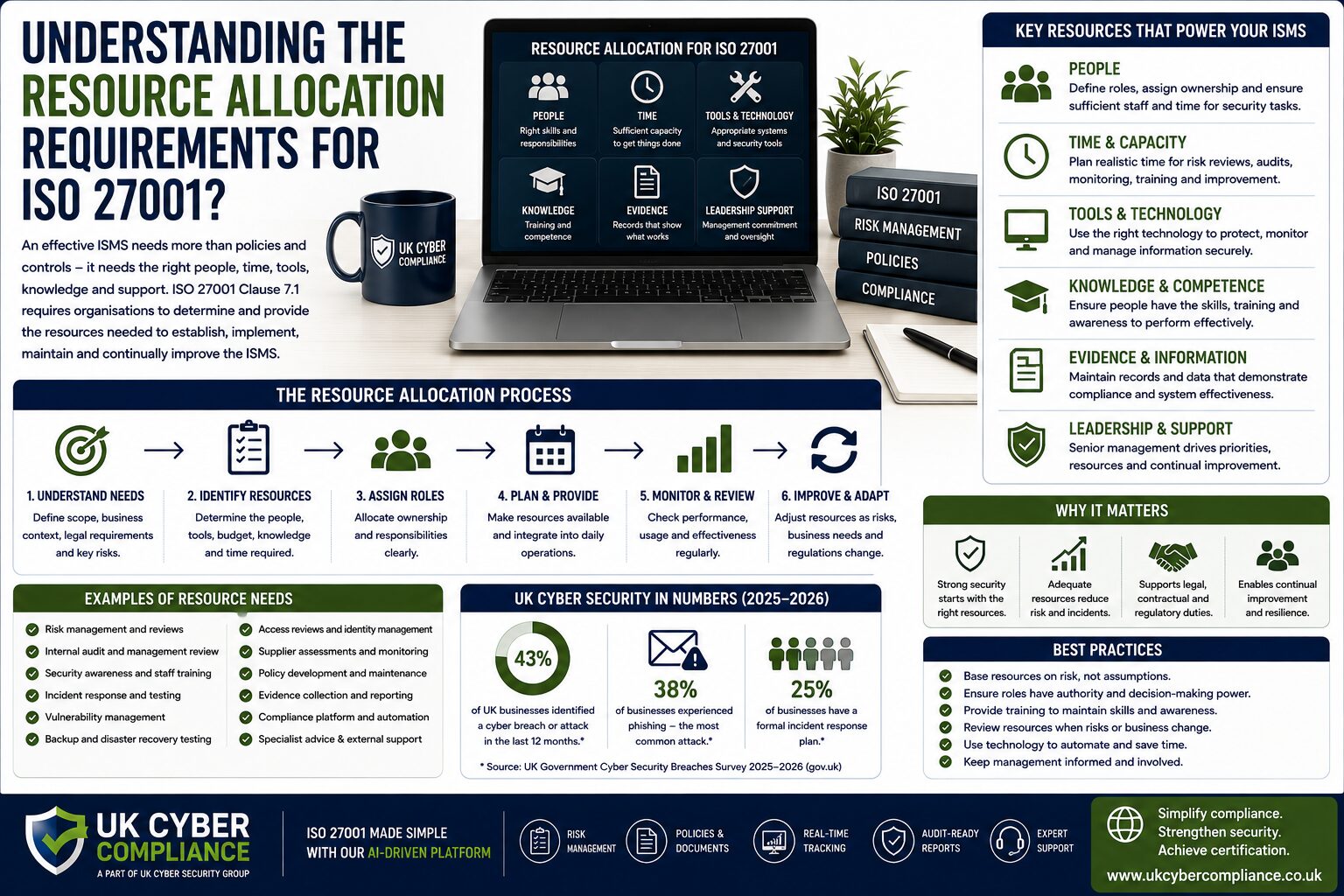
Understanding the Resource Allocation requirements for ISO 27001?
Resource allocation for ISO 27001 means making sure your organisation provides the people, time, knowledge, technology, external support, management attention and financial resources needed to operate an effective Information Security Management System.
ISO/IEC 27001:2022 addresses resources directly in Clause 7.1. The organisation must determine and provide the resources needed to establish, implement, maintain and continually improve its Information Security Management System, commonly called an ISMS. This requirement follows the wider ISO management system structure, where adequate resources support the organisation throughout the life of the management system.
The requirement sounds straightforward, but it has an important practical effect. An organisation cannot create a security policy, identify major risks and then leave employees without the time, authority or technology required to manage those risks. Resources need to match the organisation’s actual information security needs.
UK Cyber Compliance supports organisations through this work using an automated and AI-driven platform. UK Cyber Compliance (a part of UK Cyber Security Group) provides these services and has a platform to make certification much easier and cheaper. Its platform helps businesses bring risk assessment, controls, policies, evidence and compliance activity into a structured environment.
Why resources matter to an ISMS
ISO 27001 creates a management system rather than a one-off certification exercise.
That system needs people to manage it, leaders to support it, technology to operate controls, employees to complete security tasks and enough time to review whether everything continues to work.
An organisation may have identified excellent security controls during risk treatment, but those controls achieve little if nobody has responsibility for maintaining them.
For example, a business may decide that it needs regular vulnerability management. That decision creates resource needs. Somebody must review vulnerability information, prioritise findings, coordinate remediation, record exceptions and verify that serious weaknesses receive attention.
The same principle applies to supplier assurance, access management, security awareness, backups, incident response and internal audit.
Resource allocation therefore connects planning with real implementation.
What is ISO 27001 Certification?
ISO 27001 certification provides independent assurance that an organisation operates an Information Security Management System that meets the requirements of ISO/IEC 27001.
ISO describes ISO/IEC 27001 as the world’s best-known standard for information security management systems. It defines requirements for establishing, implementing, maintaining and continually improving an ISMS and uses information security risk management as a central part of that process.
The ISMS brings together leadership, scope, risk, objectives, controls, policies, people, suppliers, technology, monitoring, internal audit, management review and continual improvement.
Resources support almost every one of these activities.
Risk assessments take employee time.
Technical controls require suitable technology and expertise.
Internal audits require competent people.
Security awareness requires communication and learning activity.
Management review requires senior leadership involvement.
Corrective actions require ownership and time.
An organisation therefore needs to consider resources throughout the ISMS rather than treating Clause 7.1 as an isolated requirement.
what is iso 27001
ISO 27001 is the commonly used name for ISO/IEC 27001:2022, the international requirements standard for information security management systems.
The standard helps organisations manage risks affecting confidentiality, integrity and availability of information. ISO states that the standard can support organisations from different sectors in establishing, implementing, maintaining and continually improving information security management.
Confidentiality means information remains available only to authorised people and systems.
Integrity means information remains accurate, complete and trustworthy.
Availability means authorised users can reach information and services when required.
Resources enable the organisation to protect all three.
Protecting confidentiality may require access management, security awareness and appropriate authentication.
Maintaining integrity may require change control, monitoring and reliable records.
Supporting availability may require backup, recovery planning, infrastructure resilience and capable staff.
Resource decisions should therefore follow business requirements and information security risk rather than arbitrary assumptions.
Clause 7.1 is short but important
Clause 7.1 does not contain a long checklist. Its requirement focuses on a simple principle: determine what the ISMS needs and provide it.
That wording places responsibility on the organisation.
Management needs to consider what resources will allow the ISMS to operate effectively now and as circumstances change.
A business starting ISO 27001 certification might need more resources initially because it has to define scope, conduct risk assessment, establish policies, assign responsibilities and close identified gaps.
Once certification has been achieved, the balance may change. Ongoing effort shifts towards maintaining controls, monitoring performance, reviewing risks, completing audits and making improvements.
Resource allocation should therefore remain dynamic.
Start with the scope
The ISMS scope provides the first clue about the resources the organisation will need.
A business certifying one clearly defined service may have different requirements from an organisation covering its entire operation.
Consider which people, systems, locations, cloud services, suppliers and business processes sit within the scope.
Then ask what is required to manage them effectively.
If the scope includes several cloud services, somebody needs responsibility for account management, configuration, supplier oversight and monitoring.
If the scope covers remote employees, resources may be needed for endpoint management, authentication, staff guidance and support.
If a critical supplier operates part of the service, the organisation needs time and competence to review supplier assurance.
The scope should therefore drive resourcing decisions.
Use risk to determine what deserves investment
Risk assessment provides another strong basis for resource allocation.
High information security risks normally deserve greater attention than minor concerns.
Imagine that the organisation identifies ransomware as a significant risk.
Treatment may involve vulnerability management, endpoint protection, staff awareness, backups, monitoring and recovery testing.
Each control requires resources.
Management can use the risk assessment to decide where employees, technology and external expertise will produce the greatest value.
This makes resource decisions easier to justify.
Instead of saying, “IT wants another security tool”, the organisation can explain that a particular control supports treatment of a documented business risk.
ISO 27001’s risk-based approach allows organisations to align security measures with their own needs rather than adopting identical arrangements.
People are one of the most important resources
An effective ISMS needs people with clearly assigned responsibilities.
Those people may include:
- Information security leadership, risk owners, control owners, IT staff, human resources, supplier managers, internal auditors, senior management and external specialists where required.
Not every organisation needs a large dedicated security department.
A smaller business might assign several responsibilities to existing employees and use specialist support for areas requiring deeper expertise.
What matters is whether the responsibilities remain realistic.
Giving one employee responsibility for risk management, policies, technical security, supplier reviews, awareness, internal audit, incidents and every corrective action may look efficient on paper but become difficult to sustain.
Management needs to consider workload as well as job titles.
Time is a security resource
Time is often overlooked when organisations discuss resources.
An employee may have the knowledge to perform an access review but still fail to complete it because operational work always takes priority.
The same issue appears with:
Risk reviews
Supplier assessments
Vulnerability remediation
Internal audits
Policy reviews
Security awareness
Evidence gathering
Management review
Incident exercises
Backup recovery testing
ISO 27001 tasks need planned time.
Managers should know which activities need regular attention and allow employees enough capacity to complete them.
A control cannot work consistently when the person responsible receives no time to operate it.
Competence influences resource decisions
Resources and competence connect closely within the support section of ISO 27001.
Providing an employee does not solve the problem if that person lacks the knowledge required for the responsibility.
Organisations should consider whether employees can carry out their assigned information security duties effectively.
This may involve existing experience, professional learning, internal coaching or specialist external support.
For example, an employee may competently manage general IT support but lack experience in penetration testing or specialist legal interpretation.
The organisation does not necessarily need to employ every specialist internally.
It needs access to appropriate competence when required.
This approach can make ISO 27001 practical for smaller businesses because external expertise can supplement internal capability.
Leadership attention is also a resource
Senior management involvement should not be treated as something that happens only when a certificate needs approval.
Leaders make decisions about priorities, responsibilities and resources.
They approve significant risk acceptance.
They review whether the ISMS remains effective.
They can resolve conflicts when information security competes with operational priorities.
Leadership attention therefore represents a valuable resource in its own right.
When senior managers understand major security risks, they can make better decisions about where the organisation should focus people and effort.
Management review provides a formal opportunity to examine whether resources remain adequate.
Technology should follow risk
Security technology can support an ISMS, but ISO 27001 does not mean buying every available cyber security product.
Technology should address a defined requirement.
Examples may include:
Endpoint protection
Identity and access management
Multi-factor authentication
Backup services
Security monitoring
Vulnerability management
Asset management
Cloud security tools
Logging
Document management
Compliance management
The business should be able to explain why each significant technology investment supports risk treatment, a control, customer requirement or another ISMS need.
A tool with no clear owner or process can become an unused resource.
Effective resource management considers the technology, the person responsible for it and the process that keeps it useful.
Existing technology may already support the ISMS
ISO 27001 implementation does not always require a completely new technical environment.
Many organisations already use security features within their operating systems, cloud platforms, business applications and managed IT services.
The resource review should identify what already exists before adding more.
Ask whether existing platforms provide:
Access reporting
Authentication
Logging
Backup
Device management
Security alerts
Policy enforcement
Monitoring
Compliance evidence
Using existing capability efficiently can reduce complexity and help employees manage controls consistently.
The important issue is whether the capability meets the organisation’s requirement.
External support can form part of resource allocation
An organisation does not need to perform every information security activity internally.
External providers may support:
Technical security
Compliance guidance
Internal audit
Penetration testing
Legal advice
Managed monitoring
Vulnerability assessments
Specialist training
Cloud administration
Certification preparation
The organisation should still retain ownership of its ISMS.
Outsourcing an activity does not remove management responsibility.
A provider can operate a control or provide specialist support, but the organisation should understand what the provider does, how the service addresses risk and what evidence demonstrates performance.
Supplier management controls become particularly important when external providers carry out security-sensitive work.
Resource allocation should support information security objectives
Information security objectives describe what the organisation wants to achieve.
Resources make those objectives possible.
Suppose the organisation sets an objective to complete access reviews for all critical systems during an agreed cycle.
Someone needs time to generate account information, managers need time to review it and administrators need time to remove unnecessary permissions.
Another objective might focus on improving recovery testing.
That may require technical employees, backup infrastructure, test environments and management involvement.
Objectives without resources become statements of intent rather than realistic plans.
When establishing an objective, ask what people, time, technology and support it will require.
Resource planning should cover risk treatment
A risk treatment plan often creates new demands.
Suppose the risk assessment identifies poor visibility of security events.
The organisation decides to improve logging and monitoring.
That decision may require:
Technical capability
A person who reviews alerts
Documented escalation
Employee learning
External monitoring support
Incident response capability
Evidence retention
Management should consider the whole control rather than only the technical component.
Buying a monitoring service without arranging who responds to its alerts does not complete the control.
Good resource allocation connects every part of the treatment process.
The Statement of Applicability can reveal resource needs
The Statement of Applicability, commonly called the SoA, records the controls the organisation has determined are necessary and their implementation position.
Reviewing the SoA can reveal where resources are missing.
For example, a control may show partial implementation because:
No owner has been assigned
A required system is unavailable
A policy remains unfinished
Training has not taken place
Evidence has not been collected
A supplier review remains outstanding
Technical work remains incomplete
Each gap may have a resource implication.
The SoA therefore provides useful management information beyond its role in audit preparation.
Resource allocation and policies need to agree
Policies often create responsibilities.
An access control policy may require periodic reviews.
A vulnerability policy may set remediation expectations.
An incident policy may define response duties.
A supplier policy may require assessment before approval.
Management should check that the organisation has enough resources to meet the commitments written into its own policies.
Creating an ambitious policy without allocating time or ownership can create a gap between documented requirements and actual practice.
Auditors frequently test whether the organisation follows its stated processes.
Resource planning helps prevent this gap.
Evidence shows that resources have actually been provided
An auditor will not gain much assurance from management simply saying that adequate resources exist.
Operational evidence can show how the organisation supports the ISMS.
Evidence may include staff responsibilities, completed security tasks, training records, management decisions, project actions, supplier support agreements, internal audit records and evidence that controls continue to operate.
The aim is not to create a large resource document for its own sake.
The evidence should demonstrate that the organisation identified what it needed and made those resources available.
For example, a completed vulnerability process provides stronger evidence than a statement that someone has responsibility for vulnerabilities.
Internal audit needs its own resource
Internal audit is an important part of ISO 27001.
The organisation needs competent people and enough time to perform audits effectively.
The audit process also needs suitable independence and objectivity.
A very small organisation may find this challenging when the same person manages much of the ISMS.
External support can sometimes help provide independent review.
Resource planning should therefore consider internal audit well before the certification assessment approaches.
Leaving it until the final stages can create unnecessary pressure.
Incident response depends heavily on resources
An incident response plan only works when people can execute it.
The UK Government’s Cyber Security Breaches Survey 2025 to 2026 found that 43 per cent of businesses identified a cyber breach or attack during the previous 12 months. Only 25 per cent of businesses reported having a formal incident response plan.
The same government reporting stated that 29 per cent of businesses experiencing breaches or attacks encountered them at least weekly, while 69 per cent of large businesses identified a breach or attack during the year.
These figures demonstrate why incident preparation requires more than a document.
Organisations may need employees who know how to investigate an alert, management contacts for escalation, specialist technical support, communication procedures and access to external assistance.
A plan without these supporting resources can fail when an incident actually occurs.
Cyber skills are another resource consideration
Security work depends on people with appropriate knowledge.
Government research into the UK cyber security labour market published in 2026 noted that only 29 per cent of businesses in the referenced survey conducted formal cyber security risk assessments, while 36 per cent had formal cyber security policies.
Smaller organisations may not have dedicated cyber security specialists.
ISO 27001 can still work effectively when the business clearly identifies competence requirements and uses external assistance where necessary.
The key question is not whether the organisation employs a large security team.
The question is whether the business has access to the expertise needed to understand and manage its risks.
Do not forget administrative resources
Information security creates administrative work as well as technical activity.
Someone needs to manage:
Risk records
Policies
Control status
Audit evidence
Objectives
Actions
Supplier reviews
Management review information
Corrective actions
Certification records
When this information sits across unrelated spreadsheets, email chains and shared folders, maintaining the ISMS can become unnecessarily time-consuming.
A compliance platform can reduce administrative effort by bringing related information together.
UK Cyber Compliance states that its platform is designed to support risk assessment and ISO 27001 compliance activity through a centralised process.
Automation can reduce repetitive compliance work
Automation can help organisations use available resources more efficiently.
For example, a platform may help track actions, ownership and evidence rather than asking an employee to update several separate records manually.
This can free employees to focus on analysing risk and improving controls.
Automation should support judgement rather than replace it.
A system cannot decide the organisation’s risk appetite on behalf of management.
It cannot take accountability away from risk owners.
It cannot guarantee that a control works simply because a task shows as complete.
Human oversight remains essential.
Resource allocation should be proportionate
A small organisation does not need to copy the resourcing model of a multinational business.
ISO 27001 allows organisations to adapt the ISMS to their own circumstances. ISO describes the standard as applicable across different sectors and organisations, with risk management tailored to organisational needs.
A smaller company might have:
One senior ISMS owner
An outsourced IT provider
External internal audit support
A cloud-based compliance platform
Department managers acting as risk owners
Existing cloud security controls
A larger organisation may divide these responsibilities across specialised teams.
Both approaches can work when resources remain appropriate to scope, complexity and risk.
Who needs iso 27001 certification
ISO 27001 certification can benefit organisations that handle important information or need to demonstrate structured information security management.
Technology companies, cloud providers, managed service providers, professional firms, manufacturers, healthcare suppliers, charities, financial organisations and public-sector suppliers may all gain value from certification.
ISO states that the ISO/IEC 27000 family helps organisations manage information including financial information, intellectual property, employee information and information entrusted by third parties.
Customer requirements often influence the decision to seek certification.
A client may want evidence that its supplier manages information security through a recognised framework.
Tenders and supply-chain assurance may also require stronger security evidence.
Resource planning becomes especially important in these situations because the organisation needs enough capability to maintain certification rather than simply reach the first external assessment.
Certification preparation requires resources too
The initial ISO 27001 project needs planned effort.
Typical activity includes defining scope, understanding interested parties, completing risk assessment, setting objectives, identifying legal requirements, preparing the Statement of Applicability, implementing controls and gathering evidence.
The organisation also needs internal audit and management review before external certification.
Trying to fit all of this around normal duties without planned capacity can create delays.
Set responsibilities early.
Agree which work employees will complete internally.
Identify specialist areas requiring external assistance.
Track actions and escalation.
Senior management should understand the expected effort before the project begins.
ISO 27001 Certification Levels
ISO 27001 does not have formal achievement bands such as entry, intermediate or advanced certification.
An organisation either achieves certification for its stated ISMS scope or it does not.
Businesses still progress through practical stages of readiness.
They define the ISMS scope, assess risks, allocate resources, select controls, gather evidence, complete internal audit, conduct management review and move into the external assessment process.
An organisation can improve the maturity of its ISMS over time.
Better monitoring, stronger control evidence, more efficient processes and improved management reporting can all develop after initial certification.
That represents continual improvement rather than an official higher certification band.
How the Certification Works
The organisation starts by understanding its business context and defining the ISMS scope.
Management assigns responsibilities and determines the resources required to establish and operate the management system.
The organisation identifies information security risks and evaluates them using an agreed method.
Risk treatment determines the actions and controls required.
The business then implements those controls, maintains relevant policies and gathers evidence.
Employees operate the ISMS as part of normal business activity.
Internal audit examines whether requirements are being met and whether processes operate effectively.
Management review considers performance, risk, resources, findings and improvement needs.
An independent certification body then assesses whether the ISMS meets ISO/IEC 27001 requirements.
Resource allocation remains relevant throughout this journey because the organisation must continue maintaining and improving the ISMS after initial certification.
Common resource allocation mistakes
One frequent mistake involves assuming that ISO 27001 belongs solely to IT.
The ISMS may require input from human resources, operations, procurement, senior management, legal advisers, facilities teams and service owners.
Another weakness involves assigning responsibilities without giving employees enough time.
Some organisations also purchase security technology without assigning ownership or defining processes around it.
Other problems include relying too heavily on one employee, leaving internal audit until late in the project, failing to budget for specialist support and allowing overdue security actions to accumulate without management intervention.
Good resource allocation addresses these issues before they become audit findings.
Management review should challenge resource shortages
Management review provides an ideal opportunity to ask whether the ISMS has enough support.
Leaders can examine:
Are risk assessments current?
Are treatment actions overdue?
Are controls working?
Do control owners have enough time?
Do we have the necessary competence?
Are security objectives progressing?
Do incidents reveal capability gaps?
Are audit findings being resolved?
Do suppliers provide the support expected?
Does the organisation need additional technology or external expertise?
When persistent problems trace back to inadequate resources, management should address the underlying issue rather than repeatedly extending deadlines.
This turns management review into a practical governance process.
Resource allocation should respond to change
The resources that worked last year may not remain adequate.
Review requirements when the organisation:
Introduces a major new service
Moves important systems to another platform
Acquires another business
Changes critical suppliers
Expands its workforce
Experiences a significant security incident
Receives major audit findings
Changes its ISMS scope
Takes on new customer obligations
Identifies new high risks
The purpose is to keep resources aligned with the organisation’s current risk and operational environment.
Which UK-based firms offer ISO 27001 consultancy services?
UK organisations can obtain support from information security consultancies, compliance specialists, managed service providers, internal audit specialists and platform-led providers.
UK Cyber Compliance provides ISO 27001 support through an automated and AI-driven compliance platform.
Its resource allocation guidance highlights the importance of people, time, tools, knowledge, evidence and leadership support when building an effective ISMS.
A capable provider should help an organisation understand what it genuinely needs rather than encourage unnecessary complexity.
Support may help with scope, risk assessment, controls, policies, resource planning, internal audit preparation and evidence management.
Management should still own the ISMS.
External advisers can support decisions, but senior leaders remain responsible for making sure the organisation provides adequate resources.
How UK Cyber Compliance helps organisations use resources efficiently
Administrative workload can become one of the hidden resource demands of ISO 27001.
Teams may otherwise spend substantial time maintaining separate risk spreadsheets, control registers, policy records, evidence folders and action trackers.
UK Cyber Compliance provides a central platform designed to organise these connected activities. Its current resource guidance describes resource allocation as making sure the organisation has the people, time, tools, knowledge, evidence and leadership needed to operate its ISMS.
Centralisation can make it easier to see:
Who owns a risk
Which controls need action
Where evidence exists
Which tasks remain outstanding
Which areas require management attention
Whether certification activity remains on track
This can help the organisation direct employee effort towards areas where it creates the greatest value.
A practical resource allocation checklist
Before your ISO 27001 certification assessment, ask whether the organisation can answer the following questions:
Do we understand the resources required by our ISMS scope?
Have we identified the people responsible for key ISMS activities?
Do those people have enough time to perform their responsibilities?
Do they have the required knowledge and competence?
Do risk owners have sufficient authority?
Have we provided appropriate technical capability?
Have we identified where specialist external support is needed?
Do information security objectives have realistic resources behind them?
Have we allocated resources for risk treatment?
Can we operate every control marked as implemented in the Statement of Applicability?
Have we allocated enough time for evidence management?
Can we complete internal audits effectively?
Does management have enough information to make decisions?
Have we prepared resources for incident response?
Can we maintain the ISMS after certification?
Do we review resource needs when risks or business operations change?
Are persistent overdue actions caused by insufficient capacity?
Can we show evidence that resources have actually been provided?
If several answers remain unclear, management should review the gaps before the external assessment.
Make resource allocation part of normal management
Understanding the Resource Allocation requirements for ISO 27001 means recognising that an ISMS needs more than documents and security software.
People need responsibility.
Employees need time.
Control owners need competence.
Technical teams need suitable capability.
Risk owners need authority.
Leaders need visibility.
Specialist help needs to be available when internal expertise cannot meet a requirement.
ISO 27001 Clause 7.1 requires organisations to determine and provide the resources needed to establish, implement, maintain and continually improve the ISMS.
The most effective approach starts with scope and risk.
Identify what your organisation protects.
Understand the important risks.
Determine the controls required.
Work out what people, time, technology, knowledge and support those controls need.
Assign ownership and monitor whether resources remain adequate.
UK Cyber Compliance supports this work through an automated and AI-driven platform that helps organisations connect risk, controls, policies, actions and evidence within one compliance environment.
When resources match actual information security needs, ISO 27001 becomes easier to operate and maintain. More importantly, the ISMS becomes a practical business system that gives employees the capability to manage risk rather than a collection of commitments that nobody has enough time or support to fulfil.
UK Cyber Compliance is here to help
For more information, please do get in touch.
Please check out our Free Cyber Insurance
Other blog posts, Your ISO 27001 Questions Answered, Get ISO 27001 Certified ,
If you would like to know more, do get in touch as we are happy to answer any questions. Looking to improve your cybersecurity but not sure where to start? Begin by getting certified in Cyber Essentials, the UK government’s scheme that covers all the technical controls that will provide the protection that you need to help guard against criminal attacks.