
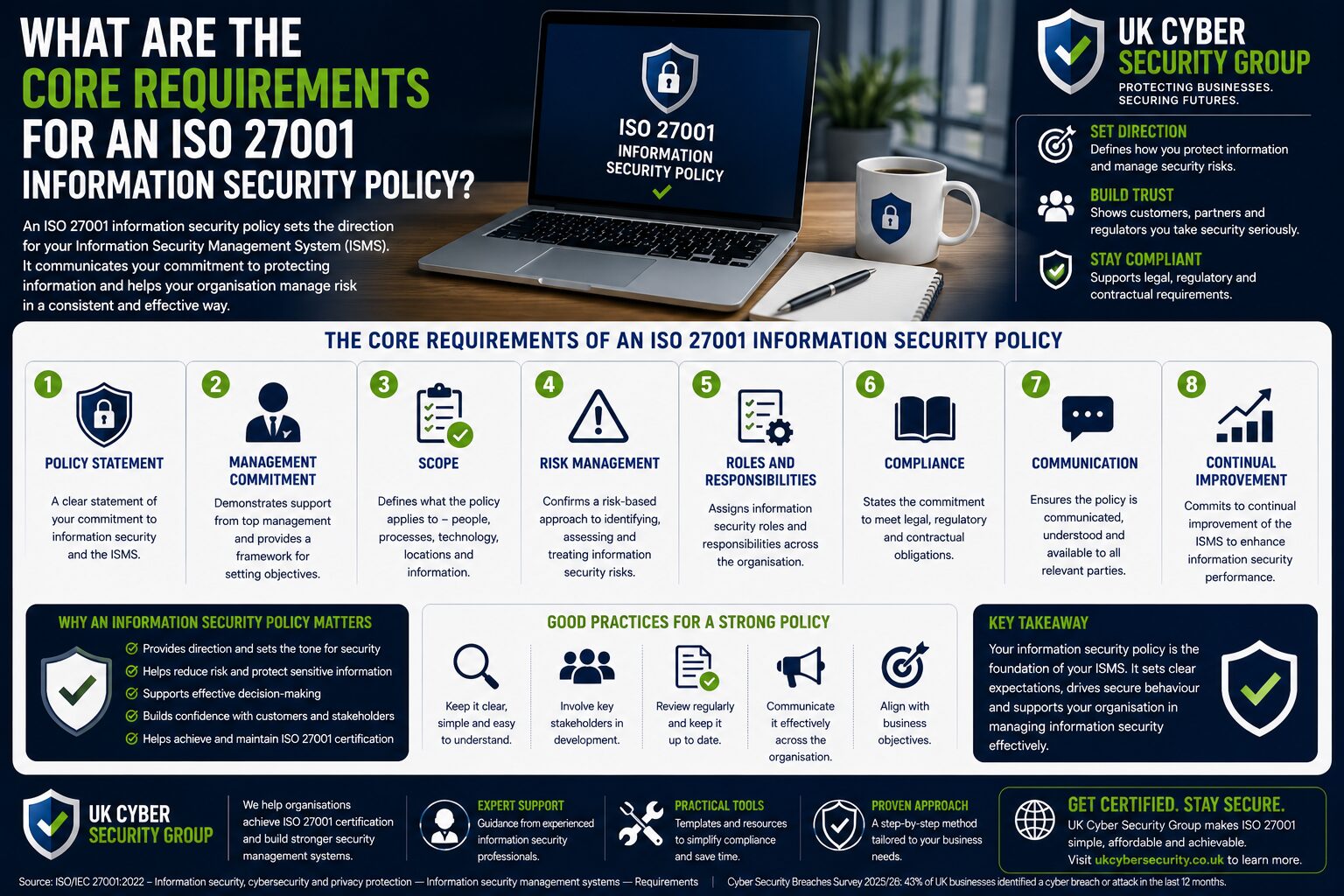
What are the core requirements for an ISO 27001 information security policy?
An ISO 27001 information security policy is the backbone of an organisation’s information security management system (ISMS). It sets the tone from the top, defines scope and responsibilities, and links everyday controls back to clear business goals and risk decisions. For a UK small or mid-sized enterprise, getting this policy right is the single most important step towards credible security and successful certification.
UK Cyber Compliance (a part of UK Cyber Security Group) provides these services and has a platform to make certification much easier and cheaper.
Why an ISO 27001 policy matters more than a folder of procedures
ISO/IEC 27001 is the core global standard for establishing, implementing, maintaining and continually improving an ISMS. It is widely recognised as the benchmark for information security governance and control.[4][7] A single, coherent policy is what turns that standard from theory into something your business can actually follow.
A strong ISO 27001 policy in a smaller enterprise should:
- Set a clear direction and commitment from senior management.
- Define scope: what information, systems, locations and processes are covered.
- Confirm a risk-based approach, not a checklist mentality.
- Establish roles and responsibilities, internally and with suppliers.
- Tie high-level intent to the Annex A controls (93 controls across 14 domains in the 2022 version).
According to guidance from certification and consultancy bodies, ISO 27001 policies and related documentation are a core part of every gap analysis, audit and surveillance review. Auditors expect to see that your written policy matches real-world practice and that it is consistently applied across the defined scope.
Core ISO 27001 requirements your policy must cover
The standard organises mandatory requirements in clauses 4 to 10, supported by Annex A controls. A compliant policy needs to reflect these clauses in a way that is proportionate to your business.
Context and scope: making the policy business-aware
ISO 27001 requires organisations to define the context of the ISMS and the scope of what is covered. Your policy should:
- Describe the internal and external issues that affect your information security (for example, regulatory duties, customer expectations, reliance on cloud services).
- Identify relevant interested parties: clients, employees, regulators, partners and suppliers.
- Explicitly state the scope of the ISMS: which entities, sites, processes and systems are included.
For a small UK enterprise, keeping scope manageable is critical. Many organisations initially focus on client-facing services or key data processing activities and expand later once the core is mature.
Leadership and commitment: tone from the top
The standard places strong emphasis on leadership involvement. Your policy must show that management is not simply delegating security and walking away. It should:
- Contain a statement of intent or commitment from senior management to protect the confidentiality, integrity and availability of information.
- Confirm that leadership will provide appropriate resources and support for the ISMS.
- Assign an ISMS owner or equivalent role with clear authority and accountability.
Certification bodies routinely check whether leaders understand and endorse the policy, and whether they are engaged in management reviews and risk decisions.
Planning: risk management and objectives
ISO 27001 is fundamentally risk-based. A compliant information security policy must spell out how you approach risk and what you aim to achieve.
At minimum, the policy should:
- Confirm that information security risks will be identified, assessed and treated using a defined methodology.
- Define risk acceptance criteria and clarify who can accept residual risk.
- Commit to setting information security objectives that are measurable and aligned with business goals.
- State that the organisation will plan actions to address risks and opportunities and integrate those plans into business processes.
In practice, this means your policy should refer to a risk assessment process, a risk register and a risk treatment plan, even if those are simple documents tailored to a smaller enterprise.
Support: resources, awareness and documented information
Clause 7 of ISO 27001 covers the support needed to make the ISMS work in reality. Your policy should include high-level requirements for:
- Resources: people, tools and services needed to operate security controls.
- Competence: ensuring staff performing security-relevant tasks have suitable skills, and that their competence is maintained.
- Awareness: informing staff of policy expectations, their responsibilities and the consequences of non-compliance.
- Communication: how information security requirements and incidents are communicated internally and externally.
- Documented information: how policies, procedures, logs and records are created, updated, controlled and retained.
Certification guidance notes that documentation is not optional: assessors will look at policies, risk assessments, incident procedures and training records to verify compliance.
Operations: risk treatment and control implementation
Clause 8 requires organisations to plan, implement and control the processes needed to meet information security requirements and to implement the actions identified in planning. Your policy must therefore:
- Require that security controls be implemented according to a risk treatment plan.
- Link to the Statement of Applicability (SoA), which maps your selected Annex A controls to risks and business context.
- Commit to managing changes in a controlled way, considering security implications.
Annex A then provides a catalogue of 93 controls in areas such as access control, cryptography, operations security, communication security, supplier management and incident management. Your policy does not need to restate every control, but it should:
- Make clear that Annex A (or an equivalent control set) has been considered.
- Affirm that selected controls are applied and maintained.
- Provide cross-references to supporting policies and procedures (for example, access control policy, acceptable use policy, supplier management policy).
Performance evaluation: monitoring, measurement and audits
To stay effective, your ISMS must be monitored and evaluated. The policy should require:
- Monitoring and measurement of key security indicators, such as incident trends, patch compliance, training completion and audit findings.
- Internal audits to assess whether the ISMS conforms to ISO 27001 and to the organisation’s own requirements.
- Management reviews to evaluate overall performance and decide on improvements.
Industry guidance emphasises that internal audits and management reviews are essential preparation steps before certification audits and surveillance audits.
Improvement: dealing with nonconformities
ISO 27001 expects organisations to address nonconformities and continually improve their ISMS. Your policy should:
- Require identification and correction of nonconformities, with root-cause analysis where appropriate.
- Commit to implementing corrective actions and evaluating their effectiveness.
- Promote continual improvement as an ongoing objective, not a one-off project.
This is particularly important during surveillance audits in years 2 and 3 of the certification cycle, where auditors look for evidence that earlier findings have been addressed and that the ISMS is maturing over time.[3]
Translating requirements into a practical policy structure
To turn the ISO clauses into a usable top-level policy, most organisations follow a structure that covers:
- Purpose, scope and context of the ISMS.
- Definitions and references (including ISO/IEC 27001 and Annex A).
- Roles and responsibilities.
- Risk management principles.
- Control requirements at a high level (e.g. access control, asset management).
- Third-party and supplier expectations.
- Incident management principles.
- Monitoring, audit and improvement commitments.
Guides to implementing ISO 27001 recommend mapping each policy section to specific ISO clauses and Annex A domains to ensure coverage and simplify audit preparation.
Key policy themes aligned with Annex A controls
While Annex A controls are implemented through supporting policies and procedures, your main information security policy should still signpost these themes clearly.
Access control and identity management
The policy should:
- Mandate unique user IDs and role-based access.
- Confirm that access is granted on the principle of least privilege.
- Require strong authentication and, where feasible, multi-factor authentication for remote access and sensitive systems.
- Cover joiner, mover and leaver processes to ensure timely adjustment or removal of access rights.
Asset management and classification
A policy aligned to ISO 27001 will require:
- An asset inventory with owners identified for key information assets and systems.
- Classification of information (for example, public, internal, confidential), with handling rules tied to each level.
- Appropriate labelling and protection measures based on classification.
Operations security and change management
Your policy should:
- Require documented operating procedures for key systems.
- Mandate regular patching and vulnerability remediation, with risk-based prioritisation.
- Set expectations for logging and monitoring of critical systems.
- Define basic change management principles, including security impact assessments for significant changes.
Supplier and cloud management
ISO 27001 places particular emphasis on managing suppliers and outsourced services. The policy must:
- Require risk assessment of suppliers that process or access your information.
- Mandate security clauses in contracts aligned to your ISMS requirements.
- Set expectations for monitoring supplier performance and handling incidents involving suppliers.
Incident management
The policy should clearly define:
- What qualifies as an information security incident.
- Who incidents should be reported to and within what timescale.
- How incidents will be recorded, investigated and learned from.
- Escalation points for serious incidents, including potential notification of regulators or affected customers (where legally required).
Common business questions about ISO 27001 and your policy
This section weaves in the specific phrases you requested, using them exactly as written and explaining each one in a straightforward way.
Who benefits from certification and when it becomes necessary
Who needs iso 27001 certification
In practical terms, organisations typically seek certification when:
- Clients or procurement teams demand it as part of supplier assurance.
- They handle sensitive personal data, intellectual property, financial information or regulated data.
- They want to demonstrate structured, independently verified control of information risk to boards and investors.
For many UK SMEs, certification becomes a competitive differentiator that opens access to larger contracts and regulated sectors.
What certification really is (and what it is not)
What is ISO 27001 Certification?
It is a formal, independent validation by an accredited certification body that your ISMS meets the requirements of ISO/IEC 27001 and is operating effectively. It confirms that you:
- Have defined the scope and context of your ISMS.
- Conduct risk assessments and implement appropriate controls.
- Maintain documentation, monitoring and continual improvement.
It is not a guarantee that incidents will never occur; rather, it shows you manage risk systematically and responsibly.
Understanding what is iso 27001 in plain language
what is iso 27001
At its core, it is the international standard that specifies requirements for creating, operating and improving an ISMS. It combines:
- A set of management requirements (clauses 4–10) about governance, risk, leadership, support and improvement.
- A catalogue of security controls (Annex A) that can be selected and tailored to your risk context.
Your information security policy is the document that knits these requirements together into a coherent approach that fits your organisation.
Clarifying ISO 27001 Certification Levels
ISO 27001 Certification Levels
The standard itself does not define formal “levels” such as bronze, silver or gold. Certification is generally binary: either you are certified for a defined scope, or you are not.[6][7] That said, organisations can show different levels of maturity by:
- The breadth and complexity of their ISMS scope.
- The sophistication of their risk management and monitoring.
- The degree to which controls are automated and integrated into everyday operations.
When shaping your policy, aim for clarity and consistency rather than worrying about unofficial maturity labels.
A high-level view of How the Certification Works
How the Certification Works
At a high level, the certification journey typically follows these steps:
- Define scope and context.
- Perform a gap analysis and risk assessment against ISO 27001 requirements and Annex A controls.
- Develop or refine your information security policy and supporting procedures.
- Implement controls and gather evidence of operation.
- Undergo a stage 1 audit (document review) and stage 2 audit (implementation and effectiveness review) by a certification body.
- Address any nonconformities and receive your certificate.
- Maintain certification through annual surveillance audits and periodic recertification.
Throughout, auditors will expect your information security policy to reflect these activities clearly and consistently.
Help available: Which UK-based firms offer ISO 27001 consultancy services?
Which UK-based firms offer ISO 27001 consultancy services?
Across the UK there is a healthy ecosystem of consultancies, certification bodies and specialist firms that help organisations interpret ISO 27001, draft policies, implement controls and prepare for audits. Services typically include:
- Gap analysis against ISO 27001 requirements.
- Policy and procedure development.
- Risk assessment workshops.
- Technical and governance remediation support.
- Audit preparation and support for surveillance audits.
UK Cyber Compliance (a part of UK Cyber Security Group) provides these services and has a platform to make certification much easier and cheaper.
Platform-driven approaches can automate document generation, evidence collection and workflow tracking, which is particularly useful for SMEs that lack full-time security staff.
Practical tips for drafting and maintaining a strong ISO 27001 policy
Keep it readable and tied to business reality
A policy that no one reads is almost as risky as having no policy at all. Aim for:
- Clear, concise language that non-specialists can understand.
- Direct links from policy statements to business risks and real processes.
- Avoidance of unnecessary jargon; use technical terms only where they add precision.
Guides from implementation specialists stress that a realistic, proportionate approach is more sustainable than a highly theoretical one.
Map every policy statement to ISO clauses and controls
Behind the scenes, maintain a mapping table that shows:
- Which policy paragraphs address each major ISO clause (4–10).
- Which policies or procedures support each Annex A control.
This mapping eases gap analysis, internal audits and certification audits and provides a clear narrative when auditors ask, “Where is this requirement addressed?”
Build in supplier and cloud expectations
Given the extensive use of cloud and third-party services by smaller UK firms, your policy should be explicit about:
- Due diligence before onboarding suppliers.
- Contractual security requirements.
- Rights to audit or obtain assurances.
- How incidents involving suppliers will be handled.
Annex A includes specific controls covering supplier relationships and information security in supplier agreements, which your policy should signpost.
Lean on automation and platforms where appropriate
For many small enterprises, the most challenging parts of ISO 27001 are documentation consistency, evidence collection and keeping everything up to date. Automated and AI-driven platforms can:
- Provide structured templates for policies and procedures.
- Help maintain asset and risk registers.
- Automate reminders for reviews, audits and monitoring tasks.
- Generate reports that align with auditor expectations.
This reduces manual effort and makes it easier to show that the commitments in your policy are being met in practice.
Using your policy as a foundation for continuous improvement
Finally, an ISO 27001 information security policy should not be a static document written once and forgotten. The standard expects you to revisit and refine it as:
- Your business model evolves.
- New threats emerge.
- You adopt new technologies or work with different partners.
Annual management reviews, internal audits and surveillance audits are all opportunities to test whether the policy still reflects reality and whether it remains effective in managing risk. When used in this way, the policy becomes a practical steering tool for the business rather than a compliance artefact, providing enduring value well beyond the certificate itself.
UK Cyber Compliance is here to help
For more information, please do get in touch.
Please check out our Free Cyber Insurance
Other blog posts, Your ISO 27001 Questions Answered, Get ISO 27001 Certified ,
If you would like to know more, do get in touch as we are happy to answer any questions. Looking to improve your cybersecurity but not sure where to start? Begin by getting certified in Cyber Essentials, the UK government’s scheme that covers all the technical controls that will provide the protection that you need to help guard against criminal attacks.