
What are the ISMS Scope for ISO 27001?
The ISMS scope is one of the most important decisions a business makes when preparing for ISO 27001 certification. It defines exactly what the Information Security Management System covers, including the services, departments, people, systems, locations, data, suppliers, and activities that are included in certification.
For many organisations, ISO 27001 can feel wide at first. The standard covers risk, policies, controls, suppliers, incidents, leadership, objectives, internal audits, management reviews, legal duties, and continual improvement. Without a clear scope, the project can become confusing. A clear scope gives the business a practical boundary. It tells everyone what is included, what is not included, and why.
UK Cyber Compliance provides ISO 27001 certification support through an automated and AI-driven platform. UK Cyber Compliance (a part of UK Cyber Security Group) provides these services and has a platform to make certification much easier and cheaper. This helps organisations define their ISMS scope, identify risks, map controls, prepare evidence, manage tasks, and stay audit-ready with less manual effort.
The ISMS scope should not be treated as a small admin task. It shapes the whole ISO 27001 project. It affects the risk assessment, Statement of Applicability, policies, controls, audit evidence, certification wording, supplier management, and customer confidence. If the scope is weak, vague, or unrealistic, the rest of the certification journey becomes harder.
Why the ISMS scope matters
The ISMS scope explains the boundary of the management system. It answers a simple but powerful question: what part of the organisation is being certified?
For some businesses, the scope may cover the whole company. For others, it may cover a particular service, software platform, office, department, operational function, or client-facing process. The right answer depends on the organisation’s goals, risks, customer expectations, contractual requirements, and practical operating model.
A well-written scope helps the auditor understand what they are assessing. It also helps customers understand what the certificate means. If a certificate only covers a specific service, that should be clear. If it covers the whole organisation, that should also be clear.
The scope also prevents wasted work. A business should not include areas that are not relevant to the certification goal unless there is a good reason. At the same time, it should not exclude important systems or suppliers that directly support the certified service. The scope needs to be honest, justifiable, and useful.
What is ISO 27001 Certification?
ISO 27001 certification is formal recognition that an organisation has implemented an Information Security Management System that meets the requirements of ISO 27001. An external audit is carried out to confirm that the organisation has established, implemented, maintained, and improved its ISMS.
An ISMS is a structured way of managing information security. It includes policies, risk assessment, risk treatment, access control, supplier management, incident handling, staff awareness, internal audits, management reviews, corrective actions, and continual improvement.
Certification does not guarantee that a business will never face a cyber incident. No recognised standard can promise that. What it does show is that the business has a structured and independently assessed approach to protecting information.
The ISMS scope is central to certification because the auditor will assess the ISMS within the defined boundary. If the scope covers a software service, the audit will focus on the people, systems, suppliers, data, processes, and controls that support that service. If the scope covers the full organisation, the audit will look across the whole business.
Clear scope wording therefore protects the value of certification. It stops confusion and helps ensure that customers, auditors, and senior leaders understand what the certificate actually covers.
what is iso 27001
ISO 27001 is an international standard for information security management. It sets out the requirements for building and maintaining an ISMS.
The standard is built around three core information security outcomes: confidentiality, integrity, and availability. Confidentiality means information is only available to authorised people. Integrity means information stays accurate and trustworthy. Availability means information and systems are accessible when needed.
ISO 27001 does not only focus on technology. It also includes leadership, risk management, policies, objectives, resources, awareness, supplier control, legal obligations, audit, review, and improvement. This makes it a business management standard as much as a security standard.
The ISMS scope connects the standard to the real organisation. It turns ISO 27001 from a broad framework into something practical. It defines where the standard applies, which information assets matter, which people are involved, which systems support the work, and which risks need to be managed.
For a small business, this clarity is especially important. A focused scope can make ISO 27001 more achievable while still giving customers meaningful assurance.
What should an ISMS scope include?
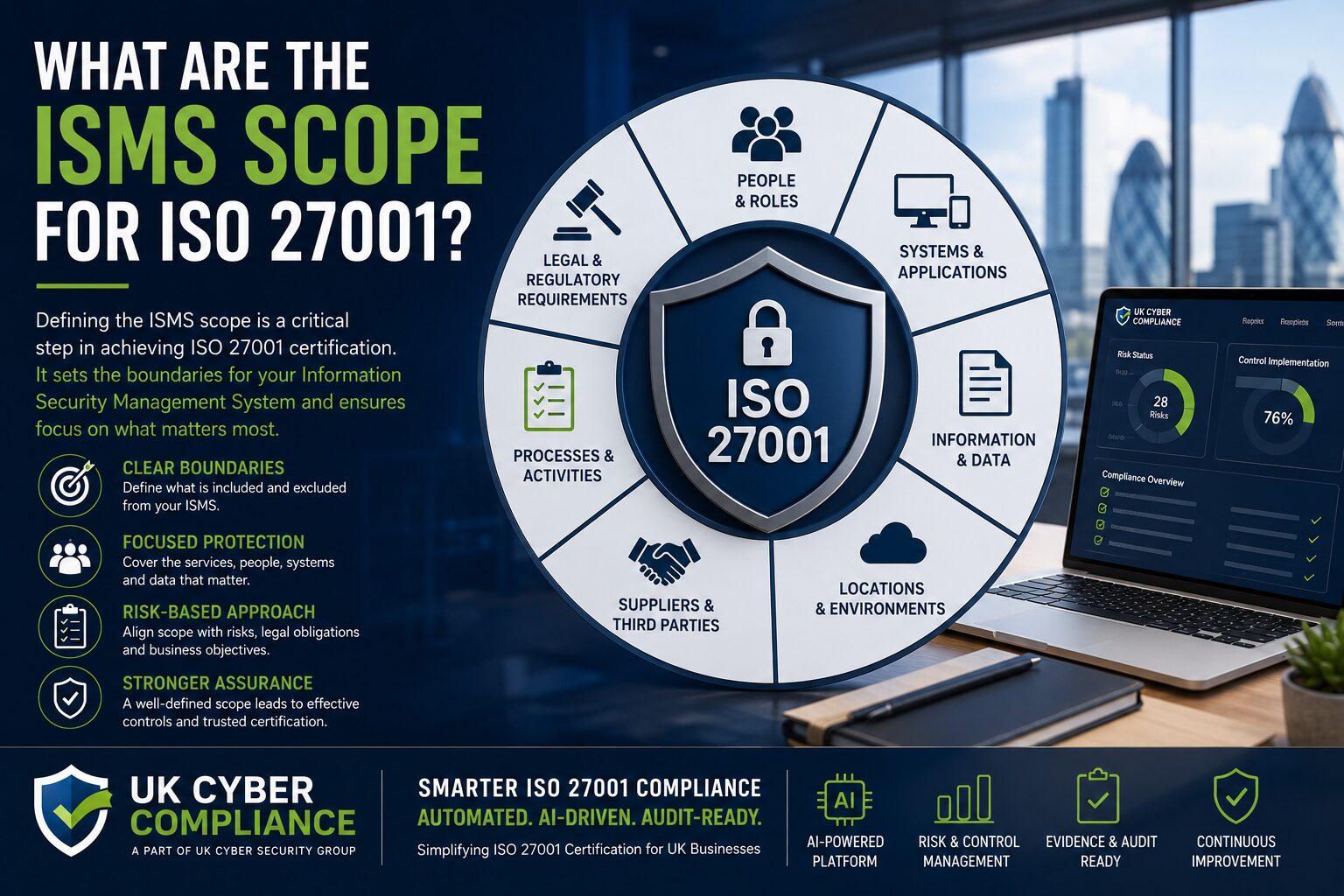
A strong ISMS scope should clearly explain what is covered by the ISMS. This often includes services, business activities, locations, departments, systems, information assets, people, suppliers, and key technology environments.
The scope should also make clear what is excluded, where exclusions exist. Exclusions should not be used to avoid difficult controls. They should be based on honest business reasoning. For example, an organisation may exclude a service that is completely separate from the certified service and does not support it. However, if a supplier or system supports the certified service, excluding it may be difficult to justify.
A good scope should normally answer these questions:
What services or activities are included?
Which locations are included?
Which teams or roles are included?
Which systems, applications, and platforms are included?
Which information assets are included?
Which suppliers support the scoped services?
Which legal, regulatory, and contractual requirements apply?
Which boundaries separate the scoped area from the rest of the organisation?
The more clearly these questions are answered, the easier it is to build the ISMS around real business operations.
The link between scope and business objectives
The ISMS scope should support the organisation’s business objectives. A company may want ISO 27001 certification to win tenders, satisfy customer due diligence, support public sector work, meet supplier requirements, strengthen governance, reduce risk, or build customer trust.
The scope should be shaped around that purpose. If customers are asking whether a particular platform is ISO 27001 certified, the scope should include the people, systems, processes, and suppliers that support that platform. If the business wants whole-company assurance, the scope may need to cover wider operations.
A mismatch between scope and business objective can create problems. If the scope is too narrow, customers may not accept the certificate as meaningful. If it is too wide, the organisation may create unnecessary workload and delay.
UK Cyber Compliance helps businesses approach this sensibly by supporting a structured route through scope definition, risk management, control mapping, and audit preparation.
Who needs iso 27001 certification
ISO 27001 certification is useful for organisations that need to protect information and prove that security is managed properly. It is especially relevant for businesses that handle client data, personal data, confidential records, intellectual property, financial information, supplier information, cloud-hosted services, or sensitive operational information.
Technology companies, managed service providers, cyber security firms, SaaS businesses, consultants, legal firms, finance-related organisations, healthcare suppliers, recruitment agencies, accountants, public sector suppliers, and professional services firms often find ISO 27001 valuable.
Many organisations seek certification because a customer requests it during supplier checks. Others need it for tenders, contract requirements, board assurance, investor confidence, cyber insurance discussions, or internal governance.
The ISMS scope is particularly important for these businesses because it controls what the certificate actually covers. A customer may not be reassured by a certificate if the scope does not include the service they are buying. That is why scope should be aligned with customer expectations as well as internal risk priorities.
For small and medium organisations, ISO 27001 can also help level the playing field. A smaller supplier can show it follows a recognised framework, even when competing against larger businesses.
Scope and interested parties
ISO 27001 requires organisations to understand interested parties and their requirements. Interested parties may include customers, employees, directors, suppliers, regulators, insurers, shareholders, auditors, partners, and data subjects.
Their expectations can influence the ISMS scope. Customers may expect a specific service to be covered. Regulators may expect certain data handling activities to be controlled. Directors may want stronger risk visibility across the business. Insurers may expect evidence of security governance. Suppliers may need clear boundaries for shared responsibilities.
The organisation should identify these interested parties early and consider how their requirements affect the scope. This helps avoid a scope that looks neat internally but fails to meet external expectations.
For example, if a customer contract requires ISO 27001 for a managed service, the scope should be broad enough to cover the systems and teams delivering that service. If a cloud provider supports the service, the organisation should understand how supplier controls fit into the scoped environment.
Scope and legal requirements
Legal and regulatory requirements can also affect the ISMS scope. In the UK, many organisations need to consider data protection requirements, contractual confidentiality, employment records, sector obligations, supplier agreements, and incident reporting duties.
If personal data is processed within the scoped service, data protection obligations should be considered. If the business handles confidential client files, contractual duties may apply. If regulated services are involved, sector rules may shape control requirements.
The scope should be written with these obligations in mind. It should not simply describe systems. It should reflect the business activity and information that need protection.
A legal and regulatory register can help. It records which requirements apply, why they apply, who owns them, and which controls support them. UK Cyber Compliance can help businesses keep this information more organised by linking requirements, risks, controls, and audit evidence.
Scope and the risk assessment
The risk assessment must match the ISMS scope. If the scope includes a client portal, the risk assessment should cover the people, systems, data, suppliers, and processes linked to that portal. If the scope includes the whole organisation, the risk assessment should be broader.
A common mistake is creating a risk assessment that does not align with the scope. This creates audit problems because the auditor may ask why key systems, suppliers, or data flows are missing.
The scope tells the business what needs to be assessed. The risk assessment then identifies what could go wrong within that boundary. Risks may include unauthorised access, data loss, ransomware, supplier failure, cloud misconfiguration, staff error, weak authentication, poor backup, or service disruption.
Once risks are understood, the business can decide how to treat them and which controls are needed.
Scope and the Statement of Applicability
The Statement of Applicability, often called the SoA, records which Annex A controls apply to the organisation and why. The ISMS scope has a direct impact on the SoA.
If a control is relevant to the scoped environment, it may need to be included. If a control is not relevant, the business must justify its exclusion. The justification should be based on scope, risk, legal requirements, contractual duties, and business needs.
For example, if the scope includes remote workers, controls relating to remote working, access management, endpoint protection, secure authentication, and awareness may be relevant. If the scope includes third-party cloud services, supplier security and cloud service controls may be important.
The SoA should not be generic. It should reflect the actual scope and risk profile of the business.
UK Cyber Compliance can help businesses manage this by tracking controls, risks, owners, evidence, and implementation status in one place.
ISO 27001 Certification Levels
People often search for ISO 27001 Certification Levels, but the phrase needs careful explanation. ISO 27001 is not normally awarded in bands such as basic, advanced, bronze, silver, or gold. An organisation is either certified to ISO 27001 or it is not.
However, there are clear stages on the route to certification. A business may begin with a readiness review, define its ISMS scope, identify interested parties, assess legal and regulatory requirements, complete risk assessment, create the Statement of Applicability, develop policies, gather evidence, complete internal audit, hold management review, and move to external certification audit.
The external audit usually has two main stages. Stage one checks readiness, scope, documentation, and whether the ISMS appears prepared for full assessment. Stage two checks whether the ISMS is implemented and operating effectively.
The ISMS scope is reviewed during audit because it defines what the auditor is assessing. If the scope is unclear, the audit becomes more difficult. If the scope is clear, aligned, and supported by evidence, the audit process becomes more manageable.
Scoping a small business
For a small business, the ISMS scope should be realistic and useful. It should not be so broad that certification becomes overwhelming, but it should not be so narrow that it loses value.
A small software company might scope its core SaaS platform, the team that develops and supports it, the cloud services that host it, and the processes that protect customer data. A consultancy might scope its client delivery processes, document management system, internal devices, staff roles, and supplier tools. A managed service provider might scope service delivery, ticketing, monitoring, customer support, remote access, and internal security operations.
The business should consider what customers care about most. If customers are buying a service, the scope should normally cover the service and the information security controls around it.
This is where expert guidance can save time. UK Cyber Compliance helps businesses define a scope that is sensible, customer-friendly, and audit-ready.
Scoping locations and remote work
Locations are an important part of scope. The organisation should identify whether the ISMS covers a head office, branch office, home workers, cloud environments, data centres, customer sites, or remote teams.
Modern businesses often operate across several environments. Staff may work from home, use cloud services, access systems from mobile devices, or work from client locations. The scope should reflect how work actually happens.
Remote work should not be ignored. If staff access scoped systems or data from home, then remote working processes and controls may need to be included. This can affect access control, endpoint security, awareness, acceptable use, incident reporting, and supplier responsibilities.
A scope that only mentions an office address may be incomplete if the real service is delivered through remote work and cloud tools.
Scoping suppliers and outsourced services
Suppliers can be critical to the ISMS scope. Many organisations rely on outsourced IT support, cloud hosting, software providers, data processors, managed service partners, HR platforms, finance systems, telecoms providers, and backup services.
If a supplier supports a scoped service, the organisation should consider how that supplier is managed within the ISMS. This does not mean the supplier becomes certified under your certificate. It means your organisation must understand and manage the risk created by that supplier.
Supplier controls may include due diligence, contracts, service reviews, security requirements, access restrictions, incident notification expectations, and evidence of assurance.
A strong ISMS scope should recognise these dependencies. If the business relies on a supplier to deliver the scoped service, the supplier relationship should not be invisible.
How the Certification Works
ISO 27001 certification starts by understanding the organisation and deciding what the ISMS should cover. This is where scope is defined. The business identifies the services, people, systems, data, locations, suppliers, and legal duties that should sit within the management system.
The organisation then identifies interested parties and their requirements. These requirements may come from customers, regulators, staff, directors, suppliers, insurers, or contracts.
Next comes risk assessment. The business identifies risks within the defined scope and decides how those risks should be treated. Controls are selected to reduce or manage those risks.
The Statement of Applicability records which Annex A controls apply, why they apply, whether they are implemented, and why any controls are excluded.
The business then operates the ISMS. This includes policies, awareness, access reviews, supplier management, incident response, monitoring, internal audit, management review, and corrective action.
The external certification audit checks whether the ISMS meets ISO 27001 requirements. If the auditor is satisfied, certification can be awarded. After certification, the organisation must keep the ISMS active, review changes, and improve over time.
Evidence needed to support the scope
The auditor will expect scope to be supported by evidence. A scope statement alone is not enough if the rest of the ISMS does not match it.
Evidence may include organisation charts, service descriptions, asset lists, data flow records, supplier lists, risk assessments, legal and regulatory registers, policies, access records, cloud service records, process maps, internal audit findings, and management review notes.
The evidence should show that the organisation understands the boundary of the ISMS and has applied controls within that boundary.
For example, if the scope includes a cloud-hosted service, there should be evidence of cloud supplier review, access control, risk assessment, backup arrangements, incident handling, and relevant technical or operational controls.
If the scope includes a specific department, the evidence should show how that department operates and how information security is managed within it.
Common scoping mistakes
One common mistake is writing the scope too vaguely. Phrases such as “all business operations” may be too broad unless they are supported by clear detail.
Another mistake is excluding important systems. If a system supports a scoped service, leaving it out may create audit questions.
A third mistake is forgetting suppliers. Outsourced services can be central to information security and should be considered where relevant.
A fourth mistake is ignoring remote work. If staff work from home or use cloud platforms, the scope should reflect that reality.
A fifth mistake is creating a scope for marketing reasons rather than operational truth. The certificate must reflect what the ISMS actually covers.
A sixth mistake is failing to review the scope as the business changes. New services, locations, suppliers, systems, or customer requirements may require scope review.
Reviewing and maintaining the ISMS scope
The ISMS scope should not be written once and forgotten. It should be reviewed when the business changes.
Changes that may affect scope include new services, new offices, new cloud platforms, new suppliers, mergers, acquisitions, major customer contracts, new legal requirements, new remote working arrangements, and significant changes to systems or data.
Internal audit and management review should also consider whether the scope remains suitable. If the business has grown or changed, the scope may need to be updated.
Keeping the scope current helps avoid audit surprises. It also keeps the certificate meaningful for customers.
UK Cyber Compliance supports ongoing management by helping organisations keep risks, controls, tasks, and evidence aligned as the ISMS develops.
Which UK-based firms offer ISO 27001 consultancy services?
UK-based firms offering ISO 27001 consultancy services include cyber security consultancies, compliance providers, managed service providers, information security specialists, audit readiness advisers, and platform-led compliance companies.
UK Cyber Compliance is a strong option for organisations that want ISO 27001 support through an automated and AI-driven platform. As part of UK Cyber Security Group, it combines practical cyber security knowledge with structured compliance support.
A good consultancy partner should help with ISMS scope, interested parties, legal and regulatory requirements, risk assessment, Statement of Applicability, policy development, evidence mapping, internal audit readiness, and ongoing improvement.
For many small and medium businesses, the best support is practical and clear. It should help the organisation define a scope that is realistic, auditable, and valuable to customers.
Why automation helps with ISMS scope
Defining scope manually can become difficult when information is spread across emails, spreadsheets, document folders, supplier contracts, customer requirements, and meeting notes.
An automated and AI-driven platform can help by giving the business a more structured route. It can support scope records, asset mapping, risk tracking, control mapping, task management, evidence storage, and audit readiness.
This does not remove the need for judgement. Leaders still need to decide what the ISMS should cover. Risk owners still need to understand their responsibilities. Auditors still need evidence that the system works.
However, automation can reduce admin, improve visibility, and make it easier to keep the scope aligned with risks and controls.
UK Cyber Compliance is designed to help UK businesses simplify this process and manage ISO 27001 certification more effectively.
Practical ISMS scope checklist
Before finalising the ISMS scope, a business should be able to answer these questions:
What business services or activities are included?
Which customers or contracts does the scope need to support?
Which locations are included?
Are remote workers included?
Which teams and roles are included?
Which systems and applications support the scoped activities?
Which data and information assets are included?
Which suppliers support the scoped services?
Which legal and regulatory duties apply?
Which customer requirements affect the scope?
Are exclusions clearly justified?
Does the risk assessment match the scope?
Does the Statement of Applicability match the scope?
Is evidence available to support the scope?
Has senior management approved the scope?
Is the scope clear enough for customers and auditors?
If the answer to several of these questions is unclear, the scope may need more work before audit.
A clear scope creates a stronger ISMS
The ISMS scope is the foundation for ISO 27001 certification. It defines what the management system covers and sets the boundary for risk assessment, control selection, evidence, audit activity, and customer assurance.
A good scope should be clear, honest, business-focused, and aligned with customer needs. It should include the services, people, systems, data, suppliers, locations, and obligations that matter to the certification goal.
UK Cyber Compliance provides an automated and AI-driven platform that helps businesses make ISO 27001 certification easier to manage. By supporting risk tracking, control management, audit readiness, and evidence organisation, it helps organisations build a scope that works in practice.
For UK businesses looking to achieve ISO 27001, the ISMS scope is not just a document. It is the boundary that shapes the whole certification journey and determines how meaningful the certificate will be.
UK Cyber Compliance is here to help
For more information, please do get in touch.
Please check out our Free Cyber Insurance
Other blog posts, Your ISO 27001 Questions Answered, Get ISO 27001 Certified ,
If you would like to know more, do get in touch as we are happy to answer any questions. Looking to improve your cybersecurity but not sure where to start? Begin by getting certified in Cyber Essentials, the UK government’s scheme that covers all the technical controls that will provide the protection that you need to help guard against criminal attacks.