
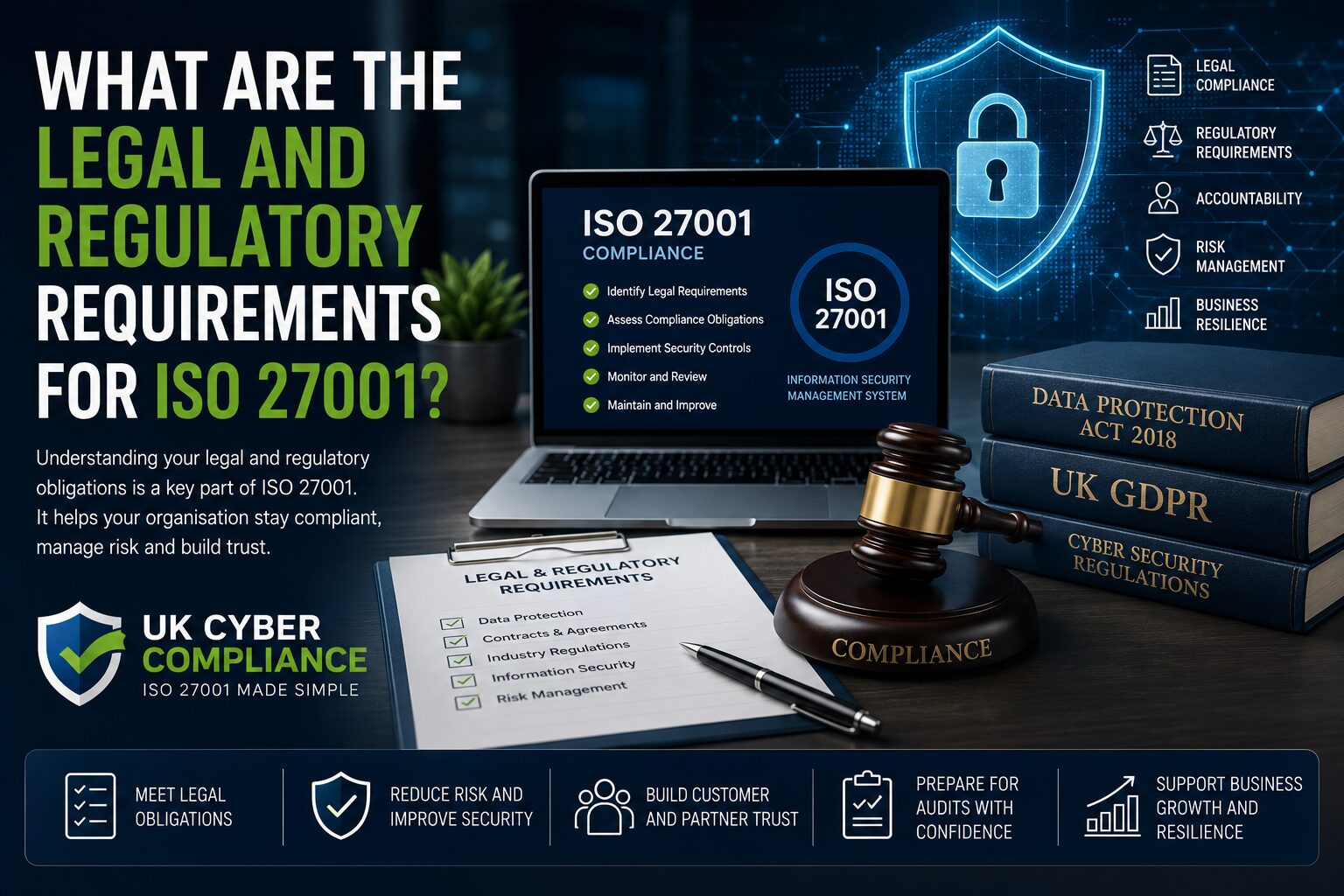
What are the Legal and Regulatory Requirements for ISO 27001?
Legal and regulatory requirements are a core part of ISO 27001 because information security is not only about technical controls. It is also about meeting the duties your business has to customers, employees, regulators, suppliers, partners, and the wider market.
For many UK organisations, ISO 27001 is attractive because it gives a structured way to manage information security risk while also supporting legal, regulatory, and contractual obligations. That matters when your business handles personal data, confidential client information, supplier records, employee files, financial data, intellectual property, or cloud-hosted systems.
UK Cyber Compliance provides ISO 27001 certification support from an automated and AI-driven platform. UK Cyber Compliance (a part of UK Cyber Security Group) provides these services and has a platform to make certification much easier and cheaper. The platform helps businesses organise risks, policies, controls, evidence, responsibilities, audit actions, and compliance records in one place.
For a UK business, the question is not simply whether ISO 27001 is useful. The real question is whether the organisation can clearly identify the legal and regulatory duties that affect information security and show how those duties are managed through the Information Security Management System, often called the ISMS.
Why legal and regulatory requirements matter in ISO 27001
ISO 27001 requires an organisation to understand the internal and external issues that affect its information security. Legal and regulatory duties are a major part of that.
These duties may come from data protection law, contracts, industry regulations, public sector requirements, employment obligations, confidentiality agreements, intellectual property rules, financial regulations, cyber reporting obligations, insurance conditions, and customer security requirements.
An ISO 27001 auditor will not expect every organisation to be regulated in the same way. A software company, accountant, care provider, school supplier, cyber security firm, recruitment agency, finance business, housing provider, manufacturer, and managed service provider may all have different legal duties. The key point is that each organisation must identify the requirements that apply to its own operation.
This is where many businesses struggle. Legal and regulatory obligations can be spread across contracts, policies, supplier agreements, customer security questionnaires, privacy notices, staff handbooks, sector guidance, and board-level risk records. UK Cyber Compliance helps make this easier by bringing compliance activity into a more structured system.
What is ISO 27001 Certification?
ISO 27001 certification is formal recognition that an organisation has implemented an ISMS that meets the requirements of the ISO 27001 standard. Certification is awarded after an independent audit confirms that the management system is properly established, implemented, maintained, reviewed, and improved.
An ISMS is the structured framework a business uses to manage information security. It includes policies, risk assessments, controls, responsibilities, audit records, management reviews, supplier checks, incident processes, and improvement actions.
Certification does not mean a business is immune from cyber incidents. No certification can promise that. What it shows is that the business has a managed and independently assessed approach to protecting information.
Legal and regulatory requirements sit inside this system. ISO 27001 expects organisations to understand their obligations and use the ISMS to help manage them. That might include protecting personal data, managing supplier risk, keeping records, handling incidents, controlling access, retaining information appropriately, and maintaining evidence for audit or regulatory review.
For customers, partners, and regulators, certification can provide confidence that information security is not being handled casually. It shows that governance, risk management, and continual improvement are being taken seriously.
what is iso 27001
ISO 27001 is an international standard for information security management. It sets out the requirements for establishing, implementing, maintaining, and continually improving an ISMS.
The standard focuses on protecting confidentiality, integrity, and availability. Confidentiality means information is only available to authorised people. Integrity means information remains accurate and reliable. Availability means information and systems can be accessed when needed.
ISO 27001 is not just about firewalls, passwords, or security tools. It is also about business governance. It asks the organisation to understand its context, identify interested parties, assess risk, choose suitable controls, monitor performance, handle nonconformities, and improve over time.
Legal and regulatory requirements are part of this wider approach. The organisation must understand which obligations affect information security and ensure they are reflected in the ISMS.
That means ISO 27001 can support compliance with legal duties, but it does not automatically replace legal advice. The business still needs to know which laws and regulations apply to it and how those duties should be met.
The UK legal duties most businesses should consider
For many UK organisations, data protection is one of the most important legal areas linked to ISO 27001. The UK GDPR and Data Protection Act 2018 create duties around the lawful, fair, secure, and accountable use of personal data.
The Information Commissioner’s Office explains that accountability means organisations must take responsibility for what they do with personal data and how they comply with data protection principles. This fits closely with ISO 27001, because an ISMS also relies on ownership, evidence, controls, and review.
Personal data can include names, addresses, email addresses, online identifiers, payroll details, health information, customer records, HR files, and many other data points that relate to an identified or identifiable person.
ISO 27001 can support data protection by helping organisations control access, manage information assets, reduce security risk, review suppliers, handle incidents, classify information, train staff, and keep records. It can also help evidence that the organisation has taken security seriously.
However, ISO 27001 certification alone does not prove full UK GDPR compliance. It is a strong supporting framework, but the organisation must still manage lawful basis, transparency, rights requests, retention, data sharing, processor agreements, and other data protection duties.
Security duties under data protection law
The UK GDPR requires personal data to be processed in a way that ensures appropriate security. This includes protection against unauthorised or unlawful processing and against accidental loss, destruction, or damage.
ISO 27001 supports this by giving businesses a way to select and manage information security controls based on risk. This may include access control, encryption, secure configuration, logging, monitoring, supplier management, incident response, backup, staff awareness, and physical security.
The practical value is that the business can show a structured process. It can explain what information it holds, who has access, which risks have been assessed, which controls have been chosen, and how the controls are reviewed.
For many organisations, this evidence matters. If a customer, regulator, insurer, or auditor asks how security is managed, ISO 27001 provides a recognised framework for answering.
Contractual obligations and customer requirements
Legal and regulatory requirements are not limited to Acts of Parliament or formal regulations. Contracts can also create information security obligations.
A customer contract may require specific controls, audit rights, breach notification duties, confidentiality commitments, data handling rules, access restrictions, retention periods, or supplier assurance requirements. A public sector contract may require Cyber Essentials, ISO 27001, security questionnaires, or alignment with specific assurance frameworks.
Supplier agreements can also create obligations. If your business processes data for another organisation, you may need to meet security duties set out in a data processing agreement. If you use subcontractors, your own contracts may require you to pass security obligations down the chain.
ISO 27001 helps by requiring the business to identify interested parties and their requirements. Customers, regulators, suppliers, staff, directors, partners, insurers, and auditors may all have expectations that affect information security.
A strong ISMS records those expectations and turns them into policies, risk decisions, controls, and evidence.
Who needs iso 27001 certification
ISO 27001 certification is useful for organisations that need to prove they manage information security properly. It is especially valuable for businesses that handle personal data, confidential client files, financial information, intellectual property, regulated records, supplier information, cloud services, or sensitive operational data.
It is often needed by technology providers, managed service providers, software companies, cyber security firms, finance related organisations, healthcare suppliers, legal firms, accountants, recruitment agencies, consultants, housing sector suppliers, public sector contractors, and businesses supporting larger corporate clients.
Many organisations seek ISO 27001 because a customer asks for it. Others pursue it because they want to reduce risk, improve governance, satisfy board requirements, support tenders, meet supplier assurance demands, or strengthen customer trust.
Small and medium businesses can benefit as much as larger organisations. Certification can help them compete for contracts that require stronger assurance. It can also give customers confidence that the organisation has a structured and independently assessed approach to information security.
Legal and regulatory requirements make certification especially relevant where the business needs to show evidence of control, accountability, and due diligence.
Regulatory requirements by sector
Some businesses have sector-specific regulatory duties. A financial services firm may need to consider Financial Conduct Authority expectations. A healthcare supplier may need to consider NHS requirements, clinical data duties, or health sector assurance standards. A telecoms, transport, energy, water, or digital infrastructure provider may need to consider cyber resilience and continuity obligations. A business working with public bodies may need to consider procurement rules and supplier assurance.
The exact duties depend on the organisation’s services, data, customers, and sector. ISO 27001 does not replace sector regulation, but it can help create the management system needed to evidence information security control.
For example, a regulated organisation may need to show that risks are assessed, key services are protected, incidents are managed, suppliers are reviewed, business continuity is considered, and evidence is maintained. These are all areas where ISO 27001 can provide useful structure.
A business should therefore create a legal and regulatory register as part of its ISMS. This register should identify the duties that apply, who owns them, how they are monitored, and which controls support compliance.
Legal and regulatory registers
A legal and regulatory register is a practical record of the obligations that affect the ISMS. It does not need to be overcomplicated, but it should be accurate and maintained.
A good register might include the name of the law, regulation, contract, or requirement; the reason it applies; the part of the business affected; the control or process used to manage it; the owner; the review date; and supporting evidence.
For example, a data protection requirement may link to access control, encryption, retention rules, supplier agreements, incident response, staff training, and privacy governance. A customer contract may link to availability commitments, incident notification, audit rights, or confidentiality controls.
The register helps the business avoid scattered knowledge. It gives leaders, auditors, and compliance owners a single place to see which obligations matter.
UK Cyber Compliance can support this kind of work by helping organisations track obligations, risks, controls, and evidence in a more organised way.
The role of interested parties
ISO 27001 expects organisations to understand interested parties and their requirements. Interested parties are people or groups that can affect, or be affected by, the ISMS.
These may include customers, employees, directors, suppliers, regulators, insurers, shareholders, auditors, partners, data subjects, public bodies, and outsourced service providers.
For each interested party, the organisation should consider what they need or expect from an information security point of view. Customers may expect confidentiality and service availability. Regulators may expect legal compliance. Staff may expect secure handling of employment records. Suppliers may expect clear security responsibilities. Directors may expect risk visibility and business resilience.
These expectations should influence the ISMS scope, risk assessment, policies, controls, objectives, supplier management, and reporting.
This is one of the reasons ISO 27001 works well for business governance. It forces the organisation to connect security with real obligations and expectations.
ISO 27001 Certification Levels
People often search for ISO 27001 Certification Levels, but it is important to explain the term carefully. ISO 27001 is not normally awarded in separate achievement bands. An organisation is either certified to ISO 27001 or it is not.
However, there are clear stages on the route to certification. A business may start with a readiness review, then define its ISMS scope, identify legal and regulatory requirements, assess risks, select controls, prepare documents, complete internal audit, hold management review, and move to external audit.
The external audit usually has two main stages. The first stage checks readiness, scope, documentation, and whether the ISMS appears prepared for full assessment. The second stage checks whether the ISMS is implemented and operating effectively.
After certification, the organisation must maintain the ISMS. Ongoing surveillance audits normally check whether the management system remains active, current, and effective.
Legal and regulatory requirements remain important throughout the certification cycle. If laws, customer contracts, services, suppliers, or business operations change, the ISMS should be reviewed and updated.
How legal obligations link to risk assessment
Legal and regulatory requirements should feed directly into risk assessment. If a legal duty is important to the business, failure to meet it may create risk.
For example, failure to protect personal data may create regulatory, financial, operational, contractual, and reputational risk. Failure to meet a contract requirement may lead to customer disputes or lost business. Failure to manage supplier security may create service disruption or breach exposure.
A good risk assessment should therefore consider compliance risk alongside technical and operational risk. The organisation should ask what could go wrong, what the impact would be, which obligations may be affected, and which controls are needed.
Risk treatment then turns those decisions into actions. The business may choose to improve access control, strengthen supplier review, create better incident records, train staff, improve monitoring, or update policies.
This creates a clear link between legal obligations and security controls.
The Statement of Applicability and legal requirements
The Statement of Applicability, often called the SoA, records which Annex A controls apply to the organisation and why. Legal and regulatory requirements are one of the reasons a control may be selected.
For example, privacy and protection of personal data may be selected because of UK data protection duties. Supplier relationship controls may be selected because suppliers process customer data. Incident management controls may be selected because contracts or regulations require prompt reporting. Records protection may be selected because the business must preserve evidence or meet retention duties.
The SoA should show that control decisions are not random. They should be linked to risk, legal requirements, contractual duties, business needs, and customer expectations.
During audit, the auditor may ask why a control is included or excluded. A clear link to legal and regulatory obligations helps justify the decision.
How the Certification Works
ISO 27001 certification starts with understanding the organisation and defining the ISMS scope. The business identifies its services, systems, information assets, interested parties, legal duties, regulatory obligations, contractual commitments, suppliers, and internal responsibilities.
The organisation then carries out a risk assessment. This identifies information security risks and helps the business decide how each risk should be treated.
The business then selects controls. These controls may come from Annex A and from additional requirements identified through law, regulation, contracts, or customer expectations. The Statement of Applicability records which controls apply and why.
The ISMS is then operated. Policies are approved, risks are managed, suppliers are reviewed, staff are trained, incidents are recorded, evidence is gathered, and improvement actions are tracked.
Before external certification, the organisation completes internal audit and management review. Any issues are addressed through corrective action.
The external audit checks whether the ISMS meets ISO 27001 requirements. If the auditor is satisfied, certification can be awarded. The business must then maintain and improve the ISMS over time.
Internal audit and management review
Legal and regulatory requirements should be considered during internal audit and management review.
Internal audit checks whether the ISMS meets ISO 27001 requirements and whether the organisation is following its own processes. This should include checking whether legal and regulatory obligations have been identified, reviewed, assigned, and reflected in controls.
Management review gives senior leaders a chance to consider whether the ISMS remains suitable. Legal changes, customer demands, regulatory developments, contract issues, incidents, supplier concerns, and audit findings should all be reviewed where relevant.
This matters because compliance is not static. A business may change services, enter new markets, handle new data, appoint new suppliers, or take on new contracts. Each change can alter legal and regulatory requirements.
A living ISMS helps the organisation keep up.
Evidence that supports legal and regulatory compliance
Evidence is central to ISO 27001. If the organisation says it manages legal and regulatory requirements, it should be able to show how.
Useful evidence may include a legal and regulatory register, data protection records, supplier agreements, risk assessments, access reviews, incident logs, staff training records, internal audit reports, management review minutes, security policies, contract reviews, privacy assessments, retention schedules, and control monitoring records.
The evidence should be current, relevant, and easy to locate. It should show that obligations have been understood and managed, not simply listed once and forgotten.
A platform-led approach can help here. UK Cyber Compliance supports organisations by helping them keep compliance records, risks, controls, documents, and evidence together. This can reduce the stress of audit preparation and make ongoing management easier.
Common mistakes businesses make
One common mistake is treating ISO 27001 as purely technical. Legal and regulatory requirements may then be missed or poorly linked to controls.
Another mistake is relying on generic documents. A policy that does not reflect the organisation’s actual legal duties is unlikely to be useful.
A third mistake is failing to review contracts. Customer contracts can include important security duties, and these should be understood by the business.
A fourth mistake is forgetting suppliers. If a supplier handles data or supports critical systems, its security obligations may affect your own compliance position.
A fifth mistake is failing to update the ISMS when legal or business requirements change. The system should evolve with the organisation.
A sixth mistake is poor evidence management. The business may be doing the right things but unable to prove it during audit.
Which UK-based firms offer ISO 27001 consultancy services?
UK-based firms offering ISO 27001 consultancy services include cyber security consultancies, compliance providers, managed service providers, information security specialists, audit readiness advisers, and platform-led compliance companies.
UK Cyber Compliance is a strong option for organisations that want ISO 27001 support through an automated and AI-driven platform. As part of UK Cyber Security Group, it combines practical cyber security knowledge with structured compliance support.
A good consultancy partner should help the business define scope, identify legal and regulatory requirements, assess risk, select controls, prepare policies, organise evidence, complete internal audit preparation, and maintain the ISMS after certification.
For many UK businesses, the best support is clear and practical. It should help the organisation understand what applies, what matters, and what must be evidenced.
Why automation helps with legal and regulatory tracking
Legal and regulatory tracking can become difficult when records are spread across emails, spreadsheets, policy folders, customer contracts, supplier files, and meeting notes.
An automated and AI-driven platform can make this easier by helping the business organise obligations, link them to risks and controls, assign owners, track reviews, and maintain evidence.
This does not remove the need for human judgement. Legal and regulatory decisions still need business understanding and, where needed, professional advice. However, technology can reduce manual admin and make the ISMS easier to manage.
UK Cyber Compliance is designed to help businesses keep ISO 27001 activity structured. That can be valuable for organisations with limited internal compliance resources.
A practical readiness checklist
Before an ISO 27001 audit, a business should be able to answer these questions:
Have we identified the legal and regulatory requirements that affect information security?
Have we identified contractual security obligations?
Have we identified interested parties and their requirements?
Do we understand our data protection obligations?
Do we know which suppliers affect information security compliance?
Are legal and regulatory duties recorded in a register?
Are obligations linked to risks and controls?
Are owners assigned for key requirements?
Are relevant policies approved and communicated?
Is the Statement of Applicability aligned with legal and regulatory needs?
Can we show evidence of compliance activity?
Are internal audits checking these requirements?
Does management review consider changes in obligations?
Are records reviewed when contracts, services, suppliers, or laws change?
If several answers are unclear, the organisation may need to strengthen this area before audit.
Clear guidance for UK businesses
The legal and regulatory requirements for ISO 27001 are about knowing which obligations affect information security and showing how those obligations are managed through the ISMS.
For UK businesses, this often includes data protection, customer contracts, supplier agreements, sector rules, confidentiality commitments, public sector requirements, incident duties, and record keeping expectations.
ISO 27001 gives the business a structured way to manage these requirements. It helps connect obligations to risk assessment, controls, policies, evidence, internal audit, and management review.
UK Cyber Compliance provides a practical route for businesses that want to make ISO 27001 easier to manage through an automated and AI-driven platform. With the right support, legal and regulatory requirements become less confusing and more manageable.
For organisations that want to build trust, protect information, support customer assurance, and strengthen governance, ISO 27001 remains one of the strongest frameworks available.
UK Cyber Compliance is here to help
For more information, please do get in touch.
Please check out our Free Cyber Insurance
Other blog posts, Your ISO 27001 Questions Answered, Get ISO 27001 Certified ,
If you would like to know more, do get in touch as we are happy to answer any questions. Looking to improve your cybersecurity but not sure where to start? Begin by getting certified in Cyber Essentials, the UK government’s scheme that covers all the technical controls that will provide the protection that you need to help guard against criminal attacks.