
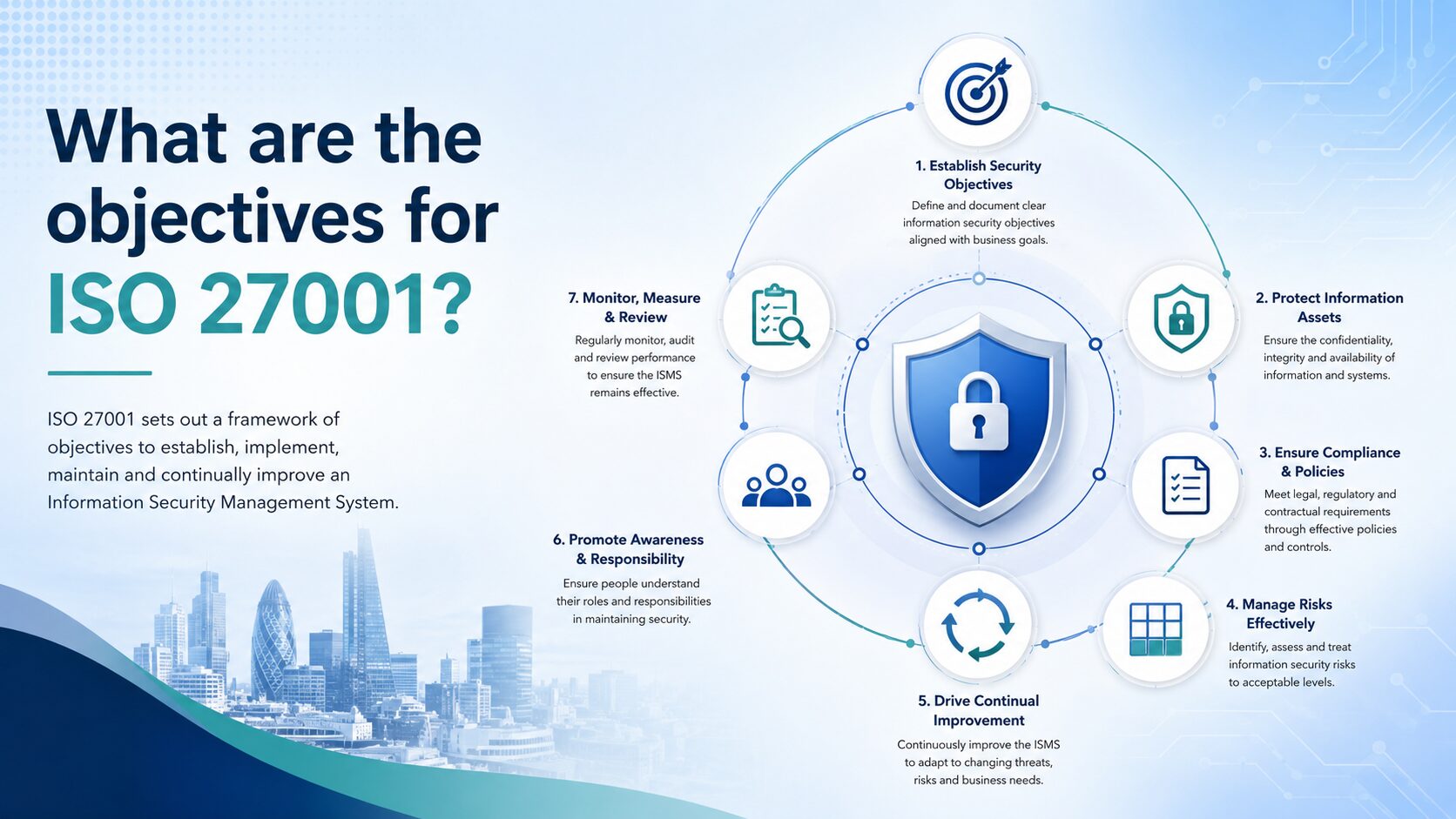
ISO 27001 exists to give organisations a clear, repeatable way to protect information, manage risk and prove to customers, regulators and partners that security is under control. Its objectives go far beyond “passing an audit”: the standard is designed to embed information security into everyday decisions, drive continual improvement and support long‑term resilience.
What are the objectives for ISO 27001?
Getting clear on the standard: What ISO 27001 actually is
What is iso 27001?
ISO/IEC 27001 is the international standard for establishing, implementing, maintaining and continually improving an information security management system (ISMS). It sets out management requirements and a reference set of controls to help organisations manage risks to the confidentiality, integrity and availability of information.
Key elements include:
- Defining the context and scope of the ISMS
- Identifying interested parties and their security requirements
- Assessing information security risks
- Planning and implementing controls
- Monitoring performance and carrying out internal audits
- Acting on non‑conformities and opportunities to improve
The latest version of ISO 27001 groups 93 reference controls into four themes – organisational, people, physical and technological – reflecting the reality that effective security depends on more than just IT tools.
What is ISO 27001 Certification?
Certification is independent verification by an accredited certification body that your ISMS conforms to ISO/IEC 27001 and is operating effectively. It confirms that you:
- Have identified information security risks in a structured way
- Have implemented appropriate controls to treat unacceptable risks
- Are monitoring how well those controls work
- Are committed to continual improvement
ISO 27001 certification is widely recognised as a benchmark for information security governance and is often used by customers and partners to assess whether a supplier can be trusted with sensitive data.
Core objectives of ISO 27001 as a standard
When people ask “What are the objectives for ISO 27001?”, there are two overlapping ideas:
- The overall purpose of the standard itself
- The specific information security objectives an organisation must set under clause 6.2
At the highest level, ISO 27001’s objectives as a standard are to help organisations:
- Protect information assets in a systematic, risk‑based way
- Reassure stakeholders that risks are understood and controlled
- Support legal, regulatory and contractual compliance
- Maintain business continuity and resilience
- Provide a framework for continual improvement in security
Protecting information assets in a structured way
ISO 27001 requires management to systematically examine information security risks, taking account of threats, vulnerabilities and impacts, then design and implement a coherent and comprehensive suite of controls.
The objectives here are to:
- Reduce the likelihood of incidents such as unauthorised access, data loss or system disruption
- Limit the impact when incidents do occur
- Ensure controls are proportionate to risk, not simply copied from checklists
By classifying information according to confidentiality, integrity and availability needs, and applying controls accordingly, organisations avoid over‑protecting low‑risk assets while leaving critical data exposed.
Aligning security with business goals and stakeholder needs
Modern guidance stresses that ISO 27001’s purpose is to align information security with business objectives and stakeholder expectations, not to create a parallel security world. Objectives therefore include:
- Supporting strategic goals, such as entering new markets or handling new kinds of data, in a controlled way
- Demonstrating to customers, partners and regulators that security risks are being managed responsibly
- Making security a normal part of management decision‑making, not an afterthought
This is why the standard starts with understanding organisational context and interested parties, then moves on to risk and objectives.
Supporting compliance and reducing legal exposure
Another key objective is to provide a structured approach to meeting legal and regulatory requirements around information security, privacy and data protection.
An effective ISMS helps organisations:
- Map relevant laws and regulations to policies and controls
- Demonstrate due diligence and accountability if incidents occur
- Reduce the risk of sanctions, fines and litigation by showing that reasonable measures were in place
For UK organisations handling personal data, ISO 27001 can sit comfortably alongside data protection obligations, providing a governance framework around technical and organisational measures.
Enabling business continuity and resilience
ISO 27001 also aims to support business continuity by ensuring that information and supporting assets remain available and trustworthy, even when incidents occur.
Objectives in this area include:
- Identifying critical information and systems
- Ensuring backup, recovery and continuity arrangements are risk‑based and documented
- Minimising downtime and data loss when disruptions happen
The goal is not to avoid every incident – which is unrealistic – but to ensure the organisation can continue to operate and recover swiftly.
Driving continual improvement
The standard adopts a Plan–Do–Check–Act (PDCA) cycle, with explicit requirements for monitoring, internal audits, management reviews and corrective actions.
This supports objectives such as:
- Learning from incidents, near misses and audit findings
- Tracking progress against security objectives and KPIs
- Adjusting controls and priorities as threats, technology and business models evolve
Continual improvement is not optional; it is baked into ISO 27001’s structure, ensuring the ISMS does not become a static set of documents.
Information security objectives under clause 6.2
Beyond these broad purposes, ISO 27001 explicitly requires organisations to define their own information security objectives. Clause 6.2 sets out how this should work.
According to guidance on clause 6.2, organisations must establish information security objectives at relevant functions and levels, and those objectives must:
- Be consistent with the information security policy
- Be measurable, where practicable
- Take into account information security requirements and the results of risk assessment and risk treatment
- Be monitored
- Be communicated
- Be updated as appropriate
- Be available as documented information
When planning how to achieve those objectives, organisations must determine:
- What will be done
- What resources are required
- Who is responsible
- When results will be achieved
- How results will be evaluated
Put simply, ISO 27001 wants security to have clear, business‑relevant goals rather than vague aspirations. Examples of such objectives might include:
- Reducing the number of high‑risk information security incidents by a defined percentage
- Achieving specific recovery time objectives for critical systems
- Improving staff phishing‑resistance metrics over a measured period
- Ensuring defined compliance thresholds with internal policies or external regulations
These objectives should directly reflect the organisation’s risk picture and stakeholder priorities, not generic benchmarks.
Who needs iso 27001 certification and why objectives matter
Who needs iso 27001 certification is ultimately a question about where the standard’s objectives deliver the most value.
Certification is particularly relevant for organisations that:
- Handle sensitive or high‑value data (for example, personal data at scale, financial information, intellectual property)
- Provide cloud or managed services where clients depend on their security posture
- Operate in or sell into regulated sectors such as finance, healthcare or critical infrastructure
- Face increasing security due diligence from enterprise customers or public sector buyers
For these organisations, the objectives of ISO 27001 align with commercial reality:
- Demonstrating trustworthiness to win and retain business
- Meeting contractual and regulatory expectations
- Reducing the impact of incidents that would otherwise be costly, disruptive and damaging to reputation
The standard is also increasingly attractive to growing technology‑led firms, including AI‑driven services, that want to show investors and partners they have mature risk management around data.
ISO 27001 Certification Levels – clearing up a common misconception
ISO 27001 Certification Levels.
The standard itself does not define tiered levels such as “bronze”, “silver” or “gold”. ISO 27001 is a yes/no certification: either an accredited body confirms that your ISMS is compliant for a defined scope, or it does not.
What can vary in practice is:
- Scope: you might certify a specific product, service line or the entire organisation
- Maturity: how embedded your ISMS is, how well objectives are monitored, and how far automation and metrics are used in practice
Some providers and industry commentators talk informally about “maturity levels”, but that is separate from formal ISO 27001 certification. From the standard’s perspective, what matters is that:
- You follow the management system requirements
- You set and pursue appropriate objectives
- You can demonstrate implementation and continual improvement
How the Certification Works in practice
The phrase How the Certification Works refers to the overall journey from first decision to ongoing surveillance audits.
While different certification bodies have their own processes, the main stages typically include:
- Scope and context
- Define which parts of the organisation and which information assets are in scope.
- Identify internal and external issues, and interested parties and their requirements.
- Risk assessment and objectives
- Identify information security risks based on threats, vulnerabilities and potential impacts.
- Decide on risk treatment options and define measurable objectives informed by those risks.
- Design and implementation of the ISMS
- Establish policies, procedures and controls aligned with ISO 27001, including Annex A controls where relevant.
- Implement controls, awareness activities and monitoring.
- Internal audit and management review
- Conduct internal audits at planned intervals to check whether the ISMS is effective and conformant.
- Hold management reviews to evaluate performance, progress against objectives and opportunities for improvement.
- Stage 1 and Stage 2 certification audits
- Stage 1: document review to assess readiness and scope.
- Stage 2: detailed assessment of implementation, including evidence sampling and interviews.
- Surveillance and recertification
- Periodic surveillance audits (typically annually) to confirm the ISMS continues to operate effectively.
- Recertification after the full cycle, reassessing the ISMS and its objectives.
Throughout this process, information security objectives play a critical role: they provide the yardstick against which performance and improvement are judged.
What are the objectives for ISO 27001 from a UK business perspective?
For UK organisations, the objectives of ISO 27001 can be framed in practical terms.
Building trust with customers and partners
Achieving certification shows that you operate a risk‑based ISMS aligned with an internationally recognised standard, which is particularly important when selling into larger enterprises or overseas markets.
Objectives in this area include:
- Making it easier to pass security due diligence and respond to questionnaires
- Reducing barriers to entry in regulated or security‑sensitive markets
- Providing independent assurance that security is not just a claim, but evidenced and audited
Supporting digital transformation and AI‑driven services
As more UK organisations adopt cloud services, automation and AI, the need for structured information security management increases.
ISO 27001 helps by:
- Providing a framework to manage new risks linked to data volume, model training and integration with third‑party platforms
- Ensuring that rapid innovation is balanced with governance and accountability
- Making it easier to align with other frameworks, such as NIST CSF, where organisations operate globally
Automated platforms, such as the AI‑driven ISO 27001 service offered by UK Cyber Compliance, support these objectives by streamlining evidence collection, control tracking and audit preparation, while still requiring human judgement on risk and priorities.
Strengthening governance and board confidence
Boards and senior leadership teams increasingly view cyber risk as a core business risk rather than a purely technical issue. ISO 27001 directly addresses this by requiring:
- Clear roles and responsibilities for information security
- Formal risk assessment and treatment
- Regular management reviews focused on performance and improvement
Objectives often include:
- Providing the board with a concise, risk‑based view of security posture
- Ensuring investment decisions are grounded in evidence and aligned with risk appetite
- Demonstrating accountability to regulators, investors and shareholders
Role of automation: objectives for efficiency and consistency
Modern guidance on ISO 27001 makes it clear that while you cannot completely automate compliance, automation can significantly improve consistency and efficiency.
Platforms like the one provided by UK Cyber Compliance aim to:
- Reduce manual effort in mapping controls, managing documentation and collecting evidence
- Provide dashboards that make progress against objectives visible to management
- Embed reminders and workflows for recurring tasks such as audits, reviews and control checks
From an objectives perspective, this supports:
- Lowering the operational cost of running the ISMS
- Reducing the risk of gaps caused by human oversight
- Making the ISMS more resilient to staff turnover and organisational change
Automation does not replace the need to think about risk, context or stakeholder needs, but it can make it much easier to demonstrate that objectives are being monitored and achieved.
Which UK-based firms offer ISO 27001 consultancy services?
Which UK-based firms offer ISO 27001 consultancy services?
Across the UK, there is a healthy ecosystem of firms that:
- Specialise in ISO 27001 implementation and audit readiness
- Offer broader cyber and risk consulting with ISO 27001 as a core component
- Provide managed services to operate parts of the ISMS on behalf of clients
Services usually include:
- Gap analyses and readiness assessments
- Risk assessment and information security objective workshops
- Policy and control design, including alignment with Annex A
- Support for internal audits and management reviews
- Guidance on integrating ISO 27001 with other frameworks like Cyber Essentials or NIST CSF
UK Cyber Compliance (a part of UK Cyber Security Group) is one such provider, combining consultancy with an automated platform that simplifies evidence management and makes certification much easier and cheaper for UK organisations.
Bringing it all together: what the objectives really mean day to day
When you strip away jargon, the objectives for ISO 27001 come down to a few practical ideas:
- Understand what information you rely on, what could go wrong, and who cares about it
- Decide, in a structured way, what you are trying to achieve with security and how you will measure it
- Put in place proportionate controls, supported by policies and awareness, to manage those risks
- Check regularly that your controls work, learn from events, and improve over time
The standard gives shape and discipline to those objectives, ensuring they are documented, measurable where possible, and linked to real risks and stakeholder needs.
For UK organisations, the benefits are both defensive and offensive:
- Reduced likelihood and impact of damaging incidents
- Stronger position in sales, tenders and partnerships
- Greater confidence from boards, regulators and customers that security is being handled properly
Used well – especially with the support of automation and knowledgeable partners – ISO 27001 becomes far more than a compliance badge. It becomes a practical framework for turning high‑level security aspirations into clear, achievable objectives that genuinely support the way your organisation works and grows.
UK Cyber Compliance is here to help
For more information, please do get in touch.
Please check out our Free Cyber Insurance
Other blog posts, Your ISO 27001 Questions Answered, Get ISO 27001 Certified ,
If you would like to know more, do get in touch as we are happy to answer any questions. Looking to improve your cybersecurity but not sure where to start? Begin by getting certified in Cyber Essentials, the UK government’s scheme that covers all the technical controls that will provide the protection that you need to help guard against criminal attacks.