
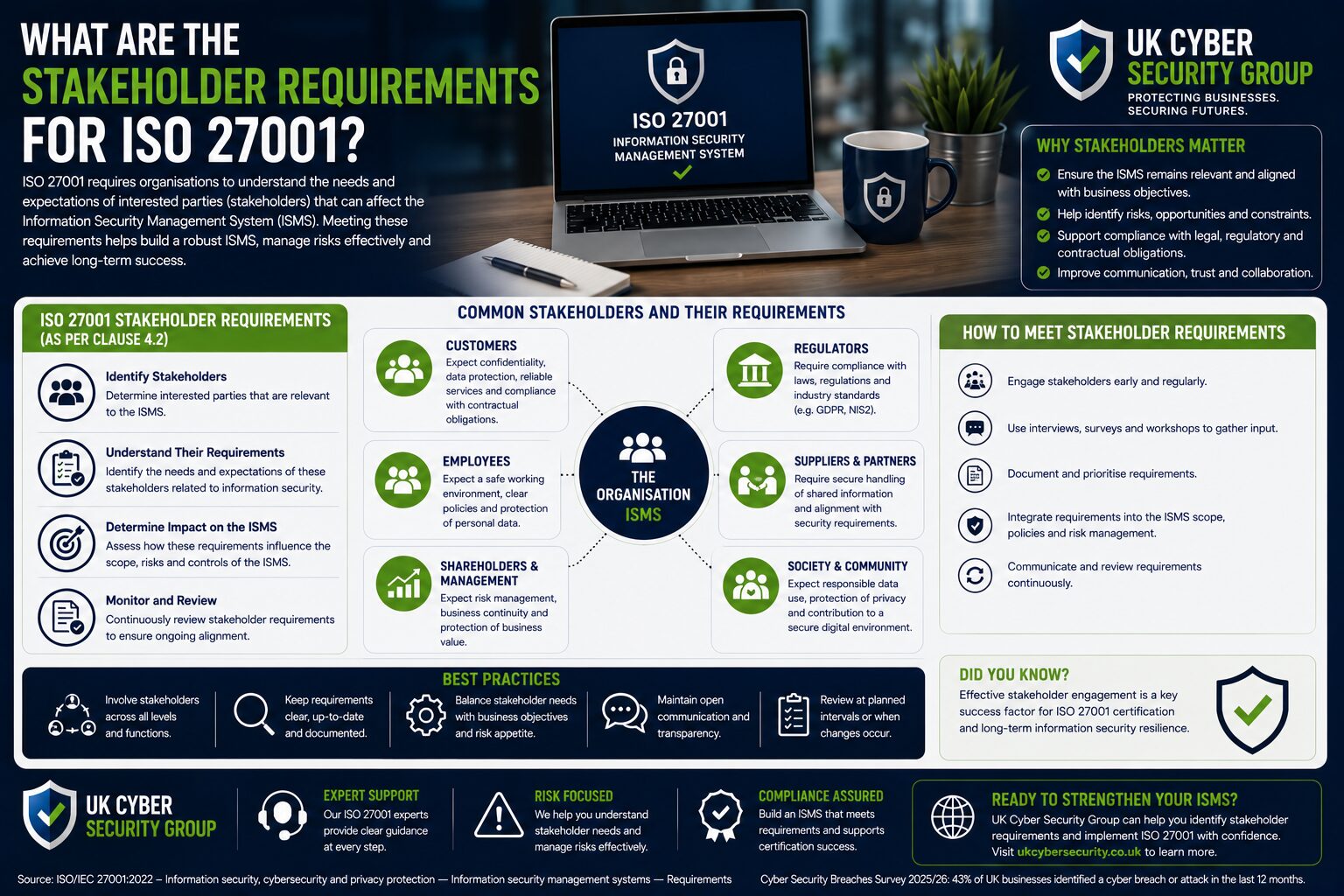
What are the stakeholder requirements for ISO 27001?
Stakeholders sit at the heart of ISO 27001. The standard is not just about ticking security boxes; it is about showing that you understand who depends on your information, what they care about, and how your controls protect those interests in a structured, auditable way.
UK Cyber Compliance (a part of UK Cyber Security Group) provides these services and has a platform to make certification much easier and cheaper.
Making sense of ISO 27001 in stakeholder terms
To unpack stakeholder requirements properly, it helps to start with a straightforward view of the standard itself.
Clarifying the core standard
What is iso 27001.
In plain language, ISO/IEC 27001 is the international management standard for information security. It sets out how an organisation should:
- Understand its context and stakeholders
- Identify and assess information security risks
- Implement controls to manage those risks
- Monitor performance and continually improve its approach
According to UK Cyber Compliance, ISO 27001 is less about ticking off requirements and more about creating a structured, resilient and trustworthy way of operating. This perspective maps directly to stakeholder thinking: you are building trust through repeatable, evidence-based security.
What is ISO 27001 Certification?
What is ISO 27001 Certification?
It is formal, independent confirmation by an accredited certification body that your information security management system (ISMS) meets the requirements of ISO/IEC 27001 and is operating effectively. In practical terms, certification shows your stakeholders that:
- You have defined the scope of your ISMS and the information it protects
- You understand the risks to that information and how they could affect people and organisations that rely on you
- You have implemented a suitable selection of controls and you can prove they are in use
- You are reviewing, auditing and improving your arrangements over time
For many customers, regulators and partners, certification is the easiest way to verify that you take their expectations seriously and that you operate to a recognised benchmark.
Who cares about ISO 27001 – and why?
Who needs iso 27001 certification
From a stakeholder perspective, Who needs iso 27001 certification comes down to three simple questions:
- Do other organisations trust you with their information or rely on your digital services?
- Would a security incident cause meaningful harm to customers, staff, partners, regulators or investors?
- Are you seeing ISO 27001 appear in tenders, due diligence questionnaires or supplier assessments?
If the answer to any of those is yes, you are already operating in a stakeholder environment where ISO 27001 matters.
Common stakeholder-driven triggers include:
- Clients insisting on ISO 27001 as a contractual requirement
- Entry into regulated markets where authorities expect structured information security governance
- Rapid growth in cloud-based services, where buyers want assurance that their data is handled securely
- Investor or board-driven demands for a recognised risk management framework
In all of these cases, certification is not just a badge; it is a structured way of showing stakeholders that you understand their requirements and can demonstrate how your controls meet them.
Stakeholders in ISO 27001: who are we talking about?
ISO 27001 explicitly expects organisations to identify “interested parties” – essentially stakeholders – and to understand their needs and expectations in relation to information security. Typical stakeholder groups include:
- Customers and end users – concerned about confidentiality, service reliability and contractual commitments
- Employees and contractors – affected by internal policies, monitoring and access controls
- Senior management and owners – accountable for risk, compliance and reputation
- Regulators and supervisory authorities – focused on legal and regulatory obligations (for example, data protection)
- Partners, suppliers and service providers – part of your extended digital supply chain
- Insurers and auditors – interested in how you manage risk and demonstrate control
- The wider public – especially where services have social or safety implications
Stakeholder requirements are essentially the expectations, obligations and concerns these groups have regarding how you manage information. ISO 27001 expects you to identify them, document them and make sure your ISMS responds to them in a structured way.
ISO 27001 Certification Levels and stakeholder maturity
ISO 27001 Certification Levels.
Strictly speaking, ISO 27001 does not define formal levels like bronze or gold. Certification is binary: you are certified, for a defined scope, or you are not.
However, stakeholders will often perceive different “levels” of assurance based on:
- Scope breadth – a certificate that covers your entire organisation and all key services can carry more weight than one that covers a single niche product
- Maturity of implementation – how well your controls are embedded in everyday operations, and how clearly you can demonstrate that they are working
- Integration with other frameworks – for example, where your ISMS supports wider risk management, operational resilience or privacy governance
From a stakeholder perspective, a narrow scope might be sufficient if it covers exactly what they rely on. For others, especially large customers or regulators, a broader scope and higher maturity can significantly increase their confidence.
How the Certification Works from a stakeholder point of view
How the Certification Works is not just a technical process; it is a stakeholder story.
Broadly, the certification journey looks like this:
- Understanding context and stakeholders
You identify who your stakeholders are, what they care about, and the internal and external issues that affect information security for your organisation. - Defining scope
You decide which parts of the business, services and information assets your ISMS will cover. Ideally this aligns with what key stakeholders expect to be covered when they see your certificate. - Assessing risks and impacts
You assess how confidentiality, integrity and availability failures could harm stakeholders – financially, operationally, legally or reputationally. - Selecting controls and policies
Based on those risks and stakeholder expectations, you choose controls from ISO 27001’s control set and document how they apply. - Implementing, training and documenting
You embed controls into processes, raise awareness with staff and generate records that show the system is working. - Internal audits and management reviews
You check your own work, identify weaknesses and demonstrate that leadership is engaged and responding. - Independent certification audit
An accredited body reviews your documentation and evidence, tests a sample of your controls and decides whether you meet the standard.
Stakeholders look at different parts of this journey:
- Customers focus on scope, controls and evidence relevant to the services they use
- Regulators pay attention to risk assessment, legal compliance and incident handling
- Boards and investors focus on governance, internal audit results and continual improvement
A mature ISMS makes it easy to tell this story in a way that each stakeholder group can understand.
Stakeholder requirements in ISO 27001 clause language
In the standard’s structure, stakeholder thinking appears explicitly in the early management clauses:
- You must determine the internal and external issues relevant to your purpose and to your information security goals
- You must determine the interested parties relevant to the ISMS and their requirements
- You must monitor and review that context over time
In practice, this means you need:
- A clear register of stakeholders and their main information security concerns
- A mapping between those concerns and your ISMS objectives, risks and controls
- Evidence that you revisit these assumptions as your business, technology and regulatory environment evolve
Stakeholder requirements often fall into three broad categories:
- Legal and regulatory requirements – for example, data protection, financial conduct rules or industry-specific standards
- Contractual requirements – promises made to customers and partners in contracts, SLAs or data processing agreements
- Voluntary or internal requirements – internal policies, codes of conduct, industry codes and ethical commitments
ISO 27001 expects your ISMS to reflect all three and to show how they influence risk treatment.
Typical stakeholder requirements in a UK context
Different stakeholder groups will emphasise different requirements. A few common ones for UK organisations include:
Customers and clients
- Evidence of secure handling of personal and commercial data
- Reliable service availability and incident response
- Clear contractual commitments on confidentiality, integrity and availability
- Assurance about third-party and supply chain security
Regulators and authorities
- Compliance with UK data protection law and related regulatory expectations
- Appropriate logging, monitoring and incident reporting arrangements
- Structured risk assessment processes, documented policies and governance
- Demonstrable training and awareness for staff handling sensitive information
Staff and internal teams
- Clear, fair acceptable use and monitoring rules
- Reliable access to systems needed for their roles
- Support and training to recognise and respond to security threats
- Confidence that the organisation handles their personal data properly
Suppliers and partners
- Clarity about what is expected of them in terms of security controls
- Realistic, proportionate contractual clauses
- Defined lines of communication during incidents and changes
Boards, investors and owners
- A clear view of major information risks and how they are managed
- Confidence that legal and contractual obligations are being met
- Evidence that security investments are targeted at real business risks
- Assurance that serious incidents will be detected, escalated and handled effectively
A well-designed ISMS draws these requirements together and turns them into objectives, controls and monitoring activities.
Turning stakeholder requirements into ISMS objectives
ISO 27001 expects you to set information security objectives that are consistent with your policy, measurable where possible and relevant to your organisation.
These objectives should reflect stakeholder requirements such as:
- Maintaining confidentiality of client data within agreed boundaries
- Meeting agreed service availability targets for critical services
- Complying with specific regulatory requirements in your sector
- Reducing the number or impact of incidents of a particular type
For example:
- If customers care deeply about uptime, you might set objectives around incident response times and system resilience.
- If regulators focus on data breach reporting, you might set objectives around detection time and investigation quality.
- If staff have raised concerns about clarity of policies, you might set objectives around training completion and policy read-and-acknowledge rates.
Stakeholder-driven objectives become a practical way to hold your ISMS accountable and show progress over time.
Risk assessment, stakeholders and impact
Risk assessment in ISO 27001 is not done in a vacuum. It is about how threats and vulnerabilities translate into consequences for stakeholders.
A mature approach will:
- Link each key information asset or process to the stakeholders who depend on it
- Assess impact in terms those stakeholders understand (for example, service disruption, financial loss, regulatory breach, reputational harm)
- Use a consistent scale that reflects stakeholder tolerances – for example, what counts as “unacceptable” downtime or data loss
When auditors examine your risk assessment, they are often looking for evidence that:
- Impact ratings make sense in business terms
- High-impact risks relate clearly to stakeholder concerns
- The controls you choose are proportionate to the potential harm
This is where stakeholder requirements, risk assessment and control selection all meet.
Communication and stakeholder engagement
Stakeholder requirements do not just affect what controls you choose; they also affect how you communicate.
A good ISO 27001 implementation considers:
- Which stakeholders need regular updates on information security performance (for example, management, boards, key clients)
- How you communicate policies and expectations to staff and contractors
- How you handle communication during incidents – who is told what, and how quickly
- What evidence you provide during tenders, audits or due diligence exercises
This communication layer is often underestimated, but it can make the difference between stakeholders seeing ISO 27001 as a tick-box exercise and seeing it as a genuine sign of maturity.
Automation, platforms and stakeholder requirements
For many organisations, especially small and mid-sized firms, meeting stakeholder expectations consistently is as much an organisational challenge as a technical one. Automated and AI-driven ISO 27001 platforms can help by:
- Providing structured ways to capture stakeholder registers and requirements
- Linking those requirements to risks, objectives and controls
- Automating reminders for reviews, audits and policy updates
- Collecting evidence that demonstrates controls are operating as claimed
This is where a service like UK Cyber Compliance’s platform comes into play. By structuring the process, it becomes easier to show stakeholders that:
- Their requirements have been understood and recorded
- Those requirements have influenced your risk treatment decisions
- You can provide proof of implementation quickly and consistently
Automation does not remove the need for stakeholder conversations, but it makes the resulting commitments easier to manage over time.
Which UK-based firms offer ISO 27001 consultancy services?
Which UK-based firms offer ISO 27001 consultancy services?
Across the UK there is an active market of:
- Specialist information security consultancies focusing on ISO 27001 design, implementation and audit readiness
- Larger professional services firms that include ISO 27001 within broader risk, assurance and cyber practices
- Certification bodies that offer readiness assessments and advisory support alongside formal auditing
They typically help organisations with:
- Stakeholder analysis and context definition
- Risk assessments and business impact assessments
- Policy and control design, including supplier and customer-facing elements
- Internal audits and preparation for external certification audits
UK Cyber Compliance (a part of UK Cyber Security Group) provides these services and has a platform to make certification much easier and cheaper.
For many organisations, a blended model works well: an automated platform to manage structure and evidence, supported by targeted consultancy to help interpret stakeholder requirements and design a risk-based response.
Keeping stakeholder requirements alive over time
Stakeholder expectations are not static. New customers arrive with different demands, laws change, services evolve and technology moves on. ISO 27001 acknowledges this by requiring:
- Regular review of context and interested parties
- Management reviews to assess whether the ISMS remains suitable, adequate and effective
- Continual improvement in response to incidents, audit findings and changing risk
From a stakeholder perspective, this means:
- You revisit which requirements are most important and whether you are still meeting them
- You adjust your objectives and controls when business priorities or regulatory expectations shift
- You treat incidents and near misses as learning opportunities, not just problems to be buried
Handled properly, this helps stakeholders see ISO 27001 as evidence that you are listening, adapting and improving, not just maintaining a static set of documents.
Bringing stakeholder requirements into everyday decisions
If you want ISO 27001 to work for your stakeholders, not just for an auditor, the key is to make stakeholder requirements visible in everyday decisions:
- When you adopt a new cloud service, do you check it against customer commitments and regulatory duties?
- When you design a new feature or product, do you consider how it affects confidentiality, integrity and availability for users?
- When you negotiate contracts, do security clauses align with what your ISMS can actually deliver?
- When you plan budgets, do you link security spending to stakeholder-driven risks and objectives rather than abstract threats?
If the answer is yes more often than no, stakeholders will recognise ISO 27001 as a living framework that genuinely protects their interests. And if you support that framework with sensible automation and the right mix of internal and external expertise, you will find it much easier to keep pace with changing expectations over time.
UK Cyber Compliance is here to help
For more information, please do get in touch.
Please check out our Free Cyber Insurance
Other blog posts, Your ISO 27001 Questions Answered, Get ISO 27001 Certified ,
If you would like to know more, do get in touch as we are happy to answer any questions. Looking to improve your cybersecurity but not sure where to start? Begin by getting certified in Cyber Essentials, the UK government’s scheme that covers all the technical controls that will provide the protection that you need to help guard against criminal attacks.