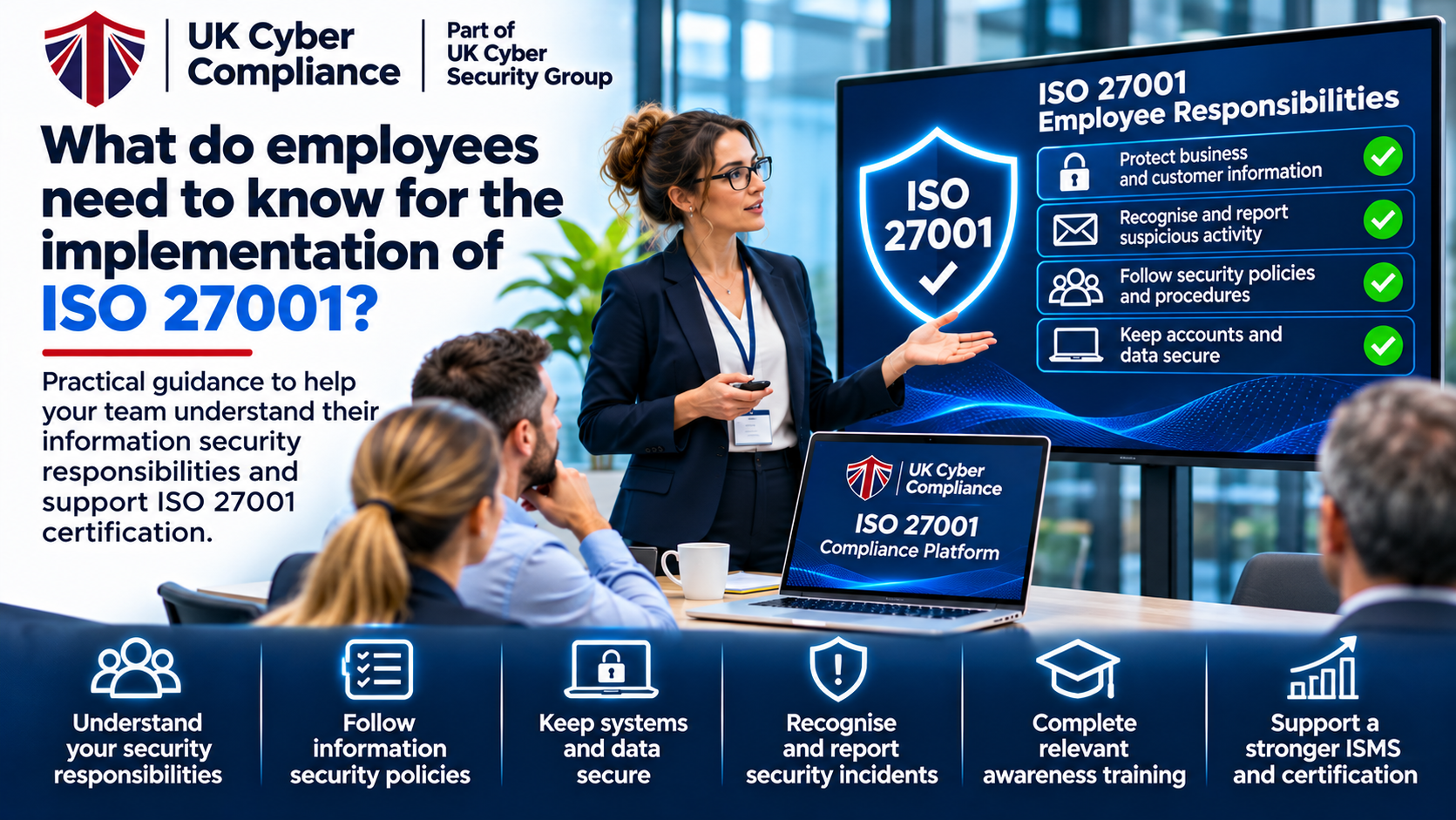
What do employees need to know for the implementation of ISO 27001
Implementing ISO 27001 is not simply about producing information security policies, completing risk assessments or preparing documentation for an external certification audit. For an organisation to achieve and maintain ISO 27001 certification, its employees must understand their responsibilities and contribute to protecting business information.
Even the most advanced security technology can become ineffective when employees do not understand how to recognise suspicious activity, protect confidential information or report a potential security incident.
This makes employee awareness, competence and communication essential parts of an effective Information Security Management System (ISMS).
Employees need to understand the information security policies relevant to their work, the responsibilities associated with their roles and how their actions contribute to the organisation’s information security objectives.
However, organisations do not need to turn every employee into an information security specialist.
The aim is to ensure that people understand the security requirements that affect their everyday activities.
For example, an employee working in finance should understand how to recognise fraudulent payment requests. A human resources employee needs to know how to protect confidential personnel information. Someone responsible for managing IT systems requires additional knowledge of the security controls within their area of responsibility.
Providing appropriate guidance to these employees helps organisations reduce risk, improve security awareness and demonstrate compliance with ISO 27001.
For many UK businesses, managing these requirements can be challenging, particularly when they lack dedicated information security personnel.
This is where UK Cyber Compliance provides a practical solution.
UK Cyber Compliance, part of UK Cyber Security Group Ltd, offers an automated and AI-driven compliance platform designed to simplify ISO 27001 preparation and ongoing Information Security Management System activities.
The platform helps organisations manage information security risks, prepare policies, establish responsibilities, monitor compliance progress and organise documentation for independent audits.
By reducing repetitive administrative work, UK Cyber Compliance makes preparing for ISO 27001 certification more straightforward and potentially more affordable.
Businesses can explore the platform at www.ukcybercompliance.co.uk.
Understanding what employees need to know is an important starting point for building a security-conscious organisation and preparing for successful ISO 27001 certification.
Why employees play such an important role in ISO 27001
Information security involves much more than protecting computer networks.
Organisations handle information through conversations, emails, business applications, paper documents and everyday operational activities.
Employees make decisions that affect the confidentiality, integrity and availability of that information.
These decisions can influence whether security controls operate effectively.
For example, a business may have appropriate procedures for protecting customer records. However, if an employee sends confidential information to an unauthorised recipient, the business may experience an information security incident.
Similarly, an organisation may establish an incident reporting process, but that process has limited value if employees do not know how to use it.
Security is a shared responsibility
ISO 27001 requires organisations to establish appropriate responsibilities for managing information security.
Senior management must demonstrate leadership and commitment.
Managers must understand the obligations associated with their departments.
Employees need to follow the policies and procedures relevant to their work.
Specialist personnel require the competence necessary to perform assigned security activities.
These responsibilities work together to support the ISMS.
Why awareness cannot remain an IT responsibility
IT departments often manage technical security controls, but they cannot control every decision employees make.
A finance employee may receive a convincing fraudulent invoice.
A manager may share commercially sensitive information with an external supplier.
A remote worker may access confidential records from an inappropriate location.
These situations require employees to apply sound judgement and follow relevant organisational requirements.
A successful ISO 27001 programme therefore involves the whole organisation rather than relying exclusively on technical personnel.
What ISO 27001 requires employees to understand
ISO/IEC 27001:2022 contains several requirements concerning employee competence, awareness and communication.
These appear within Clause 7, which addresses the resources and support necessary for an effective ISMS.
Three requirements are particularly relevant.
Clause 7.2: Competence
Organisations must determine the competence necessary for people whose work affects information security performance.
They must ensure that those individuals possess appropriate competence through education, training or experience.
Where further development is necessary, the business must take appropriate action and evaluate its effectiveness.
The organisation must also retain suitable documented evidence of competence.
For example, an employee responsible for managing information security risks should understand the organisation’s risk assessment methodology.
A person responsible for conducting internal audits should have sufficient competence to perform those audits effectively and impartially.
Simply assigning a responsibility does not demonstrate that the employee can perform it.
Clause 7.3: Awareness
People working under the organisation’s control must understand the information security policy, how they contribute to an effective ISMS and the implications of failing to meet relevant requirements.
This means employees need more than access to a document.
They should understand the expectations associated with their work and the importance of following appropriate procedures.
For example, an employee should know that reporting a suspected security incident promptly can help reduce potential harm.
Clause 7.4: Communication
ISO 27001 also requires organisations to determine relevant internal and external ISMS communications.
This includes deciding what information needs communicating, when communication should occur, who needs to receive it and which communication methods are appropriate.
Businesses should establish arrangements suited to their operations.
These might include onboarding sessions, team meetings, policy updates and security awareness communications.
The objective is to ensure that the right information reaches the right people.
Employees must understand the information security policy
The organisation’s information security policy provides an important foundation for its ISMS.
Employees need to understand the requirements relevant to their responsibilities.
They do not necessarily need to memorise every paragraph.
However, they should understand the policy’s purpose, where to access it and how it affects their work.
What should employees know?
Employees should understand the organisation’s commitment to protecting information.
They should recognise why confidentiality, integrity and availability matter.
They must also know which security requirements apply to their role and where to obtain clarification.
For example, an employee who handles customer information should understand the organisation’s rules for sharing that information with external parties.
A manager may need additional knowledge of access approval responsibilities.
Why policy acknowledgement alone is insufficient
Some organisations ask employees to confirm that they have read a security policy.
This provides useful evidence of communication.
However, clicking an acknowledgement button does not automatically prove understanding.
An employee might confirm that they have read the policy but remain unsure how to respond to suspicious activity.
Businesses should therefore consider whether employees can apply relevant requirements in realistic situations.
Protecting confidential business and customer information
One of the most important responsibilities employees have is protecting information.
Businesses frequently hold customer records, employee details, financial information, commercial agreements and intellectual property.
Not all information requires identical protection.
Employees need to understand how their organisation determines information sensitivity and the requirements associated with handling it.
Information classification
ISO 27001 Annex A includes controls concerning information classification and handling.
Organisations should determine appropriate arrangements according to their security risks and business requirements.
For example, a business may distinguish between public information, internal business records and confidential customer information.
Employees should understand the classifications used by their organisation and what those classifications mean.
Sharing information appropriately
Employees should know when they can share information and which approvals may be necessary.
For example, a commercial document containing confidential customer information should not be shared with an unrelated external party without appropriate authorisation.
Employees should also understand the importance of checking recipients and following approved communication arrangements.
Handling information outside the office
Remote working and business travel can create additional information security risks.
Employees need to understand how organisational policies apply when they work away from company premises.
This includes protecting confidential information from unauthorised viewing and following approved arrangements for accessing business systems.
The organisation should provide clear guidance appropriate to its working practices.
Recognising phishing and social engineering attacks
Phishing remains one of the most common cyber security threats facing UK businesses.
Attackers frequently attempt to deceive employees into disclosing information, opening malicious content or approving fraudulent activity.
These attacks can appear convincing.
A message may impersonate a colleague, customer, supplier or trusted organisation.
Employees therefore need to understand how to recognise suspicious requests.
Warning signs employees should recognise
Potential warning signs include unexpected requests for confidential information, unusual payment instructions, suspicious links and urgent messages that pressure employees to act without verification.
However, not every malicious message contains obvious spelling mistakes or unusual formatting.
Attackers can create professional-looking communications.
Employees should therefore follow appropriate verification procedures rather than relying exclusively on how convincing a message appears.
Why independent verification matters
Consider a finance employee who receives an email apparently from a supplier requesting a change to bank details.
The message may use familiar language and contain accurate information.
However, the organisation should have a suitable process for verifying significant payment changes independently.
Employees need to understand that process and know when to use it.
Reporting suspicious messages
Staff should also know how to report potential phishing attempts.
The reporting method must reflect the organisation’s approved procedures.
Employees should not feel discouraged from raising concerns simply because they are uncertain whether a message is malicious.
Timely reporting can help an organisation investigate suspicious activity before further harm occurs.
Understanding passwords and account security
Employees frequently use accounts to access business systems and information.
These accounts may provide access to confidential data or important operational services.
Protecting authentication information therefore forms an important part of information security awareness.
Keeping credentials confidential
Employees should understand that passwords and other authentication credentials require appropriate protection.
They should follow the organisation’s account security requirements and avoid sharing credentials with colleagues.
Where the organisation uses approved password management arrangements, employees should understand the associated responsibilities.
Multi-factor authentication
Multi-factor authentication provides additional protection for relevant accounts.
Employees should understand why the organisation requires additional authentication checks.
They also need to recognise suspicious authentication requests.
For example, an unexpected approval request may indicate that someone is attempting to access an account without authorisation.
Staff should know how to report these concerns.
Individual accountability
Employees should understand why sharing user accounts can create security problems.
Individual accounts help organisations manage permissions and maintain accountability.
Where additional access is necessary, employees should follow the appropriate request and approval process.
Access permissions and employee responsibilities
ISO 27001 requires organisations to manage information security risks associated with access to information and supporting systems.
Employees should understand that access permissions depend on legitimate business requirements.
Not everyone needs unrestricted access to every system.
The principle of least privilege
Least privilege involves providing individuals with the access necessary to perform their responsibilities without granting unnecessary permissions.
For example, a customer service employee may require access to customer records but not confidential financial administration information.
Employees should understand that restrictions exist to protect information, not simply to make their work more difficult.
Changes in employee roles
Access requirements can change when employees move between departments or take on different responsibilities.
Managers should understand their role in communicating relevant changes.
Employees should follow the organisation’s process when requesting additional permissions.
This helps maintain appropriate access arrangements throughout employment.
Employees need to know how to report security incidents
Security incident reporting is one of the most practical aspects of ISO 27001 awareness.
Employees may identify potential incidents before security personnel become aware of them.
However, reporting arrangements only work when staff understand what to report and whom to contact.
What might constitute an information security incident?
Examples include a lost company device, suspected account compromise, accidental disclosure of confidential information, unusual system behaviour or unauthorised access to business records.
Not every concern will become a confirmed security incident.
Nevertheless, employees should understand when their organisation expects them to raise a report.
What information should employees provide?
The organisation may ask employees to describe what happened, when they noticed it and which systems or information might be affected.
Employees should follow the approved reporting process and avoid taking unauthorised actions that could complicate an investigation.
Why early reporting matters
Prompt reporting gives the organisation an opportunity to investigate and respond.
An employee who accidentally shares confidential information should understand the importance of reporting the mistake rather than hiding it.
A constructive reporting culture helps businesses identify weaknesses and improve their security arrangements.
Cyber security statistics highlight the importance of employee awareness
The UK Government’s Cyber Security Breaches Survey 2025/2026 provides useful evidence about the challenges facing UK organisations.
Published on 30 April 2026, the research found that 43% of UK businesses identified a cyber security breach or attack during the preceding twelve months.
This represents approximately 612,000 businesses.
Among medium businesses, 65% identified a breach or attack.
The figure increased to 69% among large businesses.
Phishing remained the most commonly identified attack, affecting 38% of businesses.
These statistics reflect incidents organisations detected and reported rather than every attack that may have occurred.
Employee awareness remains limited
The same Government research found that only 19% of UK businesses reported undertaking staff cyber security training or awareness activities during the previous twelve months.
The proportion varied considerably according to business scale.
Only 14% of micro businesses reported undertaking these activities, compared with 33% of small businesses, 54% of medium businesses and 84% of large businesses.
These findings suggest that many smaller organisations still have opportunities to improve employee security awareness.
Incident response preparation is another concern
The survey also found that only 25% of businesses reported having a formal incident response plan.
This highlights the importance of clear reporting arrangements and defined responsibilities.
ISO 27001 helps organisations approach these issues through structured information security management.
The standard does not guarantee protection against every cyber attack, but it supports a systematic approach to understanding and managing relevant risks.
Employees must understand their responsibilities during remote working
Remote working remains common across many UK organisations.
Employees may access business information from home, customer premises or other approved locations.
These arrangements can provide flexibility, but they also create information security responsibilities.
Protecting company information
Employees should understand how to protect business information when working away from company premises.
For example, staff should avoid exposing confidential information to unauthorised individuals.
They should follow the organisation’s requirements for handling documents, communicating with customers and using approved equipment.
Reporting lost equipment
Employees need to understand what to do if a company laptop, mobile device or other relevant asset becomes lost or stolen.
The organisation should establish an appropriate reporting process.
Staff should know how to contact the responsible person without unnecessary delay.
Respecting approved working arrangements
Remote workers should understand that information security policies apply regardless of location.
The organisation must communicate its expectations clearly and provide suitable guidance.
What employees need to know about physical security
ISO 27001 considers physical security as well as digital information.
Employees may work in offices, warehouses, engineering facilities or other environments containing important business assets.
Physical security requirements depend on the organisation’s risks and activities.
Protecting restricted areas
Employees should understand whether particular areas require restricted access.
For example, a business may limit access to rooms containing sensitive information or critical equipment.
Staff should follow the organisation’s relevant access arrangements.
Visitors and contractors
Employees may have responsibilities when dealing with visitors or external contractors.
They should understand the procedures that apply to authorised visitors and know how to respond to unexpected access requests.
Protecting paper records
Not all important information exists electronically.
Printed customer details, contracts and employee records may require appropriate protection.
Businesses should explain how staff must handle relevant paper documents according to the organisation’s information security policies.
Understanding information security risks
ISO 27001 requires organisations to identify, assess and manage information security risks.
Most employees do not need to conduct formal risk assessments.
However, they should understand that everyday activities can influence information security risk.
Recognising changes that affect security
Employees may become aware of changes before those changes appear in formal management records.
For example, a department may begin using a new online service to process customer information.
Another team may change the way confidential documents are shared with suppliers.
These changes could affect the organisation’s information security risks.
Employees should know when such changes require management review or approval.
Risk awareness is not the same as risk assessment competence
A general employee should understand relevant risk awareness messages.
However, someone responsible for conducting formal risk assessments requires appropriate competence.
The organisation must determine the knowledge necessary for that responsibility.
UK Cyber Compliance provides structured risk assessment capabilities that help businesses identify, evaluate and manage relevant risks.
Why employee awareness needs to reflect individual roles
A single general awareness session may provide a useful foundation.
However, employees have different responsibilities.
Organisations should consider whether some roles require additional information or specialist competence.
| Employee role | Important knowledge |
|---|---|
| All employees | Security policies, information handling, suspicious messages and incident reporting |
| Senior management | ISMS leadership, security objectives, risk accountability and resources |
| Department managers | Relevant security responsibilities, access approvals and operational risks |
| Finance employees | Payment fraud, confidentiality and suspicious financial requests |
| Human resources employees | Personnel confidentiality, access permissions and employee records |
| IT administrators | Relevant technical controls, account management and incident responsibilities |
| Customer-facing employees | Customer information protection and appropriate communication |
| Contractors | Security requirements relevant to their authorised work |
The actual requirements depend on the organisation.
Businesses should determine suitable awareness and competence activities according to their risk assessment and operational responsibilities.
Employees need to understand the importance of security policies
An effective ISMS includes documented information that supports the organisation’s security responsibilities.
Employees should know which policies apply to their roles.
These may cover acceptable use, access control, information handling, remote working, incident reporting and other relevant activities.
However, the standard does not require every employee to memorise every document.
Turning policies into everyday behaviour
An organisation should communicate policies in a way employees can understand.
For example, a confidentiality policy may require employees to follow approved arrangements when sharing customer information.
An incident reporting policy may explain whom to contact when a security concern occurs.
Employees should understand these practical expectations.
Why documents must reflect reality
A policy that describes activities the organisation never performs does not provide meaningful assurance.
For example, a business might maintain a policy stating that employees receive regular awareness updates.
If those activities do not occur, the documentation may fail to reflect actual practice.
UK Cyber Compliance supports organisations by providing AI-assisted policy generation and structured compliance documentation.
However, management must review and approve the content and ensure that the organisation follows its stated arrangements.
What is ISO 27001 Certification?
ISO 27001 certification provides independent assurance that an organisation’s Information Security Management System meets the requirements of ISO/IEC 27001.
The current core standard is ISO/IEC 27001:2022, together with its published 2024 amendment.
The standard provides requirements for establishing, implementing, maintaining and continually improving an ISMS.
Certification normally involves an independent assessment of the organisation’s management system.
The auditor examines documented information, risk management, security controls and evidence that the ISMS operates effectively.
Employee competence and awareness form part of this wider assessment.
Why employees matter during certification audits
An auditor may speak with employees to understand whether the organisation’s security requirements operate in practice.
For example, an employee may need to explain how they report a suspected incident.
A manager may need to describe relevant information security responsibilities.
The purpose is to assess the effectiveness of the ISMS rather than test whether employees have memorised the standard.
Businesses should therefore focus on genuine understanding rather than coaching employees to repeat prepared answers.
what is iso 27001
ISO 27001 is an international standard that establishes requirements for managing information security.
The International Organization for Standardization and International Electrotechnical Commission jointly publish the standard.
It applies to organisations across many industries and sectors.
ISO 27001 provides a framework for addressing risks affecting the confidentiality, integrity and availability of information.
The standard considers people, processes and technology.
Why employees should understand the ISMS
An ISMS helps organisations establish a consistent approach to information security management.
Employees should understand how their everyday responsibilities support its effectiveness.
For example, following appropriate access restrictions helps protect confidential information.
Reporting suspicious activity supports incident management.
Recognising changes that may affect security helps the organisation maintain accurate risk information.
These activities contribute to the wider management system.
How the Certification Works
ISO 27001 certification involves establishing an effective ISMS and completing an independent certification assessment.
UK Cyber Compliance supports organisations with preparing and maintaining the management system.
However, an independent certification body conducts the formal audit and makes the certification decision.
Establishing the ISMS
The organisation begins by understanding its circumstances, identifying relevant interested parties and defining its ISMS scope.
Management then establishes information security objectives, assesses risks and determines appropriate controls.
Employee responsibilities and competence requirements form part of this process.
UK Cyber Compliance provides guided workflows that help organisations organise these activities.
Demonstrating operational effectiveness
The business must operate its ISMS and maintain suitable evidence.
This includes relevant risk management activities, internal audits, management reviews and other necessary processes.
Employee awareness and competence should support the effective operation of the management system.
Stage 1 audit
An independent certification body conducts an initial assessment of the organisation’s ISMS documentation and readiness.
The auditor considers whether the organisation has established an appropriate foundation for the next stage.
Stage 2 audit
Stage 2 examines the implementation and effectiveness of the ISMS.
The auditor reviews relevant records, processes and security arrangements.
This may include discussions with employees.
Successful assessment can lead to certification following the certification body’s independent decision.
Maintaining certification
ISO 27001 certification normally follows a three-year certification cycle.
Surveillance audits generally take place during that period, followed by recertification before the certificate expires.
Organisations must continue maintaining and improving their ISMS.
Employee awareness and competence remain relevant throughout this period.
ISO 27001 Certification Levels
Some businesses search for different ISO 27001 certification levels.
However, ISO/IEC 27001 does not establish Bronze, Silver, Gold or other graded certification categories.
An organisation either meets the requirements of the standard within the agreed certification scope or it does not.
Why employee requirements differ between organisations
Although ISO 27001 does not have formal certification grades, organisations may have different operational needs.
A small consultancy may employ only a few people and operate a relatively straightforward ISMS.
A larger company may have several departments, numerous business systems and more complex security responsibilities.
The organisation must establish appropriate arrangements according to its circumstances.
Awareness does not need to be unnecessarily complicated
Employees do not need extensive technical training simply because their organisation seeks ISO 27001 certification.
Instead, the business should determine the awareness and competence necessary for each role.
This helps organisations provide meaningful guidance without placing unnecessary demands on employees.
Who needs iso 27001 certification
ISO 27001 can benefit organisations that handle important information or need to demonstrate effective information security management.
Technology companies, professional services businesses, engineering organisations, healthcare providers and managed service providers may all benefit.
Some customers also require ISO 27001 certification through contractual arrangements.
Why employees matter in every industry
A technology employee may manage customer infrastructure.
A legal professional may handle confidential documents.
An engineering employee may access commercially sensitive designs.
A healthcare organisation may process sensitive personal information.
Although their activities differ, each organisation needs appropriate security responsibilities.
Employee awareness helps establish consistent information security practices across different working environments.
Annex A controls that employees should understand
ISO/IEC 27001:2022 includes 93 reference security controls within Annex A.
These controls fall into four groups: organisational, people, physical and technological controls.
The organisation must determine which controls are necessary according to its information security risks and relevant obligations.
It must also compare those controls with Annex A to ensure that necessary safeguards have not been overlooked.
Several Annex A controls are particularly relevant to employee awareness.
Annex A 6.3: Information security awareness, education and training
This control addresses appropriate security awareness, education and training for personnel and relevant interested parties.
The activities should reflect responsibilities and applicable security requirements.
Annex A 5.10: Acceptable use of information and associated assets
Employees should understand relevant acceptable use requirements.
This helps protect business information and supporting assets.
Annex A 5.12: Classification of information
Information classification supports appropriate protection according to information security needs.
Employees should understand the organisation’s classification arrangements where relevant.
Annex A 6.8: Information security event reporting
Employees should know how to report suspected or observed information security events through appropriate channels.
Clear reporting arrangements can help organisations investigate concerns promptly.
How UK Cyber Compliance supports ISO 27001 employee responsibilities
UK Cyber Compliance provides an automated, AI-driven platform designed to simplify ISO 27001 compliance preparation and ongoing management.
The system helps organisations manage important ISMS requirements through structured workflows.
Guided compliance activities
The platform supports important activities including organisational context, ISMS scope, risk assessment and control management.
This helps businesses understand how information security responsibilities connect with wider compliance requirements.
AI-assisted policy generation
UK Cyber Compliance provides AI-powered tools for preparing information security documentation.
Organisations can use these tools to support policy development while reviewing the content to ensure accuracy.
Relevant policies can then inform employee communication and awareness activities.
Risk assessment and control management
The platform supports the identification, evaluation and treatment of information security risks.
This helps organisations identify where employee responsibilities and security controls may need attention.
Team and access management
UK Cyber Compliance advertises multi-user access and role-based permissions for managing compliance activities.
These capabilities can support collaboration between management and relevant employees.
Real-time progress tracking
The platform includes compliance dashboards that help organisations monitor completed activities and outstanding requirements.
This can support management oversight during ISO 27001 preparation.
Expert consultancy support
UK Cyber Compliance also provides access to professional consultation support.
Businesses can obtain assistance when they require additional guidance on ISO 27001 requirements.
Specific employee training delivery and assessment arrangements should be confirmed with the UK Cyber Compliance team.
How businesses can demonstrate employee awareness to an auditor
An independent ISO 27001 auditor may examine how the organisation manages employee competence and awareness.
Businesses should retain suitable evidence of relevant activities.
However, evidence should accurately reflect what has occurred.
Training and awareness records
Organisations may maintain records of relevant awareness sessions, communications and training activities.
These records can help demonstrate that employees received appropriate information.
Competence evidence
For roles requiring specialist competence, organisations must retain appropriate documented evidence.
This may include relevant qualifications, experience, training or other suitable evidence.
Policy communication
Businesses may retain information showing how relevant policies were communicated.
However, the organisation should also consider whether employees understand and follow the requirements.
Evaluating effectiveness
Management should evaluate whether its awareness and competence activities achieve their intended outcomes.
For example, relevant discussions, knowledge checks or work reviews may help identify areas requiring further support.
A practical employee awareness checklist
Businesses preparing for ISO 27001 can use the following checklist to review employee understanding.
Information security responsibilities
Do employees understand the security requirements relevant to their roles?
Company policies
Can employees locate and explain the policies that affect their work?
Confidential information
Do employees understand how to protect and share sensitive information appropriately?
Suspicious communications
Can employees recognise potential phishing and impersonation attempts?
Account security
Do employees understand the organisation’s password, authentication and access requirements?
Incident reporting
Do employees know how to report suspected security incidents?
Remote working
Do employees understand relevant security responsibilities when working away from company premises?
Physical security
Can employees follow appropriate arrangements for protecting facilities, equipment and documents?
Risk awareness
Do employees know when operational changes or concerns may require management attention?
Specialist competence
Does the organisation understand which roles require additional knowledge or experience?
This checklist can provide a useful starting point for reviewing employee awareness.
However, the organisation should adapt it according to its actual risks, activities and responsibilities.
Common mistakes businesses should avoid
Employee awareness programmes can become ineffective when organisations treat them as purely administrative exercises.
Several problems deserve particular attention.
Relying exclusively on policy acknowledgements
Employees may confirm that they have read a policy without understanding how it applies to their work.
Businesses should consider whether staff can demonstrate practical awareness.
Providing identical training for every employee
General awareness provides a useful foundation, but specialist roles may require additional competence.
The organisation should assess relevant needs.
Ignoring temporary workers and contractors
People working under the organisation’s control may have relevant information security responsibilities even when they are not permanent employees.
Suitable awareness arrangements should reflect those responsibilities.
Failing to review awareness after changes
New systems, operational changes and emerging threats may affect what employees need to know.
Businesses should review their communication and awareness arrangements accordingly.
Treating certification as the end of the process
Employee awareness remains relevant after ISO 27001 certification.
The organisation must continue operating and improving its ISMS.
Which UK-based firms offer ISO 27001 consultancy services?
UK businesses can obtain ISO 27001 consultancy from specialist information security consultancies, cyber security service providers and experienced management system professionals.
Consultancy may help organisations understand the standard, establish an ISMS, manage information security risks and prepare for independent certification.
Support may also include employee awareness planning, competence assessment and management responsibilities.
UK Cyber Compliance and UK Cyber Security Group
UK Cyber Compliance is part of UK Cyber Security Group Ltd.
The platform provides automated ISO 27001 compliance management, AI-assisted policy generation, risk assessment capabilities and structured workflows.
Businesses can use these tools to organise important compliance activities while obtaining professional guidance where necessary.
The wider UK Cyber Security Group also provides cyber security services that can support practical security improvements.
This combination offers businesses an alternative to managing ISO 27001 preparation entirely through manual documentation.
Making ISO 27001 preparation more affordable
Traditional compliance preparation can involve significant administrative work.
UK Cyber Compliance aims to reduce unnecessary effort through automation, guided processes and AI-assisted documentation.
This can help organisations make more effective use of internal resources.
Actual savings depend on the organisation’s scope, existing security arrangements and professional support requirements.
The formal certification audit remains a separate independent assessment.
What employees should remember about ISO 27001
Most employees do not need detailed knowledge of every ISO 27001 requirement.
Instead, they should understand a few essential principles.
Protect business and customer information according to the organisation’s policies.
Recognise suspicious activity and follow appropriate verification procedures.
Keep authentication information secure.
Respect access permissions.
Report suspected information security incidents promptly.
Follow relevant requirements when working remotely or handling confidential documents.
Ask for clarification when security responsibilities are unclear.
Employees with specialist responsibilities must also possess the competence necessary to perform their assigned activities.
These expectations help establish a security-conscious organisation and support the effective operation of its ISMS.
Make employee awareness part of everyday business
Successful ISO 27001 implementation depends on more than documentation and technology.
Employees must understand the information security responsibilities relevant to their work.
Management needs to communicate clear expectations, support appropriate competence and establish suitable reporting arrangements.
The organisation must also ensure that information security practices remain effective as business activities change.
Employees do not need to become ISO 27001 experts, but they must understand how their everyday decisions influence information security.
For businesses preparing for certification, UK Cyber Compliance provides a structured platform that can help manage many of these responsibilities.
Its automated workflows, AI-assisted documentation, risk management capabilities and progress tracking help organisations organise their ISMS and prepare for independent assessment.
As part of UK Cyber Security Group Ltd, UK Cyber Compliance combines technology-driven compliance management with access to professional cyber security expertise.
Prepare your employees and your business for ISO 27001 with UK Cyber Compliance
Achieving ISO 27001 certification requires a systematic approach to information security.
Employee awareness, competence and communication form essential parts of that process.
Businesses need to establish clear responsibilities, provide appropriate guidance and demonstrate that their security arrangements operate effectively.
UK Cyber Compliance provides an automated and AI-driven platform designed to simplify ISO 27001 preparation and ongoing compliance management.
The platform supports information security risk assessment, documentation, control management, progress tracking and audit readiness.
By reducing repetitive administration and providing structured guidance, UK Cyber Compliance can make the journey towards ISO 27001 certification more manageable and potentially more affordable.
Discover how UK Cyber Compliance can help your organisation prepare for ISO 27001 certification while building a stronger information security culture.
Visit www.ukcybercompliance.co.uk to explore the platform.
Businesses can also review the UK Cyber Compliance services for further information about ISO 27001 compliance management and available professional support.
With appropriate employee awareness, clear responsibilities and a structured ISMS, organisations can improve information security and prepare more confidently for independent ISO 27001 certification.
UK Cyber Compliance is here to help
For more information, please do get in touch.
Please check out our Free Cyber Insurance
Other blog posts, Your ISO 27001 Questions Answered, Get ISO 27001 Certified ,
If you would like to know more, do get in touch as we are happy to answer any questions. Looking to improve your cybersecurity but not sure where to start? Begin by getting certified in Cyber Essentials, the UK government’s scheme that covers all the technical controls that will provide the protection that you need to help guard against criminal attacks.