
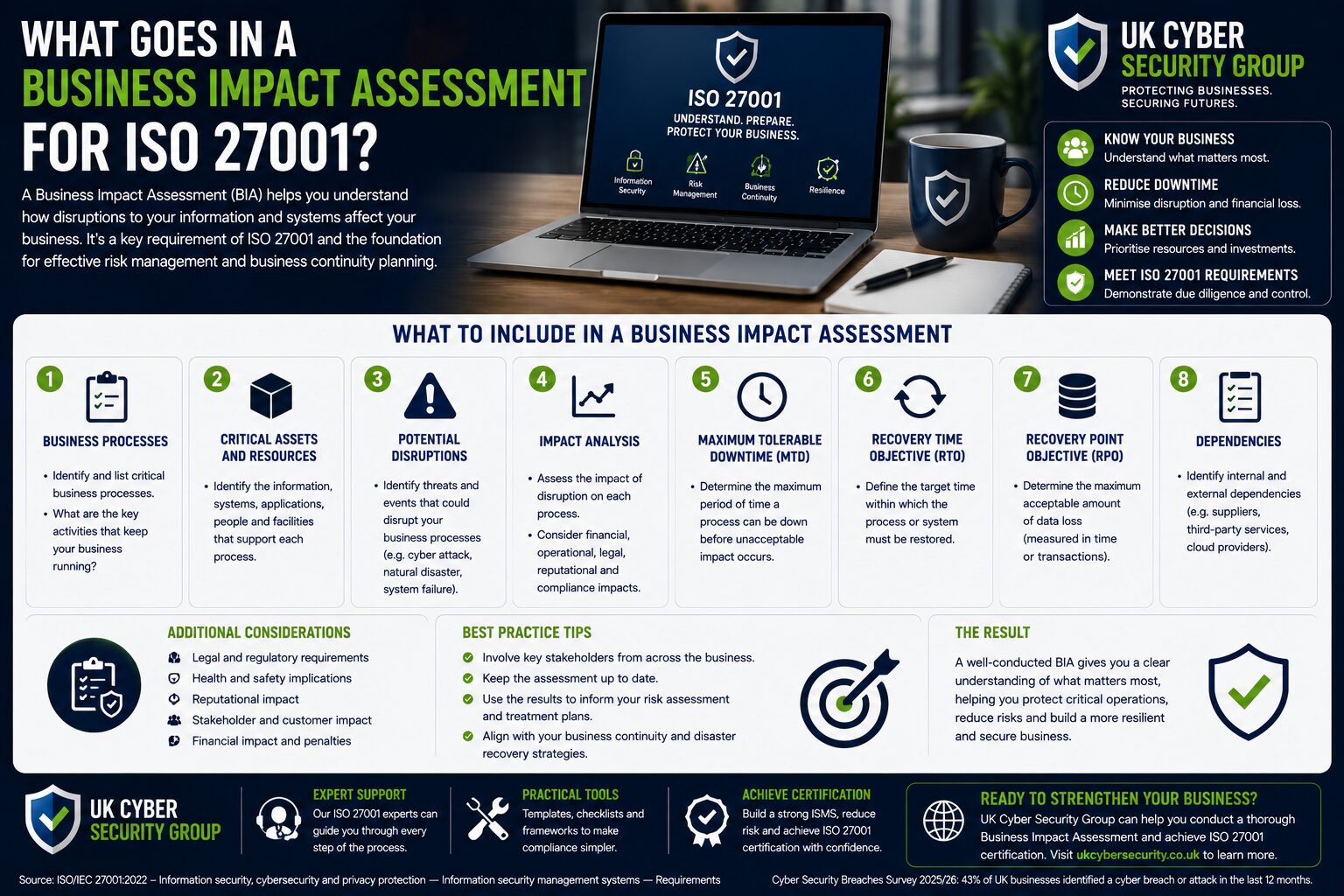
A business impact assessment for ISO 27001 is the structured way you work out what really hurts your organisation if information or systems are disrupted. It gives you evidence to justify controls, set priorities and explain to auditors why you have focused your effort where you have.
What goes in a business impact assessment for ISO 27001?
UK Cyber Compliance (a part of UK Cyber Security Group) provides these services and has a platform to make certification much easier and cheaper.
Setting the scene: ISO 27001, risk and why BIA matters
To understand what belongs in a business impact assessment for ISO 27001, it helps to be clear on the standard itself and how it handles risk.
At its core, what is iso 27001? It is an international standard that specifies requirements for establishing, implementing, maintaining and continually improving an information security management system, or ISMS. An ISMS is a structured way of managing information security based on risk, governance and continual improvement, rather than a collection of tools.
ISO 27001 requires management to:
- Systematically examine information security risks, taking account of threats, vulnerabilities and business impacts
- Implement a coherent set of controls to treat unacceptable risks
- Maintain an overarching management process to ensure those controls stay effective over time
The 2022 revision of ISO 27001 streamlined Annex A from 114 to 93 controls and regrouped them into four themes – organisational, people, physical and technological – making implementation more manageable.[1] The management clauses (4 to 10) cover scope, leadership, risk treatment, resources, daily operation, review and improvement.
A business impact assessment (often called BIA) sits alongside risk assessment. In simple terms:
- Risk assessment focuses on likelihood and potential threats.
- BIA focuses on the consequences for the business if certain processes, information or systems are disrupted.
For ISO 27001, impact thinking is essential because the standard expects you to consider confidentiality, integrity and availability when assessing risks. A BIA helps you quantify and compare those impacts in a consistent way so your risk treatment makes sense.
Some consultancy and audit guidance explicitly links BIA with ISO 27001, describing it as a way to evaluate the effects of loss of confidentiality, integrity and availability on processes and services. That evaluation then feeds into the ISMS risk assessment and the selection of controls.
Key questions: who needs ISO 27001 and what does certification involve?
Before diving into BIA detail, it is worth addressing the specific phrases you requested, as they are questions many UK organisations genuinely ask when considering ISO 27001 and supporting activities like BIA.
Who benefits from certification?
Who needs iso 27001 certification
In practice, certification is most relevant when:
- Customers, especially larger enterprises or public sector bodies, ask for it in tenders and supplier questionnaires
- You process significant volumes of personal data, financial data or other sensitive information
- Regulators or industry bodies expect structured information security governance
- You provide cloud or managed services where clients rely heavily on your security posture
ISO 27001 is widely adopted as a reference framework for managing information risk and is increasingly seen as a baseline expectation for serious digital service providers. If any of the scenarios above apply, you are likely to benefit from, or eventually need, certification and the structured risk and impact thinking that goes with it.
Clarifying the basics
What is ISO 27001 Certification?
It is an independent assessment by an accredited certification body confirming that your ISMS meets the ISO/IEC 27001 requirements and is operating effectively. To achieve it, you must:
Certification shows stakeholders that your security is based on a recognised, auditable framework rather than informal practices.
ISO 27001 Certification Levels
The standard itself does not define formal graded levels such as bronze, silver or gold. You are either certified or you are not, for a defined scope.[3] What varies in reality is:
- The breadth of the scope you choose (for example, one service vs the whole organisation)
- The maturity of your ISMS, including how integrated it is with other business processes and how well it is supported by automation and monitoring
From a BIA point of view, broader scopes and higher maturity usually mean you need a more structured and well-documented impact assessment.
How the Certification Works
The certification cycle usually follows these steps:
- Define ISMS scope and context
- Perform a gap assessment against ISO 27001 requirements
- Conduct formal risk assessment and, where appropriate, BIA
- Design and document policies, controls and procedures
- Implement controls and gather evidence of operation
- Run internal audits and management reviews
- Undergo a stage 1 document review and stage 2 implementation audit by a certification body
Once certified, you are subject to periodic external audits to confirm that the ISMS, including its supporting BIAs and risk assessments, remains effective.
Where a business impact assessment fits into ISO 27001
A BIA is not explicitly named as a mandatory document in ISO 27001, but the logic behind it is built into the standard.
ISO 27001 requires organisations to:
- Determine risks related to loss of confidentiality, integrity and availability of information
- Evaluate those risks and decide which need treatment
- Select controls that are appropriate to the level of risk and business impact
Guidance on risk assessment for ISO 27001 notes that impact should reflect potential harm to operations, customers, legal obligations and reputation if information or services are compromised. A structured BIA is one of the best ways to make that assessment rigorous and repeatable.
Typical reasons to carry out a BIA as part of ISO 27001 work include:
- Prioritising which processes and systems need the strongest protection
- Justifying controls such as backup, resilience and incident response
- Providing a business-backed view of what “unacceptable” impact looks like
- Supporting alignment with other frameworks such as UK operational resilience and business continuity expectations
In many organisations, the same BIA data is used both for ISO 27001 and for related standards like ISO 22301 on business continuity, which expect structured evaluation of downtime and disruption.
What goes in a business impact assessment for ISO 27001?
Now to the core of your question: the actual content of a BIA when you are working within an ISO 27001 context.
At a high level, a BIA for ISO 27001 should answer four simple questions:
- Which business processes and information assets matter most?
- What happens to the organisation if they are disrupted, and how quickly does that hurt?
- How do confidentiality, integrity and availability failures affect those processes?
- What recovery time and data loss tolerances are acceptable?
The sections below break that into practical components.
Purpose, scope and assumptions
Every BIA should start by clarifying:
- Purpose
For example, “to assess the business impacts of disruption to key information assets and services within the ISMS scope, to support risk assessment and control selection”. - Scope
Which locations, services, systems or business units are included. This should align with your ISO 27001 ISMS scope, not cut across it arbitrarily.[1][3] - Assumptions and constraints
For example, assuming certain shared services remain available, or focusing on defined scenarios such as complete loss of a system vs partial degradation.
This context helps ensure you do not try to boil the ocean and that the results are usable in your ISO 27001 risk assessment.
Inventory of processes, services and information assets
The next element is a structured list of the things you care about, such as:
- Business processes (for example, order fulfilment, client reporting, payment processing)
- Supporting IT services and applications
- Key information assets and data sets (customer data, financial records, intellectual property)
- Third-party services that are critical to those processes
ISO 27001 already expects you to maintain an inventory of information assets and assign ownership. A good BIA reuses that inventory, grouping assets by the processes and services they support. That way, you can evaluate impact in business terms, not just at the level of technology components.
For each process or service, you would usually record:
- A clear description
- The business owner
- Key inputs and outputs
- Supporting systems and suppliers
This becomes the backbone of your BIA worksheet.
Impact categories and measurement scales
To compare impact across different processes, you need consistent categories and scales. For an ISO 27001-focused BIA, impact categories often include:
- Financial impact (lost revenue, extra costs, penalties)
- Regulatory and legal impact (breach of laws, fines, enforcement action)
- Contractual impact (failure to meet SLAs or customer obligations)
- Operational impact (disruption to internal workflow or service delivery)
- Reputational impact (loss of trust with customers, partners or regulators)
- Safety or wellbeing impact (where relevant, for example, in healthcare)
You then define levels of impact (for example, minor, moderate, major, critical) with specific descriptions that make sense for your organisation. These descriptions should be concrete, such as:
- Rough monetary ranges, where appropriate
- Number of customers affected
- Duration of service disruption
- Seriousness of regulatory breach
This structure is often shared with your general ISO 27001 risk methodology so that impact scoring is consistent between BIA and risk assessment.
Time dimension: recovery time and data loss tolerances
One of the most valuable aspects of BIA is the time dimension. For each process or service, you assess:
- Maximum tolerable period of disruption
How long the process can be unavailable before impact becomes unacceptable. - Recovery time objectives (RTO)
Target times to restore processes or systems after a disruption. - Recovery point objectives (RPO)
How much data loss (in terms of time since last backup or successful processing) is acceptable.
Even if you are not working to a formal business continuity standard, these concepts help you define what “timely recovery” really means, and they support Annex A controls around backup, redundancy and continuity planning.
Confidentiality, integrity and availability perspectives
Because ISO 27001 is built around confidentiality, integrity and availability, your BIA should consider each of these, not just availability.
For each process or asset, you assess impact if:
- Confidentiality is compromised (for example, data breach, leakage of commercial information)
- Integrity is compromised (for example, data corruption, unauthorised changes)
- Availability is lost or degraded (for example, system outage)
This can be captured as separate impact ratings, or as narrative descriptions feeding into your risk assessment.
Linking BIA findings to CIA in this way makes it easier to justify specific controls:
- Strong access controls and encryption where confidentiality impact is high
- Validation, logging and change control where integrity impact is high
- Resilience, backup and capacity management where availability impact is high
Scenario-based impact assessment
A robust BIA does more than assign abstract scores. It looks at realistic disruption scenarios, such as:
- Complete loss of a critical application
- Prolonged unavailability of a key supplier
- Loss or corruption of a significant data set
- Widespread unavailability of remote access
For each scenario and process, you describe:
- How quickly effects would be felt
- Which impact categories are triggered
- What the knock-on effects are for other processes
This narrative is highly valuable for ISO 27001 audits because it shows that your risk assessment is grounded in business reality, not just generic security fears.
Dependencies and interdependencies
Modern organisations rely heavily on shared services, cloud platforms and cross-team collaboration. Your BIA should capture:
- Internal dependencies (for example, finance relying on core ERP systems, customer support relying on CRM and telephony)
- External dependencies (for example, hosting providers, email services, payment gateways)
ISO 27001 Annex A has specific controls around supplier relationships and shared services, and regulators in the UK increasingly focus on third-party concentration and resilience. By reflecting dependencies in your BIA, you can identify where a single provider presents a high combined impact and where alternative arrangements might be needed.
Quantitative and qualitative outputs
The final BIA content is a mix of:
- Structured impact ratings, tolerances, RTOs and RPOs
- Qualitative explanations: short narratives that explain why certain impacts are high, and what the business consequences look like
The quantitative side helps automate risk ranking and control selection. The qualitative side is essential for audit discussions and management reviews because it connects the numbers back to real business concerns.
Turning BIA content into ISO 27001 risk treatment
Once you have a BIA, the next step is to feed it into your risk assessment and treatment planning.
ISO 27001 expects you to:
- Evaluate the risks, combining likelihood and impact
- Decide which risks need treatment
- Select controls to reduce risks to acceptable levels and document them in a Statement of Applicability
BIA outputs can be used to:
- Set impact scores for each risk, based on the process or asset it affects
- Prioritise risks that threaten processes with low tolerance for disruption or high CIA impact
- Justify more robust controls for high-impact services, such as stricter access control, stronger authentication, enhanced monitoring and faster recovery arrangements
This traceability from BIA to risk assessment to controls is something auditors look for when judging whether your ISMS is risk-based and business-focused rather than compliance-driven.
Where automation and AI-driven platforms help with BIA
Carrying out and maintaining a BIA manually can be a lot of work, especially when:
- Business processes change
- New systems and suppliers are introduced
- Impact tolerances are revisited after incidents or strategic changes
Automated and AI-driven platforms for ISO 27001 can support BIA by:
- Providing structured questionnaires that guide process owners through impact questions
- Maintaining a central register of processes, assets, dependencies and impact ratings
- Helping to standardise impact scales and keep them aligned with your risk methodology
- Automatically linking BIA results to risk entries and Annex A controls
- Tracking review cycles so that key BIA entries are revisited regularly rather than forgotten
This is particularly valuable for smaller organisations with limited security or risk management headcount, as it reduces spreadsheet sprawl and gives leadership a clearer picture of where the most serious business risks lie.
Which UK-based firms offer ISO 27001 consultancy services?
Which UK-based firms offer ISO 27001 consultancy services?
Across the UK there is a broad ecosystem of consultancies and service providers that:
- Help organisations interpret ISO 27001 requirements
- Design and implement ISMS frameworks, including BIA and risk assessment
- Assist with documentation, internal audits and readiness checks for external certification
These range from specialist information security consultancies to larger professional services firms and certification bodies with advisory practices.
UK Cyber Compliance (a part of UK Cyber Security Group) provides these services and has a platform to make certification much easier and cheaper.
For many organisations, a blended approach works well: an automated platform to handle the structure and record-keeping, combined with targeted consultancy time to validate the BIA approach, sense-check impact ratings and facilitate workshops with key stakeholders.
Making your BIA genuinely useful, not just an audit artefact
It is tempting to treat a business impact assessment as a one-off exercise to satisfy ISO 27001 documentation requirements. That approach leaves a lot of value on the table.
Used well, a BIA becomes:
- A decision support tool for prioritising projects and security investments
- A shared view between IT, operations and leadership of what is “critical”
- A reference point for incident response and communication priorities
- A way to align ISO 27001 risk treatment with broader operational resilience expectations in the UK
To get there, make sure your BIA:
- Is written in business language, not buried in technical jargon
- Is owned by business process owners, with security facilitating rather than dictating
- Is kept in sync with changes in services, suppliers and regulation
- Feeds back into management reviews so leadership sees the link between security controls and real-world business impact
When you combine a well-structured BIA with a risk-based ISMS and, where appropriate, automation that keeps everything joined up, ISO 27001 becomes far more than an audit exercise. It becomes a practical, evidence-backed way to understand what matters most to your organisation and to protect it accordingly.
UK Cyber Compliance is here to help
For more information, please do get in touch.
Please check out our Free Cyber Insurance
Other blog posts, Your ISO 27001 Questions Answered, Get ISO 27001 Certified ,
If you would like to know more, do get in touch as we are happy to answer any questions. Looking to improve your cybersecurity but not sure where to start? Begin by getting certified in Cyber Essentials, the UK government’s scheme that covers all the technical controls that will provide the protection that you need to help guard against criminal attacks.