What is clause 10 of ISO 27001 certification?
ISO 27001 certification helps businesses demonstrate that they take information security seriously, understand their security risks and maintain effective processes for protecting important information.
However, achieving certification is not simply about creating policies, carrying out risk assessments or implementing security controls.
Organisations must also demonstrate that they can identify weaknesses, correct problems and continually improve their Information Security Management System (ISMS).
This is where Clause 10 of ISO/IEC 27001:2022 becomes particularly important.
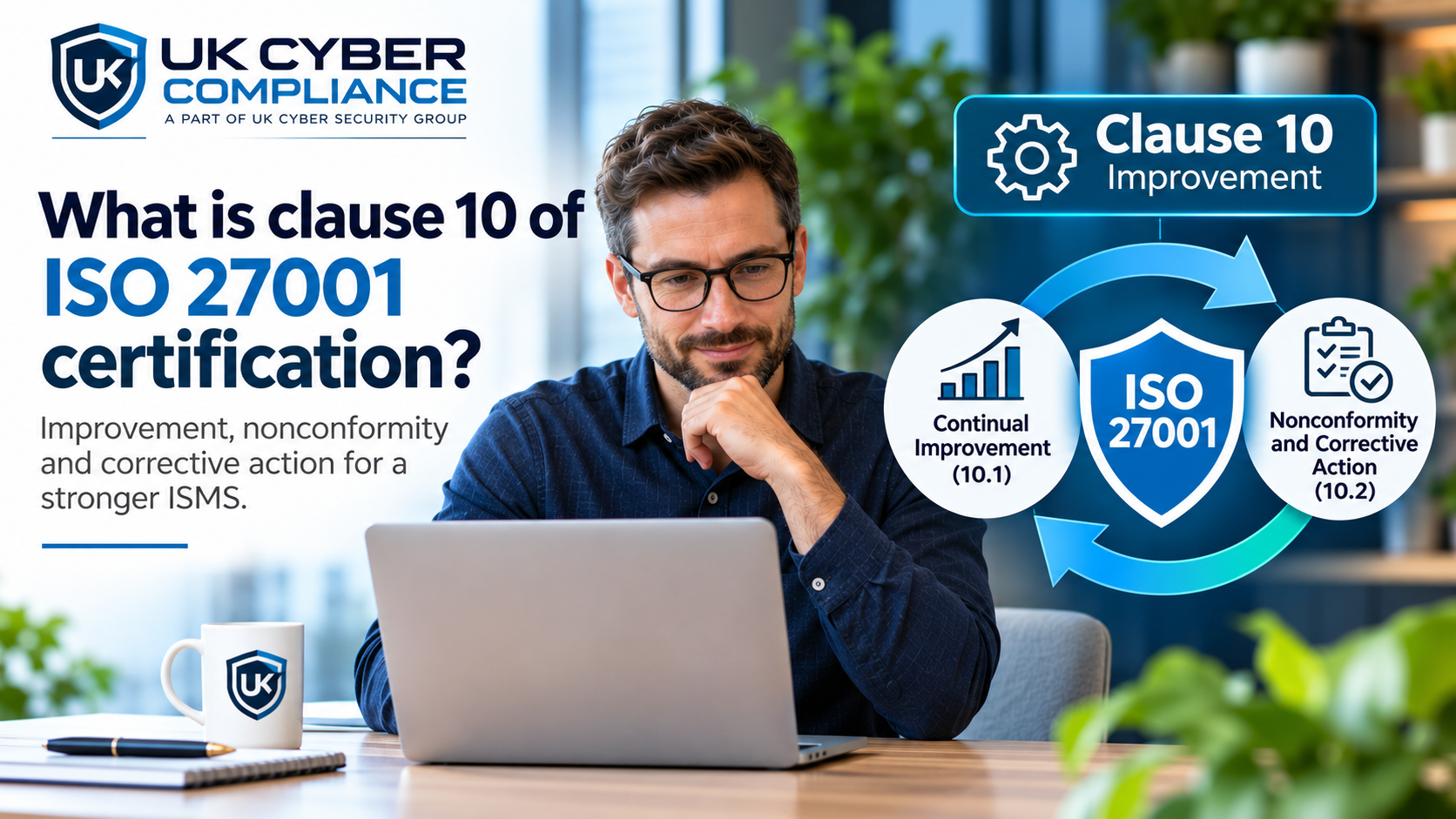
Known as Improvement, Clause 10 establishes the requirements for continually improving the ISMS and addressing nonconformities through appropriate corrective action.
It helps organisations identify when security processes are not working as intended, understand why problems occur and take meaningful action to prevent them from happening again.
For UK businesses preparing for ISO 27001 certification, Clause 10 is essential because it demonstrates that information security is an ongoing management responsibility rather than a one-off compliance exercise.
Even organisations with well-established security arrangements can experience incidents, procedural weaknesses or changes that affect their information security risks.
The important consideration is how the organisation responds and whether it learns from those experiences.
UK Cyber Compliance, part of UK Cyber Security Group Ltd, helps businesses manage ISO 27001 requirements through its automated, AI-driven compliance platform.
Available at www.ukcybercompliance.co.uk, the platform supports information security risk management, policy development, compliance tracking, control management and audit preparation.
By bringing compliance activities together in one environment, UK Cyber Compliance aims to make ISO 27001 certification preparation easier, more efficient and more affordable for UK organisations.
Understanding Clause 10 is particularly valuable because effective improvement processes can strengthen information security while making future certification assessments more manageable.
Understanding the purpose of Clause 10 in ISO 27001
ISO/IEC 27001:2022 is an internationally recognised standard for establishing, implementing, maintaining and continually improving an Information Security Management System.
An ISMS provides a structured approach to identifying information security risks, establishing appropriate safeguards and maintaining processes that support the confidentiality, integrity and availability of information.
The standard addresses several connected management system requirements.
Clause 4 concerns the organisation’s context and ISMS scope.
Clause 5 establishes leadership responsibilities.
Clause 6 addresses information security planning, including risk assessment and treatment.
Clause 7 covers supporting resources, competence, awareness, communication and documentation.
Clause 8 concerns operational activities.
Clause 9 establishes requirements for monitoring, internal auditing and management review.
Clause 10 then focuses on improving the ISMS and responding appropriately when requirements are not met.
These requirements work together.
For example, an organisation might discover during an internal audit that employee access reviews are not taking place according to its approved procedures.
Clause 9 helps identify the problem through performance evaluation and auditing.
Clause 10 requires the organisation to respond appropriately and consider the action necessary to address the underlying cause.
The objective is not simply to correct an isolated mistake.
It is to improve how information security is managed.
The two main requirements within Clause 10
ISO/IEC 27001:2022 divides Clause 10 into two requirements.
Clause 10.1: Continual Improvement
Organisations must continually improve the suitability, adequacy and effectiveness of their Information Security Management System.
Clause 10.2: Nonconformity and Corrective Action
Organisations must respond appropriately when a nonconformity occurs, evaluate the need to address its causes, implement necessary corrective actions and review their effectiveness.
These requirements complement each other.
Continual improvement helps strengthen the ISMS over time.
Corrective action addresses situations where specific requirements have not been met.
An important detail is that the numbering changed between ISO/IEC 27001:2013 and ISO/IEC 27001:2022. Under the current edition, continual improvement is Clause 10.1 and nonconformity and corrective action is Clause 10.2.
Clause 10.1: Continually improving information security
Continual improvement is one of the fundamental principles of ISO 27001.
Information security cannot remain effective if organisations establish controls and then assume those arrangements will continue working indefinitely.
Businesses change.
Employees leave and new people join.
Technology develops.
Suppliers introduce new services.
Cyber threats evolve, while customers and regulators may establish additional requirements.
An ISMS needs to remain appropriate as these changes occur.
Clause 10.1 requires organisations to continually improve the suitability, adequacy and effectiveness of their ISMS.
This does not mean businesses must constantly replace security technology or rewrite policies.
It means they should evaluate their arrangements and make appropriate improvements when opportunities or weaknesses are identified.
What does suitability mean?
Suitability concerns whether the ISMS remains appropriate for the organisation’s business activities and requirements.
For example, a small professional services company might initially operate from one office and rely on a limited number of cloud services.
Over time, the company may expand, recruit remote employees and introduce additional customer management systems.
These changes could affect information security responsibilities, supplier dependencies and existing risk assessments.
The organisation should consider whether its original ISMS arrangements remain suitable.
If they no longer reflect how the business operates, changes may be necessary.
What does adequacy mean?
Adequacy concerns whether the ISMS has sufficient processes, resources and arrangements to meet its requirements.
For example, a growing company may assign information security management to an employee who also performs several other important business functions.
As the organisation expands, the workload may become difficult to manage effectively.
Internal audits might be delayed, risk treatment actions may remain outstanding and security reviews could become inconsistent.
Management should consider whether additional resources, professional support or improved processes are necessary.
An adequate ISMS needs to support the organisation’s actual information security obligations.
What does effectiveness mean?
Effectiveness concerns whether the ISMS achieves its intended results.
For example, a business may have an approved process requiring employees to report suspected phishing messages.
However, monitoring might reveal that employees frequently fail to report suspicious communications.
The process exists, but it may not be achieving the intended outcome.
Management could review the awareness programme, employee guidance and reporting arrangements.
Suitable improvements can then be implemented and evaluated.
The objective is to ensure that documented requirements translate into effective business practices.
Where do continual improvement opportunities come from?
Organisations can identify improvement opportunities through many normal business activities.
These may include internal audits, management reviews, security incidents, risk assessments, employee feedback, customer concerns and operational monitoring.
For example, an internal audit might identify that supplier security reviews are taking longer than expected.
A management review may highlight that information security resources are insufficient.
An employee might suggest a simpler method for reporting security concerns.
A recovery test could reveal that restoring important business information takes longer than the organisation considers acceptable.
Each finding provides an opportunity to review existing arrangements.
Learning from security incidents
Security incidents can reveal weaknesses that were not previously understood.
Consider a company that experiences an attempted account compromise.
Although existing safeguards prevent unauthorised access, the incident may reveal that employees struggle to recognise convincing phishing messages.
Management could decide to improve awareness activities or review relevant authentication arrangements.
The organisation does not need to wait until an incident causes serious damage before making improvements.
Information security monitoring and incident analysis can provide valuable opportunities to strengthen protection.
Using employee feedback
Employees often understand practical weaknesses in business processes because they work with those processes every day.
For example, an employee may notice that a security reporting procedure is unnecessarily complicated.
Another employee might identify that important information is difficult to locate.
Management can consider whether these concerns indicate opportunities for improvement.
This encourages employees to contribute to information security rather than treating compliance as something managed exclusively by technical specialists.
Continual improvement does not require constant change
A common misunderstanding is that continual improvement means an organisation must introduce major security changes every month.
ISO 27001 does not establish such a requirement.
The standard expects the ISMS to improve, but the appropriate activities depend on the organisation’s circumstances.
Some improvements may involve substantial changes to security processes.
Others may involve clearer responsibilities, more effective reporting or better documentation.
A small company might improve its employee onboarding process to ensure security responsibilities are explained consistently.
A larger organisation could strengthen its supplier review process after identifying recurring delays.
Both examples can support continual improvement.
The important point is that changes should have a clear purpose and contribute to the effectiveness of the ISMS.
Clause 10.2: Understanding nonconformity and corrective action
Clause 10.2 establishes requirements for responding when an organisation fails to meet an applicable requirement.
This is known as a nonconformity.
A nonconformity can arise when the organisation does not meet a requirement of ISO 27001 or a relevant requirement established within its own ISMS.
For example, a business may have an approved procedure requiring information security risks to be reviewed at established intervals.
If those reviews are not completed, the organisation may have a nonconformity.
Another example could involve an internal audit that was required by the audit programme but did not take place.
A nonconformity may also be identified when documented information required by the standard is missing.
Why identifying nonconformities matters
No organisation should assume that every information security process will operate perfectly.
Mistakes occur.
Responsibilities may be misunderstood.
Changes can affect established procedures.
What matters is whether the organisation can identify problems and respond appropriately.
Clause 10.2 establishes a structured approach to managing these situations.
It helps businesses move beyond correcting individual mistakes and consider whether an underlying process needs improvement.
What is the difference between correction and corrective action?
Correction and corrective action are related, but they are not identical.
Correction addresses an identified problem.
Corrective action addresses the cause of a nonconformity so that it does not recur or occur elsewhere.
This distinction is particularly important during ISO 27001 certification.
A practical access management example
Imagine an organisation discovers that a former employee’s account remains active after their employment has ended.
The immediate correction may involve disabling the account and checking whether any unauthorised activity occurred.
However, simply disabling the account does not necessarily address why the problem happened.
Further investigation might reveal that the Human Resources team does not consistently notify IT when employees leave.
The corrective action could involve improving the employee departure process, clarifying responsibilities and establishing appropriate verification arrangements.
The organisation should then review whether the revised process works.
This demonstrates the difference between correcting an individual problem and addressing its underlying cause.
Responding appropriately when a nonconformity occurs
Clause 10.2 requires organisations to react to nonconformities.
Where applicable, this involves taking action to control and correct the problem and dealing with its consequences.
The appropriate response depends on the nature and seriousness of the issue.
For example, an internal audit might identify that an information security policy has not received the required approval.
The organisation should determine what action is necessary to address the issue.
Another nonconformity could involve an important security process not being followed.
Management may need to consider whether the problem has created additional security exposure.
The response should be proportionate to the effects of the nonconformity.
A minor administrative issue may require a straightforward correction.
A significant failure affecting confidential information may require more extensive investigation and corrective action.
Finding the underlying cause of a nonconformity
One of the most important parts of Clause 10.2 is evaluating the need to eliminate the causes of a nonconformity.
The organisation must consider whether action is necessary to prevent the problem from recurring or occurring elsewhere.
This involves reviewing the nonconformity, determining its causes and considering whether similar problems exist or could potentially occur.
Looking beyond the immediate mistake
Consider a business that discovers several employees have not completed mandatory information security awareness training.
The immediate problem is incomplete training.
However, the underlying cause might be unclear responsibility for monitoring completion.
Alternatively, employees may not receive reminders or sufficient time to complete the required activities.
If the business simply asks employees to complete the overdue training, the same problem may arise again.
A more effective response might involve improving the training management process and clarifying accountability.
This helps address the cause rather than only the visible symptom.
Common approaches to cause analysis
Organisations can use practical methods to investigate nonconformities.
One approach involves repeatedly asking why a problem occurred until the underlying cause becomes clearer.
For example:
An employee did not complete the required security review.
Why?
The employee did not know the review was due.
Why?
The responsibility had not been clearly communicated.
Why?
The organisation had not updated its responsibilities following a departmental restructure.
The investigation may identify that the management process needs improvement.
ISO 27001 does not prescribe one particular cause analysis method.
The organisation should use an approach appropriate to the nature and seriousness of the problem.
Checking whether similar nonconformities exist elsewhere
Clause 10.2 also requires organisations to consider whether similar nonconformities exist or could occur elsewhere.
This prevents businesses from focusing too narrowly on one isolated example.
For instance, an internal audit may identify missing approval records within one department.
Management should consider whether the same weakness could affect other departments.
Likewise, discovering inactive security monitoring on one server may justify reviewing whether similar weaknesses affect other relevant systems.
The aim is to identify the wider implications of the finding.
This can help organisations prevent repeated problems and strengthen consistency across their ISMS.
Implementing corrective actions
Once the organisation has evaluated the causes of a nonconformity, it must implement any necessary corrective action.
The action should be appropriate to the effects of the issue.
For example, a business may identify that supplier security assessments are not completed consistently.
Its corrective action might involve clarifying ownership, improving the assessment process and establishing more effective monitoring.
Another organisation might discover that information security responsibilities are not clearly communicated during employee onboarding.
It could revise the onboarding process and provide appropriate guidance to relevant managers.
The action should address the identified cause.
Assigning responsibility
Corrective actions are easier to manage when responsibilities are clear.
A practical corrective action record can identify the relevant issue, its cause, the action required, the responsible person and the expected completion date.
Management should monitor progress and ensure that important actions are not forgotten.
However, creating an action plan is not the same as completing corrective action.
The organisation must implement the necessary changes and evaluate their effectiveness.
Checking whether corrective action has worked
Clause 10.2 requires organisations to review the effectiveness of corrective action.
This is an essential requirement.
An organisation might complete an action and record it as finished.
However, that does not automatically mean the original problem has been resolved permanently.
For example, a business might improve its employee departure process following the discovery of an active account belonging to a former employee.
The organisation should subsequently verify whether the revised process operates as intended.
It may review later employee departures and confirm that relevant access was removed appropriately.
If the problem continues, further investigation may be necessary.
Why closing actions too early creates problems
Some organisations focus on completing corrective actions quickly without evaluating whether the intended improvement has occurred.
This can lead to recurring nonconformities.
For example, a business might provide additional employee training following repeated mistakes.
However, if the actual cause involves unclear procedures, training alone may not resolve the issue.
An effectiveness review helps determine whether the chosen action addressed the problem.
This is particularly valuable during certification audits because an auditor may examine whether corrective actions genuinely improved the management system.
What documented evidence does Clause 10 require?
Clause 10.2 requires organisations to retain documented information concerning nonconformities and corrective actions.
This includes evidence of the nature of the nonconformities, subsequent actions taken and the results of corrective action.
The standard does not require every organisation to use a particular software product or identical documentation templates.
A practical corrective action record might include:
- Description of the nonconformity
- Date the issue was identified
- Relevant requirement that was not met
- Immediate correction or containment
- Assessment of the consequences
- Findings from cause analysis
- Consideration of similar issues elsewhere
- Corrective action required
- Responsible action owner
- Completion information
- Supporting evidence
- Effectiveness review and outcome
These records help demonstrate that the organisation manages nonconformities systematically.
Does Clause 10.1 require a separate improvement register?
Clause 10.1 requires continual improvement but does not expressly mandate a standalone improvement register.
However, maintaining records of improvement activities can provide useful supporting evidence.
For example, an organisation might record improvements arising from management reviews, internal audits or employee feedback.
The business can explain what was changed and why the change was beneficial.
Existing management review records, audit reports and operational evidence may already provide sufficient information.
The objective is to demonstrate genuine improvement rather than create unnecessary paperwork.
How Clause 10 connects with internal audits
Internal audits play an important role in identifying nonconformities and improvement opportunities.
Clause 9.2 requires organisations to conduct internal audits at planned intervals.
These audits evaluate whether the ISMS conforms to relevant requirements and is effectively implemented and maintained.
When an audit identifies a nonconformity, Clause 10.2 establishes how the organisation should respond.
For example, an internal audit might identify that an important risk treatment action has not been completed.
Management should determine why the action was missed and whether further corrective action is necessary.
The organisation may also need to consider whether similar weaknesses affect other risk treatment activities.
The resulting evidence helps demonstrate that internal audits contribute to effective information security management.
How Clause 10 connects with management reviews
Management reviews are another important source of improvement opportunities.
Clause 9.3 requires senior management to review the ISMS at planned intervals.
These reviews consider information security performance, internal audit results, risk assessment outcomes, progress against treatment plans and opportunities for improvement.
For example, management might identify that employees responsible for information security have insufficient time to complete their duties.
The review may lead to additional resources or changes to responsibilities.
Another review might identify that important security objectives are not being achieved.
Management can consider suitable improvements.
Clause 10 supports the ongoing improvement of the ISMS following these evaluations.
This creates a clear relationship between performance evaluation, management decisions and practical action.
What happens when an external auditor finds a nonconformity?
During ISO 27001 certification, an independent auditor assesses whether the organisation meets the relevant requirements.
If a nonconformity is identified, it will be reported according to the certification body’s audit process.
Findings are commonly classified according to their significance, with major and minor nonconformities generally requiring different levels of attention.
The organisation must address findings according to the applicable certification requirements.
Major and minor nonconformities
A major nonconformity generally indicates a significant failure affecting the management system’s ability to achieve its intended results or a serious breakdown in meeting applicable requirements.
A minor nonconformity normally concerns a less significant failure that does not, by itself, demonstrate a wider breakdown of the ISMS.
The classification is determined by the certification body under the applicable audit and certification rules.
Businesses should not assume that every finding has identical consequences.
A major nonconformity may prevent certification until the certification body has verified that the relevant requirements for resolving it have been met.
Minor findings also require appropriate correction and corrective action within the certification body’s specified arrangements.
The organisation should confirm the applicable deadlines and evidence requirements with its chosen certification body.
Continual improvement supports long-term certification
ISO 27001 certification requires organisations to maintain their ISMS over time.
Following initial certification, surveillance audits normally take place during the certification cycle, with recertification generally required every three years.
An organisation should not assume that its information security arrangements remain effective simply because it passed a previous audit.
Changes in business operations, customer requirements and cyber threats may create new concerns.
Clause 10 helps ensure that weaknesses receive attention and improvements continue.
For example, an organisation may identify recurring delays in reviewing information security risks.
Rather than repeatedly recording the same finding, management should consider whether the underlying process needs improvement.
Addressing the cause can help prevent further delays and improve the effectiveness of the ISMS.
This approach supports certification maintenance while strengthening business security.
what is iso 27001 and how does Clause 10 fit into the standard?
ISO 27001 is an international standard establishing requirements for an Information Security Management System.
It helps organisations manage information security through structured governance, risk assessment, suitable controls, monitoring and ongoing improvement.
According to the International Organization for Standardization, ISO/IEC 27001 provides a framework for establishing, implementing, maintaining and continually improving an ISMS.
The current principal edition is ISO/IEC 27001:2022, supported by Amendment 1:2024 concerning climate action considerations.
Clause 10 supports the ongoing effectiveness of the management system.
It connects closely with other requirements.
Clause 6 establishes information security planning.
Clause 8 requires relevant operational activities and risk treatment.
Clause 9 evaluates performance through monitoring, internal audits and management reviews.
Clause 10 then addresses improvement and corrective action.
These activities form a connected approach to information security management.
A business cannot demonstrate effective security simply by purchasing software or creating policies.
It must understand whether its arrangements work, identify weaknesses and take appropriate action.
What is ISO 27001 Certification?
ISO 27001 certification provides independent confirmation that an organisation’s Information Security Management System meets the applicable requirements of ISO/IEC 27001 within its defined certification scope.
The assessment is performed by an independent certification body.
In the UK, organisations commonly seek accredited certification through a body accredited by the United Kingdom Accreditation Service, known as UKAS.
Accreditation provides additional assurance concerning the certification body’s competence and impartiality.
Information about accredited certification is available through the UKAS website.
Why Clause 10 matters during certification
An auditor needs evidence that the organisation responds appropriately to identified weaknesses.
They may examine internal audit findings, corrective action records and management review decisions.
For example, an auditor might identify a previously recorded nonconformity and ask whether the organisation has addressed its cause.
They may also examine how the business confirmed that corrective action was effective.
Evidence of continual improvement can help demonstrate that the ISMS remains active and relevant.
An organisation does not need to prove that no problem has ever occurred.
It needs to demonstrate that it manages its requirements effectively and responds appropriately when problems are identified.
Who needs iso 27001 certification
ISO 27001 certification can benefit organisations that manage confidential information, customer records, intellectual property or important business systems.
This includes businesses operating in technology, professional services, finance, healthcare, education, manufacturing and the public sector supply chain.
For example, a software provider may pursue certification to demonstrate that it manages information security risks affecting customer services.
A recruitment company might need to provide assurance about how candidate and employer information is protected.
An engineering supplier may seek certification to satisfy customer security expectations.
Smaller businesses can also pursue ISO 27001 certification.
The standard does not require every organisation to employ a large internal information security department.
A small company can establish a proportionate ISMS supported by suitable responsibilities, processes and professional expertise.
Certification is generally voluntary, although contractual or procurement requirements may make it commercially important.
Clause 10 is relevant to businesses of every scale because all organisations need an effective method for addressing security weaknesses and improving their management processes.
ISO 27001 Certification Levels
Businesses sometimes search for different ISO 27001 certification levels.
However, ISO/IEC 27001 does not establish bronze, silver or gold certification grades.
An organisation demonstrates conformity with the applicable requirements within its defined ISMS scope.
The independent certification process normally includes several stages.
Stage 1: Reviewing readiness
The first stage considers the organisation’s documented ISMS information and readiness for further assessment.
The auditor examines whether the organisation has established relevant management system arrangements.
Stage 2: Evaluating implementation
The second stage examines whether the ISMS has been implemented and operates effectively.
The auditor may review completed risk assessments, control evidence, management reviews, internal audits and corrective action records.
Clause 10 becomes particularly important when evaluating how the organisation responds to nonconformities.
Surveillance and recertification
Following successful certification, surveillance assessments normally take place during the certification cycle.
Recertification generally occurs every three years.
Businesses must continue maintaining and improving their ISMS throughout this period.
This means Clause 10 remains relevant after the initial certification audit.
How the Certification Works
ISO 27001 certification begins with establishing an appropriate Information Security Management System.
The organisation determines its business context, interested parties and ISMS scope.
Management then establishes information security policies, objectives and responsibilities.
The business identifies and evaluates relevant information security risks.
It determines appropriate risk treatments and establishes the controls necessary to manage those risks.
The organisation must then operate the required processes and maintain suitable supporting evidence.
Monitoring and performance evaluation help determine whether the ISMS achieves its intended results.
Internal audits assess conformity with applicable requirements.
Management reviews consider performance and opportunities for improvement.
Where nonconformities are identified, Clause 10.2 establishes the requirements for responding and taking corrective action.
Clause 10.1 requires continual improvement of the management system.
Once the organisation has established sufficient evidence of implementation and effectiveness, it can proceed with independent certification assessment.
Why improvement matters before the certification audit
An organisation may discover weaknesses during its own readiness assessment.
For example, internal audit records might show that certain information security objectives are not being monitored.
The business should address the issue appropriately before proceeding.
Another organisation might discover that a risk treatment plan has not been implemented as intended.
Management should investigate and determine the necessary actions.
Addressing these weaknesses before the external audit can improve readiness and reduce avoidable assessment problems.
UK cyber security statistics highlight the importance of improvement
Cyber security continues to create significant challenges for UK businesses.
The UK Government’s Cyber Security Breaches Survey 2025/2026, published on 30 April 2026, provides useful insight into the experiences of UK organisations.
The survey found that 43 per cent of businesses identified a cyber security breach or attack during the preceding twelve months.
This represents approximately 612,000 UK businesses.
Among medium businesses, the proportion was 65 per cent.
For large businesses, the figure increased to 69 per cent.
Phishing remained the most commonly identified attack, affecting 38 per cent of businesses.
These figures reflect incidents identified and reported by participating organisations. They do not necessarily capture every incident that occurred.
Many businesses still lack formal security processes
The same government survey found that only 30 per cent of businesses conducted a cyber security risk assessment during the preceding twelve months.
Only 25 per cent reported having a formal cyber security incident response plan.
These figures do not directly measure compliance with ISO 27001.
However, they demonstrate why structured information security management remains important.
Without established processes, businesses may struggle to understand their exposure or respond consistently when problems occur.
Clause 10 supports a more systematic approach by requiring organisations to address nonconformities and continually improve their ISMS.
Do businesses learn from security incidents?
The government survey found that 61 per cent of businesses that had identified a cyber security breach or attack reported taking some action to prevent future incidents.
Changes involving people or training were among the most commonly reported preventative actions.
This demonstrates the practical importance of learning from incidents.
However, taking action does not automatically mean the underlying cause has been addressed.
For example, an organisation may provide additional employee training following a phishing incident.
That may be appropriate, but management should also consider whether weaknesses in authentication, access control or reporting arrangements contributed to the incident.
Clause 10 encourages organisations to examine why problems occur and evaluate whether corrective actions are effective.
What is the relationship between Clause 10 and Annex A controls?
ISO/IEC 27001:2022 contains 93 Annex A information security controls.
These are organised across organisational, people, physical and technological areas.
Annex A provides a reference set that organisations consider during information security risk treatment.
Clause 10 establishes separate management system requirements concerning improvement and corrective action.
For example, Annex A Control 5.27 addresses learning from information security incidents.
This can support the wider objective of improving information security based on experience.
However, implementing Annex A Control 5.27 does not automatically demonstrate compliance with every requirement of Clause 10.
An organisation must still establish suitable arrangements for continual improvement and managing nonconformities.
The distinction matters because Annex A controls and management system requirements serve related but different purposes.
Common Clause 10 weaknesses that can affect certification
Businesses sometimes struggle with Clause 10 because they focus on recording problems rather than addressing their causes.
One common weakness is closing corrective actions immediately after an issue has been corrected.
For example, a business might disable an inappropriate user account without reviewing why the account remained active.
Another weakness is failing to evaluate whether corrective action has been effective.
The organisation may record an action as completed without verifying that the original problem is unlikely to recur.
Some businesses also struggle with incomplete documentation.
Corrective action records may lack clear descriptions, ownership or supporting evidence.
Continual improvement can become difficult when organisations collect audit findings and management feedback but fail to translate them into meaningful changes.
Making corrective action more effective
The strongest approach involves clear responsibilities and proportionate processes.
When a nonconformity occurs, the organisation should understand what happened and consider the consequences.
It should determine the relevant cause and whether similar problems could affect other activities.
Necessary corrective actions should be implemented.
The organisation should then review whether those actions achieved the intended result.
Maintaining clear evidence helps demonstrate that improvement activities contribute to an effective ISMS.
Which UK-based firms offer ISO 27001 consultancy services?
UK businesses can obtain ISO 27001 support from specialist cyber security consultancies, information security professionals and compliance service providers.
Consultancy services may include reviewing ISMS scope, conducting gap assessments, supporting risk management, developing documentation and preparing for independent certification audits.
Support can also involve internal audit preparation, corrective action management and continual improvement planning.
When selecting a provider, businesses should consider whether it has relevant experience with ISO/IEC 27001:2022.
The provider should explain the requirements clearly and help the organisation establish processes appropriate to its actual operations.
Consultancy should not simply involve supplying generic policy documents.
An effective ISMS requires genuine management responsibility and operational evidence.
UK Cyber Compliance and AI-driven certification preparation
UK Cyber Compliance, part of UK Cyber Security Group Ltd, provides ISO 27001 compliance and certification preparation services through its automated, AI-driven platform.
The platform brings together guided compliance workflows, risk management, policy development, control tracking, progress monitoring and audit-ready documentation.
It is designed to reduce repetitive administration and improve visibility of outstanding compliance activities.
Businesses can also access professional guidance through UK Cyber Compliance’s wider information security services.
This approach can be particularly helpful for organisations without a dedicated internal compliance department.
An important distinction remains: an automated platform can support certification preparation, but independent certification must still be awarded following assessment by an appropriate certification body.
How UK Cyber Compliance supports Clause 10
Clause 10 requires organisations to continually improve their ISMS and manage nonconformities effectively.
These activities can become difficult when records are maintained through disconnected spreadsheets, email conversations and separate document folders.
UK Cyber Compliance provides an automated platform designed to make information security management more organised.
Keeping improvement activities visible
The platform offers structured workflows and compliance progress tracking.
Businesses can use these capabilities to maintain visibility of relevant compliance activities and identify outstanding work.
This can support management when reviewing opportunities for improvement.
Connecting risks, controls and corrective actions
Information security weaknesses often relate to existing risks or controls.
For example, an internal audit might identify that an important security control is not operating as expected.
An integrated compliance platform can help organise the relevant control information, associated risks and supporting evidence.
This makes it easier to understand how individual activities contribute to wider compliance requirements.
Supporting corrective action records
A centralised platform can help organisations maintain information about findings, assigned responsibilities and supporting documentation.
This may reduce the administrative effort involved in tracking corrective actions.
However, software cannot independently establish that an issue has been resolved effectively.
The organisation must still investigate causes, implement necessary action and evaluate the results.
Improving audit readiness
Independent auditors may request evidence showing how nonconformities have been addressed.
Maintaining relevant records in an organised environment can help businesses retrieve information more efficiently.
UK Cyber Compliance supports compliance documentation, control evidence and progress reporting.
These capabilities can help organisations prepare for both internal and external assessments.
Making compliance management more affordable
For smaller organisations, ISO 27001 can involve substantial administrative work.
Management may need to coordinate risk assessments, policies, internal audits, corrective actions and evidence collection without a dedicated compliance team.
Automation can help reduce repetitive tasks and improve visibility.
UK Cyber Compliance aims to make ISO 27001 preparation easier and more affordable by combining AI-driven automation, guided workflows and professional support.
The potential benefits depend on the organisation’s existing processes, information security requirements and level of assistance required.
A practical Clause 10 readiness checklist
Before arranging an independent ISO 27001 certification audit, businesses should consider whether their improvement processes genuinely meet the standard.
Continual improvement
Does the organisation review whether its ISMS remains suitable, adequate and effective?
Are improvement opportunities considered during internal audits and management reviews?
Can management explain relevant improvements made to the ISMS?
Managing nonconformities
Does the organisation understand what constitutes a nonconformity?
Are identified issues recorded appropriately?
Does the business respond to problems and consider their consequences?
Addressing underlying causes
Does the organisation evaluate why nonconformities occur?
Does it consider whether similar problems exist or could occur elsewhere?
Are necessary corrective actions implemented?
Checking effectiveness
Does the organisation review whether corrective actions have worked?
Are further actions considered when problems continue?
Are changes made to the ISMS where necessary?
Maintaining evidence
Are the nature of nonconformities and subsequent actions documented?
Can the organisation demonstrate the results of corrective actions?
Can relevant records be retrieved during an audit?
These questions provide a practical way to identify gaps before certification assessment.
The aim is not to create excessive paperwork.
It is to demonstrate that the organisation understands its weaknesses and manages improvements effectively.
Maintaining Clause 10 after certification
ISO 27001 certification is not a one-off activity.
Businesses change, customer expectations develop and information security risks evolve.
An ISMS must remain effective as these changes occur.
Clause 10 supports this ongoing responsibility.
Internal audits may identify new nonconformities.
Management reviews may highlight opportunities for improvement.
Security incidents may reveal weaknesses in existing arrangements.
Employees and suppliers may provide useful feedback.
The organisation should consider these findings and take appropriate action.
Corrective actions should remain proportionate to the problems identified and should be evaluated for effectiveness.
Management should also recognise that continual improvement extends beyond responding to nonconformities.
Businesses can improve information security proactively by reviewing performance information and identifying better ways to manage their requirements.
Maintaining these activities throughout the year can make surveillance audits and recertification more manageable.
It also helps ensure that information security remains relevant to the business.
Making Clause 10 work for your business
Clause 10 of ISO 27001 focuses on strengthening the Information Security Management System through continual improvement and corrective action.
It establishes two essential requirements.
Clause 10.1 requires organisations to continually improve the suitability, adequacy and effectiveness of their ISMS.
Clause 10.2 requires businesses to respond appropriately to nonconformities, evaluate the need to address their causes, implement necessary actions and review their effectiveness.
Together, these requirements help organisations learn from weaknesses and improve their information security management.
For smaller businesses, the process should remain proportionate.
A straightforward corrective action record, clear responsibilities and appropriate effectiveness reviews can provide meaningful evidence.
Larger organisations may require more extensive coordination, but the underlying principles remain the same.
The objective is not to demonstrate that the business never experiences problems.
It is to show that problems are identified, understood and addressed in a way that strengthens the ISMS.
UK Cyber Compliance, part of UK Cyber Security Group Ltd, helps UK organisations manage ISO 27001 requirements through its automated, AI-driven platform.
By combining risk management, guided workflows, compliance tracking, documentation and audit preparation, the platform aims to reduce administrative complexity and support more efficient certification preparation.
Businesses looking for a structured and affordable approach to ISO 27001 can explore the services available at www.ukcybercompliance.co.uk.
Effective continual improvement provides benefits beyond certification.
It helps management make better decisions, strengthens accountability, reduces the likelihood of recurring weaknesses and supports customer confidence.
Most importantly, it helps ensure that information security develops alongside the organisation rather than becoming a collection of policies that gradually lose their relevance.
UK Cyber Compliance is here to help
For more information, please do get in touch.
Please check out our Free Cyber Insurance
Other blog posts, Your ISO 27001 Questions Answered, Get ISO 27001 Certified ,
If you would like to know more, do get in touch as we are happy to answer any questions. Looking to improve your cybersecurity but not sure where to start? Begin by getting certified in Cyber Essentials, the UK government’s scheme that covers all the technical controls that will provide the protection that you need to help guard against criminal attacks.