What is clause 5 of ISO 27001 certification?
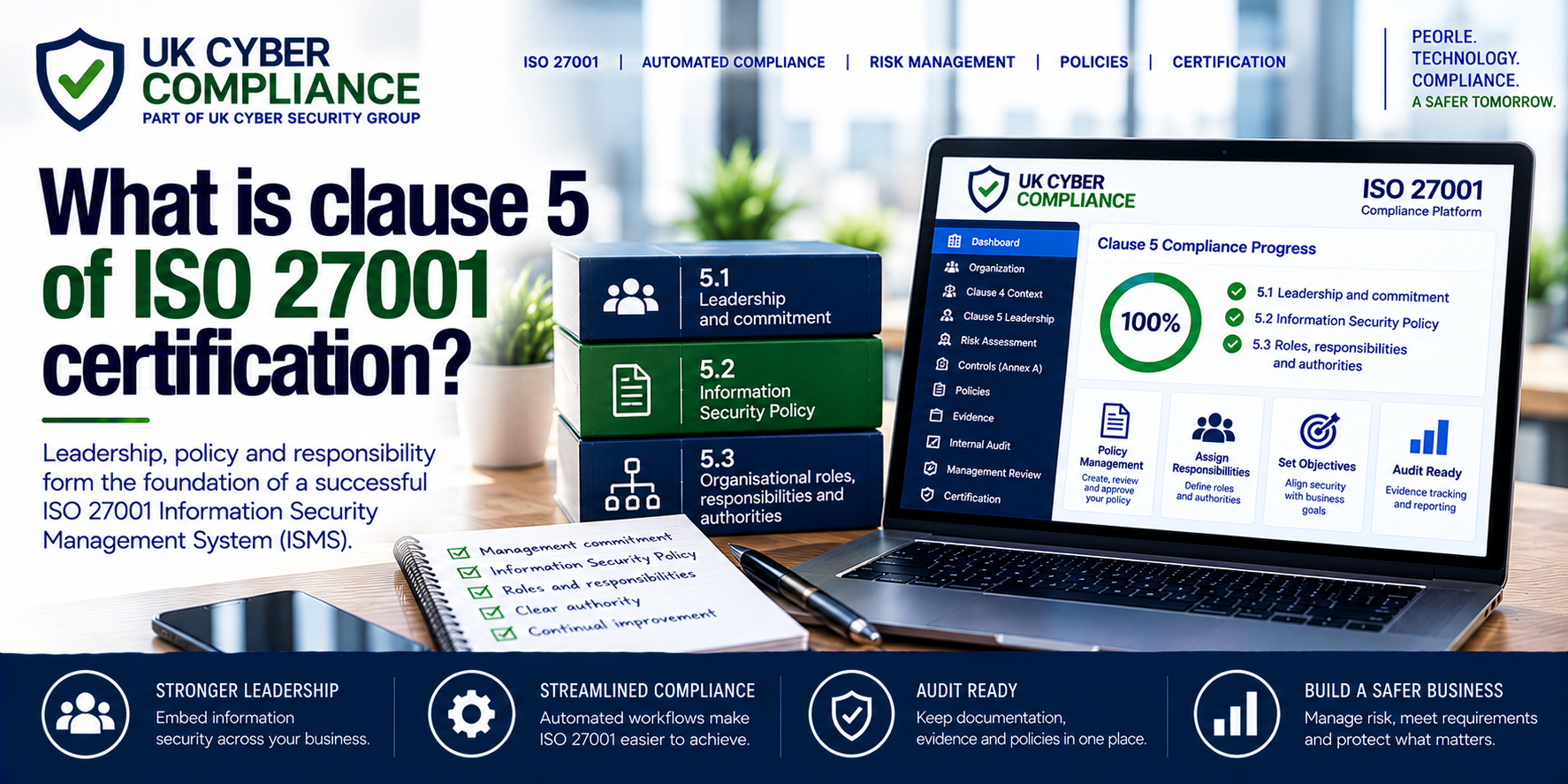
Clause 5 of ISO 27001 focuses on leadership, management commitment and responsibility for information security. It ensures that senior management takes an active role in establishing, operating and improving an organisation’s Information Security Management System, commonly known as an ISMS.
One of the most common misconceptions about ISO 27001 is that certification belongs entirely to the IT department. Although technical teams play an important role, the standard places clear responsibilities on senior management.
ISO 27001 expects information security to form part of normal business management rather than operate as a separate technical project.
Directors and senior managers need to understand the organisation’s information security risks, approve the Information Security Policy, provide appropriate resources and ensure employees understand their responsibilities.
Clause 5 of ISO/IEC 27001:2022 contains three requirements:
- Clause 5.1: Leadership and commitment
- Clause 5.2: Information Security Policy
- Clause 5.3: Organisational roles, responsibilities and authorities
Together, these requirements establish who leads the ISMS, how management communicates its information security commitments and who is responsible for keeping the management system effective.
The current international standard is ISO/IEC 27001:2022, supported by Amendment 1:2024, which addresses climate action considerations within management system requirements.
According to the International Organization for Standardization, ISO 27001 provides organisations with a framework for establishing, implementing, maintaining and continually improving information security management.
For businesses approaching certification, Clause 5 can feel complicated. However, its purpose is straightforward: senior management must demonstrate that information security matters to the organisation and that the necessary responsibilities and resources are in place.
UK Cyber Compliance provides an automated and AI-driven ISO 27001 platform designed to simplify management system requirements, including organisational understanding, information security objectives, resource allocation, policies, responsibilities, risk management and audit evidence.
UK Cyber Compliance (a part of UK Cyber Security Group) provides these services and has a platform to make certification much easier and cheaper.
By bringing these activities into a structured online environment, organisations can reduce manual administration while maintaining a clearer record of leadership decisions, responsibilities and information security performance.
what is iso 27001
ISO 27001 is the international requirements standard for an Information Security Management System.
It helps organisations manage the confidentiality, integrity and availability of information through structured governance, risk assessment, security controls, operational processes and continual improvement.
Confidentiality means protecting information against unauthorised access or disclosure.
Integrity means keeping information accurate and preventing unauthorised changes.
Availability means ensuring authorised users can access information and services when required.
ISO 27001 considers much more than IT equipment.
An ISMS can cover employees, suppliers, business operations, customer information, physical locations, cloud services, applications, contracts and information security responsibilities.
The standard contains ten numbered clauses. Clauses 4 to 10 establish the main management system requirements that organisations need to address when pursuing certification.
Clause 4 focuses on understanding the organisation, interested parties and the ISMS scope.
Clause 5 then establishes leadership, policy and accountability.
Clause 6 addresses planning, information security risks, risk treatment and objectives.
The remaining clauses cover support, operation, performance evaluation and improvement.
This structure matters because leadership provides the direction and resources needed for the other requirements to work.
Why leadership matters in ISO 27001
Information security decisions frequently involve more than technology.
An organisation may need to decide how much risk it can accept, which systems deserve priority, how employees should handle confidential information or whether additional resources are necessary.
These decisions often involve commercial considerations.
A technical employee may identify a significant security risk but lack the authority to approve the action needed to reduce it.
For example, an IT manager might discover that an important business system no longer receives security support.
The IT manager can explain the exposure and recommend action.
However, senior management may need to approve changes to business operations, allocate resources or accept the residual risk within the organisation’s approved criteria.
Clause 5 ensures that these responsibilities do not remain entirely with technical staff.
Management must provide appropriate direction, demonstrate commitment and make information security part of wider business decisions.
Clause 5.1: Leadership and commitment
Clause 5.1 requires top management to demonstrate leadership and commitment towards the ISMS.
This goes beyond approving a policy or appointing an employee to manage compliance.
Senior leaders need to show that they support information security and understand its relevance to the organisation.
The requirement includes establishing appropriate information security direction, integrating ISMS requirements into business processes, providing resources, communicating expectations, supporting employees and promoting continual improvement.
Management should also ensure the ISMS achieves its intended outcomes.
A business does not need every director to become a technical security expert.
However, leaders should understand the important risks affecting the organisation and how information security supports its objectives.
Align information security with business direction
Information security should support what the organisation is trying to achieve.
Consider a company providing cloud-based services to customers.
Its business success may depend heavily on customer trust, confidentiality and reliable service availability.
Senior management should recognise those priorities when establishing information security objectives.
For example, leadership may decide that protecting customer information, maintaining service availability and improving incident response are important organisational objectives.
Those objectives can then influence risk treatment, operational controls and resource decisions.
Another organisation might focus on protecting intellectual property or meeting demanding customer security requirements.
The important point is alignment.
Information security should support the organisation’s purpose rather than become a collection of disconnected compliance tasks.
Make information security part of everyday business decisions
Clause 5.1 expects organisations to integrate ISMS requirements into business processes.
This means information security should influence normal operational decisions rather than operate only during certification preparation.
For example, an employee onboarding process should consider appropriate access rights.
Procurement should consider relevant supplier security requirements.
Project management should assess information security risks arising from significant changes.
Employee departure procedures should include the removal of unnecessary access.
Management meetings should consider significant security risks and improvement actions.
These activities can form part of existing workflows.
The organisation does not necessarily need a separate ISO 27001 process for every business activity.
Integration helps make the ISMS more efficient and sustainable.
UK Cyber Compliance supports this approach through structured compliance workflows that help organisations connect security requirements, responsibilities and supporting evidence.
Senior management must provide appropriate resources
An effective ISMS requires resources.
These resources may include employee time, management attention, technical capability, security awareness, external expertise and suitable technology.
Clause 5.1 requires management to ensure the resources needed for the ISMS are available.
This does not mean every organisation must create a large information security department.
The resources should reflect the organisation’s scope, complexity and risks.
A small professional services business might manage its ISMS through a director, an IT support provider and an automated compliance platform.
A larger organisation may require dedicated compliance staff, information security specialists and departmental control owners.
The important point is that management understands what the ISMS needs and supports those requirements.
Resource allocation should follow business risk
Consider a business that identifies a high risk involving customer information.
The risk assessment recommends stronger access management and additional monitoring.
If management repeatedly refuses the necessary resources without making an appropriate risk decision, the ISMS may struggle to demonstrate effective risk treatment.
A better approach involves reviewing the risk, understanding the possible consequences and deciding how the organisation should respond.
Evidence of resource decisions can help demonstrate leadership commitment during the certification audit.
An automated platform can support this process by tracking risk treatment actions, assigned responsibilities and progress.
Communicate why information security matters
Leadership commitment also involves communication.
Employees need to understand that information security forms part of their responsibilities.
A signed Information Security Policy provides one element of this communication, but it should not be the only activity.
Management can reinforce security through induction, staff briefings, awareness training, internal communications and regular operational meetings.
For example, a director might explain why employees need to report suspicious emails promptly.
A department manager might remind staff about appropriate handling of confidential customer information.
Senior leaders can also demonstrate good practice by following the same security requirements as everyone else.
This approach helps build a working security culture.
Employees are more likely to take information security seriously when management consistently demonstrates that it matters.
Support employees and managers
Clause 5.1 also requires leadership to direct and support people who contribute to the effectiveness of the ISMS.
Employees need appropriate guidance, competence and authority to complete their security responsibilities.
For example, a risk owner should understand how to assess and review information security risks.
A control owner needs to understand what the control should achieve.
An employee handling customer information needs appropriate awareness of confidentiality and reporting requirements.
Departmental managers should also receive support when information security responsibilities affect their operations.
Senior management should not simply assign a task and assume it will happen.
It should ensure the employee has the necessary support and that progress receives appropriate oversight.
Continual improvement starts with leadership
Information security management needs regular review.
New threats appear.
Technology changes.
Employees join and leave.
Suppliers change.
Customers may establish additional requirements.
Clause 5.1 expects leadership to promote continual improvement of the ISMS.
This means management should support improvements when monitoring, audits, incidents or risk assessments identify weaknesses.
For example, an internal audit might identify that supplier reviews do not happen consistently.
Senior management should ensure the finding receives attention and that the organisation takes appropriate action.
The aim is not to create a perfect management system on the first day.
It is to establish a system that can recognise weaknesses, respond appropriately and improve.
Clause 5.2: The Information Security Policy
Clause 5.2 requires top management to establish an Information Security Policy.
This document provides overall direction for information security within the organisation.
It should reflect the purpose of the business and establish a framework for information security objectives.
The policy must also include commitments to satisfy applicable information security requirements and continually improve the ISMS.
Under ISO/IEC 27001:2022, the Information Security Policy must exist as documented information, receive appropriate communication within the organisation and remain available to interested parties where appropriate.
The policy should not become a generic document downloaded from the internet and approved without proper review.
It should reflect the organisation’s actual business and security commitments.
What should an Information Security Policy contain?
A practical Information Security Policy should explain why information security matters and what the organisation commits to achieving.
Useful content includes the organisation’s information security purpose, management commitment, relevant responsibilities, information security objectives or the framework for establishing them, applicable requirements and continual improvement.
The document should also identify policy ownership, management approval and review arrangements.
It may reference supporting policies and procedures where appropriate.
For example, a technology company could state that it commits to protecting customer information, maintaining the confidentiality and availability of services, meeting relevant contractual obligations and continually improving its information security management system.
The wording should remain clear and relevant.
A short policy that management understands and employees follow can provide greater value than a lengthy document that nobody reads.
The policy should reflect your organisation
Generic policies frequently contain commitments that do not match the actual business.
For example, a template may say that all employees complete quarterly security awareness training.
If the organisation only provides annual training, the policy creates a commitment that the business does not follow.
An auditor may identify the inconsistency.
Another generic policy might refer to facilities or departments that do not exist.
These problems make certification preparation harder.
The organisation should review policy content against its actual operations before approval.
UK Cyber Compliance provides AI-supported policy generation designed to help organisations prepare information security documentation based on their controls and risk information.
This can reduce repetitive drafting work.
However, management remains responsible for ensuring the generated policy accurately reflects the organisation.
Who should approve the Information Security Policy?
Clause 5.2 places responsibility for establishing the policy with top management.
The organisation should therefore demonstrate appropriate senior management approval.
In a small company, approval may come from the managing director.
In a larger organisation, the appropriate approval route may involve an executive manager, board or senior leadership team.
The exact arrangement depends on organisational governance.
The important point is that the policy represents management direction rather than an isolated IT decision.
Keep a reliable record of approval.
The policy should also remain subject to appropriate review as the organisation changes.
Make the policy accessible and understandable
Publishing a policy is not enough.
The organisation needs to communicate it.
Employees should understand the information security requirements relevant to their work.
An employee may need to know how to report a security incident, protect confidential documents or request additional system access.
Managers may need to understand their responsibilities for risk ownership, supplier review or security objectives.
Communication can happen through employee induction, awareness training, staff meetings or a controlled internal policy portal.
The approach should reflect the organisation.
An auditor may ask employees whether they know where to find the Information Security Policy and whether they understand its main commitments.
That makes real communication more important than simply having a signed document.
Clause 5.3: Organisational roles, responsibilities and authorities
Clause 5.3 requires top management to ensure that responsibilities and authorities for relevant information security roles are assigned and communicated.
The clause also requires management to assign responsibility and authority for ensuring the ISMS conforms to ISO 27001 and reporting on ISMS performance to top management.
This provides the accountability needed to operate the management system.
It should be clear who manages important security activities and who has authority to make decisions.
Without defined responsibility, security work can easily fall between departments.
For example, HR may assume IT removes access when an employee leaves.
IT may assume HR handles the complete process.
If nobody clearly owns the activity, former employees may retain access longer than necessary.
Assigning responsibility helps prevent these gaps.
Who should be responsible for the ISMS?
ISO 27001 does not require every organisation to employ a particular job title.
A small organisation might appoint a director or experienced manager to coordinate the ISMS.
A larger company might appoint an information security manager, compliance manager or Chief Information Security Officer.
The appropriate arrangement depends on the organisation.
However, operational responsibility does not remove senior management’s accountability for demonstrating leadership and commitment.
Management should still understand the ISMS, review its performance and provide appropriate support.
The person coordinating the ISMS should have sufficient authority to obtain information, track required actions and escalate significant concerns.
Assign responsibilities across the business
Information security responsibilities frequently extend beyond one individual.
The HR function may manage employee security processes.
IT may operate technical security controls.
Procurement may coordinate supplier assessments.
Department managers may own business risks.
Senior management may approve important residual risk decisions.
The ISMS coordinator may oversee compliance activities and report performance.
The organisation should understand how these responsibilities connect.
A responsibility matrix can provide a useful way to document this information.
For example, a matrix may identify who performs an activity, who approves it, who provides information and who receives the result.
ISO 27001 does not require every business to use a particular responsibility matrix format.
What matters is clear assignment and communication of relevant duties and authority.
Risk owners and control owners are not always the same people
This distinction is particularly important in a mature ISMS.
A risk owner is accountable for understanding and managing a particular business risk.
A control owner is responsible for operating or maintaining a particular security control.
For example, the Operations Director may own the risk of customer service disruption.
The IT Manager may operate the backup and recovery controls that help reduce that risk.
The Operations Director still needs to understand whether the remaining exposure is acceptable.
The IT Manager needs to make sure the relevant controls operate as required.
Keeping these responsibilities clear helps prevent technical control activity from becoming disconnected from business risk management.
Employees need authority as well as responsibility
Assigning responsibilities without sufficient authority creates practical problems.
Imagine a compliance manager who identifies an overdue high-risk action but cannot contact the relevant department or escalate the issue.
The manager technically owns compliance coordination but lacks the authority needed to perform the role.
Clause 5.3 expects management to assign relevant authority alongside responsibility.
This does not mean every control owner needs executive authority.
It means people should have the ability to carry out their assigned activities and obtain appropriate decisions when issues arise.
Senior management should establish clear escalation routes for significant risks, incidents and unresolved actions.
What evidence will an ISO 27001 auditor expect for Clause 5?
An external auditor may review documents and speak directly with management.
They may ask how leadership supports information security and how the organisation makes important security decisions.
Useful evidence can include:
- An approved Information Security Policy
- Information security objectives and management decisions
- Organisational responsibilities and authority records
- Evidence of appropriate resource allocation
- Management review records
- Risk acceptance decisions
- Internal communications and awareness records
- Assigned risk and control ownership
- Evidence of management involvement in corrective actions
- Records showing that information security forms part of normal business processes
This is a practical evidence list rather than a requirement to create ten separate documents.
Clause 5.1 does not prescribe a special leadership register.
The auditor can evaluate commitment through actual decisions, interviews, operational records and evidence from other ISMS activities.
The most convincing evidence demonstrates that management is genuinely involved.
What questions might the auditor ask senior management?
An auditor may ask senior leaders to explain why the organisation pursued ISO 27001 certification.
They could ask what the organisation considers its most significant information security risks.
Other questions may explore how management establishes security objectives, approves resources and reviews progress.
The auditor may also ask who is responsible for maintaining the ISMS.
Senior management should be able to describe the organisation’s information security approach in ordinary business language.
They do not need to explain every technical setting.
However, they should understand the major issues that affect the business.
If the only person able to answer ISMS questions is an external consultant, the auditor may question whether management demonstrates sufficient leadership.
Management review provides useful leadership evidence
Management review is a separate mandatory requirement under Clause 9.3.
However, it also provides useful evidence that the organisation meets Clause 5.
During management review, senior leaders consider ISMS performance, relevant changes, audit findings, risks, objectives, resources and improvement opportunities.
A good review should lead to meaningful decisions.
For example, management may approve additional resources for an important risk treatment action.
It may change an information security objective.
It might require a department to improve supplier security oversight.
The meeting record should explain the decisions and identify any required actions.
This demonstrates that senior management does more than approve policy documents.
It actively oversees the ISMS.
How Clause 5 connects with the other ISO 27001 requirements
Clause 5 does not operate independently.
Clause 4 establishes the organisation’s context, interested parties and ISMS scope.
Leadership should understand these matters when setting the Information Security Policy and objectives.
Clause 6 deals with planning, risk assessment, risk treatment and objectives.
Management should ensure the organisation has suitable arrangements to carry out this work.
Clause 7 addresses resources, competence, awareness, communication and documented information.
Leadership must support these activities.
Clause 8 focuses on operational processes.
Management should ensure relevant security requirements become part of business operations.
Clause 9 evaluates performance through monitoring, internal audit and management review.
Clause 10 addresses nonconformities, corrective action and continual improvement.
Leadership supports the effectiveness of the whole management system.
Clause 5 is different from Annex A control 5.1
This distinction frequently causes confusion.
Clause 5.1 concerns leadership and management commitment.
Annex A control 5.1 concerns information security policies.
Although the subjects are related, they are not the same requirement.
Clause 5 forms part of the mandatory management system requirements that organisations seeking ISO 27001 certification must address.
Annex A provides reference controls that support information security risk treatment.
The organisation determines which controls are necessary and records the relevant decisions in its Statement of Applicability.
Understanding this distinction helps prevent businesses from treating leadership requirements as merely another technical control.
Common mistakes when preparing Clause 5
One common mistake is assuming that a signed Information Security Policy proves leadership commitment.
The policy matters, but management must also demonstrate genuine involvement.
Another mistake is assigning the complete ISMS to an IT employee without sufficient authority or resources.
Some businesses create responsibility charts but never communicate the assigned duties.
Others fail to connect security objectives with business priorities.
Management review can also become a weak point when the organisation completes meetings purely for certification paperwork.
These problems are avoidable.
Senior management should participate in important decisions throughout implementation.
Responsibilities should reflect the real organisation.
Security objectives should have practical business meaning.
Records should demonstrate that decisions lead to action.
Clause 5 for small UK businesses
Smaller organisations sometimes assume ISO 27001 requires a complicated management structure.
That is not the case.
A small business may have one director responsible for overall ISMS leadership.
An external IT provider may support technical security.
Employees may have clearly defined responsibilities for information handling and incident reporting.
A compliance platform may help manage documentation, risks, control ownership and evidence.
The key requirements remain the same.
Management needs to establish direction, provide appropriate resources, approve the Information Security Policy and assign responsibilities.
A proportionate approach can make Clause 5 practical for a small organisation.
The business does not need unnecessary layers of management to demonstrate effective leadership.
UK cyber security statistics show why leadership matters
The UK Government’s Cyber Security Breaches Survey 2025/2026 found that 43 per cent of UK businesses identified a cyber security breach or attack during the previous twelve months.
That represents approximately 612,000 businesses.
Among medium businesses, 65 per cent reported identifying a breach or attack, rising to 69 per cent among large businesses.
The survey also found that only 30 per cent of businesses carried out a cyber security risk assessment during the previous twelve months.
Just 25 per cent reported having a formal incident response plan.
These figures demonstrate why information security needs management attention rather than being treated entirely as a technical responsibility.
The survey also reported that the proportion of medium businesses receiving at least annual board-level cyber security updates had fallen from 78 per cent to 70 per cent.
That finding is particularly relevant to Clause 5 because it highlights the importance of consistent leadership oversight.
The full results are available through the UK Government Cyber Security Breaches Survey 2025/2026.
Who needs iso 27001 certification
ISO 27001 can benefit organisations across many sectors.
Technology companies, managed service providers, professional services firms, financial organisations, healthcare providers, charities, education providers, manufacturers and public-sector suppliers may all pursue certification.
Businesses often seek ISO 27001 because customers or procurement frameworks require independent information security assurance.
Other organisations use the standard to strengthen governance, manage risks more effectively and demonstrate a structured approach to protecting information.
ISO 27001 does not require every organisation to obtain an external certificate.
Businesses can implement the standard without seeking certification.
However, independent certification can provide additional assurance to customers and other interested parties.
Regardless of sector, Clause 5 remains relevant because every effective ISMS requires leadership, policy and accountability.
What is ISO 27001 Certification?
ISO 27001 certification provides independent assessment of an organisation’s Information Security Management System against ISO/IEC 27001.
ISO publishes the standard but does not certify individual companies.
An independent certification body conducts the assessment and makes the certification decision.
In the UK, organisations frequently choose certification bodies accredited by the United Kingdom Accreditation Service, known as UKAS.
UKAS accreditation provides additional confidence concerning the competence and impartiality of certification bodies.
The current specialist accreditation standard for bodies conducting ISO 27001 certification is ISO/IEC 27006-1:2024.
Businesses can check providers through the UKAS directory.
An automated ISO 27001 platform can help prepare and maintain the ISMS.
However, completing the platform’s requirements does not automatically result in an independently accredited certificate.
The external certification process remains separate.
ISO 27001 Certification Levels
ISO 27001 does not have official bronze, silver, gold or other graded certification levels.
The organisation defines its ISMS scope and demonstrates conformity with the standard.
The certification process normally includes Stage 1 and Stage 2 assessments.
Stage 1 focuses on the organisation’s readiness and core management system arrangements.
Stage 2 examines implementation and effectiveness.
Following successful certification, surveillance audits and later recertification provide continuing independent assurance.
Clause 5 remains relevant throughout this process.
Management needs to maintain its commitment, review ISMS performance and ensure responsibilities continue to operate as the business changes.
How the Certification Works
The ISO 27001 certification journey begins with understanding the organisation and defining the ISMS scope.
Senior management then needs to establish information security direction, approve the Information Security Policy and assign relevant responsibilities.
The organisation completes its risk assessment, determines risk treatment actions and selects appropriate controls.
It prepares the Statement of Applicability and implements the necessary security arrangements.
Employees need appropriate competence and awareness.
The organisation must also maintain evidence that its processes operate effectively.
Internal audit examines whether the ISMS conforms to its requirements.
Management review allows senior leaders to assess performance and approve improvements.
The independent certification body then completes the external assessment.
Clause 5 supports every stage because management must ensure the organisation has the direction, ownership and resources required to maintain the ISMS.
Which UK-based firms offer ISO 27001 consultancy services?
UK businesses can obtain ISO 27001 support from information security consultants, compliance specialists, managed security providers and automated compliance platform providers.
When choosing support, consider whether the provider understands the complete ISMS rather than focusing solely on documentation.
Useful assistance should cover organisational context, leadership responsibilities, Information Security Policy development, risk assessment, resource allocation, the Statement of Applicability, controls, evidence and audit preparation.
UK Cyber Compliance provides an automated and AI-driven ISO 27001 platform supported by guided compliance workflows and access to specialist assistance.
Its platform supports intelligent risk assessment, AI-powered policy generation, control management, real-time progress tracking and audit-ready reporting.
This approach can help small and medium-sized organisations manage ISO 27001 without relying entirely on separate spreadsheets and manual document libraries.
How UK Cyber Compliance can simplify Clause 5
Clause 5 becomes easier when leadership responsibilities, policies, objectives and supporting evidence remain organised.
Traditional management may rely on separate policy documents, spreadsheets, meeting notes and action trackers.
That can make it difficult to understand which actions remain outstanding or whether the correct people have approved important decisions.
UK Cyber Compliance brings connected ISMS activities into a structured online platform.
Senior management can use progress information to understand how the organisation is moving through ISO 27001 requirements.
Control owners can track relevant actions.
Policies can be prepared using AI assistance and reviewed by appropriate employees.
Risk management records can support leadership decisions.
Audit-ready reporting can also make important information easier to retrieve.
Automation reduces administrative effort, but senior management remains accountable for the decisions required by Clause 5.
A practical Clause 5 readiness checklist
Before your external ISO 27001 audit, ask whether your organisation can demonstrate the following.
Clause 5.1: Leadership and commitment
Does senior management actively support the ISMS?
Are information security objectives aligned with the organisation’s direction?
Do managers provide appropriate resources?
Does information security form part of normal business processes?
Do employees understand the importance of information security?
Does management support continual improvement?
Clause 5.2: Information Security Policy
Has top management established and approved an appropriate policy?
Does the policy support information security objectives?
Does it contain the necessary commitments?
Can employees access and understand it?
Is it available to relevant interested parties where appropriate?
Clause 5.3: Responsibilities and authorities
Have relevant information security responsibilities been assigned?
Do employees understand their duties?
Do responsible individuals have appropriate authority?
Has management assigned responsibility for ensuring ISMS conformity?
Is someone responsible for reporting ISMS performance to top management?
If several answers remain uncertain, strengthen these areas before the external assessment.
Strong leadership makes ISO 27001 easier to maintain
Clause 5 of ISO 27001 establishes the leadership foundation of an effective Information Security Management System.
It ensures that information security receives appropriate management attention and that employees understand their responsibilities.
Clause 5.1 requires genuine leadership and commitment.
Clause 5.2 requires an appropriate Information Security Policy.
Clause 5.3 ensures relevant responsibilities and authorities are assigned and communicated.
Together, these requirements prevent the ISMS from becoming an isolated compliance project managed entirely by IT or an external consultant.
For businesses pursuing certification, the most effective approach is to establish clear responsibilities early.
Senior management should understand the organisation’s significant information security risks, approve important decisions and support the resources needed to operate the ISMS.
Employees should receive appropriate guidance and understand the security requirements relevant to their work.
Management should also monitor performance, review findings and support continual improvement.
UK Cyber Compliance helps organisations manage these activities through an automated and AI-driven ISO 27001 platform that connects policies, risks, controls, ownership, objectives, evidence and audit preparation.
By reducing unnecessary administration and providing structured guidance, businesses can make Clause 5 easier to understand, implement and demonstrate during certification.
The strongest evidence of compliance does not come from a director’s signature alone.
It comes from an organisation where leadership actively supports information security, important decisions receive appropriate attention and employees understand who is responsible for protecting information.
When those arrangements work, ISO 27001 becomes more than a certification exercise.
It becomes part of the way the organisation manages information security, protects customers and supports long-term business resilience.
UK Cyber Compliance is here to help
For more information, please do get in touch.
Please check out our Free Cyber Insurance
Other blog posts, Your ISO 27001 Questions Answered, Get ISO 27001 Certified ,
If you would like to know more, do get in touch as we are happy to answer any questions. Looking to improve your cybersecurity but not sure where to start? Begin by getting certified in Cyber Essentials, the UK government’s scheme that covers all the technical controls that will provide the protection that you need to help guard against criminal attacks.