What is clause 6 of ISO 27001 certification?
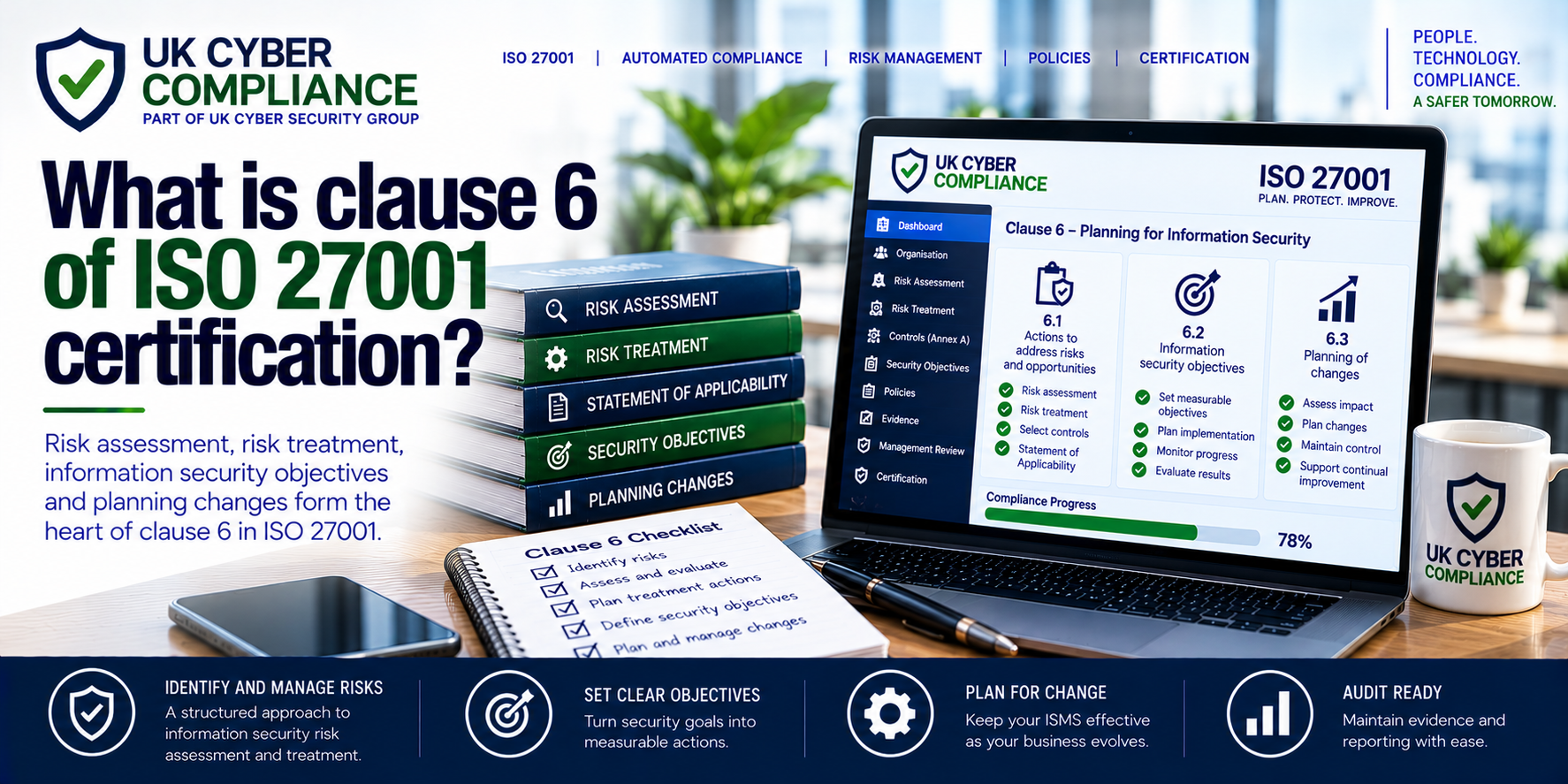
Clause 6 of ISO 27001 focuses on planning, information security risk management, security objectives and how an organisation prepares its Information Security Management System, commonly known as an ISMS, to achieve its intended outcomes.
It is one of the most important parts of ISO 27001 because it establishes how businesses identify information security risks, decide which risks require treatment and determine the controls necessary to protect their information.
Without effective planning, an organisation may invest in security technology without fully understanding what it needs to protect or why certain controls are necessary.
Clause 6 provides a structured approach.
It helps businesses move from identifying information security requirements to making informed decisions about risk, resources, controls and improvement.
ISO/IEC 27001:2022 divides Clause 6 into three main sections:
- Clause 6.1: Actions to address risks and opportunities
- Clause 6.2: Information security objectives and planning to achieve them
- Clause 6.3: Planning of changes
Clause 6.1 also contains three important requirements covering general planning, information security risk assessment and information security risk treatment.
These requirements work together to establish how the organisation manages information security risks throughout the lifecycle of its ISMS.
According to the International Organization for Standardization, ISO 27001 provides the requirements for establishing, implementing, maintaining and continually improving an information security management system.
The current standard is ISO/IEC 27001:2022, supported by Amendment 1:2024, which addresses climate action considerations within management system requirements.
For UK businesses pursuing certification, Clause 6 can involve substantial administration. Risk registers, acceptance criteria, treatment plans, information security objectives and the Statement of Applicability all need to remain accurate and consistent.
UK Cyber Compliance provides an automated and AI-driven ISO 27001 platform designed to simplify these activities through guided risk assessments, risk treatment tracking, control management, policy generation and audit-ready reporting.
UK Cyber Compliance (a part of UK Cyber Security Group) provides these services and has a platform to make certification much easier and cheaper.
By connecting the relevant activities within a structured online platform, organisations can reduce manual administration while maintaining better visibility of their information security risks and certification progress.
what is iso 27001
ISO 27001 is the international requirements standard for an Information Security Management System.
It helps organisations protect the confidentiality, integrity and availability of information through structured governance, risk assessment, security controls, policies, operational processes and continual improvement.
Confidentiality means ensuring that information is accessible only to authorised people.
Integrity means maintaining the accuracy and completeness of information while protecting it against unauthorised alteration.
Availability means ensuring that authorised users can access information and services when needed.
ISO 27001 considers information security across the entire organisation rather than focusing exclusively on computer systems.
The ISMS may involve employees, customers, suppliers, business processes, physical locations, cloud services, applications and contractual requirements.
The standard contains ten numbered clauses, with Clauses 4 to 10 establishing the main management system requirements.
Clause 4 focuses on understanding the organisation and defining the ISMS scope.
Clause 5 establishes leadership, policy and responsibilities.
Clause 6 then turns organisational understanding and management direction into practical information security plans.
This makes Clause 6 essential to the success of the remaining management system requirements.
Why Clause 6 matters to information security
Businesses frequently purchase security products because they believe those products will make the organisation more secure.
However, technology alone does not guarantee effective information security.
A company might invest heavily in endpoint protection while overlooking weak administrator access, inadequate supplier oversight or poor backup recovery arrangements.
Another organisation might create extensive policies without understanding the risks those documents should address.
Clause 6 helps prevent these problems.
It requires organisations to approach information security through structured planning.
The business identifies relevant risks and opportunities, evaluates security risks, determines necessary controls and establishes measurable objectives.
This allows management to understand why particular actions are necessary.
It also provides a clear connection between the organisation’s business priorities and its information security investment.
Clause 6.1: Actions to address risks and opportunities
Clause 6.1 requires organisations to identify and address risks and opportunities that could affect their ISMS.
This includes ensuring that the management system can achieve its intended outcomes, preventing or reducing unwanted effects and supporting continual improvement.
The organisation should consider the internal and external issues identified under Clause 4.1 and the relevant interested party requirements identified under Clause 4.2.
These earlier assessments influence the planning process.
For example, a business that relies heavily on cloud services may need to consider supplier availability, administrator access and information recovery.
A professional services company handling confidential customer information may place particular emphasis on confidentiality, employee awareness and information sharing.
Clause 6.1 ensures that planning reflects the actual organisation.
It does not require every business to implement identical security measures.
Clause 6.1.1: General planning for risks and opportunities
Clause 6.1.1 considers risks and opportunities that may affect the ISMS itself.
This requirement is broader than assessing individual cyber security threats.
An organisation should consider circumstances that could prevent its management system from working effectively.
For example, an unclear allocation of responsibilities could lead to important security actions being overlooked.
A shortage of trained employees might weaken risk assessment or incident management.
An opportunity could involve integrating information security reviews into existing business processes, reducing administration and improving consistency.
Management needs to determine appropriate actions and establish how those actions will become part of the ISMS.
The organisation must also consider how it will evaluate whether the actions are effective.
What should the organisation consider?
Useful planning questions include whether management has established appropriate responsibilities, whether sufficient resources are available and whether significant business changes could affect the ISMS.
The organisation should also consider whether existing processes support its information security objectives.
For example, a business experiencing rapid growth may identify an opportunity to improve security governance through centralised compliance management.
An automated platform can help assign responsibilities, track actions and provide management with visibility of outstanding requirements.
Clause 6.1.2: Information security risk assessment
Clause 6.1.2 establishes the specific requirements for information security risk assessment.
This is one of the most substantial activities within ISO 27001.
The organisation needs a defined process for identifying, analysing and evaluating information security risks.
It must also establish risk criteria and ensure that the assessment process produces consistent, valid and comparable results.
The BSI ISO 27001 self-assessment guidance highlights these requirements, including risk acceptance criteria, risk ownership and the assessment of likelihood and consequences.
The purpose is to ensure that the organisation makes information security decisions using a consistent method rather than personal judgement alone.
Establish a documented risk assessment method
Before assessing individual risks, the organisation should decide how the assessment will work.
This usually involves defining likelihood, impact, risk ratings and acceptance criteria.
For example, likelihood might reflect how realistically a security event could occur.
Impact might consider the consequences for customers, operations, confidentiality, contractual obligations or service availability.
The organisation then uses its agreed method to determine the level of risk.
A simple scoring method can work well when the criteria remain clear and consistent.
Businesses should avoid unnecessary complexity.
An assessment that employees understand and apply consistently is generally more useful than a complicated process that only one specialist can explain.
What should the risk assessment method include?
The methodology should explain how the organisation identifies risks, assigns risk owners, assesses likelihood, evaluates impact and determines overall exposure.
It should also describe the risk acceptance criteria, review arrangements and circumstances requiring reassessment.
The standard does not force every organisation to use an identical risk matrix.
The method should reflect the organisation’s activities and remain suitable for the ISMS.
Identify information security risks
Risk identification involves understanding what could compromise information or disrupt important services.
The organisation should consider events affecting confidentiality, integrity and availability.
Common examples include compromised administrator credentials, accidental disclosure of customer information, ransomware, cloud service disruption, supplier failure, lost equipment and unauthorised access.
However, generic statements do not always provide enough information for a useful assessment.
Instead of recording a risk simply as “data breach”, the organisation might explain that compromised employee credentials could allow an unauthorised person to access confidential customer documents stored in a cloud platform.
This gives management a clearer understanding of what could happen and why the risk matters.
It also makes treatment decisions easier to justify.
Determine likelihood and business impact
Once the organisation identifies a risk, it needs to analyse the possible consequences and realistic likelihood.
Likelihood should consider the circumstances surrounding the risk.
Factors may include existing security controls, known vulnerabilities, previous incidents, exposure to threats and the number of people who can access the relevant systems.
Impact should reflect business consequences.
A short interruption to a minor internal service may create limited disruption.
A prolonged outage affecting a critical customer platform could have much more serious consequences.
The organisation should apply its approved assessment criteria consistently.
That makes risk ratings easier to compare across departments and business functions.
Assign appropriate risk owners
ISO 27001 requires organisations to identify risk owners.
A risk owner should understand the risk and have sufficient authority to manage or escalate decisions relating to it.
Risk ownership does not always belong to IT.
For example, an Operations Director may own the business risk associated with disruption to customer services.
The IT Manager may maintain the technical controls that reduce the risk.
Both have important responsibilities.
The risk owner remains accountable for the business decision about the remaining exposure.
The control owner manages the relevant safeguard.
Clear ownership prevents significant risks from remaining unresolved because nobody accepts responsibility.
Establish risk acceptance criteria
Not every information security risk can or should be eliminated.
Organisations need to determine which remaining risks they can tolerate.
Risk acceptance criteria establish the basis for those decisions.
For example, a business may permit appropriately authorised managers to accept lower risks while requiring senior management approval for significant residual risks.
The organisation should also consider legal, regulatory and contractual obligations.
A risk should not receive acceptance simply because treatment would be inconvenient.
Acceptance needs a defensible business reason.
UK Cyber Compliance provides risk acceptance and residual risk management functionality within its structured ISO 27001 approach.
This can help businesses record decisions and maintain consistent approval arrangements.
Clause 6.1.3: Information security risk treatment
Once the organisation has assessed its risks, it needs to determine how those risks will receive treatment.
Clause 6.1.3 establishes this process.
Risk treatment involves choosing suitable responses and identifying the controls necessary to implement those decisions.
Possible responses may include reducing the risk, avoiding the activity, sharing part of the exposure or accepting the remaining risk where appropriate.
The organisation should select the response that makes sense in its circumstances.
For example, if an employee account could allow unauthorised access to sensitive business information, the organisation might reduce the risk through stronger authentication, access restrictions and monitoring.
Risk treatment should connect directly with the assessment.
The organisation should be able to explain which risk each treatment action addresses.
Select information security controls based on risk
ISO 27001 does not require organisations to select controls without considering their relevance.
Clause 6.1.3 requires the organisation to determine the controls necessary to implement the chosen risk treatment.
It must then compare those controls with Annex A to verify that no necessary controls have been overlooked.
ISO/IEC 27001:2022 Annex A contains 93 controls arranged across organisational, people, physical and technological security areas.
The UKAS guidance on ISO/IEC 27001:2022 confirms the revised control structure.
The important distinction is that organisations should not treat every Annex A control as automatically applicable in the same way.
The necessary controls depend on business risks, relevant obligations and the circumstances of the ISMS.
Create the Statement of Applicability
The Statement of Applicability, commonly called the SoA, is one of the most important outputs of Clause 6.
It identifies the information security controls the organisation has determined are necessary.
It must also provide justification for their inclusion, identify whether they have been implemented and explain exclusions of Annex A controls.
This provides a link between risk assessment, treatment decisions and operational security controls.
For example, an organisation identifying risks associated with cloud administration may determine that relevant identity management and privileged access controls are necessary.
The SoA should reflect those decisions.
UK Cyber Compliance supports the preparation and export of Statement of Applicability documents through its automated compliance platform.
By connecting risks and controls, organisations can reduce the administration involved in maintaining the SoA.
However, management still needs to ensure that the information accurately reflects the organisation’s real security arrangements.
Prepare the Risk Treatment Plan
The Risk Treatment Plan records what the organisation intends to do about risks requiring action.
It helps convert risk decisions into practical work.
A useful plan should identify the relevant risk, required treatment, responsible owner, target date, necessary resources and implementation progress.
The plan should also record the remaining risk where appropriate.
Clause 6.1.3 requires approval from risk owners for the risk treatment plan and acceptance of residual information security risks.
This is particularly important during certification.
An auditor may examine whether risk owners understand the exposure and have approved the treatment arrangements.
A treatment plan without clear ownership or progress monitoring provides limited assurance.
Risk treatment needs evidence
Writing a risk treatment action does not mean the risk has been reduced.
The organisation needs to implement the necessary measures.
For example, a treatment action might require additional monitoring of privileged accounts.
The organisation should then demonstrate that the monitoring actually operates.
Relevant evidence might include review records, security monitoring reports, access approvals or other operational records.
Clause 8 later addresses the implementation of risk treatment plans.
However, Clause 6 establishes the decisions and planned actions that make implementation possible.
This connection helps auditors trace a risk from identification through treatment to evidence.
Clause 6.2: Information security objectives and planning to achieve them
Clause 6.2 requires organisations to establish information security objectives at relevant functions and levels.
These objectives should support the Information Security Policy and reflect applicable information security requirements, risk assessment results and risk treatment decisions.
The objectives should be measurable where practicable.
They also need monitoring, communication and appropriate updating.
ISO 27001 requires the objectives to be available as documented information.
This makes objective planning an important part of the certification evidence.
The objective should describe something meaningful that the organisation wants to achieve or improve.
What makes a useful information security objective?
A weak objective might simply state that the business wants to improve cyber security.
That provides little direction.
A stronger objective could focus on completing security awareness training for all relevant employees within a defined period.
Another might target timely completion of access reviews for critical systems.
A business could also establish objectives around reducing overdue risk treatment actions, improving supplier assessments or completing recovery testing.
The important point is that management can evaluate whether the organisation achieved the intended result.
Objectives should remain relevant to the business rather than exist solely to satisfy the standard.
Plan how each objective will be achieved
Clause 6.2 requires more than identifying a target.
The organisation needs to determine what action will take place, which resources are required, who is responsible, when the work will be completed and how the results will be evaluated.
Consider an objective to improve supplier security oversight.
The organisation might decide to review all high-risk suppliers during a defined annual period.
A named manager would own the objective.
The business would allocate sufficient resources and establish the process for recording completed reviews.
Management would then monitor progress and evaluate the result.
This creates an objective that the organisation can manage and demonstrate during audit.
Use automation to monitor objectives
Traditional objective tracking often involves spreadsheets and manually prepared progress reports.
This can become difficult when several departments own different objectives.
An automated compliance platform can make tracking easier.
UK Cyber Compliance provides real-time progress visibility, control tracking and management reporting through its ISO 27001 platform.
Businesses can use structured records to monitor relevant actions, responsibilities and outstanding work.
The platform can help maintain an organised record of progress, but management still needs to assess whether the objectives remain meaningful and whether the results demonstrate improvement.
Clause 6.3: Planning changes to the ISMS
Clause 6.3 requires organisations to carry out necessary changes to the ISMS in a planned manner.
This requirement was added to ISO/IEC 27001 in the 2022 revision.
BSI’s guidance on the 2022 changes identifies Clause 6.3 as one of the new requirements.
The purpose is to prevent organisations from making important management system changes without considering their effects.
For example, a company may acquire another business, change its ISMS scope, adopt a different risk assessment method or significantly restructure its security responsibilities.
These changes could affect the operation of the ISMS.
The organisation should plan how they will take place.
What should change planning consider?
A practical planning approach should establish why the change is necessary and what it could affect.
The organisation may need to consider responsibilities, information security risks, policies, processes, supporting controls and available resources.
It should also identify who will coordinate the change and how management will determine whether it has worked.
For example, extending ISO 27001 certification to a new office may affect the scope, interested parties, risks and security arrangements.
Planning helps the organisation consider those effects before the changes take place.
Clause 6.3 does not require a separate written change plan for every minor adjustment.
However, important ISMS changes should demonstrate deliberate management rather than uncontrolled activity.
How Clause 6 connects with Clause 4 and Clause 5
The ISO 27001 clauses form one connected management system.
Clause 4 establishes the organisation’s context, relevant interested parties and scope.
These factors influence the risks and opportunities considered under Clause 6.
Clause 5 establishes leadership, policy and responsibilities.
Management then provides direction and oversight for risk assessment, treatment and objectives.
Clause 6 turns those earlier decisions into structured plans.
Clause 7 provides the resources, competence, communication and documented information needed to support implementation.
Clause 8 puts the plans into operation.
Clause 9 evaluates performance through monitoring, internal audit and management review.
Clause 10 drives corrective action and continual improvement.
Understanding these connections can make ISO 27001 easier to manage because each requirement supports the next.
Climate-related issues can influence Clause 6 planning
ISO/IEC 27001:2022 Amendment 1:2024 added climate-action considerations to the organisational context and interested party requirements addressed under Clause 4.
Although the amendment does not create a separate climate requirement within Clause 6, relevant findings may influence information security planning.
For example, a business operating critical facilities in an area exposed to flooding might identify an availability risk.
Another organisation could depend on a supplier whose services face increased disruption from extreme weather.
Where those circumstances affect information security, they may become relevant to risk assessment and treatment.
The organisation should consider actual business exposure rather than automatically creating unnecessary documents.
The aim remains appropriate risk management.
What evidence will an ISO 27001 auditor expect for Clause 6?
An auditor will normally examine how the organisation plans and manages information security risks.
Useful evidence may include:
- Risk assessment methodology and risk criteria
- Risk acceptance criteria
- Current information security risk assessments
- Assigned risk owners
- Risk treatment decisions and plans
- Statement of Applicability
- Evidence of risk owner approval
- Residual risk acceptance decisions
- Information security objectives and achievement plans
- Progress and performance records
- Evidence of planned ISMS changes where relevant
- Supporting management decisions and operational records
This is a practical evidence guide rather than a requirement to create twelve separate documents.
Some information may exist within a compliance platform.
Other records may come from management meetings, technical systems or existing business processes.
The important point is that the information remains accurate, controlled and accessible for audit.
How an auditor may follow a risk through the ISMS
An ISO 27001 auditor may select a risk from the organisation’s register and examine its history.
For example, the risk may concern unauthorised access to confidential customer information through compromised cloud credentials.
The auditor could ask how the organisation identified the risk.
They may examine the likelihood and impact assessment.
Next, they may review the chosen treatment and relevant controls.
The auditor could then check the Statement of Applicability and examine whether the controls have been implemented.
Finally, they may ask who owns the risk, whether the remaining exposure received appropriate approval and when the organisation will review it.
A well-managed Clause 6 process makes these relationships clear.
Common mistakes businesses make with Clause 6
One common mistake is creating generic risk assessments without considering the organisation’s actual circumstances.
Another involves selecting Annex A controls without understanding the risks they should address.
Some businesses fail to define clear risk acceptance criteria.
Others assign risks to employees who lack sufficient authority to manage them.
Risk Treatment Plans may contain overdue actions without meaningful progress.
The Statement of Applicability can also become inconsistent with the risk register.
Another frequent weakness involves information security objectives that cannot be measured or evaluated.
These problems usually arise when the organisation treats Clause 6 as disconnected paperwork.
A structured compliance platform can help maintain consistency, but the underlying decisions still need appropriate management attention.
Clause 6 matters because UK cyber risk remains significant
The UK Government’s Cyber Security Breaches Survey 2025/2026 found that 43 per cent of UK businesses identified a cyber security breach or attack during the previous twelve months.
This represents approximately 612,000 businesses.
The figure increased to 65 per cent among medium businesses and 69 per cent among large businesses.
Phishing remained the most commonly identified attack, affecting 38 per cent of businesses.
The survey also found that only 30 per cent of businesses had carried out a cyber security risk assessment during the previous twelve months.
Only 15 per cent reviewed cyber risks involving their immediate suppliers, while 6 per cent reviewed their wider supply chains.
These findings show why structured risk management is important.
Organisations cannot prioritise security effectively without understanding their exposure.
Clause 6 provides a recognised framework for turning that understanding into practical action.
The full findings are available in the UK Government Cyber Security Breaches Survey 2025/2026.
Who needs iso 27001 certification
ISO 27001 can benefit organisations across almost every sector.
Technology companies, managed service providers, professional services firms, manufacturers, financial organisations, healthcare providers, charities, education providers and public-sector suppliers may all have reasons to pursue certification.
Businesses often seek ISO 27001 because customers require independent information security assurance.
Others use the standard to strengthen governance, manage risks consistently and support procurement opportunities.
ISO 27001 does not require every business to seek external certification.
Organisations can establish and maintain an ISMS without obtaining a certificate.
However, independent certification can demonstrate that the organisation’s management system has received external assessment against the standard.
Regardless of the sector, Clause 6 remains important because information security risks require structured planning and management.
What is ISO 27001 Certification?
ISO 27001 certification provides independent assessment of an organisation’s Information Security Management System against ISO/IEC 27001.
ISO publishes the standard but does not issue company certificates itself.
An independent certification body conducts the external assessment and makes the certification decision.
UK organisations frequently choose certification bodies accredited by the United Kingdom Accreditation Service, known as UKAS.
UKAS accreditation provides additional assurance concerning the competence and impartiality of the certification body.
Businesses can verify accredited providers through the UKAS organisation directory.
An automated ISO 27001 compliance platform helps organisations prepare and maintain the ISMS.
However, completing the platform’s workflows does not automatically result in an independently accredited certificate.
The formal certification decision remains with the certification body.
ISO 27001 Certification Levels
ISO 27001 does not have official bronze, silver, gold or similar certification levels.
An organisation determines its ISMS scope and demonstrates conformity with the standard.
The external certification process normally includes Stage 1 and Stage 2 audits.
Stage 1 focuses on readiness and key management system arrangements.
Stage 2 examines implementation and effectiveness.
Following successful certification, surveillance audits and later recertification provide continuing independent assurance.
Clause 6 remains relevant throughout the certification cycle because information security risks, controls and objectives can change.
The organisation needs to maintain suitable planning processes rather than completing risk assessment only for the initial audit.
How the Certification Works
The ISO 27001 certification process begins with understanding the organisation and establishing the ISMS scope.
Senior management then needs to provide direction, approve the Information Security Policy and assign appropriate responsibilities.
Clause 6 establishes the planning requirements.
The organisation defines its risk assessment method, identifies risks, determines acceptance criteria and selects appropriate treatment actions.
It then determines necessary controls and prepares the Statement of Applicability.
Information security objectives provide measurable direction.
The organisation implements relevant controls and maintains supporting evidence.
Internal audit examines whether the management system meets its requirements.
Management review considers performance, risks, audit findings and improvement opportunities.
An independent certification body then assesses the ISMS against ISO/IEC 27001.
A well-organised Clause 6 process helps make this assessment easier because the auditor can follow the relationship between risks, controls, objectives and operational evidence.
Which UK-based firms offer ISO 27001 consultancy services?
UK businesses can obtain ISO 27001 support from information security consultancies, compliance specialists, managed security providers and automated compliance platform services.
When selecting support, consider whether the provider understands the complete ISMS rather than simply offering generic templates.
Useful assistance should include organisational context, ISMS scope, risk assessment, risk acceptance criteria, risk treatment, the Statement of Applicability, information security objectives, policies, controls and audit preparation.
UK Cyber Compliance provides an automated and AI-driven ISO 27001 platform supported by guided workflows and access to compliance expertise.
Its platform includes intelligent risk assessment, residual risk tracking, control management, AI-assisted policy generation, real-time progress monitoring and audit-ready reporting.
This approach can help smaller organisations manage Clause 6 without relying entirely on manually maintained spreadsheets and document libraries.
How UK Cyber Compliance simplifies Clause 6
Clause 6 creates several connected records.
Risk assessments identify exposure.
Risk treatment establishes actions.
The Statement of Applicability records necessary controls.
Information security objectives establish measurable priorities.
Management needs visibility of progress across these activities.
Traditional manual systems can make it difficult to keep all the information aligned.
UK Cyber Compliance provides a structured platform that helps organisations connect these activities within one compliance environment.
Risk owners can maintain assessments and treatment information.
Relevant controls can be tracked against the organisation’s security requirements.
Policies can receive AI-assisted drafting and appropriate management review.
Progress dashboards can help identify outstanding actions.
Audit-ready reports can make evidence easier to retrieve.
Automation reduces repetitive administration, but employees and management must still ensure that the information represents the real organisation.
A practical Clause 6 readiness checklist
Before the external certification audit, ask whether your organisation can demonstrate the following.
Clause 6.1: Risk and opportunity planning
Do we understand the risks and opportunities that could affect our ISMS?
Have we established appropriate risk criteria?
Is our information security risk assessment process consistent and repeatable?
Have we identified the significant risks affecting confidentiality, integrity and availability?
Are risk owners assigned?
Do we have suitable risk acceptance criteria?
Have we selected appropriate treatment actions?
Does our Statement of Applicability reflect the necessary controls?
Have risk owners approved the treatment plan and accepted residual risks where appropriate?
Clause 6.2: Information security objectives
Have we established relevant information security objectives?
Are they measurable where practicable?
Do we know who owns each objective?
Have we identified the resources and actions required?
Can management monitor progress and evaluate results?
Clause 6.3: Planning changes
Do we consider the effect of significant changes to the ISMS?
Are responsibilities clear?
Do we plan changes before making them?
Can we demonstrate appropriate management oversight?
If several answers remain uncertain, strengthen those areas before the external assessment.
Effective ISO 27001 planning starts with Clause 6
Clause 6 provides the planning foundation of an effective Information Security Management System.
It helps businesses move from understanding information security requirements to deciding how those requirements should receive attention.
Clause 6.1 establishes how organisations address risks and opportunities.
Clause 6.1.2 requires a consistent information security risk assessment process.
Clause 6.1.3 establishes risk treatment and the Statement of Applicability.
Clause 6.2 requires information security objectives and plans for achieving them.
Clause 6.3 ensures that important ISMS changes take place in a planned manner.
Together, these requirements make information security planning more structured and accountable.
For UK businesses pursuing ISO 27001 certification, the key is to keep risk assessment, treatment, objectives and controls connected.
Generic documentation alone will not create an effective ISMS.
The organisation should understand its risks, assign appropriate owners, implement necessary safeguards and maintain evidence that its decisions lead to action.
UK Cyber Compliance helps organisations manage these activities through an automated and AI-driven ISO 27001 platform that connects risk assessment, acceptance criteria, treatment planning, controls, the Statement of Applicability, objectives and audit preparation.
By reducing repetitive administration and providing structured workflows, businesses can approach Clause 6 with greater clarity and confidence.
When the planning process reflects the organisation’s actual activities, ISO 27001 becomes easier to manage and maintain.
Most importantly, the business gains a structured way to identify what could go wrong, understand the consequences, choose appropriate controls and continually improve its information security management.
That is the real value of Clause 6: turning information security risk into informed business decisions and practical action.
UK Cyber Compliance is here to help
For more information, please do get in touch.
Please check out our Free Cyber Insurance
Other blog posts, Your ISO 27001 Questions Answered, Get ISO 27001 Certified ,
If you would like to know more, do get in touch as we are happy to answer any questions. Looking to improve your cybersecurity but not sure where to start? Begin by getting certified in Cyber Essentials, the UK government’s scheme that covers all the technical controls that will provide the protection that you need to help guard against criminal attacks.