What is clause 7 of ISO 27001 certification?
ISO 27001 certification helps businesses demonstrate that they take information security seriously and have established a structured approach to protecting information, managing cyber risks and maintaining effective security controls.
However, achieving certification involves more than creating policies, carrying out risk assessments or purchasing security software.
An organisation also needs the people, knowledge, resources, communication arrangements and documentation required to support its Information Security Management System (ISMS).
This is where Clause 7 of ISO/IEC 27001:2022 becomes particularly important.
Known as Support, Clause 7 establishes the requirements that enable an organisation to operate, maintain and continually improve its ISMS.
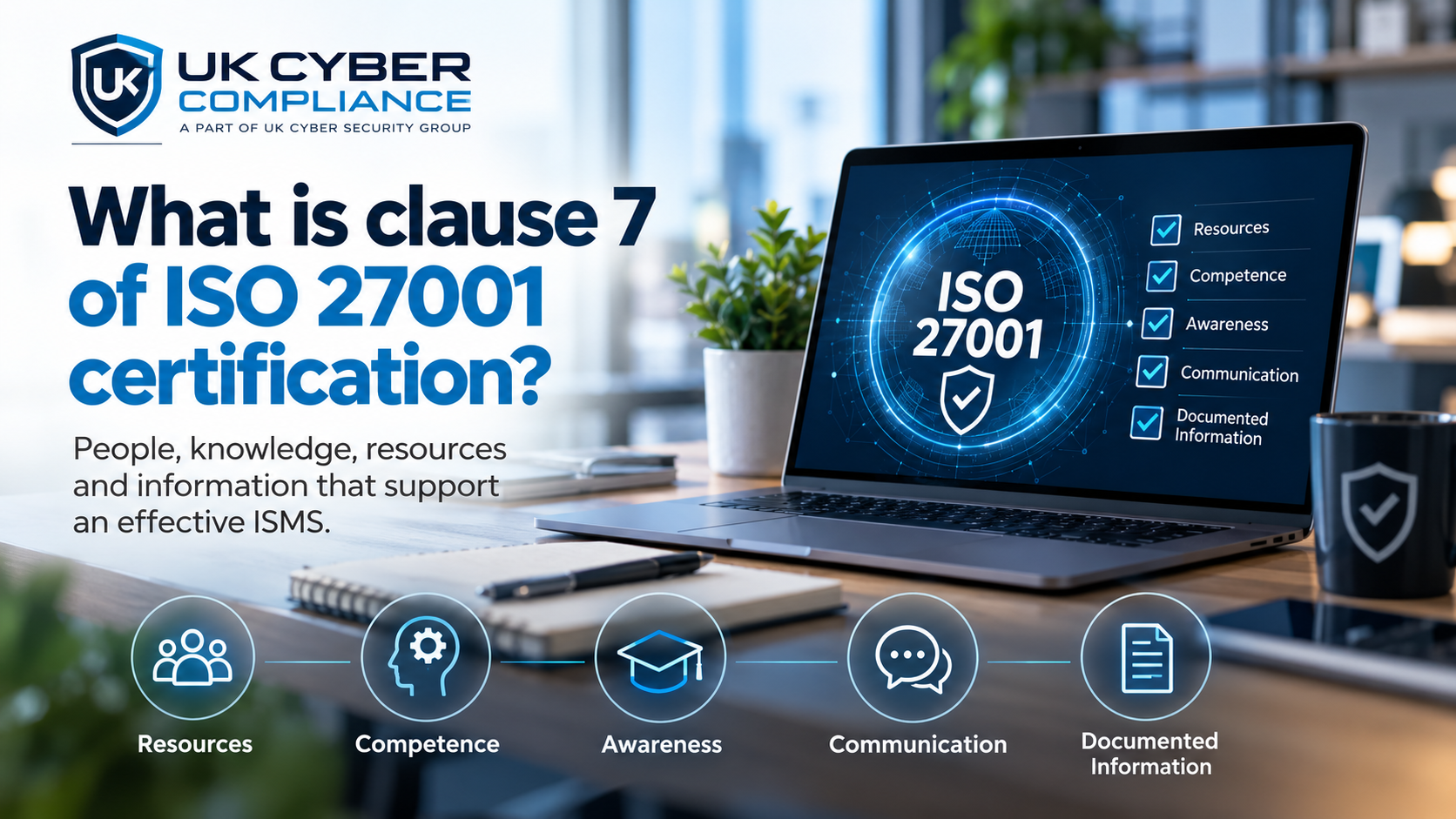
It addresses five essential areas: resources, competence, awareness, communication and documented information.
For UK businesses preparing for ISO 27001 certification, understanding these requirements can make the assessment process more manageable and help ensure that information security responsibilities become part of everyday business operations.
UK Cyber Compliance, part of UK Cyber Security Group Ltd, helps businesses manage ISO 27001 requirements through its automated, AI-driven compliance platform.
Available at www.ukcybercompliance.co.uk, the platform supports risk management, policy development, evidence collection and audit preparation.
By bringing compliance activities together in one environment, businesses can reduce repetitive administration, improve visibility and potentially lower the cost of preparing for certification.
Understanding Clause 7 is an important starting point because even well-designed security controls depend on employees, resources and reliable information to operate effectively.
Understanding the purpose of Clause 7 in ISO 27001
ISO/IEC 27001:2022 is an internationally recognised standard for establishing, implementing, maintaining and continually improving an Information Security Management System.
An ISMS helps an organisation manage information security risks using documented processes, responsibilities, policies and controls.
The standard contains requirements covering organisational context, leadership, planning, support, operation, performance evaluation and improvement.
Clause 7 concentrates on the supporting arrangements that make these activities possible.
For example, a business may identify ransomware as a significant information security risk.
It might decide to strengthen employee awareness, improve incident response arrangements and maintain more effective recovery procedures.
However, those decisions achieve little without suitable resources, employees who understand their responsibilities and documented information showing that the necessary activities take place.
Clause 7 addresses these underlying needs.
The five areas covered by Clause 7
Clause 7 is divided into five main requirements.
7.1 Resources: Identifying and providing what the organisation needs to establish, maintain and improve its ISMS.
7.2 Competence: Ensuring people performing work that affects information security have suitable knowledge, training or experience.
7.3 Awareness: Making sure people understand the information security policy, their contribution to the ISMS and the implications of failing to follow its requirements.
7.4 Communication: Determining appropriate internal and external communication arrangements relating to information security.
7.5 Documented Information: Creating, updating, protecting and controlling the records and documents needed to support the ISMS.
These requirements apply to organisations seeking ISO 27001 certification, although the way they are demonstrated will depend on their activities, complexity and operational needs.
Clause 7.1: Providing the resources your ISMS needs
Information security cannot operate effectively without suitable resources.
Clause 7.1 requires organisations to determine and provide the resources necessary to establish, implement, maintain and continually improve their ISMS.
This does not mean every business needs a dedicated information security department or expensive security technology.
It means the organisation must understand what is required and ensure those resources are available.
What counts as an information security resource?
Resources can include employees, management time, specialist knowledge, technology, external professional support and financial investment.
For example, a small accountancy practice might rely on an external managed IT provider to maintain its technical infrastructure.
Its Office Manager may coordinate information security documentation, while a Director takes responsibility for approving policies and significant risk decisions.
These arrangements can be appropriate when responsibilities are clear and the organisation has access to the resources necessary to operate its ISMS.
A larger business may require a dedicated information security team, additional management oversight and formal reporting arrangements.
The key consideration is whether available resources are sufficient for the organisation’s actual needs.
How can businesses demonstrate resource allocation?
An ISO 27001 auditor may examine whether management has considered the resources needed to operate the ISMS.
Useful supporting evidence might include a resource allocation plan, employee responsibilities, approved training arrangements, supplier agreements or management meeting records.
A business may also demonstrate that it has assigned sufficient time for internal audits, security reviews and corrective actions.
For example, if an employee is responsible for maintaining the risk register, management should ensure they have the time, access and appropriate knowledge to perform that responsibility.
Simply assigning a task without providing the necessary support may create weaknesses.
Organisations should review resource requirements when their business changes.
Recruitment, additional offices, new customers, cloud services and changing contractual obligations can all affect the resources needed to maintain information security.
Clause 7.2: Making sure people are competent
Technology plays an important role in information security, but employees and contractors also influence whether an ISMS operates successfully.
Clause 7.2 requires organisations to determine the necessary competence of people whose work affects information security performance.
They must ensure those individuals are competent through appropriate education, training or experience.
Where additional competence is necessary, the organisation must take suitable action and evaluate whether that action has been effective.
It must also retain appropriate documented evidence of competence.
Competence involves more than attending a training course
An organisation might provide its employees with annual cyber security awareness training.
This can be valuable, but attending a course does not automatically demonstrate competence for every security-related responsibility.
Consider an employee responsible for approving information security risks.
That person needs to understand the organisation’s risk assessment process, acceptance criteria and escalation arrangements.
Someone responsible for conducting internal audits needs suitable auditing knowledge and an understanding of the requirements being assessed.
Similarly, an employee managing supplier security reviews should understand the organisation’s expectations and how to evaluate relevant evidence.
Different responsibilities require different knowledge and experience.
The organisation should identify these needs rather than assuming one training programme covers everyone.
Creating a competence record
A practical competence record can identify an employee’s role, their relevant responsibilities, the required knowledge or experience and the evidence demonstrating their competence.
For example, an Information Security Manager may demonstrate competence through recognised professional qualifications, previous employment experience and ongoing professional development.
An employee responsible for handling personal information may demonstrate competence through relevant training and observed understanding of company procedures.
Where gaps are identified, the organisation can arrange further training, mentoring or specialist support.
The effectiveness of that action should then be evaluated.
This might involve reviewing completed work, asking practical questions or checking whether previously identified mistakes have been resolved.
Can an external consultant provide the necessary competence?
Yes.
ISO 27001 does not require every organisation to employ all its information security expertise internally.
Businesses can engage external consultants and specialist service providers where appropriate.
However, outsourcing specialist work does not transfer overall accountability for the ISMS away from the organisation.
Management must still understand its responsibilities and ensure that externally delivered activities support the required outcomes.
UK Cyber Compliance provides access to structured compliance guidance and specialist support, helping organisations understand their obligations and manage information security activities.
Clause 7.3: Building information security awareness
Competence and awareness are closely connected, but they are not identical.
Competence concerns whether people have the necessary knowledge and ability to perform their responsibilities.
Awareness concerns whether they understand the organisation’s information security expectations and their role in meeting them.
Clause 7.3 requires people working under the organisation’s control to understand the information security policy, how they contribute to the ISMS and the implications of failing to meet its requirements.
This includes relevant employees and may extend to contractors and other individuals whose work is controlled by the organisation.
Why awareness matters to everyday business operations
An organisation might maintain strong technical security controls but still experience problems when employees fail to recognise suspicious messages or handle confidential information carelessly.
For example, an employee may receive an email requesting an urgent change to a supplier’s bank details.
Without suitable awareness, they might follow the instructions without verifying the request through an established process.
Another employee may accidentally disclose customer information by sending a document to the wrong recipient.
These examples demonstrate why employees need to understand the risks associated with their activities.
Awareness should address real business situations rather than rely exclusively on general statements about cyber security.
Making awareness relevant to individual roles
Employees working in finance may benefit from guidance concerning payment fraud and supplier impersonation.
Customer service teams may need to understand confidentiality and appropriate information sharing.
Managers should understand their responsibility for approving access, reporting concerns and supporting security requirements.
Senior leadership should understand how information security relates to business risk and organisational objectives.
This role-based approach helps employees understand why security matters to their work.
It also makes awareness activities more practical.
How can awareness be demonstrated during an audit?
An auditor may ask employees questions about the information security policy and how they contribute to protecting information.
They may also examine awareness communications, training records, employee acknowledgements or internal guidance.
An organisation could demonstrate awareness through regular team briefings, employee onboarding activities and periodic reminders.
Short knowledge checks can help determine whether important messages have been understood.
However, Clause 7.3 does not prescribe one particular awareness programme or require every organisation to use identical training materials.
The important requirement is that relevant people understand their responsibilities and the consequences of failing to meet ISMS requirements.
Clause 7.4: Getting information security communication right
Information security depends on effective communication between employees, managers, customers and relevant external parties.
Clause 7.4 requires organisations to determine their internal and external communication needs concerning the ISMS.
This involves establishing what information needs communicating, when communication should happen, who needs to receive it and how it should be delivered.
Without clear arrangements, important security information may arrive too late or fail to reach the appropriate person.
Internal communication keeps responsibilities clear
Internal communication may involve notifying employees about changes to security policies, reporting identified risks or informing management about significant incidents.
For example, a business might discover that an important security procedure is no longer being followed consistently.
The relevant manager needs to understand the issue and determine what action is required.
Employees may then need updated guidance.
A business might also communicate the results of an internal audit to the people responsible for resolving identified weaknesses.
These communications support accountability and help ensure that security activities remain coordinated.
External communication supports customers and suppliers
External communication can involve customers, regulators, external auditors, suppliers and specialist service providers.
For example, a managed IT provider may need to notify a customer when a significant security incident affects its services.
A business may also have contractual obligations to communicate certain incidents to customers.
Where personal data is involved, relevant UK GDPR reporting and notification obligations must be considered.
The Information Commissioner’s Office explains that certain personal data breaches must be reported within 72 hours of the organisation becoming aware of them, where feasible, when the legal reporting threshold is met.
Not every incident requires notification to the ICO, so businesses need to understand the applicable requirements.
Developing a practical communication plan
A communication plan helps businesses identify who should receive important information and when it needs to be communicated.
For example, the plan might establish that significant cyber incidents are reported immediately to the responsible manager.
It could also identify who communicates with affected customers, who provides information to regulators and who coordinates with external service providers.
The organisation should identify the communication channels it will use and the people responsible for delivering important messages.
A separate formal communication plan is not expressly demanded by Clause 7.4, but maintaining suitable records can help demonstrate that communication requirements have been considered.
Clause 7.5: Keeping documented information under control
Documentation is one of the most visible parts of ISO 27001 certification.
Organisations need reliable information to explain how their security arrangements work, support operational decisions and demonstrate compliance during assessment.
Clause 7.5 establishes requirements for creating, updating and controlling documented information.
The requirement is not simply to produce as many documents as possible.
It is to maintain the information the standard requires and the additional information the organisation determines is necessary for an effective ISMS.
Clause 7.5.1: What documented information is required?
An ISMS must include documented information specifically required by ISO 27001 and information the organisation determines is necessary for its effectiveness.
Relevant examples may include the information security policy, ISMS scope, information security objectives, risk assessment results, risk treatment records and the Statement of Applicability.
These records are required through the applicable provisions of the standard, rather than all being separately mandated by Clause 7 itself.
Additional documents may be useful depending on how the organisation operates.
For example, a business may maintain an asset register, supplier assessment records, employee awareness records and internal audit reports.
The level of detail should support the organisation’s actual processes.
A small professional services business may need less extensive supporting documentation than an organisation managing numerous offices, complex infrastructure and significant regulatory responsibilities.
However, all organisations must satisfy the mandatory requirements relevant to their ISMS.
Clause 7.5.2: Creating and updating information
Documentation needs to remain accurate, identifiable and suitable for its intended purpose.
Clause 7.5.2 addresses the creation and updating of documented information.
This includes appropriate identification, descriptions, format and review or approval.
For example, an organisation might maintain an Information Security Policy approved by its Managing Director.
The policy could include a document owner, version number, approval date and scheduled review date.
When changes occur, the document should be reviewed and approved through the organisation’s established arrangements.
Employees should not have to guess whether they are using the latest approved policy.
Clause 7.5.3: Protecting and controlling records
Documented information must be available and suitable for use where needed.
It must also receive appropriate protection.
Relevant controls include managing access, distribution, retrieval, storage, preservation, changes, retention and disposal.
Consider a business maintaining employee competence records.
Those records may contain personal information and should only be accessible to authorised individuals.
However, the organisation must also be able to retrieve suitable evidence when needed for an ISO 27001 audit.
Similarly, an outdated policy should not remain available as though it were the current approved version.
Information obtained from external sources, where necessary for the ISMS, also needs appropriate identification and control.
Why document control becomes difficult
Many businesses initially manage their compliance documents through shared folders, email attachments and spreadsheets.
This can work, but administration becomes more difficult as the number of records increases.
Different employees may save copies of the same document.
Reviews may be missed.
Actions may remain outstanding because nobody has clear ownership.
Evidence may exist but be difficult to locate during an audit.
A centralised compliance platform can help organisations manage these challenges more consistently.
UK Cyber Compliance supports structured documentation, progress monitoring and evidence management through its automated platform.
what is iso 27001 and how does Clause 7 fit into the standard?
ISO 27001 is an international standard that establishes requirements for managing information security risks through an ISMS.
It follows a risk-based approach rather than requiring every business to use the same security products or internal processes.
The organisation must understand its information security risks, determine appropriate safeguards, assign responsibilities and evaluate whether its management system is effective.
Clause 7 supports these activities by ensuring that the people, resources, communication arrangements and information necessary to operate the system are available.
For example, Clause 6 addresses information security planning and risk-related activities.
Clause 7 supports the people and resources required to carry out that planning.
Clause 8 concerns operational activities.
Clause 9 addresses performance evaluation, including internal audits and management reviews.
Clause 10 focuses on improvement.
These requirements work together.
An organisation cannot expect its risk management process to remain effective when the responsible employees lack competence or when important information is unavailable.
Likewise, documented policies alone will not demonstrate that employees understand their responsibilities.
Clause 7 helps connect management decisions with practical daily activities.
What is ISO 27001 Certification?
ISO 27001 certification is the process through which an organisation’s ISMS is independently assessed against the requirements of ISO/IEC 27001.
Certification provides external assurance that the organisation has established and operates a management system meeting the applicable requirements within its certified scope.
An independent certification body conducts the formal assessment.
In the UK, organisations often select certification bodies accredited by the United Kingdom Accreditation Service (UKAS) or another appropriately recognised accreditation body.
Accreditation provides additional assurance about the certification body’s competence and impartiality.
A compliance platform can support certification preparation, but software alone does not issue an accredited ISO 27001 certificate.
Organisations must still complete the applicable independent assessment.
Why Clause 7 matters during certification
An auditor needs evidence that the ISMS operates effectively.
They may ask how the organisation determines security resources, how employees demonstrate competence and how awareness activities take place.
They may also examine communication arrangements and document control.
For example, a business may state that all employees receive information security training.
The auditor might request supporting records and ask how the business determines whether the training is effective.
If the business has identified a need for additional security expertise, the auditor may examine how that need was addressed.
The purpose is to determine whether the organisation genuinely meets the requirements.
Who needs iso 27001 certification
ISO 27001 certification can benefit organisations that store, process, manage or exchange information requiring appropriate protection.
This includes businesses operating in technology, professional services, finance, healthcare, education, manufacturing and the public sector supply chain.
Smaller businesses may also pursue certification to satisfy customer requirements or demonstrate a structured approach to information security.
For example, a software company providing cloud applications to corporate customers may be asked to demonstrate how it manages security risks.
A recruitment agency may need to demonstrate appropriate protection of candidate and employer information.
An engineering supplier may need to provide security assurance to customers handling sensitive commercial information.
ISO 27001 certification is generally voluntary, but it may become an important contractual or procurement requirement.
Whether certification is necessary depends on the organisation’s commercial commitments, customer expectations and regulatory circumstances.
ISO 27001 Certification Levels
Businesses sometimes search for different ISO 27001 certification levels.
However, ISO/IEC 27001 does not establish separate bronze, silver or gold certification grades.
An organisation either meets the applicable certification requirements within its defined scope or it does not.
There are, however, different stages in the certification process.
Stage 1 normally involves a review of the organisation’s readiness, documented information and understanding of the standard.
Stage 2 examines the implementation and effectiveness of the ISMS in greater detail.
Once certification is awarded, surveillance audits ordinarily take place during the certification cycle, followed by recertification.
The normal accredited certification cycle lasts three years, subject to continuing compliance and the certification body’s applicable arrangements.
Businesses should also distinguish the certification scope from the organisation as a whole.
A certificate may cover a defined business activity, service or organisational boundary.
Customers should review that scope rather than assuming every activity undertaken by a certified company is covered.
How the Certification Works
ISO 27001 certification is most manageable when businesses approach it as a structured project rather than a last-minute documentation exercise.
The first stage involves understanding the organisation’s activities, interested parties, information security requirements and ISMS scope.
Management then establishes an information security policy, objectives and appropriate responsibilities.
The business identifies and assesses information security risks, determines suitable risk treatments and prepares its Statement of Applicability.
Supporting processes are then established to operate the ISMS.
This is where Clause 7 becomes especially relevant.
Employees need appropriate competence and awareness.
Management must provide suitable resources.
Communication arrangements need to be defined.
Required information must remain available and controlled.
The organisation subsequently evaluates its ISMS through monitoring, internal audits and management reviews.
Any identified nonconformities must receive appropriate attention.
When ready, the business can proceed to independent certification assessment.
Making the process easier through automation
Traditional compliance activities can involve substantial manual administration.
Employees may maintain risk registers, policy records, action plans and audit evidence in separate locations.
This can make it difficult to see which activities are complete and which require attention.
UK Cyber Compliance offers an automated, AI-driven platform designed to bring these activities into a more structured environment.
Its capabilities include guided compliance workflows, intelligent risk assessment, AI-assisted policy generation, progress tracking and audit-ready documentation.
The platform can help businesses maintain records and manage outstanding actions while reducing repetitive manual work.
However, any AI-generated material still needs appropriate human review.
Policies, records and compliance evidence must accurately reflect the organisation’s real activities.
Automation supports the process; it does not replace management accountability or independent certification.
How does Clause 7 connect with Annex A controls?
ISO 27001 includes both management system requirements and an Annex A reference set of information security controls.
These serve related but different purposes.
Clause 7 establishes mandatory management system requirements concerning support.
Annex A provides a reference set of controls used when considering information security risk treatment and preparing the Statement of Applicability.
Some Annex A controls relate closely to activities supported by Clause 7.
For example, Annex A Control 6.3 addresses information security awareness, education and training.
Annex A Control 5.1 concerns information security policies.
Annex A Control 5.37 addresses documented operating procedures.
However, an organisation should not treat Clause 7 and Annex A as interchangeable.
Clause 7 must be addressed as part of the ISMS requirements.
Annex A controls are considered through the risk treatment process, with inclusion or exclusion decisions justified in the Statement of Applicability.
This distinction matters during certification because implementing an individual control does not automatically demonstrate compliance with the wider management system.
What evidence might an ISO 27001 auditor request for Clause 7?
Evidence should demonstrate that the organisation has understood and implemented the applicable requirements.
For Clause 7.1, an auditor might examine resource planning, assigned responsibilities, management decisions and relevant service agreements.
For Clause 7.2, evidence may include competence assessments, qualifications, experience records, training activities and evaluations of their effectiveness.
For Clause 7.3, relevant evidence could include employee awareness communications, briefing records, policy acknowledgements and responses to interview questions.
For Clause 7.4, evidence might include communication procedures, incident reporting arrangements, relevant notifications and records of important internal communications.
For Clause 7.5, an auditor may examine document approval records, version histories, access arrangements and retention procedures.
Not every business needs a separate document for each activity.
Existing business records may provide suitable evidence where they demonstrate the relevant requirements.
What matters is that the evidence is accurate, accessible and consistent with how the organisation operates.
Common weaknesses that can affect certification
One frequent problem is assigning information security responsibilities without considering whether the individuals involved have the necessary competence.
Another is providing training without assessing whether employees understand or can apply what they have learned.
Document control can also create difficulties.
For example, a business may have an approved information security policy but continue using an outdated version in another department.
Communication arrangements can be another weakness when nobody understands who should notify management or external parties during a significant security incident.
These problems often arise because supporting processes have not been fully established.
Regular reviews can help identify weaknesses before a formal audit.
Why the UK cyber security figures make Clause 7 important
The UK’s cyber security experience demonstrates why management support, employee awareness and documented processes matter.
According to the UK Government’s Cyber Security Breaches Survey 2025/2026, 43 per cent of UK businesses identified a cyber security breach or attack during the preceding twelve months.
That represents approximately 612,000 businesses.
The proportion increased to 65 per cent among medium businesses and 69 per cent among large businesses.
Phishing remained the most commonly identified attack method, affecting 38 per cent of businesses.
These figures concern attacks and breaches that organisations identified and reported to the survey. They do not represent every incident that may have occurred.
The findings reinforce the value of employee awareness, clear responsibilities and appropriate communication arrangements.
Many businesses still lack structured security management
The same government survey found that only 30 per cent of businesses had undertaken a cyber security risk assessment during the preceding twelve months.
Only 25 per cent reported having a formal cyber security incident response plan.
These findings do not directly measure compliance with ISO 27001 Clause 7.
However, they demonstrate gaps in wider cyber security governance and preparation.
A business may have security software in place but lack the management processes necessary to maintain security consistently.
ISO 27001 encourages organisations to address information security as an ongoing business responsibility.
Clause 7 supports that approach by ensuring that people understand their roles, important information is available and security activities receive suitable resources.
Which UK-based firms offer ISO 27001 consultancy services?
UK businesses can obtain ISO 27001 consultancy support from specialist cyber security organisations, information security consultancies and experienced compliance providers.
Providers may assist with ISMS scoping, gap analysis, risk management, policy development, internal audits, employee awareness and certification preparation.
When selecting consultancy support, businesses should consider whether the provider understands ISO/IEC 27001:2022, has relevant professional experience and can explain the requirements in practical terms.
Consultancy should help a business create an ISMS that reflects its real operations rather than simply produce generic documents.
UK Cyber Compliance, part of UK Cyber Security Group Ltd, provides ISO 27001 compliance and certification preparation services through its automated, AI-driven platform.
The service combines structured workflows, documentation support, risk management functionality and access to professional guidance.
This approach can be particularly helpful for smaller businesses that do not employ a dedicated information security team.
Organisations should also confirm how independent certification will be arranged and whether the selected certification body holds suitable accreditation.
How UK Cyber Compliance supports Clause 7 activities
Managing Clause 7 effectively requires businesses to keep information accurate, maintain accountability and understand which supporting activities remain outstanding.
A centralised compliance platform can make these responsibilities easier to coordinate.
Clearer visibility of responsibilities and resources
UK Cyber Compliance helps businesses manage compliance activities through structured workflows and progress monitoring.
This can support management when reviewing assigned responsibilities, identifying outstanding work and considering additional resource needs.
The platform provides a more coordinated approach than maintaining disconnected records across numerous spreadsheets and folders.
Supporting competence and awareness evidence
Businesses can use structured compliance records to organise information about relevant training, competence and awareness activities.
The important consideration is whether the organisation can demonstrate that its people have the necessary knowledge and understand their responsibilities.
Records should support genuine operational activity rather than replace it.
Better control over documentation
UK Cyber Compliance provides AI-assisted policy generation and documentation management capabilities designed to support ISO 27001 preparation.
This can reduce repetitive administrative work and make important information easier to maintain.
The organisation remains responsible for reviewing, approving and keeping its documents accurate.
Preparing for independent assessment
The platform supports the creation and export of compliance evidence, risk information and relevant documentation.
This can help organisations prepare information for internal review and independent certification audits.
Businesses can also monitor their progress and identify activities requiring further attention.
By improving visibility and reducing manual administration, UK Cyber Compliance aims to make ISO 27001 preparation easier, more efficient and more affordable for UK organisations.
A practical Clause 7 readiness review
Before arranging an ISO 27001 certification audit, businesses should consider whether their supporting arrangements genuinely meet the standard.
Start with resources.
Can management explain what the ISMS needs to operate, and have those resources been provided?
Next, review competence.
Do people performing security-related activities have the appropriate knowledge or experience, and is suitable evidence retained?
Consider awareness.
Do employees understand the information security policy, their contribution to security and the implications of not meeting ISMS requirements?
Review communication.
Can the business explain what security information must be communicated, when it should be shared, who needs to receive it and how communication takes place?
Finally, examine documented information.
Are relevant policies and records accurate, approved where appropriate, accessible to authorised people and protected against inappropriate access or modification?
If the organisation cannot answer these questions confidently, further preparation may be necessary.
The purpose is not to generate unnecessary paperwork.
It is to demonstrate that the systems supporting information security are operating as intended.
Maintaining Clause 7 after certification
ISO 27001 certification requires continuing attention.
Businesses change, employees leave, new suppliers are engaged and information security risks evolve.
The supporting arrangements established under Clause 7 therefore need to remain effective over time.
Resource requirements should be reconsidered when responsibilities or business operations change.
Employee competence needs may develop as new services, technologies and legal requirements emerge.
Awareness activities should remain relevant to the threats and responsibilities employees encounter.
Communication arrangements may need updating when the organisation changes its management structure or supplier relationships.
Documentation should remain current and reflect approved business practices.
Internal audits and management reviews provide opportunities to examine whether these supporting arrangements continue to work.
Where weaknesses are identified, management should determine suitable corrective action.
Maintaining these activities throughout the year can also reduce the disruption associated with surveillance audits and future recertification.
Making Clause 7 work for your business
Clause 7 of ISO 27001 is about ensuring that information security has the practical support it needs to succeed.
Its five main areas address the foundations of an effective ISMS: resources, competence, awareness, communication and documented information.
Businesses need suitable people and resources to carry out their security responsibilities.
Employees must understand what is expected of them.
Important information needs to reach the right people.
Policies and records must remain accurate, available and appropriately protected.
When these requirements are managed effectively, information security becomes easier to maintain and demonstrate during independent assessment.
For smaller organisations, the process does not need to be unnecessarily complicated.
A proportionate approach supported by clear responsibilities, practical procedures and reliable documentation can meet the relevant requirements.
UK Cyber Compliance, part of UK Cyber Security Group Ltd, helps UK businesses manage their ISO 27001 journey through an automated, AI-driven compliance platform.
By combining risk management, guided workflows, policy development, documentation and progress tracking, the platform can reduce administrative complexity and help organisations prepare for certification more efficiently.
Businesses interested in improving their information security management and working towards ISO 27001 certification can visit www.ukcybercompliance.co.uk to explore the available services.
The real value of Clause 7 is not simply meeting an audit requirement.
It is ensuring that people, resources and information work together to protect the business, support customers and maintain effective information security over the long term.
UK Cyber Compliance is here to help
For more information, please do get in touch.
Please check out our Free Cyber Insurance
Other blog posts, Your ISO 27001 Questions Answered, Get ISO 27001 Certified ,
If you would like to know more, do get in touch as we are happy to answer any questions. Looking to improve your cybersecurity but not sure where to start? Begin by getting certified in Cyber Essentials, the UK government’s scheme that covers all the technical controls that will provide the protection that you need to help guard against criminal attacks.