What is clause 8 of ISO 27001 certification?
ISO 27001 certification helps businesses demonstrate that they take information security seriously, understand their security risks and have established effective processes to protect important information.
However, creating policies and identifying security risks is only part of achieving certification.
Organisations must also demonstrate that their security processes operate in practice, that information security risks are regularly assessed and that appropriate actions are taken to manage those risks.
This is where Clause 8 of ISO/IEC 27001:2022 becomes particularly important.
Known as Operation, Clause 8 establishes the requirements for implementing and controlling the activities needed to operate an effective Information Security Management System (ISMS).
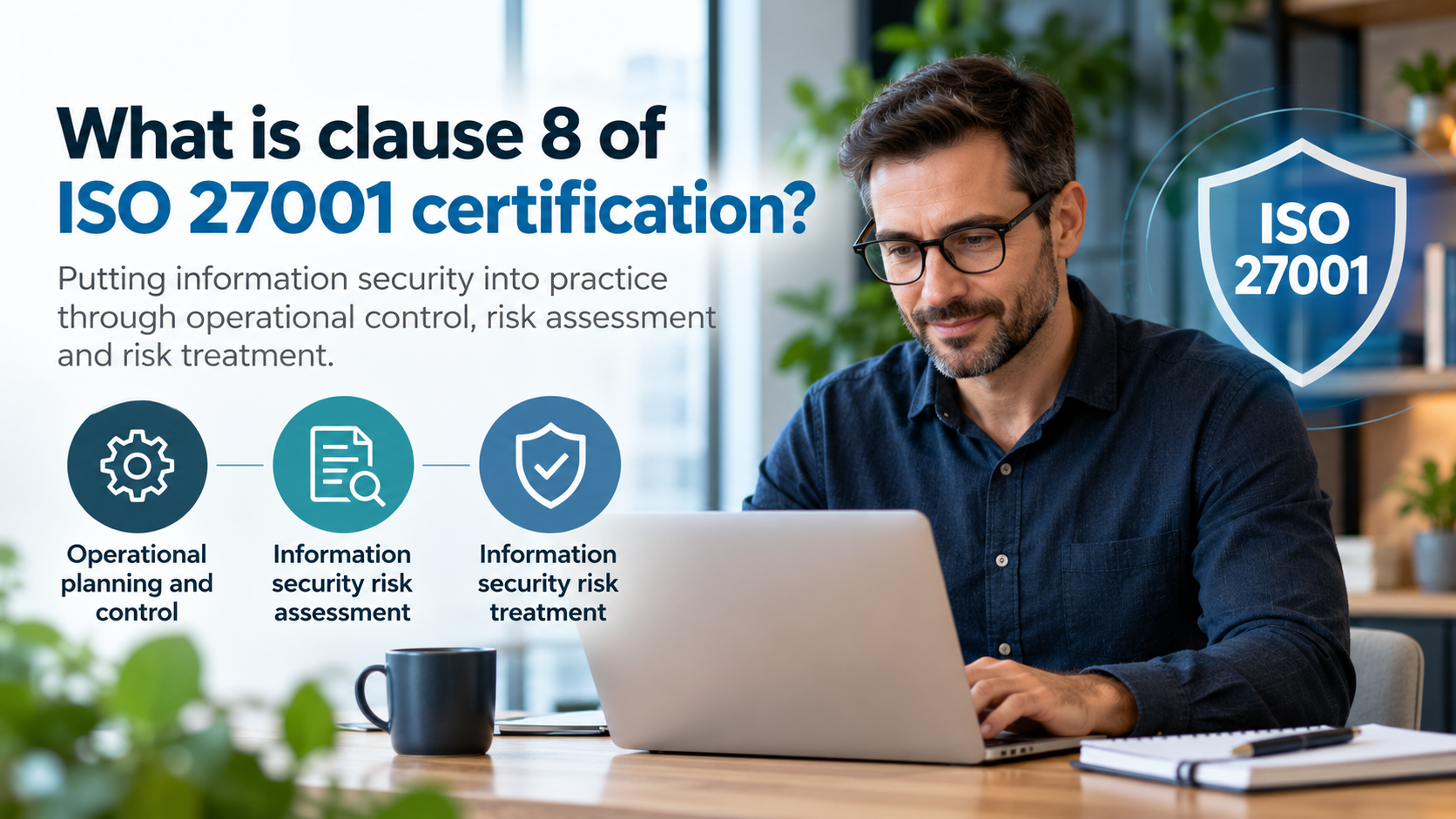
It focuses on three essential areas: operational planning and control, information security risk assessment, and information security risk treatment.
For UK businesses preparing for ISO 27001 certification, Clause 8 represents the point where security planning becomes practical business activity.
It is not enough to identify a cyber security risk or record that a particular security control should exist. The organisation must demonstrate that its processes are carried out effectively and that relevant risks receive appropriate attention.
UK Cyber Compliance, part of UK Cyber Security Group Ltd, helps organisations manage these requirements through its automated, AI-driven ISO 27001 compliance platform.
Available at www.ukcybercompliance.co.uk, the platform provides structured workflows, risk assessment functionality, policy development, control management and audit preparation support.
By bringing compliance activities together in one environment, UK Cyber Compliance aims to make ISO 27001 certification preparation easier, more efficient and more affordable for businesses.
Understanding Clause 8 is essential because it helps organisations move beyond written policies and demonstrate that information security forms part of their everyday operations.
Understanding Clause 8 of ISO 27001
ISO/IEC 27001:2022 is an internationally recognised standard for establishing, implementing, maintaining and continually improving an Information Security Management System.
An ISMS provides a structured approach to protecting information through appropriate policies, processes, responsibilities and security controls.
ISO 27001 addresses information security through a management system that considers organisational requirements, leadership, planning, support, operation, performance evaluation and improvement.
Clause 8 focuses specifically on the operational activities necessary to put information security plans into practice.
For example, an organisation might identify ransomware as a significant security risk.
It could decide to strengthen access controls, improve backup arrangements and provide additional employee awareness training.
However, recording those decisions does not automatically demonstrate that the risk has been managed.
The organisation needs to implement the planned actions, retain appropriate evidence and review whether its risk assessment remains accurate.
Clause 8 establishes the operational requirements supporting these activities.
The three requirements within Clause 8
Clause 8 contains three main requirements.
Clause 8.1: Operational Planning and Control
Organisations must plan, implement and control the processes needed to meet their information security requirements and carry out relevant planned actions.
Clause 8.2: Information Security Risk Assessment
Organisations must perform information security risk assessments at planned intervals and when significant changes are proposed or occur, using the established risk assessment criteria.
Clause 8.3: Information Security Risk Treatment
Organisations must implement their information security risk treatment plans and retain documented information demonstrating the results.
These requirements work together.
Operational controls support information security activities, risk assessments identify and evaluate potential threats, and risk treatment ensures that appropriate action is taken.
Clause 8.1: Turning information security planning into action
Clause 8.1 concerns operational planning and control.
It requires organisations to plan, implement and control the processes necessary to meet ISMS requirements and carry out the actions determined during planning under Clause 6.
This includes establishing criteria for relevant processes and controlling those processes according to the criteria.
In practical terms, businesses need to demonstrate that their information security arrangements operate consistently rather than relying entirely on informal practices.
What does operational planning mean?
Operational planning involves determining how security-related activities will be managed.
For example, a business may identify employee access management as an important process.
The organisation needs to understand who approves access, how permissions are reviewed and what should happen when an employee leaves.
Another business might identify supplier security management as a critical process.
It may need to determine how suppliers are assessed, who approves significant supplier relationships and how relevant security obligations are monitored.
The purpose is to establish a consistent approach.
Employees should understand their responsibilities, and management should be able to determine whether activities have been completed as expected.
Establishing clear process criteria
Clause 8.1 requires organisations to establish criteria for the processes needed to meet ISMS requirements.
These criteria help define what acceptable performance looks like.
Consider a business that maintains a vulnerability management process.
Its criteria might establish how identified vulnerabilities are evaluated, who is responsible for reviewing them and when significant concerns require escalation.
The organisation may also establish internal targets for addressing security weaknesses, taking account of risk and applicable contractual requirements.
Similarly, a business managing employee access might establish criteria for approving privileged accounts and reviewing permissions.
These arrangements help reduce uncertainty and support consistent decisions.
The standard does not prescribe identical operating procedures for every organisation.
Instead, businesses should establish arrangements appropriate to their requirements and information security risks.
Controlling operational activities
Once the organisation has established its processes, it needs to ensure they operate as intended.
This may involve assigning responsibilities, reviewing completed activities and maintaining appropriate records.
For example, an organisation may establish a process requiring managers to approve access to confidential customer information.
The process should then operate consistently.
Access should not be granted without the appropriate authorisation simply because someone needs information urgently.
Likewise, a business may require important security incidents to be reported through an established management process.
Employees should understand how to report concerns, and the organisation should ensure that relevant incidents receive appropriate attention.
Operational control helps turn policy requirements into repeatable business practices.
Keeping operational evidence ready for assessment
Clause 8.1 requires documented information to be available to the extent necessary to provide confidence that relevant processes have been carried out as planned.
This is important for certification.
An auditor does not simply want to read a policy stating that the organisation manages security.
They need sufficient evidence that relevant activities actually take place.
For example, a company might have a documented supplier assessment procedure.
Supporting evidence could include completed supplier reviews, identified concerns and management decisions.
Another organisation may maintain an employee access review process.
Evidence could include access review records, approvals and actions taken to address inappropriate permissions.
The documentation required will depend on the process and the organisation’s operational needs.
Not every activity requires a separate formal report.
Existing business records, management dashboards and approved documentation may provide suitable evidence.
Why accurate records matter
An organisation may operate appropriate security controls but struggle to demonstrate them because relevant evidence is scattered across different systems.
Employees might maintain spreadsheets locally.
Managers may approve activities through email.
Technical teams may store security information within specialist management platforms.
These arrangements can make audit preparation unnecessarily difficult.
Centralising relevant compliance information can help the organisation maintain visibility and retrieve evidence more efficiently.
UK Cyber Compliance provides a structured platform designed to support evidence management, control tracking and ISO 27001 audit preparation.
Managing planned and unexpected changes
Another important requirement under Clause 8.1 concerns change management.
Organisations must control planned changes and review the consequences of unintended changes, taking appropriate action to reduce adverse effects when necessary.
This matters because business changes can affect information security arrangements.
For example, an organisation may move important customer records to a new cloud service.
Before making that change, the business should consider relevant security requirements, information risks and operational responsibilities.
The change may affect access arrangements, supplier dependencies, information availability and contractual commitments.
Similarly, a company introducing a new business application should consider whether its existing information security controls remain appropriate.
What happens when a change creates an unexpected problem?
Not every change produces the expected outcome.
A system change might accidentally remove an access restriction.
A supplier change could affect the availability of important information.
An organisational restructure might leave security responsibilities unclear.
Clause 8.1 requires the organisation to review the consequences of unintended changes and take suitable action where adverse effects need to be addressed.
For example, if a change results in employees receiving unnecessary access to confidential information, the organisation should evaluate the consequences and address the problem.
Depending on the circumstances, this may also trigger a fresh information security risk assessment.
Effective change management helps prevent business improvements from creating unmanaged security exposure.
Managing external suppliers and service providers
Most modern businesses depend on external organisations.
These may include cloud service providers, managed IT businesses, software suppliers, data processing companies and professional service providers.
Clause 8.1 requires externally provided processes, products and services relevant to the ISMS to be controlled.
This does not mean every supplier must hold ISO 27001 certification.
It means the organisation should establish appropriate arrangements for managing external dependencies that affect its information security management system.
Why supplier controls are important
Consider a business that uses an external IT provider to manage its cloud infrastructure.
The provider may carry out activities affecting account security, information availability and system recovery.
Although the supplier performs those activities, the customer still needs appropriate oversight of the services relevant to its ISMS.
The organisation might review supplier responsibilities, contractual arrangements, relevant security assurance and service performance.
For a critical supplier, the business may also consider how service disruption would affect its operations.
A practical supplier review can help management understand the associated risks.
The aim is not to produce excessive paperwork.
It is to ensure that outsourced responsibilities remain appropriately managed.
Clause 8.2: Carrying out information security risk assessments
Information security risk assessment is a central part of ISO 27001.
Clause 8.2 requires organisations to perform risk assessments at planned intervals and when significant changes are proposed or occur.
The assessments must take account of the risk assessment criteria established under Clause 6.1.2.
Organisations must also retain documented information of the results.
This means an initial risk assessment completed during certification preparation is not enough on its own.
Information security risks change as businesses develop, adopt new technologies and encounter new threats.
What is an information security risk assessment?
An information security risk assessment helps an organisation identify events that could compromise the confidentiality, integrity or availability of information.
Confidentiality concerns preventing unauthorised access to information.
Integrity concerns maintaining information accuracy and protecting it against unauthorised or inappropriate changes.
Availability concerns ensuring that information and supporting systems remain accessible when required.
A risk assessment considers how threats could affect these important security objectives.
For example, a company storing customer information in a cloud application might identify the possibility of compromised credentials allowing unauthorised access.
Another business may identify a risk involving ransomware affecting its shared documents.
An engineering company might consider the consequences of losing access to important production information.
The assessment should consider realistic circumstances relevant to the organisation.
Identifying meaningful information security risks
A useful risk assessment goes beyond recording generic concerns such as cyber attacks or data loss.
It should explain what could happen, what information or services might be affected and why the consequences matter.
For example, consider a business that relies on Microsoft 365 for communication and document management.
A relevant risk might involve an employee account being compromised through phishing.
The potential consequences could include unauthorised access to commercial information, disruption to communications or misuse of the compromised account.
Existing safeguards might include multi-factor authentication, account monitoring and employee awareness activities.
The organisation can evaluate whether those safeguards reduce the exposure sufficiently or whether additional action is required.
This creates a practical relationship between the identified risk and the organisation’s security arrangements.
Understanding likelihood and impact
Many organisations assess information security risks by considering likelihood and impact.
Likelihood concerns how realistically a particular security event might occur.
Impact concerns the potential consequences for the business.
For example, the loss of access to a rarely used internal application may cause limited disruption.
However, losing access to a system essential for customer orders could significantly affect business operations.
A risk assessment should consider relevant existing safeguards when evaluating the exposure.
The organisation may use a scoring method to support consistent assessments.
However, ISO 27001 does not require every business to use the same numerical risk matrix.
The important requirement is to establish and apply suitable criteria that produce consistent, valid and comparable results.
Recording the results
A practical risk assessment record might identify the affected information or business activity, relevant threat, potential impact, likelihood, existing safeguards and assessed risk level.
The organisation should also identify the responsible risk owner.
Where further action is required, the record can link to the relevant risk treatment decision.
This information helps management determine which concerns need attention.
It also provides evidence that risk assessment takes place according to the organisation’s established process.
How frequently should risk assessments be completed?
ISO 27001 does not prescribe one universal interval, such as every six or twelve months, for every organisation’s information security risk assessment.
Clause 8.2 requires assessments at planned intervals and when significant changes are proposed or occur.
The organisation should establish a suitable review schedule based on its circumstances and risk assessment criteria.
Many businesses choose annual reviews as part of their wider ISMS activities.
However, annual reviews alone may be insufficient when significant changes occur between scheduled assessments.
For example, an organisation might acquire another business, move essential services to a different provider or experience a significant cyber incident.
These events may require the business to reassess relevant security risks before its next scheduled review.
What might trigger an additional assessment?
Significant changes to information systems, business activities, supplier relationships or information processing arrangements can affect the risk profile.
New contractual obligations may also require consideration.
For example, a business beginning to process sensitive customer information may face different security requirements from those previously assessed.
Similarly, moving from internally managed servers to a cloud service could create different operational and supplier dependencies.
The organisation should consider whether these changes affect its existing risk assessment.
This approach helps ensure the ISMS remains relevant as the business develops.
Clause 8.3: Turning risk treatment plans into real protection
Once an organisation understands its information security risks, it needs to decide how to manage them.
Clause 8.3 requires organisations to implement their information security risk treatment plans.
It also requires documented information to be retained showing the results of risk treatment.
This is one of the most important distinctions in ISO 27001 certification.
A risk treatment plan describes what the organisation intends to do.
Clause 8.3 requires the organisation to carry out the plan and demonstrate the results.
What is risk treatment?
Risk treatment involves deciding how to respond to identified information security risks.
An organisation may choose to reduce a risk by implementing suitable safeguards.
It might avoid a risk by stopping an activity that creates unacceptable exposure.
It may share certain financial or operational consequences through appropriate contractual or insurance arrangements.
Alternatively, a risk may be accepted when it falls within the organisation’s established risk acceptance criteria and receives appropriate approval.
However, accepting a risk does not remove mandatory legal, contractual or ISO 27001 requirements.
Management must understand the implications of its decisions.
A practical risk treatment example
Consider a company that identifies a significant risk involving the loss of access to essential customer documents following a ransomware incident.
The risk assessment identifies that the interruption could prevent employees from completing important customer work.
The organisation decides to strengthen its recovery arrangements.
Its risk treatment plan identifies the necessary actions, responsible employees and completion expectations.
Those actions might include reviewing backup coverage, evaluating recovery arrangements and carrying out recovery testing.
Under Clause 8.3, the organisation must implement its approved treatment plan.
It should then retain evidence showing the results.
This might include completed review records, recovery test results and updated risk information.
The process demonstrates that management has moved from identifying a concern to taking practical action.
The relationship between risk assessment and risk treatment
Risk assessment and risk treatment are closely connected, but they perform different functions.
Risk assessment identifies and evaluates security exposure.
Risk treatment determines and implements appropriate responses.
Clause 6 establishes the requirements for planning risk assessment and treatment.
Clause 8 requires those activities to be carried out.
For example, Clause 6.1.3 requires an organisation to establish an information security risk treatment process, determine necessary controls, prepare a Statement of Applicability and formulate a risk treatment plan.
Relevant risk owners must approve the treatment plan and accept the residual information security risks.
Clause 8.3 then requires the organisation to implement the plan and retain documented results.
This distinction is important during certification.
An organisation may have an approved treatment plan but still fail to demonstrate that the planned actions have been completed or appropriately managed.
Monitoring treatment progress
A practical approach is to maintain clear visibility of outstanding risk treatment actions.
Each action should have an assigned owner.
Management should understand its intended outcome and review progress.
Where an action has been completed, supporting evidence should be available.
If implementation has been delayed, the organisation should understand the reason and evaluate any continuing exposure.
A structured compliance platform can support these activities by bringing together risk records, assigned responsibilities and evidence.
Understanding residual risk
Residual risk is the information security risk remaining after treatment.
No organisation can eliminate every possible security threat.
However, management should understand whether the remaining exposure is acceptable according to its established criteria.
For example, a business may introduce stronger authentication and account monitoring to reduce the likelihood of unauthorised access.
These safeguards can reduce the risk, but they do not guarantee that account compromise will never occur.
The business therefore needs to consider the remaining exposure.
Risk owners should understand and approve relevant residual risk decisions according to the established process.
Recording these decisions helps demonstrate accountability.
An auditor may review whether risk acceptance decisions are consistent with the organisation’s approved criteria.
How does Clause 8 relate to the Statement of Applicability?
The Statement of Applicability, commonly called the SoA, is an important ISO 27001 document.
It identifies the controls determined as necessary through the risk treatment process and includes required justifications and implementation information.
ISO/IEC 27001:2022 Annex A provides a reference set of 93 information security controls.
These are organised across organisational, people, physical and technological areas.
An organisation must consider the Annex A controls when checking that it has not overlooked necessary safeguards.
It may also identify additional controls based on its risks and requirements.
The Statement of Applicability records the necessary controls, why they are included, whether they have been implemented and the justification for excluding Annex A controls.
Why Clause 8 matters to the SoA
The Statement of Applicability should accurately reflect the organisation’s actual arrangements.
For example, a business might identify access control as a necessary safeguard.
Its SoA should indicate the relevant implementation status.
Clause 8 supports the operational activities through which risk treatments are implemented and assessed.
If a control is recorded as implemented, the organisation should be able to support that statement with appropriate evidence.
This may include relevant records, observed practices or information from management systems.
An accurate SoA helps connect information security planning with operational reality.
what is iso 27001 and why does Clause 8 matter?
ISO 27001 is an internationally recognised standard for managing information security through an Information Security Management System.
The standard establishes requirements for identifying security risks, implementing suitable arrangements and continually improving information security management.
According to the International Organization for Standardization, ISO/IEC 27001 provides requirements for organisations seeking to establish and maintain an effective ISMS.
It can be used by businesses operating across different industries, including technology, finance, healthcare, manufacturing and professional services.
Clause 8 matters because it establishes the operational requirements needed to turn information security planning into practical activity.
For example, Clause 4 requires an organisation to understand its context and determine the scope of its ISMS.
Clause 5 addresses leadership and responsibilities.
Clause 6 addresses planning, including information security risk assessment and treatment processes.
Clause 7 concerns the resources, competence, awareness, communication and documented information needed to support the ISMS.
Clause 8 then addresses operational planning, risk assessment and risk treatment.
Clause 9 evaluates performance, while Clause 10 addresses improvement.
These requirements work together.
A business cannot demonstrate effective information security management by completing one isolated activity.
It needs a consistent system in which responsibilities, risk decisions and operational activities support one another.
What is ISO 27001 Certification?
ISO 27001 certification involves an independent assessment of an organisation’s Information Security Management System against the applicable requirements of ISO/IEC 27001.
The assessment considers whether the organisation has established and operates an appropriate management system within its defined certification scope.
An independent certification body conducts the formal audit.
UK organisations commonly seek certification through a body accredited by the United Kingdom Accreditation Service (UKAS) or another appropriately recognised accreditation body.
Accreditation provides additional assurance concerning the competence and impartiality of the certification body.
The UKAS website provides information about accredited certification services and how organisations can verify relevant accreditation.
Why auditors focus on operational evidence
An ISO 27001 auditor needs to understand whether security arrangements operate in practice.
They may examine risk assessments, treatment plans, process records and supporting evidence.
For example, an organisation may state that it reviews information security risks annually.
The auditor may request records showing when reviews took place and what changes were identified.
If the organisation has implemented a risk treatment plan, the auditor may examine the resulting actions and evidence.
A policy describing how risk management should work is useful, but it does not automatically demonstrate that the organisation follows the process.
Clause 8 helps establish that distinction.
Who needs iso 27001 certification
ISO 27001 certification can benefit organisations that manage information requiring appropriate protection.
This includes businesses handling confidential customer records, commercially sensitive information, employee data and important operational information.
Technology companies frequently pursue ISO 27001 because their customers depend on the confidentiality and availability of digital services.
Professional service providers may seek certification to demonstrate effective management of client information.
Manufacturing and engineering businesses may use certification to support supplier assurance and contractual requirements.
Healthcare organisations may benefit from a structured approach to managing sensitive information and service availability.
Smaller businesses can also pursue ISO 27001 certification.
The standard is not restricted to large organisations with dedicated information security departments.
A small company can establish a proportionate ISMS that reflects its business activities and information security risks.
Certification is generally voluntary, although customer contracts, procurement requirements or commercial expectations may make it important.
Organisations should consider the expectations of their customers and other relevant interested parties when determining whether certification is appropriate.
ISO 27001 Certification Levels
Businesses sometimes search for information about ISO 27001 certification levels.
However, ISO/IEC 27001 does not establish separate bronze, silver or gold certification grades.
Certification assesses conformity with the applicable requirements within the organisation’s defined scope.
The formal assessment process normally includes several stages.
Stage 1: Reviewing certification readiness
The first stage examines the organisation’s documented ISMS information, relevant requirements and readiness for further assessment.
The auditor considers whether the organisation has established suitable arrangements for managing information security.
This may include reviewing the ISMS scope, risk assessment process, information security policy and other relevant documentation.
Stage 2: Evaluating implementation
The second stage examines whether the management system has been implemented and operates effectively.
This can include interviews, operational observations and examination of relevant records.
Clause 8 is particularly important at this stage because the organisation must demonstrate its operational processes, risk assessments and risk treatment activities.
Surveillance and recertification
Following successful certification, surveillance audits normally take place during the certification cycle.
A full recertification assessment is typically required every three years.
Organisations must continue maintaining their ISMS rather than treating certification as a one-off exercise.
Risk assessments, operational reviews and risk treatment activities therefore remain important after the initial audit.
How the Certification Works
The ISO 27001 certification process begins with understanding the organisation and its information security requirements.
Management establishes the ISMS scope and identifies relevant interested parties.
The business then determines information security responsibilities, establishes appropriate policies and considers the resources necessary to operate the ISMS.
Next, the organisation defines its risk assessment and risk treatment processes.
It identifies relevant risks and evaluates them against established criteria.
Management determines suitable risk treatment decisions and prepares the Statement of Applicability.
The organisation then implements the necessary processes and controls.
Clause 8 becomes particularly important at this point.
The business must operate its information security processes, perform risk assessments when required and implement approved treatment plans.
Evidence should be retained to demonstrate the relevant results.
The organisation subsequently evaluates its management system through monitoring, internal audits and management reviews.
Where weaknesses are identified, appropriate corrective actions should be taken.
Once the organisation is ready, it can proceed with independent certification assessment.
Making certification preparation more manageable
Traditional compliance activities often involve separate spreadsheets, policy documents, action records and audit evidence.
Maintaining these materials can require significant administrative effort.
An automated compliance platform can help organisations organise information and monitor progress more efficiently.
UK Cyber Compliance provides guided ISO 27001 workflows, AI-assisted documentation support, risk management functionality and control tracking.
This helps businesses approach the requirements systematically rather than relying on disconnected records.
Why cyber security risk management matters to UK businesses
Cyber security continues to affect organisations throughout the United Kingdom.
The UK Government’s Cyber Security Breaches Survey 2025/2026, published on 30 April 2026, provides useful insight into the challenges businesses face.
The survey found that 43 per cent of UK businesses identified a cyber security breach or attack during the preceding twelve months.
This represents approximately 612,000 businesses.
Among medium businesses, the proportion was 65 per cent.
For large businesses, the figure increased to 69 per cent.
Phishing remained the most commonly identified attack, affecting 38 per cent of UK businesses.
These findings show that information security remains a significant business concern.
The figures reflect incidents organisations identified and reported, so they do not necessarily capture every attack that occurred.
Risk assessment remains a weakness for many organisations
The government survey also found that only 30 per cent of businesses reported conducting a cyber security risk assessment during the preceding twelve months.
Among small businesses, the proportion was 41 per cent.
The survey found that 15 per cent of businesses reviewed cyber security risks associated with their immediate suppliers.
Only 6 per cent reviewed risks across their wider supply chains.
These findings do not measure ISO 27001 compliance directly.
However, they demonstrate why structured risk assessment and supplier oversight are valuable.
Clause 8 helps organisations establish operational arrangements for assessing risks and managing relevant external dependencies.
Incident response planning also needs attention
The same government research found that only 25 per cent of businesses reported having a formal cyber security incident response plan.
This matters because identifying a security incident is only part of managing it.
An organisation also needs appropriate responsibilities, communication arrangements and response activities.
Although incident response planning is not a separate named requirement within Clause 8, relevant operational arrangements may support the organisation’s wider ISMS and selected information security controls.
Businesses should ensure that important security activities are supported by suitable processes and evidence.
What documented information does Clause 8 require?
Clause 8 establishes specific expectations concerning documented information.
Under Clause 8.1, documented information must be available to the extent necessary to provide confidence that relevant processes have been carried out as planned.
Clause 8.2 requires organisations to retain documented information showing the results of information security risk assessments.
Clause 8.3 requires documented information showing the results of information security risk treatment.
Useful evidence for certification
Practical supporting evidence may include:
- Information security risk assessment records
- Risk registers and relevant review histories
- Approved risk treatment plans
- Risk treatment action records
- Evidence of implemented security controls
- Relevant supplier oversight records
- Operational process records
- Change management information
- Risk owner approvals
- Residual risk acceptance records
- Updated Statements of Applicability
- Supporting management and review information
This is a practical evidence checklist rather than a requirement to create twelve separate documents.
The organisation should determine how best to maintain the information necessary for its ISMS.
Existing business records may provide suitable evidence when they are accurate, accessible and appropriately controlled.
Common Clause 8 weaknesses that can affect certification
Businesses sometimes struggle with Clause 8 because they concentrate on preparing documentation rather than demonstrating operational activity.
One common weakness is completing an initial risk assessment and failing to review it when important changes occur.
Another is maintaining a treatment plan without clear evidence that the identified actions have been implemented.
Some organisations record controls as implemented without maintaining suitable supporting information.
Supplier management can also create difficulties when businesses depend on external services but lack appropriate oversight.
Change management is another area where problems can arise.
An organisation may introduce new technology without reviewing how the change affects its information security risks.
These weaknesses can reduce confidence that the ISMS operates effectively.
How to avoid unnecessary assessment problems
The most effective approach is to make risk assessment and operational control part of normal business activity.
Risk owners should understand their responsibilities.
Planned reviews should take place.
Important changes should receive appropriate consideration.
Risk treatment actions should be tracked and supported by evidence.
Management should have sufficient visibility to identify overdue activities and unresolved security concerns.
This approach supports certification while improving the organisation’s ability to manage information security.
Which UK-based firms offer ISO 27001 consultancy services?
UK businesses can obtain ISO 27001 consultancy support from specialist information security consultancies, managed service providers and compliance professionals.
Support may include reviewing ISMS scope, performing gap assessments, establishing risk management processes, developing policies and preparing for independent audits.
When selecting a provider, organisations should consider whether it has relevant experience with ISO/IEC 27001:2022.
The provider should explain the requirements clearly and help the organisation develop processes appropriate to its actual operations.
Consultancy should not simply involve supplying generic policies.
It should help the business understand its security risks and establish an effective management system.
UK Cyber Compliance and automated certification support
UK Cyber Compliance, part of UK Cyber Security Group Ltd, provides ISO 27001 compliance and certification preparation services through an automated, AI-driven platform.
The platform helps organisations manage information security requirements through structured workflows, risk assessment functionality, policy development, control management and audit-ready documentation.
Its approach is designed to reduce repetitive administration and make compliance activities easier to manage.
As part of UK Cyber Security Group, UK Cyber Compliance can also provide access to broader cyber security and compliance expertise.
This combination can be useful for organisations without extensive internal information security resources.
Businesses should understand that independent ISO 27001 certification is awarded following assessment by a certification body.
An automated platform supports preparation and ongoing compliance management but does not replace the independent certification audit.
How UK Cyber Compliance supports Clause 8
Clause 8 requires organisations to manage operational processes, carry out risk assessments and implement risk treatment plans.
These activities can become difficult when information is maintained in separate documents or managed through informal arrangements.
UK Cyber Compliance provides an automated platform designed to organise these activities more efficiently.
Structured operational planning
The platform provides guided workflows that help organisations work through relevant ISO 27001 requirements.
Businesses can monitor compliance activities, identify outstanding actions and maintain a clearer overview of progress.
This supports a more organised approach to operational management.
AI-assisted risk management
Information security risk assessment can involve identifying business activities, evaluating potential threats and documenting relevant safeguards.
UK Cyber Compliance provides risk management functionality designed to support these activities.
Its AI-driven features can help organisations prepare and organise relevant information.
However, risk assessments should still reflect the organisation’s actual circumstances.
Management remains responsible for reviewing assessments, approving appropriate decisions and ensuring the results are accurate.
Risk treatment and control tracking
Once risks have been assessed, businesses need to manage their treatment activities.
A central platform can help connect identified risks with relevant controls and outstanding actions.
This improves visibility and helps management understand whether additional work is required.
Maintaining accurate implementation information can also support the Statement of Applicability and audit preparation.
Bringing evidence together
Audit preparation becomes more manageable when relevant documentation and supporting records are organised.
UK Cyber Compliance supports the management of compliance documentation, control evidence and progress information.
Its automated workflows can reduce the need to maintain separate manual records.
This can save administrative effort and help businesses prepare information for independent assessment.
A more affordable approach to compliance management
For smaller organisations, the administrative demands of ISO 27001 can be challenging.
A business may not employ a dedicated information security team.
Management may also have limited time to coordinate risk assessments, documentation and compliance activities.
An automated platform can reduce repetitive work and help organisations manage the process more efficiently.
UK Cyber Compliance aims to make ISO 27001 preparation easier and more affordable by combining AI-driven automation, guided workflows and professional compliance support.
The potential savings will depend on the organisation’s existing processes, technical complexity and level of assistance required.
A practical Clause 8 readiness checklist
Before progressing to an independent ISO 27001 certification audit, businesses should consider whether they can demonstrate that Clause 8 requirements are being met.
Operational planning and control
Can the organisation explain how its information security processes operate?
Have suitable criteria been established?
Are relevant processes controlled according to those criteria?
Can management demonstrate how significant changes and relevant external services are managed?
Information security risk assessment
Has the organisation established and applied appropriate risk assessment criteria?
Are risk assessments performed at planned intervals?
Are significant proposed or actual changes considered?
Can the organisation provide documented assessment results?
Information security risk treatment
Has the organisation prepared and approved an appropriate risk treatment plan?
Have the planned actions been implemented?
Can the organisation demonstrate the results?
Are relevant risk owners involved in decisions concerning residual risk?
Evidence and accountability
Are responsibilities clear?
Can employees explain relevant operational activities?
Are supporting records accurate and accessible?
Can management identify outstanding actions and demonstrate progress?
Answering these questions helps organisations identify gaps before their formal assessment.
The aim is not to create unnecessary documentation.
It is to establish that the organisation understands and manages its information security responsibilities.
Maintaining Clause 8 after certification
ISO 27001 certification requires ongoing management.
Business operations change, employees move into different roles and new security threats emerge.
Organisations may introduce new technology, engage additional suppliers or change how information is processed.
These developments can affect previously assessed risks and established security controls.
Clause 8 therefore remains relevant throughout the certification cycle.
Operational processes should continue to work as intended.
Risk assessments should take place at the planned intervals and when significant changes require them.
Risk treatment plans should remain current and be implemented.
Relevant evidence should be maintained to demonstrate the results.
Internal audits and management reviews can help identify whether these arrangements remain effective.
Where weaknesses are discovered, the organisation should determine appropriate corrective action.
Maintaining these activities throughout the year helps prevent compliance from becoming an exercise carried out only before an external audit.
Making Clause 8 work for your business
Clause 8 of ISO 27001 focuses on the practical operation of information security management.
It establishes three essential requirements: operational planning and control, information security risk assessment, and information security risk treatment.
Together, these requirements help organisations demonstrate that information security plans are implemented and managed effectively.
Businesses must establish suitable operational processes, assess risks at appropriate intervals and respond to significant changes.
They must also implement approved risk treatment plans and retain evidence showing the results.
This is important because documentation alone does not demonstrate effective information security management.
An organisation should be able to explain what it does, why it does it and how it knows that relevant activities have taken place.
For smaller businesses, these responsibilities should remain proportionate to their operations and security needs.
A well-managed risk register, clear operational responsibilities and reliable supporting evidence can provide a strong foundation.
UK Cyber Compliance, part of UK Cyber Security Group Ltd, helps UK organisations manage these requirements through its automated, AI-driven ISO 27001 platform.
By combining guided compliance workflows, risk assessment, policy development, control tracking and audit preparation, the platform can help businesses reduce administrative complexity and maintain better oversight of their ISMS.
Organisations seeking a more structured and affordable approach to ISO 27001 certification preparation can explore the services available at www.ukcybercompliance.co.uk.
Ultimately, the purpose of Clause 8 is not simply to satisfy an auditor.
It is to ensure that information security plans become effective operational activities, risks remain understood and necessary safeguards are implemented.
When organisations consistently manage these responsibilities, they build a stronger foundation for protecting information, maintaining customer confidence and supporting long-term business resilience.
UK Cyber Compliance is here to help
For more information, please do get in touch.
Please check out our Free Cyber Insurance
Other blog posts, Your ISO 27001 Questions Answered, Get ISO 27001 Certified ,
If you would like to know more, do get in touch as we are happy to answer any questions. Looking to improve your cybersecurity but not sure where to start? Begin by getting certified in Cyber Essentials, the UK government’s scheme that covers all the technical controls that will provide the protection that you need to help guard against criminal attacks.