What is clause 9 of ISO 27001 certification?
ISO 27001 certification helps businesses demonstrate that they manage information security risks, protect important information and maintain effective security processes. However, achieving certification involves more than writing policies, completing risk assessments and implementing security controls.
Organisations must also demonstrate that their Information Security Management System (ISMS) is working effectively.
This is where Clause 9 of ISO/IEC 27001:2022 becomes particularly important.
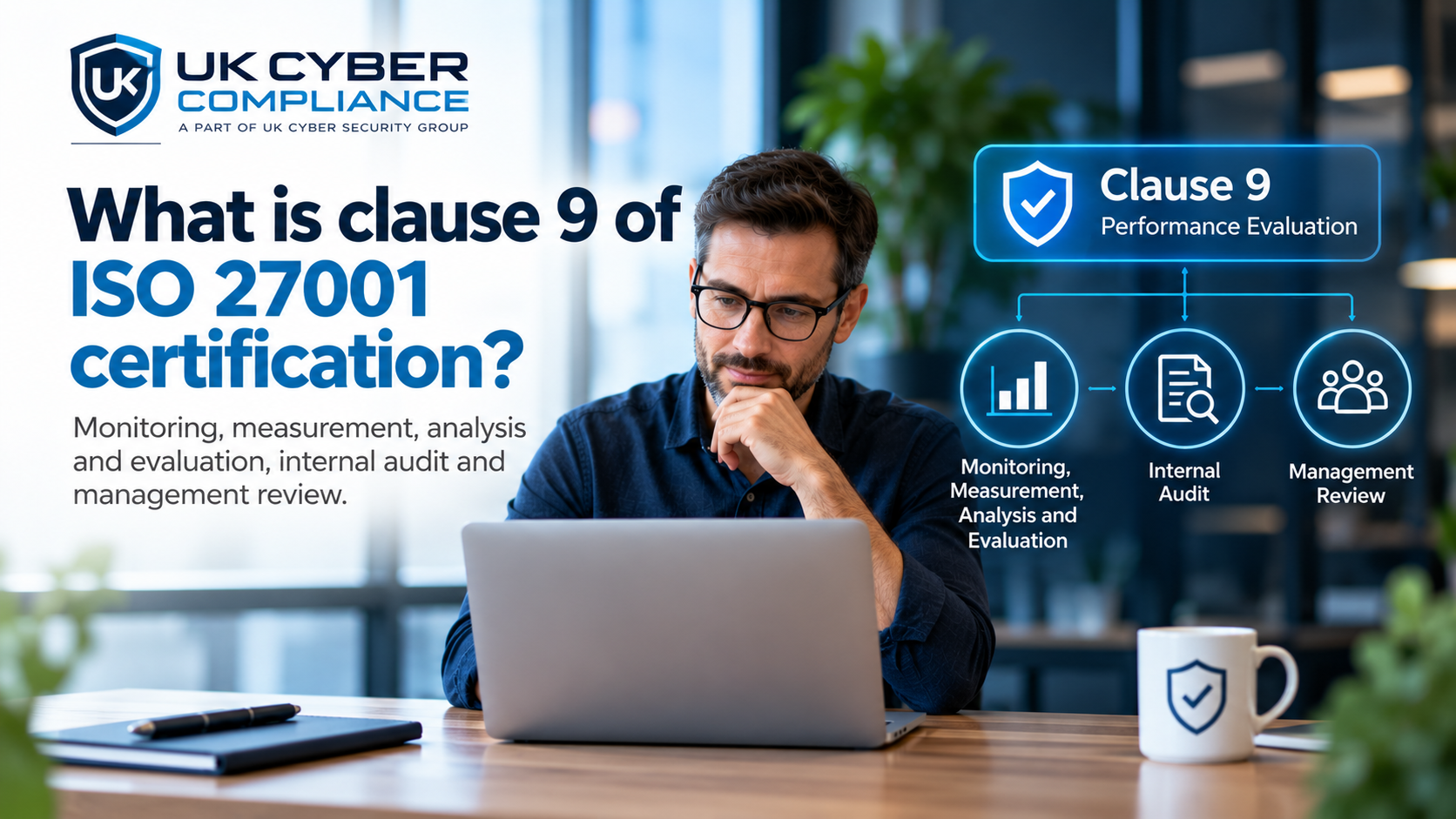
Known as Performance Evaluation, Clause 9 establishes the requirements for monitoring information security performance, conducting internal audits and carrying out management reviews.
It helps organisations determine whether their security arrangements are achieving the intended results, whether weaknesses need addressing and whether the ISMS remains appropriate for their business.
For UK organisations preparing for ISO 27001 certification, Clause 9 is one of the most important parts of the standard because it focuses on demonstrating that information security processes genuinely work.
An organisation may have comprehensive policies, established security controls and an approved risk management process. However, without monitoring, auditing and management oversight, it may struggle to determine whether those arrangements remain effective.
UK Cyber Compliance, part of UK Cyber Security Group Ltd, helps businesses manage ISO 27001 requirements through its automated, AI-driven compliance platform.
Available at www.ukcybercompliance.co.uk, the platform supports risk management, compliance tracking, policy development, control management and audit preparation.
By bringing these activities together in one environment, UK Cyber Compliance aims to make ISO 27001 certification preparation easier, more efficient and more affordable for UK businesses.
Understanding Clause 9 is essential because information security management should involve continuous evaluation rather than simply preparing documentation for an annual audit.
Understanding Clause 9 of ISO 27001
ISO/IEC 27001:2022 establishes the requirements for creating, implementing, maintaining and continually improving an Information Security Management System.
An ISMS helps an organisation identify information security risks, implement appropriate safeguards and maintain structured processes for protecting information.
The standard addresses several connected areas of information security management.
Clause 4 concerns organisational context and the scope of the ISMS.
Clause 5 addresses leadership and responsibilities.
Clause 6 establishes planning requirements, including information security risk assessment and treatment.
Clause 7 covers the resources, competence, awareness, communication and documented information needed to support the management system.
Clause 8 focuses on operational planning, risk assessment and risk treatment.
Clause 9 then evaluates whether these arrangements are working effectively.
This is an important distinction.
An organisation might have implemented a process for reviewing employee access permissions.
However, that does not automatically mean the process operates consistently.
Clause 9 helps the organisation determine whether reviews actually take place, whether relevant issues are identified and whether the process achieves its intended purpose.
The three main requirements within Clause 9
Clause 9 contains three principal requirements.
Clause 9.1: Monitoring, Measurement, Analysis and Evaluation
Organisations must determine what information security activities need monitoring or measurement, establish suitable methods and evaluate the performance and effectiveness of their ISMS.
Clause 9.2: Internal Audit
Organisations must conduct internal audits at planned intervals to determine whether their ISMS meets the applicable requirements and operates effectively.
Clause 9.3: Management Review
Senior management must review the ISMS at planned intervals to ensure it remains suitable, adequate and effective.
Together, these requirements provide a structured method for evaluating information security performance.
Clause 9.1: Measuring whether your security controls work
Clause 9.1 focuses on monitoring, measurement, analysis and evaluation.
Its purpose is to help organisations understand how effectively their information security arrangements operate.
Businesses should not assume that implementing a security control automatically means it continues to provide the intended protection.
For example, an organisation may use endpoint security software across its computers.
However, some devices might stop reporting to the central management platform.
Others may have inactive protection or unresolved security alerts.
Simply purchasing endpoint protection does not demonstrate that it remains effective.
Monitoring helps the organisation identify these weaknesses.
What should businesses monitor?
Clause 9.1 requires organisations to determine what needs monitoring and measurement, including relevant information security processes and controls.
The specific activities will depend on the organisation’s risks, objectives and operating environment.
For example, a business might monitor:
- Security incidents and response performance
- Completion of information security training
- Outstanding risk treatment actions
- Vulnerability management performance
- Security update compliance
- Completion of access reviews
- Backup and recovery testing results
- Information security objectives
- Supplier security review activities
- Corrective action progress
- Security control effectiveness
- Compliance with important internal procedures
This is a practical selection of possible monitoring activities rather than a mandatory list prescribed by Clause 9.
The organisation should choose measures that provide meaningful information about its security performance.
Why monitoring matters
Imagine a company that establishes an information security objective to complete all scheduled employee access reviews.
Management might assume the objective is being achieved because the company has an approved access control policy.
However, monitoring may reveal that several departments have missed their reviews.
The business can then investigate why the process is not operating as intended.
Perhaps managers do not understand their responsibilities.
Alternatively, employees may lack access to the information necessary to complete the reviews.
Monitoring helps identify these problems before they become more serious.
It also provides management with information needed to make informed decisions.
Choosing meaningful information security measurements
Organisations sometimes collect large amounts of security information without determining what the results actually mean.
This can make performance evaluation unnecessarily complicated.
A more practical approach is to select measurements connected to important information security objectives and risks.
Measuring security update performance
Consider a business that wants to maintain effective security update management.
It might measure the percentage of relevant devices receiving required updates within its established deadlines.
For example, a monthly report might show that 94 per cent of applicable devices met the company’s defined security update target.
Management can then examine the remaining devices and determine whether further action is required.
The figure alone does not establish ISO 27001 compliance.
However, it provides useful information about the performance of the organisation’s update management process.
Measuring security awareness
Another organisation might establish an objective to ensure employees complete relevant information security awareness training.
The business could monitor training completion rates and evaluate whether employees understand important security responsibilities.
For example, the organisation might use knowledge checks or review whether employees correctly follow relevant security reporting procedures.
This provides more useful assurance than simply recording that training materials were distributed.
Measuring incident management effectiveness
An organisation may also monitor how quickly significant security incidents are identified, escalated and resolved.
For example, management might review the average time required to investigate incidents and identify whether delays are becoming more common.
A significant increase in investigation time could indicate insufficient resources or weaknesses in established procedures.
The organisation can then consider improvements.
Effective measurement should support decisions rather than exist solely to satisfy an audit.
Establishing the right monitoring methods
Clause 9.1 does not simply require organisations to collect information.
They must also determine suitable methods for monitoring, measurement, analysis and evaluation.
Where applicable, the methods should produce valid results that can be compared and reproduced.
For example, a business measuring the completion of employee access reviews should establish a consistent way of calculating performance.
If one department counts partially completed reviews while another only counts fully approved reviews, the results may not be comparable.
Establishing consistent criteria helps prevent misleading reporting.
When should monitoring take place?
Different activities may require different monitoring intervals.
Security alerts might need continuous attention.
Vulnerability management performance could be reviewed regularly according to risk.
Employee awareness results might be evaluated after training activities and during scheduled management reviews.
Supplier security performance may be reviewed according to the importance of the service and established contractual arrangements.
ISO 27001 does not require every activity to be measured at the same frequency.
Instead, the organisation must determine suitable monitoring arrangements.
Who is responsible?
Clause 9.1 requires organisations to determine who performs monitoring and measurement.
They must also establish when the results will be analysed and evaluated, and who will perform that evaluation.
These responsibilities may involve different employees.
For example, an IT Manager might produce technical security reports.
An Information Security Manager may analyse the results.
Senior management may then consider significant findings when reviewing the ISMS.
Clear responsibilities help ensure that monitoring produces useful outcomes.
Keeping evidence of information security performance
Clause 9.1 requires documented information to be available as evidence of monitoring and measurement results.
This is particularly important during certification assessments.
An auditor may ask how the organisation knows whether its information security controls are effective.
The business should be able to explain what it monitors, how the information is collected and how the results are evaluated.
Evidence might include management reports, security dashboards, performance records or documented reviews.
Not every organisation needs a complicated reporting system.
A smaller business might maintain a straightforward record showing relevant measurements, review dates, responsible employees and decisions.
The important consideration is whether the information provides reliable evidence of performance.
Looking beyond the numbers
A performance measurement becomes more valuable when management understands its meaning.
For example, a report showing that employee awareness training completion has fallen from 98 per cent to 82 per cent may indicate an emerging problem.
Management should investigate the reason.
The reduction might result from recent recruitment, insufficient reminders or employees being unable to access training materials.
Once the cause is understood, the business can determine appropriate action.
This demonstrates why Clause 9.1 includes analysis and evaluation rather than monitoring alone.
Clause 9.2: Understanding ISO 27001 internal audits
Internal auditing is another important requirement within Clause 9.
Clause 9.2 requires organisations to conduct internal audits at planned intervals.
These audits help determine whether the ISMS conforms to the organisation’s own requirements and the applicable requirements of ISO 27001.
They also evaluate whether the management system is effectively implemented and maintained.
An internal audit is therefore more than a documentation check.
It examines whether the organisation follows its established processes and whether those processes meet the relevant requirements.
What does an internal auditor examine?
An internal auditor may review policies, procedures, risk assessments and operational evidence.
They might also interview employees and examine how security-related activities are performed.
For example, an organisation may have established a procedure requiring management approval before employees receive access to sensitive information.
The internal auditor might examine a sample of access requests.
They would consider whether approvals were recorded appropriately and whether the process was followed.
Another audit activity might involve reviewing information security risk assessments.
The auditor could examine whether assessments were completed according to the established methodology and whether significant changes received appropriate consideration.
The purpose is to obtain objective evidence about the ISMS.
Establishing an effective internal audit programme
Clause 9.2.2 requires organisations to establish, implement and maintain an internal audit programme.
The programme must address matters such as audit frequency, methods, responsibilities, planning requirements and reporting.
It should consider the importance of the processes being audited and the results of previous audits.
For example, a business may identify its customer information processing arrangements as particularly important.
Those activities may require closer audit attention than a less significant administrative process.
Similarly, if a previous audit identified weaknesses in supplier management, the next audit programme may give additional attention to that area.
The organisation should establish appropriate coverage of its ISMS requirements.
Defining audit scope and criteria
Every internal audit needs an appropriate scope and criteria.
The scope explains which activities, processes or parts of the ISMS are being examined.
The criteria establish the requirements against which the evidence will be evaluated.
These may include relevant ISO 27001 requirements, approved company policies and established procedures.
For example, an internal audit might focus on access management within a particular department.
Its criteria could include relevant ISMS requirements and the organisation’s access control procedures.
Clearly defined criteria help auditors reach consistent findings.
Can employees conduct their own internal audits?
ISO 27001 does not require every organisation to employ an external consultant to carry out internal audits.
Suitably competent employees can conduct internal audits.
However, Clause 9.2 requires the organisation to ensure objectivity and impartiality.
This is important because an employee auditing their own work may struggle to provide an independent evaluation.
For example, the person responsible for maintaining the risk assessment process should not simply audit their own activities without appropriate safeguards for impartiality.
A small business may therefore assign auditing responsibilities to another competent employee or engage an external professional.
The appropriate arrangement depends on the organisation’s available resources and responsibilities.
Why auditor competence matters
An internal auditor needs enough knowledge to understand the applicable requirements and evaluate evidence.
They should be able to identify whether activities meet the relevant criteria and communicate their findings clearly.
Experience with ISO 27001 can be valuable.
However, the organisation should consider the actual competence required for the audit rather than relying only on a qualification.
An auditor examining technical security activities may need access to specialist knowledge.
Likewise, someone auditing management processes should understand the relevant responsibilities and records.
What happens when an internal audit identifies a problem?
Internal audits may identify weaknesses in an organisation’s information security arrangements.
These findings can include nonconformities, where a requirement has not been met.
For example, an internal audit might discover that scheduled risk assessments were not completed.
Another finding could involve an information security policy that has not received its required approval.
The auditor should record the relevant evidence and communicate the results to appropriate management.
The organisation must then address any nonconformities according to the applicable requirements.
Clause 10.2 establishes requirements for responding to nonconformities and taking corrective action.
This may involve determining the cause, addressing the issue and evaluating whether the corrective action has been effective.
Treat audit findings as opportunities for improvement
An audit finding does not necessarily mean the organisation has a serious security failure.
Sometimes it identifies an administrative weakness or an inconsistent process.
However, management should not dismiss findings simply because no incident has occurred.
For example, an organisation might discover that access reviews were completed but the approvals were not properly recorded.
Although the reviews may have taken place, the lack of reliable evidence can create accountability and assurance problems.
Addressing the issue can strengthen the process.
A well-managed internal audit programme helps organisations identify weaknesses before an independent certification assessment.
What evidence should internal audits produce?
Clause 9.2 requires documented evidence of the audit programme and audit results.
Useful records may include an audit schedule, defined scope, audit criteria, assigned auditors and completed reports.
The organisation should also retain relevant findings and information about actions taken.
For example, an audit report might identify the requirement examined, evidence reviewed, findings and any necessary follow-up.
Management should receive the relevant results.
An internal audit does not need to generate excessive documentation, but the records should clearly demonstrate that the audit was planned and completed appropriately.
Accurate audit records also support management reviews under Clause 9.3.
Clause 9.3: Why senior management must review the ISMS
Clause 9.3 requires top management to review the Information Security Management System at planned intervals.
The purpose is to ensure that the ISMS remains suitable, adequate and effective.
This requirement is important because information security should not operate independently of wider business management.
Senior leadership needs to understand whether the organisation’s security arrangements remain appropriate.
They should also consider whether additional resources, changes or improvements are necessary.
What does suitability, adequacy and effectiveness mean?
Suitability concerns whether the ISMS remains appropriate for the organisation’s activities and requirements.
For example, a business that starts processing additional sensitive customer information may need to reconsider its information security arrangements.
Adequacy concerns whether the ISMS has sufficient arrangements and resources to meet its requirements.
A growing business might discover that existing information security responsibilities are no longer manageable without additional support.
Effectiveness concerns whether the ISMS achieves the intended results.
For example, a business may have an established incident management process but discover that important incidents are not being escalated promptly.
Senior management should consider these matters when evaluating overall ISMS performance.
Clause 9.3.2: What should management reviews cover?
ISO 27001 identifies information that management must consider during its ISMS review.
The review should examine the status of actions arising from previous management reviews.
It should also consider relevant changes affecting the organisation and its information security requirements.
For example, a company may have introduced new services, entered different markets or changed important supplier relationships.
These developments may affect information security responsibilities and risks.
The review must consider changes in the needs and expectations of relevant interested parties.
It should also examine information security performance, including trends involving:
- Nonconformities and corrective actions
- Monitoring and measurement results
- Internal audit results
- Achievement of information security objectives
Other required considerations include feedback from interested parties, information security risk assessment results, progress against the risk treatment plan and opportunities for continual improvement.
Turning review information into useful decisions
A management review should involve more than reading reports.
Senior leadership needs to understand what the available information means for the organisation.
For example, monitoring may reveal that security incidents are taking longer to resolve.
Internal audit findings may identify weaknesses in access management.
Risk assessment results may show that a new supplier dependency has created additional exposure.
Management should consider whether these findings require changes to existing arrangements.
This might involve assigning additional resources, updating responsibilities or improving relevant processes.
The important point is that management uses the information to make informed decisions.
Clause 9.3.3: Recording management review results
Clause 9.3.3 addresses the results of management reviews.
These must include decisions relating to opportunities for continual improvement and any needs for changes to the ISMS.
The organisation must retain documented information as evidence of the review results.
For example, a review might identify that employee awareness activities need improvement.
Management could approve additional training and assign responsibility for delivering it.
Another review might identify that vulnerability management reporting needs greater oversight.
Management could establish a revised review schedule and request regular reporting.
The decisions should be recorded clearly.
What should management review records include?
A practical management review record may identify the review date, attendees, relevant performance information and significant matters discussed.
It should record the decisions made and any actions requiring follow-up.
Where appropriate, actions should have assigned owners and target dates.
Previous actions should be reviewed during subsequent meetings.
This provides accountability and helps demonstrate that management reviews contribute to the operation and improvement of the ISMS.
How frequently should management reviews take place?
ISO 27001 requires management reviews at planned intervals.
It does not prescribe a universal monthly, quarterly or annual schedule for every organisation.
Many businesses arrange formal management reviews annually, while others conduct reviews more frequently.
The appropriate frequency depends on the organisation’s circumstances.
For example, a small business with relatively stable operations may establish a different review schedule from an organisation undergoing significant expansion.
Businesses experiencing major operational changes may benefit from more frequent management oversight.
The organisation should establish a suitable schedule and follow it.
Significant matters should not necessarily remain unresolved until the next planned review.
Management can consider urgent concerns when they arise.
The difference between an internal audit and a management review
Internal audits and management reviews both help evaluate the ISMS, but they serve different purposes.
An internal audit assesses whether the management system conforms to relevant requirements and whether it is effectively implemented and maintained.
A management review considers whether the ISMS remains suitable, adequate and effective from a leadership perspective.
For example, an internal auditor might identify that a business has not completed its scheduled supplier security reviews.
The finding is reported to relevant management.
During a management review, senior leadership may consider whether the problem reflects insufficient resources, unclear responsibilities or weaknesses in the process.
The organisation can then decide what improvements are necessary.
The two activities complement one another.
They should not be treated as interchangeable requirements.
How Clause 9 connects with continual improvement
ISO 27001 is designed to support ongoing information security management.
Clause 9 helps organisations evaluate performance and identify matters requiring attention.
Clause 10 then addresses improvement and corrective action.
For example, performance monitoring may reveal that security training completion rates have fallen.
An internal audit might confirm that the organisation has not followed its established training procedure.
Management may then consider the issue and approve additional resources or changes to responsibilities.
The organisation should address any applicable nonconformity and evaluate whether corrective action has been effective.
This creates a practical cycle of monitoring, reviewing and improving information security.
The process should help businesses make better decisions rather than simply generate documentation.
what is iso 27001 and how does Clause 9 fit into the standard?
ISO 27001 is an internationally recognised standard for establishing and maintaining an Information Security Management System.
It helps organisations manage information security risks through appropriate governance, planning, operational controls and regular evaluation.
The standard uses a risk-based approach.
This means businesses should consider their activities, information security requirements and relevant threats when determining how to protect information.
Clause 9 focuses on evaluating whether those arrangements work.
For example, Clause 6 establishes requirements for information security planning.
Clause 8 addresses operational activities.
Clause 9 evaluates their performance.
Clause 10 supports corrective action and continual improvement.
These requirements work together.
An organisation cannot demonstrate effective information security management simply by creating policies or implementing software.
It needs reliable processes for reviewing performance and addressing weaknesses.
Further information about the standard is available from the International Organization for Standardization.
What is ISO 27001 Certification?
ISO 27001 certification is an independent assessment of an organisation’s Information Security Management System against the requirements of ISO/IEC 27001.
Certification provides assurance that the organisation has established and maintains a management system meeting the applicable requirements within its defined scope.
An independent certification body conducts the formal assessment.
In the UK, businesses commonly seek certification through a body accredited by the United Kingdom Accreditation Service (UKAS).
Accreditation provides additional confidence that the certification body has been independently assessed for competence and impartiality.
Organisations can verify relevant accreditation through the UKAS website.
Why Clause 9 matters during certification
An independent auditor needs evidence that the ISMS has been evaluated appropriately.
The organisation should demonstrate how it monitors performance, conducts internal audits and carries out management reviews.
For example, an auditor might request the latest internal audit report.
They may also ask how the organisation monitors its information security objectives.
Management review records may be examined to determine whether senior leadership has considered relevant security performance information.
If these activities have not been completed, the organisation may struggle to demonstrate compliance with Clause 9.
Who needs iso 27001 certification
ISO 27001 certification can benefit organisations that manage confidential information, customer records, intellectual property or important business systems.
This includes businesses operating in technology, finance, professional services, healthcare, education, manufacturing and other sectors.
For example, a software company may pursue ISO 27001 certification to demonstrate effective management of information security risks affecting its services.
A recruitment business might seek certification to provide assurance about how it handles candidate and employer information.
An engineering supplier may need to demonstrate appropriate information security arrangements to customers.
Certification can also benefit smaller businesses.
ISO 27001 does not require every organisation to employ a large internal information security team.
A smaller company can establish a proportionate ISMS supported by suitable responsibilities, expertise and management processes.
Certification is generally voluntary, although contractual obligations and customer requirements may make it commercially important.
ISO 27001 Certification Levels
Businesses sometimes search for different ISO 27001 certification levels.
However, ISO/IEC 27001 does not establish separate bronze, silver or gold certification grades.
Certification confirms that the assessed ISMS meets the applicable standard requirements within the scope stated on the certificate.
The certification process normally includes several stages.
Stage 1: Reviewing certification readiness
The first stage considers the organisation’s documented ISMS information and readiness for further assessment.
The auditor examines relevant management system arrangements and identifies matters that may require attention before Stage 2.
Stage 2: Evaluating implementation
The second stage involves a more detailed assessment of whether the ISMS has been implemented and operates effectively.
This includes examining evidence, interviewing relevant employees and reviewing information security activities.
Clause 9 records are particularly important because they demonstrate that the organisation evaluates its ISMS.
Surveillance and recertification
Following successful certification, surveillance assessments normally take place during the certification cycle.
A full recertification assessment is typically required every three years.
Businesses must continue maintaining their ISMS throughout this period.
Monitoring, internal audits and management reviews therefore remain important after the initial certification assessment.
How the Certification Works
ISO 27001 certification begins with establishing an appropriate Information Security Management System.
The organisation first determines its relevant business activities, interested parties and information security requirements.
Management then defines the ISMS scope and establishes appropriate policies, objectives and responsibilities.
The business identifies and assesses information security risks.
It determines suitable risk treatment decisions and prepares the Statement of Applicability.
The organisation then implements the relevant operational processes and security controls.
Once those arrangements are operating, it needs to evaluate whether they achieve the intended results.
This is where Clause 9 becomes particularly important.
The business must establish suitable monitoring and measurement activities.
It must also conduct internal audits at planned intervals.
Senior management must review the ISMS and consider whether changes or improvements are required.
Any identified nonconformities must receive appropriate attention.
When the organisation is ready, it can proceed with independent certification assessment.
Why preparation matters
A business might have strong technical security controls but limited evidence showing how they are evaluated.
Another organisation may maintain extensive policies but have no completed internal audit.
These issues can create difficulties during certification.
The most effective preparation involves making relevant ISMS activities part of normal business operations.
This helps reduce last-minute administration and provides more reliable evidence.
Why UK cyber security statistics make performance evaluation important
Cyber security remains a significant challenge for UK businesses.
The UK Government’s Cyber Security Breaches Survey 2025/2026, published on 30 April 2026, provides useful information about the country’s cyber security experience.
The survey found that 43 per cent of UK businesses identified a cyber security breach or attack during the previous twelve months.
This represents approximately 612,000 businesses.
The proportion increased to 65 per cent among medium businesses and 69 per cent among large businesses.
Phishing remained the most commonly identified attack, affecting 38 per cent of businesses.
These findings show why organisations need to understand whether their security arrangements remain effective.
The figures reflect incidents that organisations identified and reported, so they may not capture every attack that occurred.
Monitoring remains an important area for improvement
The same government survey found that 32 per cent of businesses used specific security monitoring tools during the previous twelve months.
Only 30 per cent reported carrying out a cyber security risk assessment.
The survey also found that 18 per cent had conducted a cyber security vulnerability audit.
These figures do not directly measure ISO 27001 compliance.
However, they demonstrate that many businesses still have opportunities to strengthen security monitoring and assessment.
Clause 9 provides a structured approach to evaluating information security performance.
Why management oversight matters
The 2025/2026 survey found that 72 per cent of UK businesses considered cyber security a high priority for senior management.
However, management attention needs to be supported by reliable information and appropriate decisions.
A business may recognise cyber security as important without having a clear understanding of how effectively its controls operate.
Management reviews help address this problem.
They provide senior leaders with an opportunity to examine performance information, consider important risks and determine whether further improvements are necessary.
What evidence will an ISO 27001 auditor expect for Clause 9?
Auditors need sufficient evidence to determine whether the organisation meets the relevant requirements.
For Clause 9.1, useful evidence might include monitoring records, performance measurements, information security objective reviews and documented evaluations.
For Clause 9.2, the organisation should maintain evidence of its internal audit programme and completed audit results.
For Clause 9.3, documented management review results are required.
A practical evidence checklist
Useful supporting information may include:
- Monitoring and measurement arrangements
- Information security performance reports
- Results of security control evaluations
- Information security objective tracking
- Internal audit programmes
- Internal audit scope and criteria
- Completed internal audit reports
- Nonconformity records
- Relevant corrective action information
- Management review schedules
- Management review records
- Recorded management decisions
- Improvement actions and assigned responsibilities
- Evidence of completed follow-up activities
Not every item needs to exist as a separate document.
Businesses can use existing records where those records adequately demonstrate the relevant requirements.
The most important consideration is that information remains accurate, accessible and consistent with the organisation’s actual processes.
Common Clause 9 weaknesses that can affect certification
Organisations sometimes struggle with Clause 9 because they concentrate on creating compliance documentation rather than evaluating how their ISMS operates.
One common weakness is collecting security measurements without analysing their meaning.
For example, a business may produce monthly vulnerability reports but never review whether identified weaknesses are addressed appropriately.
Another weakness involves internal audits.
An organisation may establish an audit schedule but fail to complete the planned activities.
Some businesses also struggle with auditor impartiality, particularly when employees assess processes for which they are directly responsible.
Management reviews can create difficulties when senior leadership receives reports but fails to make or record relevant decisions.
How to avoid unnecessary audit problems
The most effective approach is to establish clear responsibilities and maintain reliable records.
Monitoring activities should have defined methods and review arrangements.
Internal audits should follow an established programme.
Audit findings should be reported to relevant management.
Management reviews should consider the required information and produce documented results.
Where improvement actions are identified, the organisation should ensure they receive appropriate attention.
This creates a more consistent approach to managing information security.
Which UK-based firms offer ISO 27001 consultancy services?
UK businesses can obtain ISO 27001 consultancy support from specialist cyber security consultancies, information security professionals and compliance service providers.
Consultancy may involve reviewing ISMS scope, conducting gap assessments, supporting risk management, preparing documentation and helping organisations understand certification requirements.
Support can also include planning internal audits, establishing performance measures and preparing for management reviews.
When selecting a consultancy provider, businesses should consider relevant experience with ISO/IEC 27001:2022 and the ability to explain the requirements in practical terms.
A useful provider should help the organisation establish an ISMS that reflects its real activities.
Simply supplying generic documents is unlikely to provide the operational evidence needed for certification.
UK Cyber Compliance and AI-driven certification support
UK Cyber Compliance, part of UK Cyber Security Group Ltd, provides ISO 27001 compliance and certification preparation services through an automated, AI-driven platform.
The platform brings together guided compliance workflows, risk management, policy development, control tracking, audit reporting and supporting documentation.
It is designed to reduce manual administration and provide clearer visibility of outstanding compliance activities.
Businesses can also access professional guidance through UK Cyber Compliance’s wider information security services.
This combination can be particularly useful for organisations without a dedicated internal compliance department.
How UK Cyber Compliance supports Clause 9
Clause 9 requires organisations to monitor performance, conduct internal audits and review the effectiveness of their ISMS.
Managing these activities can become difficult when information is spread across multiple documents, spreadsheets and communication systems.
UK Cyber Compliance provides a centralised platform designed to make compliance management more efficient.
Better visibility of information security performance
The platform offers dashboards and progress tracking that help organisations understand the status of their compliance activities.
Businesses can identify outstanding requirements, review control information and maintain a clearer overview of their ISMS.
This can support the monitoring arrangements established under Clause 9.1.
However, organisations must still determine which performance measures are appropriate and evaluate the actual results.
Supporting internal audit preparation
UK Cyber Compliance provides structured compliance records, control information and audit-ready documentation.
These capabilities can help businesses prepare the evidence needed for internal audits.
A centralised record of relevant activities can make it easier to identify incomplete actions and locate supporting documentation.
The organisation must still ensure that its internal audit programme meets Clause 9.2 and that audits are conducted objectively and impartially.
Making management reviews more manageable
Senior management needs access to reliable information when reviewing the ISMS.
Compliance dashboards, risk records and progress reports can help provide a clearer picture of information security activities.
UK Cyber Compliance helps organise relevant information so that management can review compliance progress and identify matters requiring attention.
The organisation remains responsible for conducting the review and recording the decisions required by Clause 9.3.
Reducing repetitive compliance administration
Manual compliance processes can create unnecessary work.
Employees may spend considerable time updating spreadsheets, locating evidence and preparing reports.
An automated platform can help reduce these repetitive activities.
UK Cyber Compliance offers AI-assisted documentation, guided workflows, intelligent risk management and compliance reporting.
This can help businesses maintain their ISMS more efficiently and reduce the administrative burden associated with certification preparation.
The potential benefits will depend on the organisation’s existing processes, complexity and requirements.
A practical Clause 9 readiness review
Before arranging an independent ISO 27001 certification assessment, businesses should consider whether their performance evaluation arrangements are operating effectively.
Monitoring and measurement
Has the organisation determined what needs monitoring and measurement?
Are suitable methods established?
Does the business understand when monitoring takes place and who is responsible?
Are results analysed and evaluated?
Is appropriate evidence retained?
Internal auditing
Has the organisation established an internal audit programme?
Are audits conducted at planned intervals?
Does each audit have an appropriate scope and criteria?
Are auditors competent and impartial?
Are the results reported to relevant management?
Management review
Does senior management review the ISMS at planned intervals?
Are the required review inputs considered?
Does management understand significant performance findings and information security risks?
Are decisions concerning improvement and necessary changes recorded?
Follow-up and accountability
Are identified weaknesses addressed appropriately?
Can the organisation demonstrate progress against relevant actions?
Does management evaluate whether significant corrective actions have been effective?
Can supporting information be provided during an independent assessment?
A business that can answer these questions clearly has established a useful foundation for demonstrating Clause 9 compliance.
Maintaining Clause 9 after certification
ISO 27001 certification requires organisations to maintain their ISMS over time.
Business activities change, new employees join, suppliers change and information security threats develop.
These changes can affect the effectiveness of existing security arrangements.
Monitoring should therefore remain an ongoing business activity.
Internal audits should continue according to the established audit programme.
Senior management should review the ISMS at planned intervals and consider whether additional action is required.
The organisation should also maintain accurate evidence of performance evaluation activities.
This approach helps reduce the disruption associated with surveillance audits and future recertification.
More importantly, it helps management understand whether the organisation’s information security arrangements continue to meet its needs.
Making Clause 9 work for your business
Clause 9 of ISO 27001 focuses on evaluating information security performance and the effectiveness of the Information Security Management System.
It contains three essential requirements: monitoring and measurement, internal auditing, and management review.
Together, these activities help organisations identify weaknesses, understand performance and make informed improvements.
Businesses must determine what needs monitoring, establish suitable methods and evaluate the results.
They must conduct internal audits at planned intervals and ensure that relevant findings are reported to management.
Senior leadership must also review the ISMS and consider whether changes or improvements are necessary.
For smaller organisations, these activities do not need to become unnecessarily complicated.
A proportionate approach supported by clear responsibilities, reliable records and meaningful performance information can provide strong assurance.
The objective is not to collect large amounts of documentation.
It is to understand whether information security arrangements work and take appropriate action when they do not.
UK Cyber Compliance, part of UK Cyber Security Group Ltd, helps UK businesses manage ISO 27001 requirements through its automated, AI-driven compliance platform.
By combining risk management, guided workflows, compliance monitoring, control tracking and audit preparation, the platform aims to reduce administrative complexity and make certification preparation more affordable.
Businesses seeking a more structured approach to ISO 27001 can explore the services available at www.ukcybercompliance.co.uk.
Effective performance evaluation supports more than certification.
It provides management with reliable information, strengthens accountability and helps ensure that information security continues to protect the organisation as its business requirements evolve.
UK Cyber Compliance is here to help
For more information, please do get in touch.
Please check out our Free Cyber Insurance
Other blog posts, Your ISO 27001 Questions Answered, Get ISO 27001 Certified ,
If you would like to know more, do get in touch as we are happy to answer any questions. Looking to improve your cybersecurity but not sure where to start? Begin by getting certified in Cyber Essentials, the UK government’s scheme that covers all the technical controls that will provide the protection that you need to help guard against criminal attacks.