
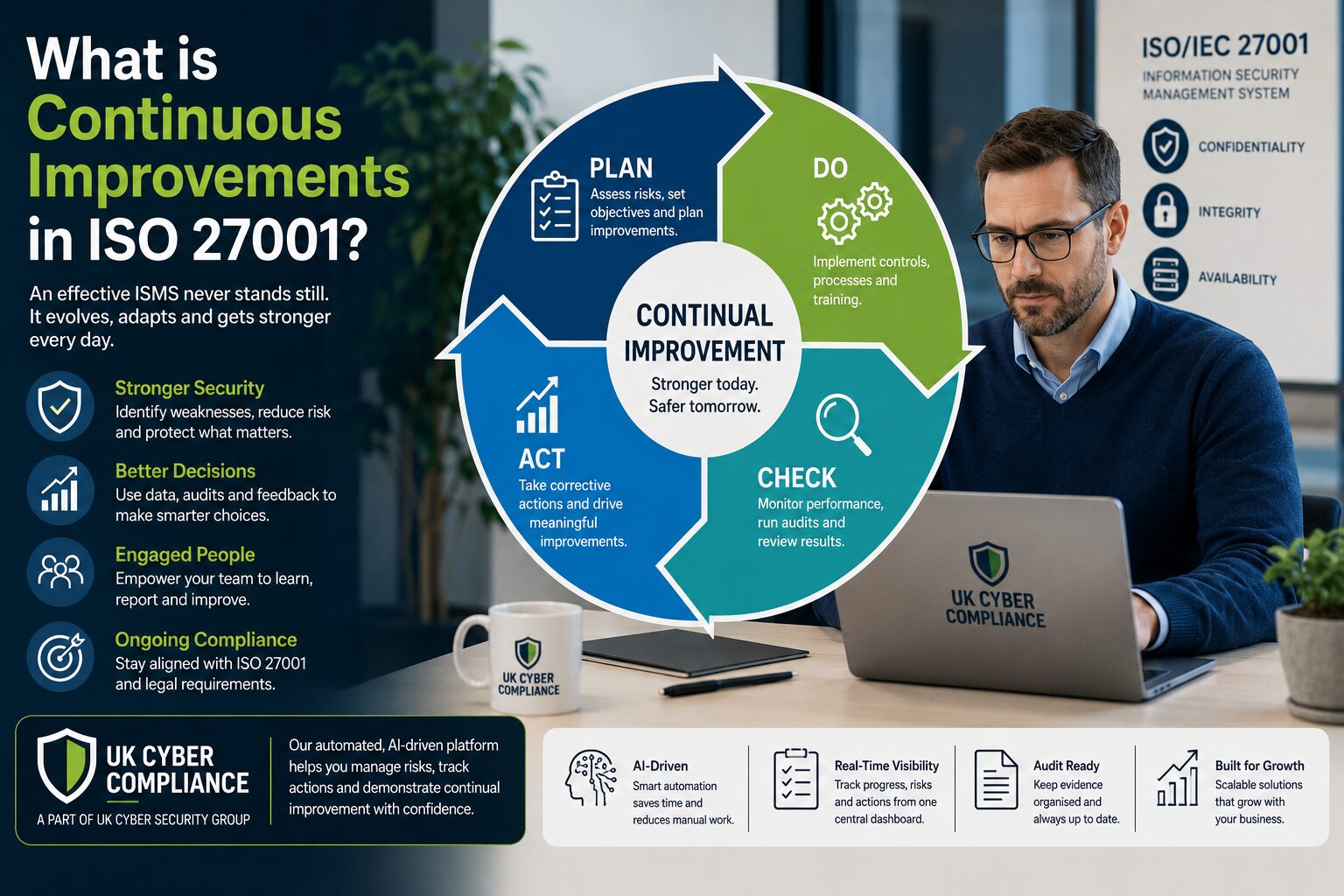
What is Continuous Improvements in ISO 27001?
Continuous improvement keeps an Information Security Management System useful after the first policies, risk assessments and controls go live. Without regular review, an ISMS can slowly drift away from the organisation it protects. Staff change, suppliers change, technology develops, customer expectations move and attackers find new ways to exploit weaknesses. ISO 27001 therefore expects an organisation to keep checking whether its management system remains suitable, adequate and effective.
The phrase in the title is widely used, although ISO/IEC 27001 uses the formal term continual improvement. The difference matters less than the business principle behind it. An organisation should not treat certification as a finished project. It should use evidence, incidents, audits, feedback and changing risks to make the ISMS stronger over time.
ISO describes ISO/IEC 27001 as the best-known international standard for information security management systems. It requires organisations to establish, implement, maintain and continually improve an ISMS. The current edition is ISO/IEC 27001:2022, supported by Amendment 1:2024.
Continuous improvement does not mean changing controls every week or creating paperwork for its own sake. It means finding worthwhile opportunities, deciding which actions matter most, assigning responsibility, checking results and keeping evidence. Done well, this process improves security, supports customer confidence and helps the organisation remain ready for future audits.
Why an ISMS Must Keep Moving
An ISMS reflects the organisation at a particular point in time. The original risk assessment may cover the right systems, people, offices and suppliers when the organisation creates it. Six months later, a new cloud service, acquisition, remote working arrangement or customer contract may change the risk picture.
Static controls create false confidence. A policy may still carry a current approval date even though employees no longer follow the process it describes. A risk treatment may show completion while a technical change has weakened the control. Training records may look complete, yet new starters may not understand incident reporting. Improvement work closes the gap between documented intent and actual practice.
The UK Cyber Security Breaches Survey 2025/2026 shows why organisations need this discipline. Forty-three per cent of UK businesses and 28% of charities identified a cyber breach or attack during the previous 12 months. The figure rose to 65% for medium businesses and 69% for large businesses. Among organisations that identified a breach or attack, 29% of businesses experienced one at least weekly.
These figures do not mean that an ISMS has failed whenever an attack occurs. Attackers can target even mature organisations. The important question is whether the organisation detects problems, responds effectively, learns from the event and reduces the chance or impact of a repeat.
What ISO 27001 Expects from Continual Improvement
ISO 27001 places improvement within Clause 10. It connects that requirement with the rest of the management system, including leadership, risk planning, support, operations, performance evaluation, internal audit and management review.
The organisation should improve the suitability, adequacy and effectiveness of its ISMS. Suitability asks whether the system still fits the organisation and its purpose. Adequacy asks whether the arrangements provide enough coverage and resource. Effectiveness asks whether the system achieves the intended results.
Those three tests help leaders avoid cosmetic action. Updating a document may improve presentation, but it does not necessarily improve security. A useful change should solve a real weakness, reduce risk, improve control performance or make the ISMS more dependable.
Suitability Means Keeping the ISMS Relevant
A suitable ISMS matches the organisation’s activities, information, obligations and operating environment. A business that moves from local file storage to cloud services needs to reassess access, backup, supplier and configuration risks. A company that begins handling health information may face stronger confidentiality and retention duties.
Leaders should review the scope, interested parties, legal obligations and business objectives when major change occurs. They should also consider whether new technology, working practices or customer demands alter the assumptions behind existing controls.
Adequacy Means Providing Enough Coverage
An adequate system gives people enough authority, information, time and resource to carry out security responsibilities. The organisation may identify a strong control but fail to support it properly. For example, a vulnerability process cannot work well when no one owns remediation, asset records remain incomplete and teams lack time to resolve findings.
Adequacy also applies to competence and communication. Employees need clear procedures, role-relevant learning and a simple route for reporting concerns. Senior managers need meaningful information rather than a large dashboard that hides the most serious issues.
Effectiveness Means Checking Real Results
An effective control produces the intended outcome. A backup policy does not prove recoverability. Restore testing provides stronger evidence. An incident response plan does not prove readiness. A realistic exercise shows whether people can make decisions, communicate and recover services.
Organisations should use measures that reveal performance. Examples include time taken to close high-priority actions, repeated audit findings, overdue access reviews, incident reporting speed, restore success, response exercise results and the number of risks operating outside approved limits.
The National Cyber Security Centre advises boards to use effective security measures and meaningful metrics to improve decision-making, performance and accountability. It also highlights staff reporting, awareness results and engagement with phishing exercises as useful indicators.
Nonconformity and Corrective Action
Continual improvement works alongside the requirement to manage nonconformity and corrective action. A nonconformity occurs when the organisation fails to meet an applicable requirement. The requirement may come from ISO 27001, the organisation’s own ISMS, a contract, a law or another binding commitment.
Examples include a missed internal audit, an access review that did not take place, incomplete competence records, an unapproved policy, an unresolved high risk or a control that staff do not follow.
When a nonconformity appears, the organisation should react promptly. It should control and correct the immediate problem, deal with any consequences and decide whether it needs action to remove the underlying cause. The team should then implement that action, review whether it worked and change the ISMS where necessary.
Correction Is Not the Same as Corrective Action
A correction fixes the immediate issue. Corrective action addresses why the issue happened.
Suppose an employee keeps access after leaving the company. Removing the account corrects the immediate problem. The organisation should then investigate why the leaver process failed. Perhaps human resources did not notify IT, the service desk missed the request or the organisation had no complete list of applications. Corrective action might include a new workflow, stronger ownership, automated notifications and periodic checks.
This distinction prevents repeated failures. Teams often close an action as soon as they fix the visible symptom. Root-cause thinking asks what condition allowed the problem to arise and whether the same weakness could affect another process.
Proportionate Action Keeps Effort Focused
Not every issue needs a lengthy investigation. A minor formatting error in a record may need a simple correction. A repeated access failure, major incident or legal breach requires deeper analysis.
The organisation should match effort to risk, impact and recurrence. It should also avoid using root-cause analysis to delay urgent containment. Teams can protect the business first and complete the deeper review once they control the immediate risk.
Where Improvement Opportunities Come From
A healthy ISMS receives signals from many parts of the business. Improvement should not depend on one annual meeting or an auditor finding a weakness.
Internal Audits
Internal audits test whether the ISMS meets planned arrangements and whether people apply those arrangements effectively. A good audit does more than compare documents with clauses. It follows processes, samples evidence, speaks with employees and checks whether controls achieve their purpose.
Audit findings can reveal nonconformities, observations and opportunities. The organisation should prioritise them according to risk and track actions through to verified completion. Repeated findings deserve particular attention because they often point to weak ownership, limited resource or ineffective corrective action.
Auditors should remain objective and independent of the work they assess wherever practical. Smaller organisations may need external support or carefully separated responsibilities to achieve a credible review.
The internal audit programme should consider the importance of each process, previous audit results and areas of greater risk. Auditing every part of the ISMS with identical frequency may waste effort. A risk-based programme places more attention on systems, processes and controls that could create serious harm.
Management Review
Management review gives leaders a structured view of ISMS performance. It should consider changes in internal and external issues, feedback from interested parties, security objectives, audit results, incidents, risk status, monitoring results and opportunities for improvement.
The value comes from decisions, not from meeting attendance. Leaders should agree actions, allocate resources and record who owns the next step. They should also challenge whether previous decisions produced the expected outcome.
A useful management review does not simply repeat information that managers already receive. It brings evidence together so leaders can see connections. For example, rising incident reports, delayed training and high staff turnover may show a wider competence or resource problem.
Management review should produce clear outputs. These may include approved actions, revised objectives, additional resources, changes to risk treatment or a decision to reassess part of the ISMS.
Incidents and Near Misses
Incidents provide direct evidence about how controls behave under pressure. Near misses matter too because they reveal weaknesses before serious harm occurs.
The NCSC advises organisations to document incident reviews, capture lessons from incidents and near misses, improve security measures and feed analysis into risk management and ongoing improvement. It also encourages organisations to learn from events within their sector, not only from their own experience.
A useful review asks what happened, how the organisation detected it, which controls worked, which controls failed, what slowed the response and what changes would reduce future risk. The review should avoid blame and focus on facts, decisions and system conditions.
Teams should share relevant lessons with the people who need them. A technical team may need detailed findings, while senior managers need a clear explanation of business impact, control weakness and required action.
Near misses deserve a proportionate review. An employee who reports a suspicious payment request before money leaves the business has provided valuable evidence. The organisation can use that event to test verification procedures, communication routes and staff awareness.
Risk Assessments and Treatment Plans
Risk assessment creates a major source of improvement work. New threats, assets, suppliers and business processes may change likelihood or impact. Control testing may also show that a treated risk remains higher than expected.
Teams should review risk at planned intervals and after significant change. They should update treatment actions, acceptance decisions and control evidence when the facts move. A risk register that never changes usually signals weak engagement rather than a stable business.
Risk treatment should also reflect control performance. A control may exist on paper but operate inconsistently. When testing reveals a weakness, the organisation should reassess residual risk and decide whether further action is necessary.
Risk owners need enough information to make informed decisions. They should understand the potential business effect, current controls, remaining exposure and available treatment options.
Objectives and Performance Measures
Information security objectives should support business priorities and provide measurable direction. An objective might focus on reducing overdue critical actions, improving recovery performance or increasing timely incident reporting.
Measures should help people make decisions. Large volumes of data can distract leaders from the main risks. A useful measure has a clear owner, reliable source, target, reporting frequency and agreed response when performance moves outside tolerance.
Objectives should remain achievable but meaningful. An objective that the organisation can meet without changing behaviour offers little benefit. An unrealistic target may also weaken engagement because employees stop treating it seriously.
When an objective falls behind, managers should investigate the cause rather than simply move the date. The delay may point to a resource shortage, unclear ownership, competing priorities or an ineffective plan.
Employees and Operational Teams
Employees often see practical weaknesses before leaders do. They notice confusing instructions, duplicate approvals, unsafe workarounds and systems that make secure behaviour difficult.
A positive culture encourages people to report concerns and suggest better ways of working. The NCSC notes that healthy security cultures learn from incidents and use reflection to drive improvement and innovation.
Organisations should make reporting simple and accessible. A complicated route discourages early action. Staff should know where to report an incident, policy concern, control weakness or improvement idea.
Managers should acknowledge useful feedback and explain what happened next. Employees may stop reporting concerns when they never see a response. Even when the organisation decides not to make a change, a clear explanation can maintain trust.
Customers, Suppliers and Other Interested Parties
Customer complaints, due diligence questions, supplier reviews and contract discussions can expose gaps in the ISMS. Regulators, insurers and certification auditors may also identify changing expectations.
The organisation should assess each request rather than accepting every demand automatically. Improvement remains risk-based. A customer request may reveal a valuable control gap, but it may also sit outside the agreed scope or provide little benefit.
Supplier performance can also create improvement work. Repeated service failures, delayed incident notices or weak assurance evidence may require closer monitoring, contract changes or an alternative provider.
A Practical Improvement Cycle
Organisations often use the Plan, Do, Check, Act cycle to explain management system improvement. ISO 27001 does not require teams to label every activity this way, but the model provides a clear business rhythm.
Plan the Change
Define the problem or opportunity. Gather evidence, understand risk and decide what outcome the organisation wants. Agree scope, ownership, resource, dependencies and success measures.
A strong plan describes the reason for action. “Update the policy” gives little direction. “Reduce delays in disabling leaver access by creating one accountable workflow and measuring completion” connects the change to a clear risk.
Planning should also consider unintended effects. A stronger approval process may reduce unauthorised access, but it could also delay urgent work. Teams should balance security with operational needs.
Do the Work
Implement the agreed action and communicate with affected people. Update relevant procedures, responsibilities, training, records and technical settings.
Change control matters because an improvement in one area can create risk elsewhere. Teams should test significant changes, consider business disruption and keep a route for escalation.
Employees need to understand why the change matters. A new process gains better support when people can connect it with a real risk, incident or customer requirement.
Check the Result
Review evidence against the success measure. Confirm whether the action removed the cause, reduced risk and worked across the intended scope.
A completion date does not prove effectiveness. The organisation may need follow-up sampling, control testing, employee feedback or another audit. Where the result falls short, teams should adjust the action rather than declare success.
Checking should take place after enough time has passed to produce meaningful evidence. Reviewing too early may create false confidence, while waiting too long can leave a weakness unresolved.
Act on What the Evidence Shows
Standardise successful changes and apply relevant lessons elsewhere. Update the ISMS, risk records and future plans. Where the change failed, revise the approach and repeat the cycle.
This final step turns one action into organisational learning. It also helps the organisation avoid solving the same problem separately in several departments.
Successful improvement may create a new baseline. The organisation can then set a more ambitious objective or focus attention on another priority.
Measuring Progress Without Creating Noise
Good metrics show whether the ISMS improves. Poor metrics count activity without showing value.
Training completion offers a simple example. A report may show that every employee finished a module, yet the organisation may still receive low-quality incident reports. A stronger view combines completion, assessment results, reporting behaviour and findings from exercises.
The 2025/2026 UK survey found that 61% of businesses that experienced a breach or attack took action to prevent future incidents. Changes involving people or training formed the most common response, reported by 31% of businesses.
That response shows the importance of learning, but organisations gain more value when they improve before a serious event. Internal audits, near misses, exercises and threat information can highlight weaknesses earlier.
Useful measures may include:
- Open corrective actions by priority and age
- Repeat nonconformities
- Risk treatment actions completed on time
- Average time to detect, contain and recover
- Successful restore tests
- Privileged access reviews completed
- Security incidents reported by staff
- Supplier reviews completed
- Objectives achieved or off track
- Actions that passed effectiveness checks
Leaders should review trends rather than isolated numbers. A temporary increase in incident reports may show better awareness, not weaker security. Context prevents teams from rewarding silence or hiding difficult information.
Metrics should also lead to decisions. A dashboard has limited value when no one acts on the information. Each significant measure should have a defined threshold and an agreed response.
Threat Change Makes Improvement Essential
Attack methods continue to develop. Verizon’s 2026 Data Breach Investigations Report states that 31% of breaches now begin with software vulnerabilities and 48% involve ransomware. It also reports that mobile-focused social engineering achieved click rates 40% higher than traditional email approaches.
These findings show why organisations must update assumptions. A training programme focused only on email may miss fraudulent calls and mobile messages. A vulnerability process designed for a small internal network may not cover cloud services and externally hosted applications. Risk treatment should move as evidence changes.
Improvement does not require chasing every headline. The organisation should use reliable threat information, assess relevance and act where the risk justifies action.
Threat information should connect with business context. A new attack method may create little risk for one organisation but serious exposure for another. Leaders need to understand which systems, services and information matter most.
Common Barriers That Slow Improvement
The first barrier is treating certification as the finish line. Teams may reduce attention after the audit, allowing actions and reviews to drift. Leaders should set the next review cycle before certification and keep responsibilities active.
Weak ownership creates another problem. Actions remain open when no one has authority, time or a clear due date. Every improvement should have one accountable owner, even when several teams contribute.
Organisations also struggle when they collect too much evidence. Excessive records consume time and make important information harder to find. Keep evidence proportionate, controlled and linked to a real requirement or decision.
A blame culture blocks learning. Employees may hide mistakes or near misses when they fear punishment. Leaders should distinguish honest error from deliberate misconduct and reward prompt reporting.
Some teams make changes without checking results. This creates a list of completed tasks rather than evidence of stronger security. Effectiveness review should form part of the original action plan.
Another barrier comes from attempting too many actions at once. A long improvement register can overwhelm employees and hide critical work. Risk-based prioritisation helps teams focus on actions that protect the most important information and services.
Poor communication can weaken otherwise sensible changes. People may resist a new control when they do not understand the reason behind it. Managers should explain the risk, the expected behaviour and the support available.
Continuous Improvement for Smaller Organisations
A smaller organisation does not need a large governance structure. It still needs a dependable routine.
One monthly security review can cover incidents, changes, risks, overdue actions and upcoming obligations. A quarterly leadership review can examine objectives, audit results, supplier concerns and resource needs. The organisation can keep one controlled improvement register that records the issue, risk, action, owner, due date, evidence and effectiveness result.
The process should remain simple enough to use. Complexity does not prove maturity. A concise record that drives action offers more value than a large system that staff ignore.
Automation can reduce administrative work, but people still need to make informed decisions. Reminders, dashboards, linked evidence and status reporting help teams maintain momentum. Leaders should still review risk, challenge assumptions and approve meaningful changes.
Smaller businesses can also combine related activities. A leadership meeting may cover risk, objectives, incidents and supplier performance in one structured session. The organisation should record the decisions and resulting actions clearly.
External specialists may support internal audits or technical reviews when the organisation lacks independence or specialist knowledge. Responsibility for the ISMS still remains with the organisation’s leadership.
How an Automated and AI-Driven Platform Can Help
An integrated compliance platform can bring risk assessments, controls, policies, audits, objectives, evidence and corrective actions into one place. This gives leaders a clearer view of dependencies and overdue work.
UK Cyber Compliance describes its platform as using AI-powered automation, guided risk assessment, real-time progress tracking and audit-ready documentation to support the ISO 27001 journey.
For improvement work, a central platform can help an organisation:
- Log findings and opportunities
- Assign actions and due dates
- Connect actions with risks and controls
- Retain evidence of completion
- Record effectiveness reviews
- Track repeated issues
- Show progress to leaders
- Prepare records for an audit
Technology should support judgement rather than replace it. AI may help organise information, suggest drafts and highlight gaps, but accountable people should validate outputs, assess risk and approve decisions.
A platform can also reduce reliance on disconnected spreadsheets, emails and document folders. Central visibility makes it easier to see whether an audit finding links with a risk, control, policy or objective.
Automated reminders can stop actions from disappearing after meetings. Dashboards can show leaders where progress has slowed, while linked records make evidence easier to review.
What is ISO 27001 Certification?
What is ISO 27001 Certification? It is an independent assessment of whether an organisation’s ISMS meets the requirements of ISO/IEC 27001 within its defined scope. Certification can provide customers and other interested parties with added confidence that the organisation manages information security through a structured system.
ISO explains that organisations may implement ISO/IEC 27001 without seeking certification, while others choose certification to reassure customers and stakeholders. Accredited certification also adds independent confidence in the competence of the certification body.
Continual improvement matters throughout the certification cycle. Auditors look for evidence that the ISMS operates, that leaders review performance and that the organisation corrects weaknesses rather than leaving them unresolved.
what is iso 27001
what is iso 27001 is a common question from organisations that want a clear explanation of the standard. ISO/IEC 27001 sets requirements for an ISMS that protects confidentiality, integrity and availability through risk management.
The standard brings people, processes, policies and technology into one management framework. ISO states that the framework helps organisations become risk-aware, address weaknesses and prepare for changing threats.
Continual improvement ensures that this framework remains relevant. It connects everyday security work with leadership decisions, risk treatment and measurable business outcomes.
Who needs iso 27001 certification
Who needs iso 27001 certification depends on customer expectations, contracts, risk exposure and strategic goals. Technology firms, professional services, healthcare providers, manufacturers, charities, education bodies and public sector suppliers may all gain value from a structured ISMS.
ISO reports that more than 70,000 certificates appeared across 150 countries in its 2022 survey, covering economic sectors from agriculture and manufacturing to social services.
Certification often has particular value where an organisation handles sensitive information, supports larger supply chains, bids for contracts or needs independent assurance for customers.
The need does not depend only on company scale. A small provider may hold highly sensitive customer information or support a critical client. Risk, contractual expectations and business strategy provide a better guide.
ISO 27001 Certification Levels
The phrase ISO 27001 Certification Levels can create confusion. ISO/IEC 27001 does not award bronze, silver and gold grades. An organisation receives certification for a defined ISMS scope after demonstrating conformity with the applicable requirements.
Businesses may use internal maturity stages to plan progress. Those stages can support project management, but they do not create official grades under ISO/IEC 27001.
The scope matters because it states which business activities, locations, systems and services the certified ISMS covers. Customers should review that scope rather than assuming that a certificate covers every part of the organisation.
How the Certification Works
How the Certification Works usually begins with defining scope, understanding interested parties, assessing information security risks and selecting suitable treatment. The organisation then operates its controls, trains relevant people, monitors performance, completes internal audits and holds management reviews.
An independent certification body assesses the ISMS. After initial certification, surveillance activity checks whether the organisation continues to maintain and improve the system. Recertification later examines the system again across the certification cycle.
Continual improvement links each stage. It gives the organisation a controlled way to respond to findings, risk changes, incidents and performance evidence.
Certification should not force a business into unnecessary complexity. The ISMS should reflect the organisation’s real activities and risks while meeting every applicable requirement.
Which UK-based firms offer ISO 27001 consultancy services?
Organisations asking Which UK-based firms offer ISO 27001 consultancy services? should compare practical experience, platform capability, clarity of guidance, sector knowledge and ongoing support. A provider should help the business understand the standard and build a system that staff can operate after certification.
UK Cyber Compliance (a part of UK Cyber Security Group) provides these services and has a platform to make certification much easier and cheaper.
The UK Cyber Compliance platform offers guided workflows, risk management support, policy generation, progress tracking and audit-ready evidence management. These capabilities can help organisations organise improvement work and maintain visibility across the ISMS.
A useful provider should also explain what the organisation must own internally. Consultants and platforms can provide structure, expertise and efficiency, but leadership must remain accountable for risks, resources and ISMS performance.
Making Improvement Part of Normal Business
Continuous improvement works best when it becomes part of routine management. Teams should discuss security during change projects, supplier reviews, leadership meetings and operational planning. Employees should know how to raise concerns, and managers should act on useful feedback.
The organisation does not need constant change. It needs consistent attention. Some reviews will confirm that controls remain effective. Others will identify a small adjustment or a major corrective action. Both outcomes provide value because they replace assumption with evidence.
A mature ISMS learns from audits, incidents, near misses, employees, customers and changing threats. It keeps actions proportionate, verifies results and records enough evidence to support accountability.
This approach turns ISO 27001 from a one-time exercise into a practical system for protecting information and supporting long-term business resilience. It also helps the organisation demonstrate that certification represents an active management system rather than a collection of documents prepared for an auditor.
UK Cyber Compliance is here to help
For more information, please do get in touch.
Please check out our Free Cyber Insurance
Other blog posts, Your ISO 27001 Questions Answered, Get ISO 27001 Certified ,
If you would like to know more, do get in touch as we are happy to answer any questions. Looking to improve your cybersecurity but not sure where to start? Begin by getting certified in Cyber Essentials, the UK government’s scheme that covers all the technical controls that will provide the protection that you need to help guard against criminal attacks.