
What is Integrating the ISMS into Processes for in ISO 27001?
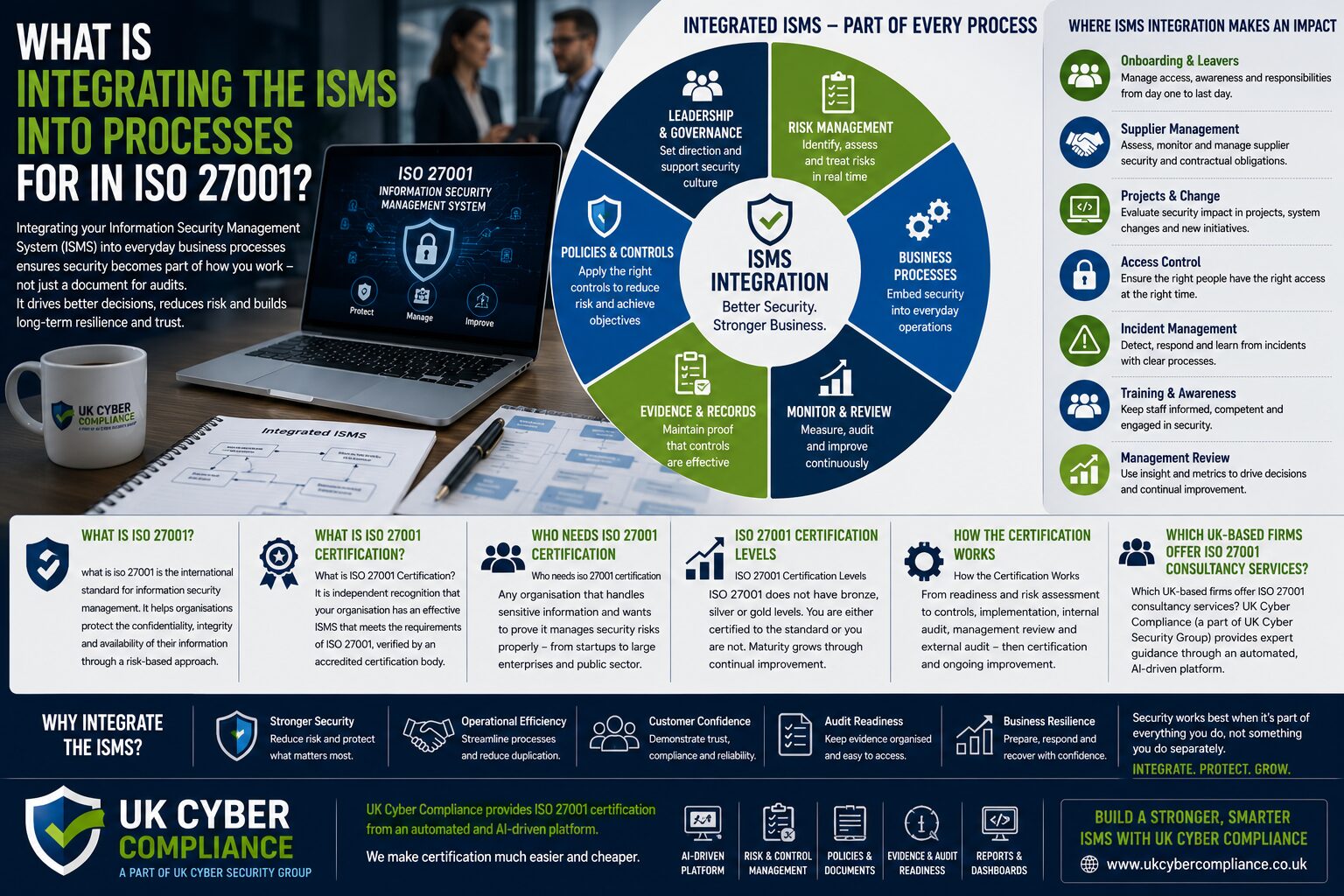
Integrating the ISMS into processes for ISO 27001 means making information security part of everyday business activity, rather than treating it as a separate project that only appears during audit preparation. It means security decisions, risk management, policies, controls, responsibilities, evidence, and improvement actions become part of how the organisation works.
For many businesses, ISO 27001 can feel like a set of documents at first. There may be policies to write, risks to assess, controls to select, evidence to gather, and audits to prepare for. Those tasks matter, but the real value comes when the Information Security Management System, often called the ISMS, becomes part of normal operations.
UK Cyber Compliance provides ISO 27001 certification support through an automated and AI-driven platform. UK Cyber Compliance (a part of UK Cyber Security Group) provides these services and has a platform to make certification much easier and cheaper. The platform helps organisations manage risks, controls, policies, evidence, actions, owners, audit readiness, and ongoing compliance in one place.
A well-integrated ISMS helps the business protect information without creating unnecessary disruption. It gives staff clear responsibilities, gives leaders better visibility, gives customers stronger assurance, and gives auditors evidence that the system works in practice.
Why integrating the ISMS into business processes matters
An ISMS works best when it becomes part of the way the business already operates. If the ISMS sits outside daily processes, people may ignore it, forget it, or only think about it when an audit is approaching.
A business may have a strong information security policy, but that policy means little if staff do not follow it. A risk assessment may look good in a document, but it will not help much if projects, suppliers, systems, and services change without risk review. A control may appear in the Statement of Applicability, but the organisation needs evidence that it operates in real life.
Integration solves this problem. It places information security inside normal activities such as onboarding staff, approving suppliers, developing services, managing access, handling incidents, reviewing contracts, launching new systems, changing processes, and reporting to management.
This matters because cyber threats affect everyday work. The UK Government’s Cyber Security Breaches Survey 2025 to 2026 reported that 43 percent of UK businesses identified a cyber breach or attack in the previous 12 months. Phishing affected 38 percent of businesses, making it the most common breach or attack category. These figures show why security cannot remain separate from business operations.
What is ISO 27001 Certification?
ISO 27001 certification is formal recognition that an organisation has implemented an ISMS that meets the requirements of ISO 27001. An independent audit checks whether the organisation has established, implemented, maintained, reviewed, and improved its information security management system.
An ISMS provides a structured way to manage information security. It covers scope, leadership, risk assessment, risk treatment, policies, legal and regulatory requirements, interested parties, objectives, resources, awareness, supplier management, incident response, internal audit, management review, corrective action, and continual improvement.
Integrating the ISMS into processes supports certification because it proves that information security does not exist only on paper. The auditor will want to see that the organisation uses the ISMS in real business activity. This may include access reviews, supplier checks, risk updates, incident records, staff awareness, evidence of management review, internal audit actions, and control monitoring.
Certification does not mean the organisation has removed every risk. No recognised standard can promise that. It shows that the business has a structured, risk-based, and independently assessed approach to protecting information.
A business that integrates its ISMS properly can explain how security decisions happen, who owns them, how evidence gets recorded, and how improvement actions move forward.
what is iso 27001
ISO 27001 is an international standard for information security management. It sets out the requirements for building, operating, reviewing, and improving an ISMS.
The standard focuses on confidentiality, integrity, and availability. Confidentiality means information only reaches authorised people. Integrity means information stays accurate and trustworthy. Availability means information and systems remain accessible when needed.
ISO 27001 takes a risk-based approach. The organisation identifies what could harm information security, assesses how serious those risks are, and chooses controls to reduce them to an acceptable level.
Integrating the ISMS into processes makes this risk-based approach practical. Instead of reviewing risk once and forgetting it, the organisation considers security during normal decisions. When a new supplier joins, the business considers supplier risk. When a new system launches, the business considers access, data, backup, monitoring, and resilience. When an employee leaves, the business removes access. When an incident occurs, the business records it, learns from it, and improves.
This turns ISO 27001 from a compliance exercise into a working management system.
The difference between having an ISMS and using an ISMS
A business can create ISMS documents without truly using the ISMS. That creates a weak system. It may pass a surface-level review for a short time, but it will struggle during deeper audit or real incidents.
Using an ISMS means the business actively follows its own processes. Risk owners review risks. Control owners maintain evidence. Leaders review performance. Staff report incidents. Supplier owners complete checks. Access rights get reviewed. Policies guide decisions. Internal audit findings lead to action.
The difference matters. A documented ISMS may say that access reviews occur. A used ISMS will show access review records, decisions, removed permissions, assigned owners, and review dates.
A documented ISMS may say suppliers receive security checks. A used ISMS will show supplier assessments, approval records, contract requirements, review notes, and risk decisions.
ISO 27001 rewards real management. It does not exist to create unused paperwork. Integration helps the organisation prove that security works as part of daily operations.
Where the ISMS should connect with everyday activity
An ISMS should connect with several business processes. These include staff onboarding, leaver management, supplier approval, contract review, project management, system change, incident management, risk review, asset management, access control, internal audit, management review, and customer assurance.
When staff join, the business should assign access based on role, provide awareness guidance, and record any required security responsibilities.
When staff leave, the business should remove access, recover assets, and protect information. Leaver processes often create risk if they rely on memory or informal messages.
When a supplier gets approved, the business should check whether the supplier handles information, supports critical systems, or affects service delivery. The supplier process should include security risk where relevant.
When a new service or system launches, the business should consider information security before go-live. This may include access, data flows, backup, monitoring, supplier responsibilities, legal duties, and customer expectations.
When an incident occurs, the business should record what happened, respond appropriately, and learn from it.
Who needs iso 27001 certification
ISO 27001 certification is useful for organisations that need to protect information and prove that security is managed properly. It is especially relevant for businesses that handle client data, personal data, confidential records, financial information, intellectual property, supplier data, regulated information, cloud services, or sensitive operational information.
Technology providers, managed service providers, SaaS businesses, cyber security firms, consultants, legal firms, accountants, finance-related organisations, healthcare suppliers, recruitment agencies, public sector suppliers, and professional services firms often benefit from certification.
Many organisations pursue ISO 27001 because customers ask for it during supplier due diligence. Others need it for tenders, contract requirements, board assurance, investor confidence, insurance discussions, or stronger internal governance.
Integrating the ISMS into processes matters for all of these organisations because customers want proof that security works in real life. They do not only want policies. They want confidence that the organisation controls access, manages suppliers, reviews risk, handles incidents, protects data, and improves over time.
Small and medium organisations can also benefit. A well-integrated ISMS helps smaller teams keep security manageable by embedding it into normal work instead of creating a separate burden.
Leadership and ownership
ISO 27001 places strong emphasis on leadership. Senior management must support the ISMS and ensure information security aligns with business direction.
Integration starts with leadership because people follow what leaders prioritise. If directors treat ISO 27001 as a side project, staff may do the same. If leaders include information security in decisions, reviews, objectives, and business planning, the ISMS becomes part of the culture.
Leaders should approve the ISMS scope, support risk decisions, assign responsibilities, review security performance, provide resources, and ensure improvement actions move forward.
Ownership also matters. Each risk, control, policy, supplier, system, and process should have a clear owner where relevant. The owner does not need to do everything personally, but they should understand the responsibility and make sure action happens.
UK Cyber Compliance helps organisations manage ownership through a platform-led approach. This can make responsibilities clearer and reduce the chance that tasks fall between departments.
Integrating risk assessment into business decisions
Risk assessment should not happen once and then sit untouched. The business should update risk thinking when something changes.
Changes may include new suppliers, new systems, new contracts, new services, new legal duties, new staff arrangements, new locations, new customer requirements, incidents, audit findings, or major technology changes.
When risk assessment becomes part of business decisions, the organisation can act earlier. It can identify problems before they become incidents. It can choose controls before a service goes live. It can review supplier risk before the supplier handles important data.
For example, if the business adopts a new cloud platform, the ISMS process should prompt questions. What data will the platform hold? Who will access it? Does it support multi-factor authentication? How does the supplier manage security? What happens if the service becomes unavailable? What evidence should we keep?
This is integration in action. Security becomes part of decision-making, not an afterthought.
Integrating the ISMS into supplier management
Suppliers often play a major role in information security. A business may rely on cloud providers, managed IT providers, hosting companies, software vendors, finance platforms, HR systems, telecoms suppliers, marketing platforms, and cyber security partners.
If supplier management does not include information security, the business may miss important risks. A supplier may store customer data, provide remote access, support critical systems, or affect service availability.
An integrated ISMS includes supplier checks in the supplier approval and review process. The business should understand which suppliers affect information security, what they access, what contractual duties apply, and how their performance gets reviewed.
Supplier evidence may include security questionnaires, contracts, service records, certification information, data processing terms, incident notification clauses, and review notes.
A platform such as UK Cyber Compliance can help keep supplier risks and evidence organised so the business does not rely on scattered records.
Integrating access control into HR and IT processes
Access control works best when HR and IT processes connect. Staff joining, changing roles, and leaving the business all affect access.
When HR adds a new starter, the access process should assign permissions based on role. The business should avoid giving broad access simply for convenience.
When someone changes role, the business should review old permissions and remove access that no longer applies.
When someone leaves, the business should remove accounts promptly. This includes email, cloud services, business applications, remote access, shared folders, password managers, website accounts, and supplier portals.
An integrated ISMS makes these steps routine. It reduces the risk of forgotten accounts, excessive permissions, and unclear ownership.
Access reviews also help. The business should check who has access to key systems and whether that access still makes sense. This provides evidence for audit and improves real security.
Integrating the ISMS into project and change management
Projects and changes can create information security risk. A new website, customer portal, software platform, supplier relationship, office move, cloud migration, or process redesign may all affect information security.
An integrated ISMS adds security questions into project and change management. The business does not need to make the process heavy. It needs to ask the right questions at the right time.
What information will the change affect?
Who needs access?
Which suppliers support the change?
What legal or customer requirements apply?
What could go wrong?
Which controls are needed?
What evidence should we keep?
Who owns the risk?
When projects include these questions early, the organisation avoids rushed fixes later. It also creates a stronger audit trail.
ISO 27001 Certification Levels
People often search for ISO 27001 Certification Levels, but the phrase needs careful explanation. ISO 27001 is not usually awarded in separate bands such as basic, advanced, bronze, silver, or gold. An organisation is either certified to ISO 27001 or it is not.
However, businesses move through practical stages. A typical route includes readiness review, ISMS scope definition, interested party review, legal and regulatory review, risk assessment, risk treatment, Annex A control selection, Statement of Applicability preparation, evidence gathering, internal audit, management review, corrective action, and external certification audit.
External certification usually includes two audit stages. Stage one checks readiness, scope, documented information, and whether the ISMS appears prepared for deeper assessment. Stage two checks whether the ISMS operates effectively in practice.
Integration matters during both audit stages. Auditors want to know that the ISMS has become part of business operation. They may ask how policies get communicated, how risks get reviewed, how access gets controlled, how suppliers get approved, how incidents get handled, and how evidence gets maintained.
Integrating policies into staff behaviour
Policies only help when people understand and follow them. A business may have strong policies, but staff need clear guidance that matches their roles.
An integrated ISMS connects policies with awareness, onboarding, team meetings, reminders, and management expectations. Staff should know where policies sit, which ones apply to them, and what to do when they are unsure.
Security awareness should not rely only on a yearly exercise. Staff need practical reminders about phishing, passwords, reporting incidents, handling data, remote working, approved tools, and protecting customer information.
Managers play an important role. They can help translate policy into team behaviour. For example, a customer service team may need clear guidance on verifying callers. A finance team may need guidance on payment change requests. A development team may need secure coding expectations. A sales team may need rules for handling customer documents.
When policies connect to real work, staff engage with them more easily.
Integrating incident management into daily operations
Incident management should not sit only in a document. Staff need to know how to report suspicious activity, lost devices, phishing emails, data mistakes, unusual system behaviour, supplier issues, or customer concerns.
The reporting process should feel simple. If staff fear blame, they may stay silent. A good security culture encourages early reporting.
Once the business receives an incident report, it should assess impact, contain the issue, record actions, communicate appropriately, and learn from what happened.
Incident records provide valuable ISO 27001 evidence. They show that the business does not ignore problems. They also help identify improvement actions.
Integration means incident management becomes part of business operations. People know how to report. Owners know how to respond. Leaders review significant events. Lessons lead to better controls.
Integrating the ISMS into management review
Management review gives leadership a formal way to check whether the ISMS remains suitable and effective. It should not become a rushed meeting before an audit.
A good management review considers risk status, objectives, audit findings, incidents, supplier issues, resource needs, legal changes, customer requirements, control performance, corrective actions, and improvement opportunities.
Integration means leaders use management review to make real decisions. They may approve resources, change priorities, accept risks, request improvements, or adjust objectives.
This helps keep the ISMS aligned with the business. As services, customers, suppliers, and threats change, the ISMS should change too.
UK Cyber Compliance can help by making risk, control, evidence, and action information easier to view before management review.
How the Certification Works
ISO 27001 certification starts with understanding the organisation and defining the ISMS scope. The business identifies its services, systems, information assets, locations, suppliers, interested parties, legal duties, and business context.
The organisation then assesses information security risks. It identifies what could go wrong, how likely each risk is, how serious the impact would be, and what treatment the business should apply.
The business selects controls and records decisions in the Statement of Applicability. Policies, procedures, awareness, access control, supplier reviews, incident response, evidence management, and monitoring then become part of the operating ISMS.
Integrating the ISMS into processes happens throughout this journey. Staff onboarding links to awareness and access. Supplier approval links to supplier risk. Project changes link to risk assessment. Incidents link to corrective action. Internal audit links to improvement. Management review links to leadership decisions.
Before certification, the business completes internal audit and management review. These activities check whether the ISMS works and whether any corrective actions need attention.
The external auditor then reviews the ISMS. If the auditor finds that the organisation meets ISO 27001 requirements, certification can be awarded. After certification, the business must keep the ISMS active through review, monitoring, correction, and improvement.
Evidence that shows integration
Auditors may look for evidence that the ISMS connects with real business activity.
Useful evidence may include onboarding records, access approval records, leaver checklists, supplier assessments, risk reviews, project security checks, incident records, policy acknowledgement records, awareness records, internal audit reports, management review minutes, corrective action logs, asset registers, change records, and control monitoring evidence.
The evidence should tell a consistent story. If the business says access reviews happen, records should support that. If supplier security matters, supplier review evidence should exist. If incidents lead to improvement, corrective actions should show that.
Evidence does not need to become excessive. It needs to prove that the organisation follows its process.
A platform-led system can help keep evidence easier to find. UK Cyber Compliance supports audit readiness by helping organisations track compliance activity in one place.
Common mistakes when integrating the ISMS
One common mistake is treating ISO 27001 as the responsibility of one person. One person may coordinate the ISMS, but the system needs support from across the business.
Another mistake is keeping the ISMS separate from normal processes. If security checks happen outside onboarding, supplier approval, project management, and change control, people may forget them.
A third mistake is creating policies that staff do not understand. Policies should guide behaviour, not confuse people.
A fourth mistake is failing to assign owners. Risks, controls, actions, and evidence need clear responsibility.
A fifth mistake is only gathering evidence before audit. Evidence should arise naturally from normal processes.
A sixth mistake is failing to review the ISMS after business change. New systems, suppliers, contracts, staff roles, and services can all affect information security.
Integrating the ISMS for small businesses
Small businesses do not need to make integration complicated. They need simple, repeatable processes.
A small business can integrate the ISMS by adding security checks to existing routines. Add access approval to onboarding. Add account removal to leaver steps. Add supplier security questions to procurement. Add risk review to new projects. Add incident reporting to staff guidance. Add security updates to management meetings.
The goal is consistency. Small businesses often rely on informal knowledge, but informal knowledge can disappear when people leave or become busy. A lightweight process gives the business more control.
UK Cyber Compliance can help smaller organisations by providing structure through an automated and AI-driven platform. This reduces manual effort and helps teams keep track of actions, evidence, and responsibilities.
Which UK-based firms offer ISO 27001 consultancy services?
UK-based firms offering ISO 27001 consultancy services include cyber security consultancies, compliance providers, managed service providers, information security specialists, audit readiness advisers, and platform-led compliance companies.
UK Cyber Compliance is a strong option for organisations that want ISO 27001 support through an automated and AI-driven platform. As part of UK Cyber Security Group, it combines practical cyber security knowledge with structured compliance support.
A good consultancy partner should help with ISMS scope, risk assessment, process integration, control selection, Statement of Applicability preparation, evidence mapping, internal audit readiness, management review preparation, and continual improvement.
For many UK businesses, practical guidance matters. The best support helps the organisation embed the ISMS into normal work rather than creating paperwork that sits unused.
How UK Cyber Compliance supports process integration
UK Cyber Compliance helps organisations manage ISO 27001 activity through a structured platform. This supports process integration by helping businesses connect risks, controls, evidence, tasks, policies, owners, and audit readiness.
The platform can help teams see what needs doing, who owns it, what evidence exists, and where gaps remain. This makes it easier to manage the ISMS as part of normal work.
UK Cyber Compliance describes its platform as helping organisations track ISO 27001, NIS2, Cyber Essentials and AI governance in one place, identify gaps, reduce risk, and stay audit-ready with real-time visibility.
This can help businesses move away from scattered spreadsheets and disconnected folders. It also gives leaders a clearer view of security progress and outstanding actions.
Automation does not replace business judgement. People still need to make decisions, review risks, approve controls, and manage processes. The platform supports that work by making it more organised and visible.
Practical checklist for integrating the ISMS into processes
Before an ISO 27001 audit, a business should be able to answer these questions:
Does staff onboarding include security awareness and access approval?
Does the leaver process remove access promptly?
Do role changes trigger access review?
Does supplier approval include security risk where relevant?
Do projects include information security review?
Does change management consider information security impact?
Do staff know how to report incidents?
Do incidents lead to review and corrective action?
Do managers understand their security responsibilities?
Are risk reviews linked to business change?
Are policies communicated in clear language?
Are control owners assigned?
Does management review lead to decisions?
Does internal audit check real operation?
Does evidence come from normal processes?
Can the business show how the ISMS works day to day?
If several answers are unclear, the organisation should strengthen process integration before external audit.
Clear guidance for UK businesses
Integrating the ISMS into processes for ISO 27001 means making information security part of everyday business management. It connects the ISMS with onboarding, leavers, access control, supplier management, project change, incident handling, risk review, internal audit, management review, and continual improvement.
This integration helps the business avoid paper-only compliance. It shows that information security works in practice and supports customers, staff, suppliers, leaders, and auditors.
UK Cyber Compliance provides an automated and AI-driven platform that helps businesses manage ISO 27001 certification more effectively. By connecting risks, controls, policies, tasks, evidence, owners, and audit readiness, the platform helps organisations embed the ISMS into real business processes.
For UK organisations preparing for ISO 27001, integration should not be treated as optional. It is one of the clearest signs that the ISMS has become a working part of the business rather than a document set created for audit day.
UK Cyber Compliance is here to help
For more information, please do get in touch.
Please check out our Free Cyber Insurance
Other blog posts, Your ISO 27001 Questions Answered, Get ISO 27001 Certified ,
If you would like to know more, do get in touch as we are happy to answer any questions. Looking to improve your cybersecurity but not sure where to start? Begin by getting certified in Cyber Essentials, the UK government’s scheme that covers all the technical controls that will provide the protection that you need to help guard against criminal attacks.