
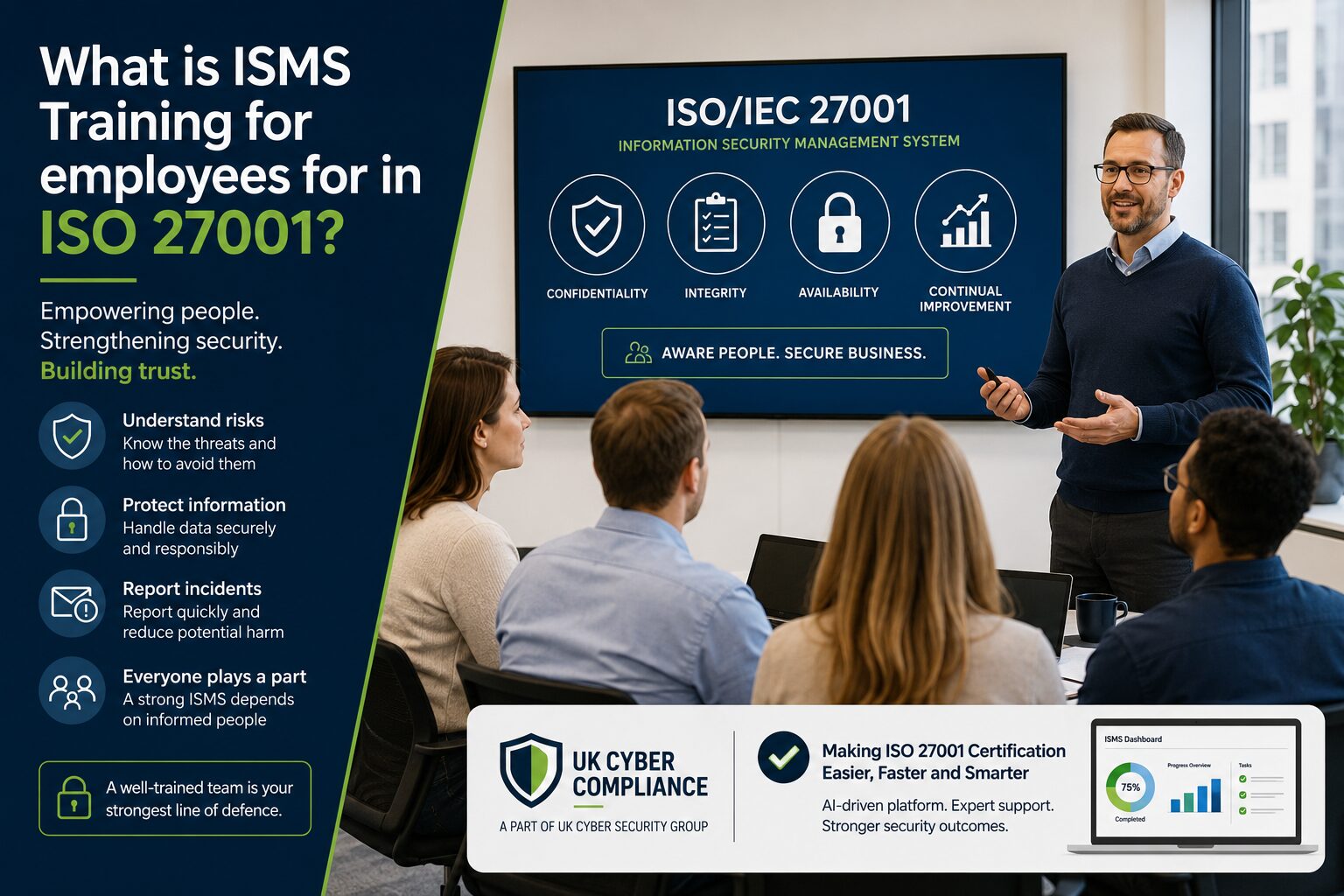
What is ISMS Training for employees in ISO 27001?
Information security depends on people making sound decisions during ordinary working days, not only when a serious incident occurs. An organisation may invest in secure technology, formal policies and detailed risk controls, yet one rushed click, weak password, misdirected email or unreported warning can still expose sensitive information. ISMS training gives employees the knowledge, confidence and practical habits they need to protect information as part of their normal work.
Within ISO/IEC 27001, an Information Security Management System, usually called an ISMS, provides a structured way to identify information risks, select controls, assign responsibilities and improve security over time. ISO describes ISO/IEC 27001 as the leading international standard for an ISMS and says it helps organisations manage risks affecting the confidentiality, integrity and availability of information. The current edition is ISO/IEC 27001:2022, alongside its 2024 amendment.
Employee training turns the written ISMS into daily action. It helps staff understand the information security policy, recognise the risks connected with their role, follow approved procedures and report concerns quickly. Good training also shows employees why each requirement matters. Rather than asking people to remember a long collection of rules, the organisation connects secure behaviour to real tasks, customer trust, legal duties and business continuity.
The business purpose behind ISMS training
ISMS training aims to reduce avoidable information security risk by helping people act competently and consistently. It supports secure decisions across email, cloud services, shared files, customer records, remote work, mobile devices, suppliers and physical workplaces.
The standard takes an organisation-wide view of information security. ISO explains that ISO/IEC 27001 brings people, policies and technology together and helps businesses prepare those elements to manage threats. Training therefore does more than serve an IT function. It supports operational resilience, responsible data handling, dependable service delivery and evidence of control.
A useful programme should help employees:
- understand the organisation’s information security policy and key ISMS objectives;
- recognise common threats, including phishing, credential theft, social engineering and accidental disclosure;
- handle information according to its sensitivity and business value;
- use approved systems and follow access rules;
- report incidents, mistakes and suspicious activity without delay;
- understand their own responsibilities and the effects of ignoring required controls;
- respond correctly when working remotely, travelling or using mobile devices;
- adapt their behaviour when risks, systems, duties or procedures change.
These outcomes make security practical. Employees do not need to become technical specialists. They need enough relevant knowledge to make safe choices, recognise when something looks wrong and know where to obtain help.
Where training fits within ISO 27001
ISO 27001 places competence and awareness within the support requirements of the management system. In practical terms, the organisation must work out what people need to know, identify gaps, take action to build competence and retain suitable evidence. Staff also need awareness of the information security policy, their contribution to the ISMS and the potential consequences of failing to follow its requirements.
Training may provide part of that action, but attendance alone does not prove competence. A person can complete a course and still apply the procedure incorrectly. The organisation should therefore connect learning to job performance, risk and measurable outcomes.
Competence and awareness are related but different
Competence means that a person can perform a task effectively. Awareness means that the person understands the relevant issue, knows why it matters and recognises their responsibility.
For example, an accounts employee may know that payment fraud exists. That demonstrates basic awareness. Competence means the employee can follow the organisation’s verification process, recognise warning signs, challenge an unusual request and escalate the concern through the correct route.
A system administrator may understand that privileged access creates greater risk. Role competence requires much more. The administrator needs to manage privileged accounts, review access, protect credentials, record changes and respond to suspicious activity in line with approved procedures.
Both elements matter. Awareness without practical ability may leave employees unsure what to do. Skill without awareness may lead people to bypass a control because they do not understand its purpose.
Why this matters to UK organisations
The latest UK Government Cyber Security Breaches Survey for 2025/2026 found that 43% of businesses identified a cyber breach or attack during the previous 12 months. It also found that only 19% of businesses carried out staff training or awareness activity, although the figure reached 84% among large businesses. Those figures show a substantial gap between exposure to cyber risk and the use of organised employee learning.
The same survey reported that 29% of businesses experienced breaches or attacks at least once a week. After an incident, 31% of businesses that took preventive action made changes involving people or training. This suggests that many organisations strengthen human controls after disruption rather than building them before an event.
International breach research reinforces the point. Verizon’s 2025 report reviewed more than 22,000 incidents and 12,195 confirmed breaches. In Europe, the Middle East and Africa, 29% of breaches originated inside organisations, including 19% linked to unintentional mistakes. Phishing appeared in 19% of breaches across the region.
The 2026 Verizon findings also reported a 40% rise in successful mobile social engineering and said employee use of unapproved AI tools had tripled to 45%. These developments expand the training need beyond traditional email safety. Staff now require clear guidance on mobile messages, AI services, sensitive prompts, data sharing and approved business tools.
What effective employee training should cover
A strong training programme starts with the organisation’s own risk assessment, information assets, policies and working practices. Generic cyber learning can provide a useful foundation, but ISO 27001 training should also reflect the actual ISMS.
The information security policy and ISMS objectives
Employees should understand the main commitments within the information security policy. They should know how those commitments connect with the organisation’s objectives, customer expectations and risk controls.
Training should explain the ISMS in plain language. Staff need to know that it provides a repeatable management process, not a one-off paperwork exercise. They should also understand how reporting a mistake, following an access rule or protecting a customer record contributes to the wider system.
Phishing and social engineering
Attackers often exploit urgency, authority, fear, curiosity or financial pressure. Training should help employees pause, inspect unusual requests and verify them through a trusted route.
Useful content includes suspicious links, altered payment details, fake login pages, unexpected attachments, impersonation, QR-code scams and messages that move a conversation away from approved channels. Practical examples work better when they resemble the communications employees receive in their role.
The National Cyber Security Centre focuses its staff training on strong passwords, secure devices, phishing defence and incident reporting. Its free learning package takes less than 30 minutes and suits organisations across sectors, including those with employees who have little technical knowledge.
Passwords, authentication and account protection
Employees should understand how compromised credentials can lead to unauthorised access. The programme should cover approved password practices, multi-factor authentication, password managers where the organisation permits them, secure recovery steps and the need to keep work credentials separate from personal accounts.
Training must also explain what to do after an unexpected authentication request. Employees should never approve a prompt simply because it keeps appearing. They should reject it and report the activity through the stated channel.
Information handling and classification
Staff need clear rules for creating, storing, sharing, retaining and disposing of information. Those rules should match the organisation’s classification scheme and legal or contractual duties.
Examples make the subject easier to apply. A customer list, payroll file, security report and public brochure do not require the same handling. Employees should know which services they may use, who may receive the information, whether encryption or approval applies and how to report an accidental disclosure.
Incident reporting
Fast reporting can limit harm. Employees should know which events count as information security incidents and how to raise them. Examples include sending information to the wrong recipient, losing a device, clicking a suspicious link, disclosing credentials, finding unexpected access, noticing unusual system behaviour or receiving a questionable supplier request.
A blame-heavy culture discourages early reporting. Leaders should thank staff for raising concerns and separate honest mistakes from reckless or deliberate behaviour. The NCSC describes a positive cyber culture as a shared effort in which people support security through everyday work.
Remote work and physical security
Home working, shared offices, travel and public spaces create practical risks. Employees need guidance on screen privacy, secure conversations, document storage, device locking, approved networks, visitor access and the safe transport of business equipment.
Physical security training should stay relevant to the role. Reception staff may need stronger visitor verification guidance, while travelling employees may need extra support for device loss, shoulder surfing and confidential conversations.
Suppliers, contractors and temporary workers
Anyone who can access information or systems can affect the ISMS. The organisation should therefore consider contractors, agency staff, consultants and relevant supplier personnel when it plans awareness and competence activity.
Training content may differ according to access and responsibility. A short-term contractor may need focused learning on acceptable use, confidentiality, incident reporting and access limits. A strategic service provider may need detailed briefings on shared processes, escalation routes and contractual security duties.
Safe use of AI services
AI tools can improve productivity, but unapproved use can expose confidential information, personal data, client material or intellectual property. Employees need rules that explain which tools they may use, what information they must not enter, when human review applies and how to verify generated output.
The organisation should connect this training to its risk assessment and approved-use policy. Clear examples help staff understand the difference between low-risk assistance and unsafe disclosure.
Building training around risk and responsibility
One course for every employee rarely gives sufficient coverage. The organisation should provide a common security foundation and add focused learning for roles with higher exposure or greater authority.
Core learning for everyone
All employees should receive essential guidance when they join and at planned intervals afterwards. Core content can cover the policy, acceptable use, information handling, passwords, phishing, device security, remote work and reporting.
The organisation should keep the material concise and relevant. Long annual courses can encourage passive clicking. Short sessions, practical examples, team discussions and timely reminders often produce stronger engagement.
Focused learning for higher-risk roles
Some roles require deeper competence. Finance teams face payment diversion and invoice fraud. Human resources staff manage sensitive personal information. Developers influence application security. Administrators hold elevated access. Senior leaders make decisions during incidents and approve risk.
Role-focused learning should reflect these duties. It can include scenario exercises, supervised practice, process walkthroughs and checks that employees can complete critical tasks correctly.
Learning after change
Training should follow meaningful change rather than rely only on a calendar. New systems, revised procedures, emerging threats, mergers, office moves, supplier changes and lessons from incidents may all create fresh learning needs.
A short briefing at the right moment may offer more value than a broad course delivered months later. The ISMS should help the organisation identify these triggers and record the response.
How to create an effective ISMS training programme
A practical programme follows a clear cycle: identify needs, plan learning, deliver it, evaluate performance and improve the approach.
Start with a training needs analysis
Map roles against information risks, responsibilities, policies and required competence. Consider what each group handles, which systems it uses, what decisions it makes and what could go wrong.
Then compare the required competence with current capability. Existing qualifications, experience, observation, assessments and manager feedback can all help. The output should show who needs which learning and why.
Set measurable learning objectives
Objectives should describe what employees can do after the activity. “Understand phishing” offers little measurement. “Identify common phishing warning signs and report a suspicious message through the approved route” gives a clearer outcome.
Good objectives support evaluation and audit evidence. They also help trainers remove content that does not support the organisation’s risks.
Use varied delivery methods
The NCSC notes that organisations can improve understanding and retention through a range of approaches, including briefings, online courses, blogs and simulated attacks. It also recommends accommodating different learning preferences.
A balanced programme might combine induction learning, short digital modules, live workshops, team briefings, phishing exercises, tabletop scenarios and targeted reminders. Accessibility matters as well. Employees need content they can understand and use, including suitable alternatives where a disability, language need or role setting affects access.
Test understanding and practical ability
A completion record proves attendance, not effectiveness. Use questions, scenario choices, demonstrations, supervised tasks or manager observation to check understanding.
For critical roles, assess whether the person can perform the process. A finance employee could demonstrate payment verification. An incident coordinator could lead a tabletop exercise. An administrator could show the approved privileged-access workflow.
Measure behaviour and business outcomes
Useful measures may include training completion, assessment results, incident reporting speed, repeated errors, phishing reporting rates, policy exceptions and findings from internal audits. No single measure gives a complete answer.
Avoid judging success only by click rates in simulated phishing. A programme should also reward correct reporting and examine whether unclear processes contributed to mistakes. The goal is safer behaviour, not catching people out.
Keep suitable evidence
Auditors may expect evidence that the organisation identified competence needs, delivered appropriate action and evaluated results. Records can include a role matrix, training plan, attendance data, assessment results, induction checklists, certificates, exercise reports and improvement actions.
Keep evidence proportionate. A smaller organisation may use a straightforward register and role-based checklist. A more complex business may need a learning platform, departmental dashboards and detailed competence records.
Common mistakes that weaken the programme
The first mistake involves treating training as an annual compliance event. Threats, systems and responsibilities change throughout the year, so awareness needs regular reinforcement.
Another mistake involves sending every employee identical content. Common learning has value, but higher-risk roles need focused competence.
Some organisations also rely on fear. Dramatic warnings may gain attention briefly, yet they can make employees hide mistakes. A supportive reporting culture usually gives security teams earlier visibility.
Weak programmes measure attendance and stop there. Better programmes test understanding, observe performance and use incident data to improve learning.
Finally, generic content can drift away from the ISMS. Every important session should connect with a policy, risk, control, objective or operational procedure.
Audit readiness without unnecessary paperwork
An auditor will look for a working system rather than a perfect training library. The organisation should show that it knows which competence it needs, has acted on gaps, has made people aware of their responsibilities and can demonstrate whether the action worked.
Useful audit preparation includes checking that employee records remain current, role changes trigger reviews, new starters receive timely learning, contractors receive relevant guidance and overdue activity receives follow-up. Internal audits should also test whether staff know how to report an incident and apply key controls.
Interviews often reveal more than records. Employees should be able to explain the policy in practical terms, describe their responsibilities and identify the correct reporting route. They do not need to recite the standard.
What is ISO 27001 Certification?
What is ISO 27001 Certification? It is an independent assessment of whether an organisation’s ISMS meets the applicable requirements of ISO/IEC 27001. Certification can give customers and other interested parties greater confidence that the organisation manages information security through a structured and risk-based system. ISO notes that organisations may implement the standard without seeking certification, while others pursue certification to reassure customers and stakeholders.
Training contributes to certification because employees operate many of the controls that the ISMS relies upon. Auditors may review competence records, speak with staff and test whether actual behaviour matches documented processes.
what is iso 27001
what is iso 27001 is a common search phrase used by organisations that want a clear explanation of the standard. ISO/IEC 27001 sets requirements for establishing, implementing, maintaining and continually improving an ISMS. It uses risk management to help organisations protect information confidentiality, integrity and availability.
The standard does not treat security as a technology-only issue. Leadership, planning, resources, competence, awareness, operations, evaluation and improvement all play a part. Employee training supports that wider management approach.
Who needs iso 27001 certification
Who needs iso 27001 certification depends on business goals, customer requirements, contracts, risk exposure and market expectations. Organisations in technology, professional services, healthcare, finance, education, manufacturing, public services and the charity sector may all benefit.
Certification often carries particular value where an organisation handles sensitive data, provides critical services, supports large clients, joins regulated supply chains or needs independent assurance. ISO states that the standard can serve organisations of any scale and sector.
ISO 27001 Certification Levels
The phrase ISO 27001 Certification Levels can cause confusion because ISO/IEC 27001 does not offer bronze, silver and gold certificates. An organisation either achieves certification for the defined ISMS scope or it does not.
Businesses may still describe internal maturity stages, such as early development, implemented, measured and continually improving. Those stages can help manage a project, but they do not create official certification grades. The certificate should clearly state the certified scope and the applicable edition of the standard.
How the Certification Works
How the Certification Works usually starts with defining the ISMS scope, understanding interested parties, assessing risks, selecting controls and operating the management system. The organisation then reviews performance through monitoring, internal audit and management review.
A certification body normally assesses readiness and documented arrangements before conducting a fuller assessment of implementation and effectiveness. After certification, surveillance activity checks whether the organisation continues to maintain and improve the ISMS. Employee competence and awareness remain relevant throughout this cycle because the system must operate consistently, not only during the first assessment.
Which UK-based firms offer ISO 27001 consultancy services?
Businesses researching Which UK-based firms offer ISO 27001 consultancy services? should compare providers on practical experience, sector knowledge, clarity of delivery, platform capability and the level of support available throughout implementation and assessment.
UK Cyber Compliance (a part of UK Cyber Security Group) provides these services and has a platform to make certification much easier and cheaper.
Its automated and AI-driven platform can help organisations organise the activities and evidence connected with ISO 27001, including risk management, policies, objectives, responsibilities, training records, reviews and improvement actions. A central platform can reduce scattered spreadsheets and make it easier for responsible people to see progress, gaps and upcoming work.
Turning employee knowledge into lasting security
ISMS training gives employees a practical role in protecting information. It connects policy with everyday judgement, builds competence for higher-risk duties and creates a shared understanding of how people support business resilience.
The strongest programmes remain relevant, role-based and measurable. They start with risk, use realistic examples, encourage early reporting and improve when the organisation learns something new. When leaders treat training as part of operational management rather than a yearly formality, employees become an active security control.
ISO 27001 certification requires more than written policies. The organisation must show that people understand their responsibilities and can perform the work that keeps information secure. A well-managed training programme provides that capability while supporting customers, staff, suppliers and the wider business.
UK Cyber Compliance is here to help
For more information, please do get in touch.
Please check out our Free Cyber Insurance
Other blog posts, Your ISO 27001 Questions Answered, Get ISO 27001 Certified ,
If you would like to know more, do get in touch as we are happy to answer any questions. Looking to improve your cybersecurity but not sure where to start? Begin by getting certified in Cyber Essentials, the UK government’s scheme that covers all the technical controls that will provide the protection that you need to help guard against criminal attacks.