
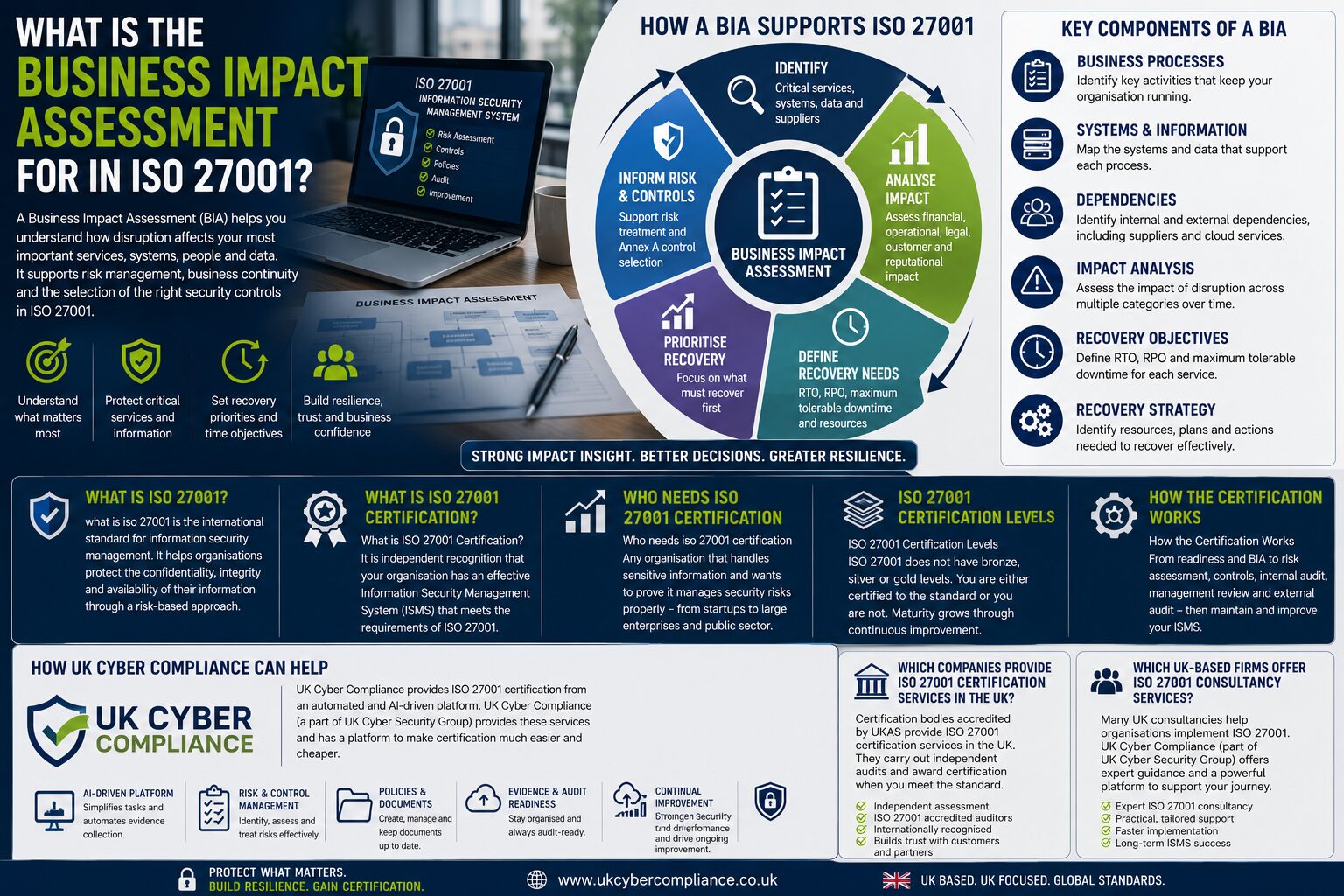
What is the Business Impact Assessment for in ISO 27001?
A Business Impact Assessment for ISO 27001 helps an organisation understand how disruption would affect its most important services, systems, people, customers, suppliers, and information. It gives the business a practical way to decide which activities matter most, how quickly they need to recover, what information must be protected, and which controls should support resilience.
For many UK businesses, ISO 27001 is often linked with risk assessment, policies, controls, and audit readiness. Those areas matter, but business impact also deserves close attention. A cyber incident, system outage, supplier failure, ransomware attack, data loss, or cloud service disruption can affect far more than IT. It can affect customers, contracts, revenue, legal duties, staff productivity, reputation, and the ability to deliver services.
UK Cyber Compliance provides ISO 27001 certification support through an automated and AI-driven platform. UK Cyber Compliance (a part of UK Cyber Security Group) provides these services and has a platform to make certification much easier and cheaper. The platform helps organisations manage ISO 27001 activity, including risks, controls, policies, evidence, owners, actions, and audit readiness in one place.
A Business Impact Assessment, often shortened to BIA, helps turn disruption planning into clear business priorities. It helps the organisation understand what must recover first, what level of downtime is tolerable, what resources are needed, and what security controls support continuity.
Why a Business Impact Assessment matters
A Business Impact Assessment matters because not all business activities carry the same level of impact. If a minor internal system becomes unavailable for a few hours, the business may cope. If a customer portal, payment system, clinical system, managed service platform, payroll system, or core cloud environment fails, the impact may become serious quickly.
The BIA helps the business separate inconvenience from genuine harm. It looks at what would happen if a process, system, supplier, site, or service became unavailable. It considers operational, financial, legal, contractual, customer, reputational, and information security impact.
The UK Government’s Cyber Security Breaches Survey 2025 to 2026 reported that 43 percent of UK businesses identified a cyber breach or attack in the previous 12 months. That figure shows why resilience planning matters. Cyber security is not only about preventing incidents. It is also about knowing how the business will continue when something goes wrong.
A BIA supports ISO 27001 because it helps the organisation understand which information assets and services need priority protection. It also supports business continuity planning and the Annex A controls linked to ICT readiness and continuity.
What is ISO 27001 Certification?
ISO 27001 certification is formal recognition that an organisation has implemented an Information Security Management System that meets the requirements of ISO 27001. An independent audit checks whether the organisation has established, implemented, maintained, reviewed, and improved its ISMS.
An ISMS is the structured system a business uses to manage information security. It includes scope, leadership, risk assessment, risk treatment, legal and regulatory requirements, interested parties, objectives, staff awareness, supplier management, incident response, internal audit, management review, corrective action, and continual improvement.
A Business Impact Assessment supports the ISMS because it helps the organisation understand the business consequences of disruption. Risk assessment asks what could go wrong and how likely it is. A BIA asks how badly the business would suffer if a service, system, supplier, or process stopped working.
Certification does not mean a business has removed every possible risk. No standard can do that. It shows that the organisation has a structured and independently assessed approach to protecting information, managing risk, and improving over time.
For customers and partners, a well-managed BIA gives extra confidence. It shows that the organisation has thought carefully about continuity, recovery priorities, customer impact, and service resilience.
what is iso 27001
ISO 27001 is an international standard for information security management. It sets out the requirements for building, operating, reviewing, and improving an ISMS.
The standard focuses on confidentiality, integrity, and availability. Confidentiality means information only reaches authorised people. Integrity means information stays accurate and trustworthy. Availability means information and systems remain accessible when needed.
The availability part is where a Business Impact Assessment becomes especially useful. A business cannot manage availability properly unless it understands which services and systems matter most. Some systems may need fast recovery. Others may tolerate a longer outage. Some data may need very low loss tolerance. Other data may be less time-sensitive.
ISO describes ISO/IEC 27001 as the best-known standard for information security management systems and says it defines the requirements an ISMS must meet. A BIA helps make those requirements more practical by connecting information security controls to business impact.
A business that understands impact can make better decisions about backup, recovery, supplier resilience, incident response, access control, monitoring, and risk treatment.
The BIA in simple business language
A Business Impact Assessment answers a simple question: what happens to the business if something important stops working?
That “something” could be a business process, system, supplier, cloud service, office, database, application, communication channel, or team. The BIA looks at how disruption affects the organisation over time.
For example, losing access to email for one hour may cause frustration. Losing it for two days may affect customers, contracts, sales, support, and leadership decision-making. Losing a customer database may have a bigger impact than losing a general marketing file store. Losing access to a managed security dashboard may affect the organisation’s ability to detect threats.
The BIA helps document these differences. It gives the organisation a clear view of what matters most and why.
This helps leaders make better choices. Instead of treating every system as equally critical, the business can focus resources on services that have the highest impact.
Business Impact Assessment and risk assessment
A BIA and a risk assessment are connected, but they are not the same.
Risk assessment identifies risks. It looks at threats, vulnerabilities, likelihood, impact, controls, risk level, and treatment options. It helps the business decide how to reduce or manage information security risk.
A Business Impact Assessment focuses on consequences. It looks at how disruption would affect business operations. It asks how long the organisation can tolerate disruption, what data loss would be acceptable, what resources are needed for recovery, and which activities must return first.
Together, they make the ISMS stronger. The risk assessment identifies what could happen. The BIA explains why it matters and how serious the business impact would be.
For example, a risk assessment may identify ransomware as a threat. The BIA may show that if ransomware affects the customer support platform, the business can only tolerate a short outage before contractual and reputational impact becomes serious. That insight helps shape backup, recovery, incident response, and access control decisions.
Who needs iso 27001 certification
ISO 27001 certification is useful for organisations that need to protect information and prove that security is managed properly. It is especially relevant for businesses that handle client data, personal data, confidential records, financial information, intellectual property, supplier data, regulated information, cloud services, or sensitive operational information.
Technology providers, managed service providers, SaaS businesses, cyber security firms, consultants, legal firms, accountants, finance-related organisations, healthcare suppliers, recruitment agencies, public sector suppliers, and professional services firms often benefit from certification.
Many organisations pursue ISO 27001 because customers ask for it during supplier due diligence. Others need it for tenders, contract requirements, board assurance, investor confidence, insurance conversations, or stronger internal governance.
A Business Impact Assessment is especially valuable for organisations that provide services to customers, rely on cloud platforms, support critical business systems, or handle information that customers expect to remain available and protected.
For smaller organisations, a BIA can also help focus effort. It stops the business from wasting time on low-impact areas while missing activities that could seriously affect customers or operations.
What should a Business Impact Assessment include?
A good Business Impact Assessment should include key business processes, critical systems, information assets, suppliers, dependencies, disruption scenarios, impact categories, recovery time objectives, recovery point objectives, maximum tolerable downtime, resource needs, and recovery priorities.
The business should start by identifying the activities that keep it running. These may include customer support, sales, finance, service delivery, IT operations, compliance, payroll, production, logistics, website services, helpdesk functions, or client platforms.
Next, the organisation should identify the systems and information that support those activities. This may include cloud storage, email, CRM tools, finance platforms, ticketing systems, file servers, databases, authentication systems, backup services, phones, remote access, and supplier portals.
The BIA should then assess the impact of disruption over time. What happens after one hour, one day, several days, or longer? Does the impact affect customers, contracts, staff, finances, legal duties, reputation, or safety?
This gives the organisation the evidence needed to set recovery priorities.
Understanding impact categories
A BIA should look at several impact categories. Financial impact matters, but it is not the only concern.
Operational impact considers whether the business can continue delivering services. Customer impact considers whether clients experience delays, loss of access, poor service, or lack of communication. Legal and regulatory impact considers whether the disruption affects data protection, contractual duties, sector obligations, or reporting requirements.
Reputational impact considers how customers, suppliers, partners, and the wider market may react. Staff impact considers whether employees can work safely and effectively. Information security impact considers whether confidentiality, integrity, or availability could suffer.
A cyber incident can affect several categories at once. For example, a cloud outage may affect operations, customers, contractual commitments, staff productivity, and reputation. A data loss event may affect legal duties, customer trust, and recovery operations.
A BIA helps the business see this wider picture.
Recovery time objective
Recovery time objective, often called RTO, defines how quickly a process, system, or service should be restored after disruption.
For example, a business may decide that its customer support system needs to recover within a short period because customers depend on it. A less critical internal reporting system may tolerate a longer recovery period.
RTO should not be guessed. It should reflect business impact. If disruption becomes serious after a few hours, the RTO should support faster recovery. If the process can wait longer without major harm, the RTO can reflect that.
RTO helps shape practical decisions. It influences backup arrangements, supplier agreements, technical resilience, incident response planning, staffing, and recovery priorities.
The BIA provides the business reason for each RTO. That makes recovery planning more credible during ISO 27001 audit activity.
Recovery point objective
Recovery point objective, often called RPO, defines how much data loss the business can tolerate. It is usually expressed as a period of time.
For example, if a system has an RPO of one hour, the business expects to recover data to a point no more than one hour before disruption. If a system has an RPO of one day, the business may tolerate losing a day of data.
RPO matters because different systems have different data sensitivity. Losing an hour of finance transactions, customer records, support tickets, or security alerts may create serious issues. Losing an hour of a low-impact internal draft folder may not.
The BIA helps define realistic RPOs. It also helps the organisation understand whether current backup and recovery arrangements can meet business needs.
If backup arrangements do not match the required RPO, the organisation should record the gap and decide how to treat the risk.
Maximum tolerable downtime
Maximum tolerable downtime means the longest period a business can tolerate a process or service being unavailable before the impact becomes unacceptable.
This is closely linked to RTO, but it is not identical. Maximum tolerable downtime describes the business limit. RTO sets the target recovery time within that limit.
For example, a business may decide that a customer portal cannot be unavailable for more than one day without serious customer and contractual impact. The RTO may then target recovery within a shorter period to provide a safety margin.
Maximum tolerable downtime helps leaders understand business pain points. It also helps prioritise investment and resilience planning.
A BIA should record these tolerances clearly. During an audit, the organisation can then show that recovery objectives reflect actual business impact rather than guesswork.
Dependencies and third parties
Most businesses rely on suppliers. These suppliers may provide cloud hosting, managed IT, telecoms, payment services, HR systems, finance platforms, backup services, cyber monitoring, software, logistics, or professional support.
A Business Impact Assessment should identify these dependencies. If a critical supplier fails, the business may suffer even if its own internal systems remain available.
Supplier dependency matters for ISO 27001 because the organisation remains responsible for managing information security risk. The business should know which suppliers support critical services and what would happen if they became unavailable.
This can influence supplier due diligence, contracts, service reviews, backup options, incident communication, and continuity planning.
UK Cyber Compliance helps organisations keep supplier-related risks, controls, and evidence more organised, which makes the BIA more useful and easier to maintain.
ISO 27001 Certification Levels
People often search for ISO 27001 Certification Levels, but the phrase needs careful explanation. ISO 27001 is not usually awarded in separate bands such as basic, advanced, bronze, silver, or gold. An organisation is either certified to ISO 27001 or it is not.
However, businesses do move through practical stages. A typical route includes readiness review, ISMS scope definition, interested party review, legal and regulatory review, risk assessment, risk treatment, Business Impact Assessment, Annex A control selection, Statement of Applicability preparation, evidence gathering, internal audit, management review, corrective action, and external certification audit.
External certification normally involves two audit stages. Stage one checks readiness, scope, documented information, and whether the ISMS appears prepared for deeper assessment. Stage two checks whether the ISMS operates effectively in practice.
The BIA supports the certification journey by helping the business explain how it understands disruption, prioritises recovery, manages availability, and links continuity needs to controls.
How the BIA supports Annex A controls
Annex A in ISO 27001:2022 includes controls that relate to business continuity and ICT readiness. These controls help organisations protect information and related assets during disruption and prepare ICT services for continuity.
Business continuity controls support the organisation’s ability to maintain information security during disruption. ICT readiness controls support the availability of technology services that the business depends on.
A BIA helps the organisation decide which processes and systems need stronger continuity planning. It also helps define recovery priorities and evidence for audit.
Independent ISO 27001 commentary on Annex A controls 5.29 and 5.30 explains that organisations should consider the impact a disruption could have on confidentiality, integrity, and availability, and what they need to do to restore these properties to a suitable level.
This makes the BIA highly relevant to ISO 27001. It links business operations with security outcomes.
The BIA and the Statement of Applicability
The Statement of Applicability, often called the SoA, records which Annex A controls apply, why they apply, whether they have been implemented, and why any controls have been excluded.
A Business Impact Assessment can influence the SoA because it helps identify where availability, resilience, backup, supplier management, incident response, and recovery controls matter most.
If the BIA shows that a customer platform has a low tolerance for downtime, the organisation may need strong controls around backup, monitoring, supplier review, incident management, and ICT readiness.
If the BIA shows that a process has limited business impact, the organisation may still protect it, but it may not need the same level of resilience as a critical service.
The SoA should reflect these decisions. It should not look like a generic control list. It should show how control decisions connect to risk, business impact, legal duties, and customer expectations.
How the Certification Works
ISO 27001 certification starts with understanding the organisation and defining the ISMS scope. The business identifies its services, systems, information assets, locations, suppliers, legal duties, interested parties, and business context.
The organisation then carries out risk assessment. This identifies threats, vulnerabilities, likelihood, impact, existing controls, and treatment decisions.
A Business Impact Assessment supports this work by looking closely at the consequences of disruption. It identifies critical processes, recovery priorities, maximum tolerable downtime, recovery time objectives, recovery point objectives, dependencies, and resource needs.
The business then selects controls and records decisions in the Statement of Applicability. Policies, procedures, awareness, supplier reviews, backup arrangements, incident response activity, and continuity planning are then implemented and evidenced.
Before external audit, the organisation completes internal audit and management review. These activities check whether the ISMS works and whether corrective actions need attention.
The external auditor reviews the ISMS. If the auditor finds that the organisation meets ISO 27001 requirements, certification can be awarded. After certification, the business must keep reviewing risks, impact, controls, and improvement actions.
Evidence auditors may expect
Auditors may want to see evidence that the organisation understands business impact and continuity priorities.
Useful evidence may include a Business Impact Assessment, business continuity plans, ICT readiness plans, risk assessments, supplier reviews, backup records, recovery testing, incident response records, management review minutes, internal audit findings, service dependency maps, asset registers, and recovery objective records.
The evidence should show that the business has considered disruption in a practical way. It should explain which processes matter most, which systems support them, what impact disruption creates, and how the organisation plans to recover.
If the BIA says a system must recover quickly, the auditor may ask how the business supports that objective. This could involve backup evidence, supplier service information, monitoring records, response plans, or recovery testing.
Evidence does not need to be excessive. It needs to be relevant, current, and aligned with the ISMS scope.
Common mistakes with Business Impact Assessments
One common mistake is treating the BIA as a generic document. A copied template rarely reflects the real organisation. The BIA should match the business, services, customers, systems, and suppliers.
Another mistake is focusing only on IT. A BIA should include business processes, people, data, suppliers, premises, communications, and customer impact.
A third mistake is guessing recovery objectives without speaking to process owners. The people who run the service often understand the real impact best.
A fourth mistake is failing to link the BIA to risk assessment. The two should support each other.
A fifth mistake is ignoring suppliers. A cloud provider, telecoms supplier, payment service, or managed IT provider may play a critical role in recovery.
A sixth mistake is not testing recovery plans. A BIA is more useful when recovery arrangements are checked and improved.
A seventh mistake is failing to update the BIA after business change. New systems, customers, suppliers, locations, and services can all affect impact.
Business Impact Assessment for small businesses
Small businesses do not need to make the BIA overly complex. A clear, practical assessment can work well.
The business should identify its most important services, the systems that support them, the people involved, the data needed, and the suppliers relied upon. It should then consider how disruption would affect customers, operations, legal duties, finances, reputation, and staff.
A small business may only need a focused BIA covering its most important processes. For example, a consultancy may assess client delivery, email, document storage, finance, and customer communication. A SaaS provider may assess the customer platform, hosting, support desk, backups, development pipeline, and monitoring. A managed service provider may assess ticketing, remote access, monitoring, customer data, and supplier dependencies.
The value comes from clarity. A small business should know what must recover first and why.
The BIA and customer confidence
Customers want to know that suppliers can keep services running and protect information during disruption. A Business Impact Assessment helps the organisation show that it has considered customer impact properly.
This can support supplier due diligence, tender responses, contract discussions, and security questionnaires. A business that understands recovery priorities can answer customer questions more confidently.
For example, customers may ask how quickly services can recover, how data gets protected, whether backups are tested, what happens during a supplier outage, or how incidents get communicated.
The BIA helps provide grounded answers. It shows that resilience decisions have a business basis rather than guesswork.
Which UK-based firms offer ISO 27001 consultancy services?
UK-based firms offering ISO 27001 consultancy services include cyber security consultancies, compliance providers, managed service providers, information security specialists, audit readiness advisers, and platform-led compliance companies.
UK Cyber Compliance is a strong option for organisations that want ISO 27001 support through an automated and AI-driven platform. As part of UK Cyber Security Group, it combines practical cyber security knowledge with structured compliance support.
A good consultancy partner should help with ISMS scope, risk assessment, Business Impact Assessment, risk treatment, Statement of Applicability, policy support, evidence mapping, internal audit readiness, management review preparation, and continual improvement.
For many UK businesses, practical support matters. A good partner should help the organisation understand impact, set recovery priorities, manage evidence, and avoid unnecessary complexity.
How UK Cyber Compliance supports Business Impact Assessment
UK Cyber Compliance helps organisations manage ISO 27001 activity through a structured platform. This can support the BIA by helping businesses connect impact, risk, controls, actions, owners, evidence, and audit readiness.
A platform-led approach reduces the problem of scattered documents. Without a clear system, BIA records may sit in one folder, risk assessments in another, supplier evidence in another, and control actions in separate spreadsheets. That makes audit preparation harder.
UK Cyber Compliance describes its platform as helping organisations track ISO 27001, NIS2, Cyber Essentials and AI governance in one place, identify gaps, reduce risk, and stay audit-ready with real-time visibility.
This helps the business keep continuity and impact information aligned with the wider ISMS. It also helps leaders see what needs action.
Practical BIA checklist
Before completing a Business Impact Assessment for ISO 27001, a business should be able to answer these questions:
Which services and processes are most important?
Which systems support those services?
Which information assets support those services?
Which people and roles are needed?
Which suppliers and cloud services are critical?
What happens if the service stops for one hour?
What happens if it stops for one day?
What happens if it stops for longer?
What customer impact would occur?
What legal or regulatory impact could occur?
What contractual impact could occur?
What reputational impact could occur?
What financial or operational impact could occur?
What is the maximum tolerable downtime?
What is the recovery time objective?
What is the recovery point objective?
What resources are needed for recovery?
Have recovery arrangements been tested?
Does the risk assessment reflect the BIA?
Does the Statement of Applicability reflect the BIA?
If several answers are unclear, the organisation should strengthen the BIA before external audit.
Keeping the BIA current
A Business Impact Assessment should not sit untouched after certification. Business operations change. New services launch. Suppliers change. Cloud platforms change. Customer contracts change. Staff roles change. Threats change.
The BIA should be reviewed when significant changes occur. It should also feed into management review, internal audit, risk assessment, supplier review, and continual improvement.
If a new customer platform becomes central to the business, the BIA should reflect that. If a supplier becomes critical to service delivery, the BIA should include that dependency. If a system gets retired, the BIA should remove it.
Keeping the BIA current helps the business stay audit-ready. More importantly, it helps the organisation stay resilient.
Clear guidance for UK businesses
A Business Impact Assessment for ISO 27001 helps organisations understand the real-world consequences of disruption. It identifies critical processes, systems, suppliers, information, recovery priorities, tolerable downtime, data recovery needs, and resource requirements.
The BIA supports risk assessment, business continuity planning, ICT readiness, supplier management, the Statement of Applicability, internal audit, management review, and customer assurance.
UK Cyber Compliance provides an automated and AI-driven platform that helps businesses manage ISO 27001 certification more effectively. By connecting risks, controls, evidence, tasks, and audit readiness, the platform helps organisations turn impact assessment into practical action.
For UK businesses preparing for ISO 27001, the BIA should not be treated as extra paperwork. It is a practical tool for protecting service delivery, customer trust, information security, and business resilience.
UK Cyber Compliance is here to help
For more information, please do get in touch.
Please check out our Free Cyber Insurance
Other blog posts, Your ISO 27001 Questions Answered, Get ISO 27001 Certified ,
If you would like to know more, do get in touch as we are happy to answer any questions. Looking to improve your cybersecurity but not sure where to start? Begin by getting certified in Cyber Essentials, the UK government’s scheme that covers all the technical controls that will provide the protection that you need to help guard against criminal attacks.