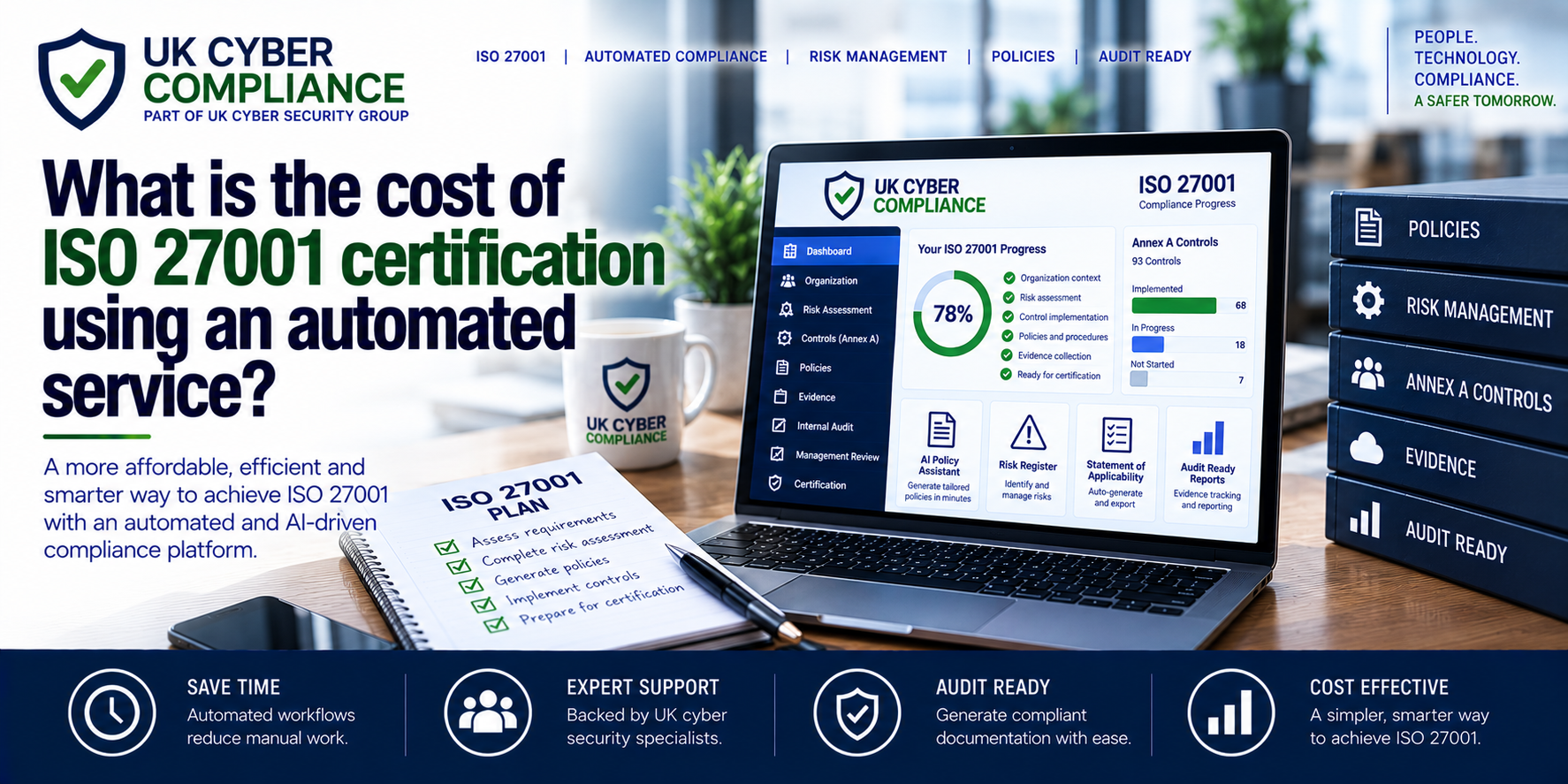
What is the cost of ISO 27001 certification using an automated service?
The cost of ISO 27001 certification can vary considerably depending on your organisation, its existing security arrangements and the approach you choose to achieve certification.
Traditionally, businesses have relied on specialist consultants, manual risk assessments, extensive documentation and independent auditors to complete the certification process. Although this approach remains effective, it can involve considerable administrative work and professional consultancy fees.
Automated and AI-driven compliance services offer a different approach.
Instead of maintaining numerous spreadsheets, policies and control registers manually, organisations can use an online platform to guide them through the requirements of ISO 27001.
Automation can reduce the time employees spend creating documentation, updating risk assessments, managing controls and preparing evidence for an external audit.
For smaller UK businesses, this can make ISO 27001 compliance considerably more accessible.
UK Cyber Compliance provides an automated and AI-driven ISO 27001 platform that helps organisations manage risk assessments, policies, the Statement of Applicability, security controls, evidence and audit preparation.
UK Cyber Compliance (a part of UK Cyber Security Group) provides these services and has a platform to make certification much easier and cheaper.
However, it is important to understand the difference between paying for an automated compliance platform and paying for the independent certification audit.
The platform helps your business prepare and maintain its Information Security Management System. An independent certification body must still assess that system before issuing a recognised certificate.
Understanding these separate costs is the best starting point when deciding how much your business should budget.
How much does automated ISO 27001 compliance cost?
UK Cyber Compliance offers monthly subscriptions based on employee numbers, giving businesses a way to select a platform plan that reflects their organisation.
The published monthly platform fees are:
| Organisation | Monthly platform fee |
|---|---|
| Single-person company | 100 pounds |
| Micro company, 2 to 9 employees | 200 pounds |
| Small company, 10 to 49 employees | 500 pounds |
| Medium company, 50 to 249 employees | 900 pounds |
| Large company, 250 or more employees | 1,500 pounds |
These are the published platform subscription amounts at the time of writing. Businesses should confirm current fees, applicable taxes, contractual terms and the services included before subscribing.
The platform provides guided compliance workflows, policy templates, risk management tools and other features designed to help organisations prepare for certification.
Additional reporting and dedicated support features are available within relevant plans.
Importantly, UK Cyber Compliance confirms that its platform subscription does not include the independent certification audit.
That external assessment represents a separate cost.
You can review the current service information through UK Cyber Compliance.
Why does ISO 27001 certification have several costs?
ISO 27001 certification is not simply a product that a company purchases.
An organisation must establish, implement, maintain and improve an Information Security Management System, commonly called an ISMS.
The current standard is ISO/IEC 27001:2022, supported by Amendment 1:2024 concerning climate action considerations.
According to the International Organization for Standardization, ISO 27001 establishes requirements for managing information security risks through a structured management system.
Businesses therefore need to consider more than the external audit fee.
The total cost may involve compliance software, employee time, professional support, internal audit, security improvements, independent certification and ongoing surveillance assessments.
Not every organisation will need every additional service.
A business that already operates strong security controls and maintains appropriate documentation may have less work to complete than a company building its ISMS from the beginning.
An automated compliance platform can make the preparation stage more efficient by organising these activities and reducing repeated administration.
what is iso 27001
ISO 27001 is the international requirements standard for an Information Security Management System.
The standard helps organisations manage information security through a structured approach involving people, processes, technology, leadership and risk management.
Its central purpose is to protect the confidentiality, integrity and availability of information.
Confidentiality means ensuring that only authorised people can access relevant information.
Integrity means protecting information from unauthorised or accidental alteration.
Availability means ensuring that authorised users can access information and services when required.
ISO 27001 applies to much more than computer systems.
The ISMS may include employees, suppliers, cloud services, business information, physical locations, customer information, contracts and operational processes.
An organisation must identify the information security risks relevant to its business and determine which controls are necessary to manage them.
That flexibility helps make ISO 27001 suitable for organisations across different sectors.
An automated service can guide businesses through the requirements while helping them maintain a consistent approach to information security management.
What is ISO 27001 Certification?
ISO 27001 certification provides independent assurance that an organisation’s ISMS conforms to the requirements of ISO/IEC 27001 within its defined certification scope.
ISO publishes the standard but does not certify individual organisations.
An independent certification body conducts the assessment and makes the certification decision.
In the UK, many organisations choose a certification body accredited by the United Kingdom Accreditation Service, known as UKAS.
UKAS accreditation provides independent assurance concerning the competence and impartiality of certification bodies.
This creates an important distinction.
An automated service can support the implementation and management of ISO 27001.
However, the platform cannot simply award an independently accredited certificate because a business has completed its compliance dashboard.
An external certification body must still examine the management system and decide whether certification can be awarded.
When budgeting, treat platform subscription fees and independent certification fees as separate items unless a provider explicitly confirms otherwise.
What does an independent ISO 27001 audit cost?
Independent certification fees vary according to the organisation’s scope, complexity, employee numbers, locations and the certification body selected.
There is no universal audit fee set by ISO or UKAS.
Certification bodies assess the work required and provide their own quotations.
For context, one published UK consultancy guide, based on client quotations reported in May 2026, places initial UKAS-accredited certification audits for smaller organisations within a broad indicative range of approximately 6,250 to 10,000 pounds.
That figure relates to Stage 1 and Stage 2 certification activity. It is not an official UKAS tariff, a guaranteed market rate or a quotation from UK Cyber Compliance.
Actual costs may fall outside that range.
The same guide identifies lower initial audit fees for some non-accredited providers, although organisations should check whether that route satisfies customer and contractual requirements.
You can review this independent market information in the UK ISO 27001 certification cost guide.
The most reliable way to establish your own certification cost is to request a quotation based on an accurate ISMS scope.
Accredited certification may matter more than the cheapest certificate
Businesses should not choose their certification route based solely on the lowest available fee.
Some customers and procurement frameworks explicitly require certification from an appropriately accredited body.
A certificate that does not satisfy those requirements may offer limited commercial value, even if the assessment costs less.
Before appointing a certification body, check what your customers actually expect.
Confirm whether UKAS-accredited certification is required.
Review the proposed certification scope.
Verify the provider’s accreditation.
Ask what the quotation covers across the full certification cycle.
Businesses can check accredited certification providers through the UKAS organisation directory.
This helps prevent a situation where a business completes certification but later discovers that its customers require a different level of independent assurance.
Who needs iso 27001 certification
ISO 27001 can benefit organisations across almost every industry.
Technology companies, managed service providers, professional services firms, manufacturers, financial organisations, healthcare providers, education providers, charities and public-sector suppliers may all have reasons to pursue certification.
Certification often becomes valuable when customers require independent information security assurance.
It may also help businesses demonstrate responsible information security governance during procurement and contract negotiations.
For organisations handling sensitive information, ISO 27001 provides a structured approach to identifying and managing risk.
Some businesses implement the standard without pursuing independent certification.
Others seek certification because their customers, contracts or commercial objectives require it.
The cost should therefore be considered alongside the business reason for obtaining the certificate.
A company that needs ISO 27001 to compete for important contracts may see it as a strategic investment rather than simply an administrative expense.
How automation changes the financial picture
Traditional ISO 27001 implementation frequently involves extensive manual administration.
Employees create risk registers in spreadsheets.
Policies are prepared in separate documents.
The Statement of Applicability may exist in another spreadsheet.
Control owners maintain their own records.
Audit evidence is collected through email and shared folders.
The organisation then spends additional time checking whether everything remains consistent.
An automated platform can reduce this duplicated effort.
Information entered during the risk assessment can support risk treatment and control management.
Controls can connect with the Statement of Applicability.
Policy drafting can draw on relevant business information.
Evidence can remain associated with the requirements it supports.
Managers can track progress through a central dashboard.
The financial benefit comes from reducing unnecessary employee time and external assistance, not from eliminating the need for proper information security management.
The hidden cost of employee time
One of the most overlooked costs of ISO 27001 is internal employee time.
Even when a business uses an automated service, employees need to provide accurate information about its systems, customers, suppliers, risks and processes.
Somebody needs to coordinate the ISMS.
Risk owners must assess risks.
Managers need to approve policies and treatment decisions.
Employees must operate security controls.
Internal audits and management reviews also require time.
A traditional manual approach can increase the amount of time needed for administration.
Automation can help by reducing repetitive record-keeping.
However, it cannot remove the responsibility of employees and management to make informed decisions.
When comparing certification approaches, consider both the money paid to external providers and the time your employees will spend completing the work.
AI-powered risk assessments can reduce consultancy work
Risk assessment forms a major part of ISO 27001 implementation.
The organisation needs a consistent method for identifying, analysing and evaluating information security risks.
This includes defining likelihood, impact and risk acceptance criteria.
Businesses without information security experience may rely heavily on consultancy support to develop these arrangements.
An automated platform can guide users through the process.
For example, UK Cyber Compliance provides guided risk assessment and residual risk tracking functions.
The platform can help organisations organise risk descriptions, record ownership, evaluate exposure and determine treatment actions.
AI can assist by suggesting relevant considerations and helping users prepare clearer documentation.
However, the organisation still needs to review the results.
AI does not automatically know every business risk, contractual obligation or supplier dependency.
Risk owners should confirm that assessments accurately describe the organisation.
Using AI for drafting and administration may reduce the amount of external assistance needed, but management must remain responsible for risk decisions.
The Statement of Applicability becomes easier to maintain
The Statement of Applicability, commonly called the SoA, is one of the most important ISO 27001 documents.
It records the controls the organisation has determined are necessary, explains why they are needed, identifies implementation status and justifies relevant exclusions from Annex A.
ISO/IEC 27001:2022 contains 93 Annex A controls arranged across organisational, people, physical and technological areas.
Creating the SoA manually can involve significant administration, particularly when risk treatment decisions and controls change.
An automated platform can help keep those relationships connected.
UK Cyber Compliance includes Statement of Applicability reporting and export functions within its advertised capabilities.
This can reduce the effort needed to maintain a current control record and prepare information for auditors.
The SoA still requires review.
An accurate control register depends on accurate information about the organisation’s real security arrangements.
Policy generation can reduce repetitive documentation
Many businesses spend considerable time preparing information security policies.
Documents may cover access control, acceptable use, supplier security, incident management, backups, cloud services, remote working and other relevant requirements.
Traditional consultancy may involve writing and reviewing each document manually.
AI-powered policy generation offers a more efficient starting point.
UK Cyber Compliance advertises AI-assisted policy generation tailored to organisational controls and risk information.
This can help businesses produce draft documentation without starting every policy from a blank page.
However, generated policies still need proper approval and review.
A policy must reflect what the organisation actually does.
If a document states that access reviews occur every quarter, the business should carry out and record those reviews.
Automation reduces document preparation effort.
It does not remove the cost of implementing the controls described in those documents.
Evidence collection can become less expensive
The certification auditor needs evidence that the ISMS operates effectively.
This may include risk assessment records, completed access reviews, training records, supplier assessments, incident records, backup tests, vulnerability reports and management review minutes.
Where evidence sits across disconnected systems, employees may spend considerable time gathering it.
A central compliance platform can make the process easier.
Records can be associated with controls and relevant requirements.
Missing evidence can become visible earlier.
Control owners can understand which actions remain outstanding.
UK Cyber Compliance promotes audit-ready documentation, evidence reporting and central compliance tracking as platform features.
Better organisation can reduce the time employees spend preparing for internal and external audits.
It can also reduce the risk of discovering significant gaps shortly before the assessor arrives.
Existing security controls may reduce the overall investment
An organisation does not need to rebuild its entire IT environment simply because it is pursuing ISO 27001.
Many businesses already operate controls that support their information security risks.
These may include:
- Multi-factor authentication and access management
- Endpoint protection and security monitoring
- Supported operating systems and security updates
- Backup and recovery arrangements
- Employee security awareness
- Supplier assessments and contractual security requirements
- Incident response and business continuity arrangements
- Existing security policies and operational records
The first step should be to assess these arrangements against the ISMS requirements.
If controls already operate effectively, you may only need to document their purpose, ownership and evidence.
This is one of the reasons a preliminary gap assessment can save money.
It helps prevent unnecessary purchases and avoids duplicating processes that already work.
Security improvements may create additional costs
Some businesses discover genuine weaknesses during ISO 27001 preparation.
These weaknesses may require additional controls or changes to existing arrangements.
For example, an organisation might need stronger access management, better recovery testing, improved supplier oversight or clearer incident response responsibilities.
Some improvements can be achieved through better processes.
Others may require additional technology or external expertise.
An automated compliance platform can help identify and track these actions.
It cannot guarantee that every necessary improvement will be free.
The right approach is to use risk assessment to determine which measures are genuinely necessary.
Avoid purchasing security products simply because they appear in a generic compliance checklist.
ISO 27001 uses a risk-based approach, and the controls should reflect the organisation’s actual needs.
Internal audit is another cost to consider
ISO 27001 requires organisations to perform internal audits at planned intervals.
Internal audit provides an objective evaluation of whether the ISMS meets ISO 27001 and the organisation’s own requirements.
Businesses with suitably competent and sufficiently impartial internal auditors may perform this activity using existing staff.
Others may need to appoint an external professional.
That creates a potential additional cost.
An automated platform can support the preparation process by organising evidence, presenting control records and tracking findings.
However, the audit itself still needs appropriate competence and objectivity.
For organisations with limited internal expertise, arranging suitable internal audit support early can prevent delays and unexpected expenditure.
Management review should not require expensive administration
ISO 27001 also requires senior management to review the ISMS at planned intervals.
Management review considers security performance, significant risks, audit findings, objectives, changes, resources and improvement opportunities.
In a manual compliance system, preparing this information can involve collecting reports from several employees.
An automated platform can make preparation more efficient.
Current risk records, outstanding tasks, control progress and evidence can remain available in one place.
This gives management more time to focus on decisions.
The review still needs genuine leadership involvement.
Technology can prepare information, but managers remain responsible for evaluating the ISMS and approving necessary actions.
How the Certification Works
The certification journey normally involves two initial external audit stages.
Stage 1: Reviewing certification readiness
The certification body examines the scope, required documentation and overall readiness of the ISMS.
The auditor wants to understand whether the organisation has established an appropriate management system and appears ready for a full assessment.
An automated platform can help by keeping relevant information organised.
Risk records, policies, objectives and the Statement of Applicability can remain accessible in one environment.
Stage 2: Demonstrating that the ISMS operates
Stage 2 focuses on implementation and effectiveness.
The auditor may interview employees, examine records, sample controls and verify that the organisation follows its documented processes.
This is where accurate evidence becomes essential.
The auditor may identify nonconformities that require corrective action before certification can proceed.
Following successful assessment and an independent certification decision, the certification body issues the certificate.
UK certification provider NQA confirms that its initial certification process involves two mandatory assessment stages, followed by ongoing surveillance and later recertification.
ISO 27001 Certification Levels
ISO 27001 does not use official bronze, silver, gold or similar certification levels.
An organisation defines its ISMS scope and demonstrates conformity with ISO/IEC 27001.
The certification process itself contains different audit stages.
These normally include Stage 1, Stage 2, surveillance assessments and recertification.
The cost can change across those stages because the amount of audit work differs.
Initial certification normally requires the most extensive assessment.
Surveillance audits examine whether the ISMS continues to operate.
Recertification then takes place as the certification cycle renews.
A platform subscription may continue throughout this period because the organisation still needs to manage risk, update controls and maintain evidence.
Consider the full three-year certification cycle
Businesses often concentrate on the initial certification fee and overlook ongoing costs.
ISO 27001 certification normally operates through a three-year cycle.
After initial certification, surveillance audits take place during the cycle, followed by recertification.
Certification provider NQA confirms that its process includes annual surveillance activity and recertification in the third year.
This means organisations should plan for continued external assessment.
Other ongoing activities include risk reviews, internal audits, management reviews, employee awareness, policy maintenance and corrective actions.
An automated platform can support these recurring requirements.
Instead of rebuilding documentation every year, the organisation can maintain its ISMS continuously.
That may make future audits easier to prepare for and reduce unnecessary administrative effort.
What does a realistic small-business budget look like?
Consider a hypothetical UK business with eight employees.
Under UK Cyber Compliance’s currently published subscription arrangements, it falls within the micro-company plan at 200 pounds per month.
Over twelve months, that amounts to 2,400 pounds in platform subscriptions, assuming the rate remains unchanged and the business uses the service throughout the year.
The organisation would then need to budget separately for its independent certification audit.
It should also consider employee time, any external internal audit assistance and any genuine security improvements.
The total amount will depend on its existing maturity and the certification body it selects.
Now consider a larger business with thirty employees.
Under the currently published small-company plan, the platform subscription is 500 pounds per month, equivalent to 6,000 pounds over twelve months at the stated rate.
Its external assessment may involve more audit activity because of employee numbers, business complexity, locations and certification scope.
These examples demonstrate why the platform subscription should not be mistaken for the complete certification cost.
They are illustrative subscription calculations, not full certification quotations.
Automation versus traditional consultancy
Traditional consultancy and automated compliance services both have advantages.
A consultant can provide direct guidance, lead workshops, review security risks and help an organisation interpret complex requirements.
This can be particularly valuable where the business has unusual technical environments or challenging regulatory obligations.
However, consultancy can involve substantial professional time.
An automated platform offers structured workflows and tools that employees can use directly.
It can reduce the need to pay professionals for repetitive documentation and administrative tasks.
A combined approach may provide the best balance.
For example, a business might use UK Cyber Compliance for its daily compliance management while obtaining specialist support for internal audit or particularly complex risk decisions.
This allows the organisation to concentrate professional assistance where it provides the greatest value.
Which UK-based firms offer ISO 27001 consultancy services?
UK organisations can obtain ISO 27001 consultancy from specialist information security firms, compliance providers, managed service companies and independent consultants.
When comparing providers, consider what the service actually includes.
Useful support can cover ISMS scope, interested parties, risk assessment, risk treatment, the Statement of Applicability, policy preparation, control implementation, internal audit readiness and management review.
Some providers focus mainly on advice and documentation.
Others combine consultancy with ongoing information security management.
UK Cyber Compliance offers an automated and AI-driven platform with guided compliance functions and access to specialist assistance.
As part of UK Cyber Security Group, it also benefits from the wider organisation’s cyber security and compliance services.
This combination allows businesses to manage much of the ISMS through the online platform while obtaining additional support where needed.
Compare the total service, not just the monthly fee
A low monthly subscription can look attractive, but businesses should understand what is included.
Ask whether the platform supports the full ISO 27001 management system requirements.
Check whether it provides risk assessment, control management, policy generation, the Statement of Applicability and evidence tracking.
Consider whether employees need additional training or support.
Confirm whether external consultancy assistance carries separate fees.
Ask how information can be exported if the organisation changes provider.
Most importantly, establish whether independent certification body fees are included.
UK Cyber Compliance’s published information explicitly states that its platform prepares organisations for the audit rather than including the audit itself.
That distinction should form part of every comparison.
Why a properly defined scope can reduce unnecessary work
The certification scope affects both implementation effort and external assessment requirements.
A well-defined scope helps the organisation identify which services, functions, systems and dependencies need inclusion.
This allows businesses to concentrate on relevant risks and controls.
However, the scope must remain credible.
Organisations should not exclude important services simply to reduce the audit fee.
If a supporting system has a meaningful effect on the security of the activities within scope, the auditor may question its exclusion.
Define scope according to the real organisation and its business objectives.
A clear, justified scope helps prevent wasted effort and makes certification planning more predictable.
Current UK cyber security risks make structured management worthwhile
The financial discussion should also consider why businesses pursue ISO 27001.
The UK Government Cyber Security Breaches Survey 2025/2026 found that 43 per cent of UK businesses identified a cyber security breach or attack during the previous twelve months.
This represents approximately 612,000 businesses.
The rate rose to 65 per cent among medium businesses and 69 per cent among large businesses.
The same research found that only 30 per cent of businesses had carried out a cyber security risk assessment during the previous twelve months.
Just 25 per cent reported having a formal incident response plan.
These figures highlight gaps in cyber risk governance across UK organisations.
ISO 27001 provides a recognised framework for addressing those gaps through structured management and continual improvement.
Automation can help businesses maintain those activities without creating excessive administrative demands.
ISO 27001 certification is an investment in business assurance
Businesses should evaluate ISO 27001 against their commercial requirements as well as its cost.
Certification can help demonstrate information security governance to customers, partners and procurement teams.
It may support tender responses where independent assurance is required.
An effective ISMS can also improve visibility of information security risks and clarify management responsibilities.
However, certification does not guarantee that an organisation will avoid cyber attacks.
Neither does an automated compliance platform eliminate every possible security weakness.
The value comes from managing information security consistently and demonstrating that management system to an independent assessor.
For some businesses, those benefits justify the certification investment.
For others, implementing ISO 27001 principles without immediate external certification may be an appropriate first step.
Keep costs manageable after certification
An automated platform can continue providing value once certification has been achieved.
The organisation still needs to review risks, maintain controls, update policies, monitor objectives, complete internal audits and conduct management reviews.
Business changes can also affect the ISMS.
New employees join.
Suppliers change.
Cloud services expand.
Customer requirements evolve.
Security incidents can reveal new risks.
Maintaining this information through an automated system can reduce the amount of work needed before future surveillance assessments.
The objective is to make information security part of normal business management rather than an expensive project repeated before each audit.
Practical ways to reduce the overall cost
The most effective savings often come from better organisation rather than simply choosing the lowest fee.
Begin by reviewing your existing security arrangements.
Define a clear and credible ISMS scope.
Assign internal responsibilities.
Reuse policies and processes that already work.
Use automation to organise risk assessments, treatment actions and control records.
Generate draft documentation efficiently, but review it carefully.
Keep evidence connected to the relevant requirements.
Address weaknesses before the external audit.
Plan internal audit and management review in advance.
Choose an appropriately accredited certification body when your customers require accredited assurance.
Finally, budget for ongoing surveillance and recertification rather than considering only the initial certificate.
This approach helps control unnecessary expenditure without weakening the management system.
Is automated ISO 27001 certification cheaper?
Automated compliance can be considerably more economical than relying entirely on traditional manual implementation.
The greatest potential savings come from reducing repetitive administration, policy drafting, documentation management and evidence collection.
UK Cyber Compliance provides a subscription-based platform that helps businesses work through ISO 27001 requirements using automated workflows, AI-assisted policy generation, risk management and real-time compliance tracking.
Its published subscriptions begin at 100 pounds per month for a single-person organisation, with other plans available according to employee numbers.
However, businesses should not mistake that subscription for the complete cost of ISO 27001 certification.
Independent external audit fees remain separate.
Employee time, internal audit requirements and any necessary security improvements must also be considered.
The final investment depends on the organisation’s circumstances and the services it genuinely needs.
Make ISO 27001 affordable without weakening the ISMS
The cheapest approach is not necessarily the one that produces the greatest long-term value.
A business that cuts corners on risk assessment, policies or control implementation may encounter problems during the external audit.
Correcting those problems can create additional work and expense.
A more efficient approach combines structured preparation with good security governance.
Automation reduces unnecessary manual activity.
Management maintains responsibility for decisions.
Employees operate the necessary controls.
Internal audits identify weaknesses.
An independent certification body provides external assurance.
UK Cyber Compliance helps businesses bring these activities together through an automated and AI-driven platform designed to make ISO 27001 easier to understand and manage.
The platform can support organisations from initial scope definition through risk assessment, control management, documentation and audit preparation.
For UK businesses looking to reduce the overall cost of ISO 27001 certification, automation offers a practical way to spend less time managing paperwork and more time improving information security.
The objective should be to achieve certification through a reliable, proportionate and well-managed ISMS.
With a clear scope, accurate risk assessments, suitable controls, organised evidence and the right external certification partner, businesses can reduce unnecessary costs while gaining the benefits of independently assessed information security management.
To explore the automated approach, visit UK Cyber Compliance.
The most valuable result is not simply a certificate. It is an information security management system that the organisation can operate efficiently, maintain confidently and continually improve.
UK Cyber Compliance is here to help
For more information, please do get in touch.
Please check out our Free Cyber Insurance
Other blog posts, Your ISO 27001 Questions Answered, Get ISO 27001 Certified ,
If you would like to know more, do get in touch as we are happy to answer any questions. Looking to improve your cybersecurity but not sure where to start? Begin by getting certified in Cyber Essentials, the UK government’s scheme that covers all the technical controls that will provide the protection that you need to help guard against criminal attacks.