What Is the Difference Between ISO 27001 Compliance and Certification?
When businesses start looking into ISO 27001, two terms frequently appear: compliance and certification. Although they are closely connected, they are not the same thing.
Understanding the difference is important, particularly for UK businesses that want to improve information security, meet customer expectations or demonstrate that their organisation follows internationally recognised security standards.
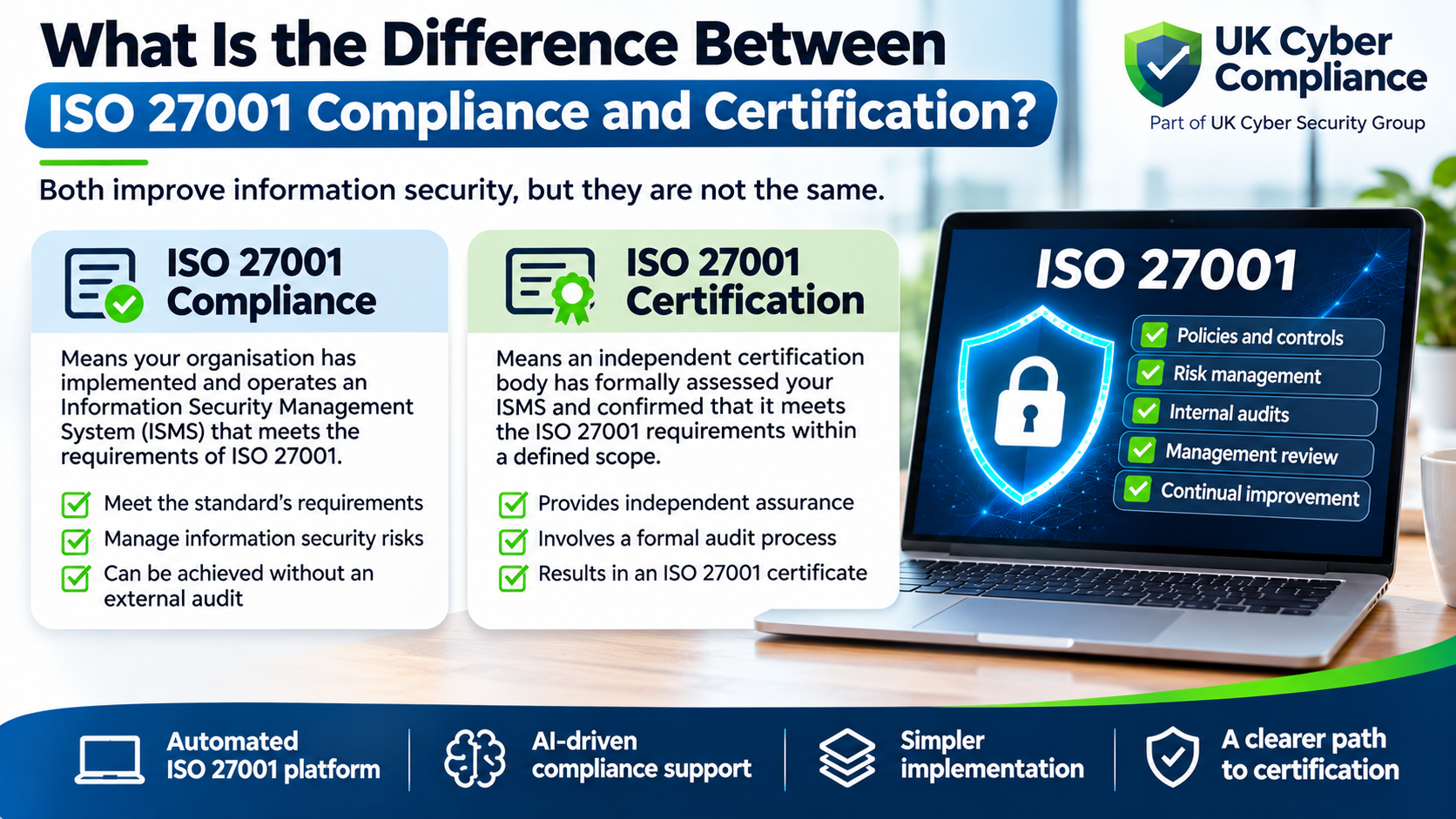
ISO 27001 compliance means that an organisation has implemented and operates an Information Security Management System (ISMS) that meets the applicable requirements of ISO/IEC 27001. ISO 27001 certification means that an independent certification body has formally assessed the ISMS and confirmed that it meets those requirements within a defined scope.
In simple terms, compliance is about meeting the standard, while certification provides independent confirmation that you have done so.
A business can operate an ISMS that meets ISO 27001 without holding a certificate. However, it cannot legitimately claim to be ISO 27001 certified unless it has successfully completed the relevant independent certification process.
This distinction matters because customers, suppliers and procurement teams may require different levels of assurance.
Some organisations are satisfied with evidence of good information security practices. Others specifically require independent ISO 27001 certification as part of their contractual or supplier assessment requirements.
According to the UK Government’s Cyber Security Breaches Survey 2025/2026, 43% of UK businesses identified a cybersecurity breach or attack during the previous 12 months. Yet only 30% reported carrying out cybersecurity risk assessments.
These figures highlight the importance of having structured processes for managing information security risks.
For UK businesses wanting to achieve ISO 27001 compliance and work towards certification, UK Cyber Compliance, part of UK Cyber Security Group, provides an automated and AI-driven platform designed to simplify risk assessment, policy development, compliance management and certification preparation.
Understanding where compliance ends and certification begins can help businesses choose the most appropriate approach, avoid unnecessary expenditure and make better decisions about information security.
Understanding ISO 27001 and Why Businesses Use It
Before comparing compliance and certification, it helps to understand what the standard is designed to achieve.
what is iso 27001
ISO/IEC 27001 is an internationally recognised standard that specifies the requirements for establishing, implementing, maintaining and continually improving an Information Security Management System.
An ISMS is a structured approach to managing information security risks across an organisation.
It brings together people, business processes, policies, technology and management responsibilities to protect valuable information.
The standard is based on three fundamental principles.
- Confidentiality: Ensuring information is only accessible to authorised individuals.
- Integrity: Protecting the accuracy, completeness and reliability of information.
- Availability: Ensuring information and essential services remain accessible when required.
These principles apply to organisations across almost every industry.
For example, an accountancy firm may need to protect financial records and confidential customer information.
A software development company may need to protect intellectual property, customer systems and operational services.
A recruitment business may need to safeguard candidate information and employee records.
Although these organisations face different information security risks, they can all use ISO 27001 to establish an appropriate management framework.
The standard is designed to be flexible. It allows businesses to develop an ISMS that reflects their operations, business objectives and identified risks.
What Does ISO 27001 Compliance Actually Mean?
ISO 27001 compliance means that an organisation meets the applicable requirements of the standard.
More precisely, a business claiming full conformity with ISO/IEC 27001 must have established, implemented, maintained and continually improved an ISMS that meets the requirements of Clauses 4 to 10.
This involves more than having cybersecurity software or a collection of security policies.
The business must demonstrate that information security is actively managed.
Establishing an Information Security Management System
An organisation working towards ISO 27001 compliance must first establish an ISMS.
This includes understanding its business activities, identifying relevant interested parties and defining the scope of the management system.
The ISMS scope establishes which activities, locations, services and business functions are covered.
An organisation may include its entire business or a clearly defined part of its operations.
However, the scope must be appropriate and must consider relevant dependencies and interfaces.
Once the scope is established, the organisation must develop the policies, responsibilities and management processes needed to protect information.
Identifying and Managing Information Security Risks
Risk assessment is a central requirement of ISO 27001.
Businesses must establish a consistent process for identifying, analysing and evaluating information security risks.
These risks might include:
- Unauthorised access to confidential information.
- Compromised employee accounts.
- Loss of customer or supplier records.
- Disruption to essential business services.
- Accidental disclosure of sensitive information.
- Inadequate supplier security arrangements.
- Failure to recover important business information.
The organisation must determine how identified risks will be treated.
This may involve implementing appropriate security controls, avoiding particular activities, sharing aspects of risk or accepting residual risks where appropriate.
The decisions must follow the organisation’s established risk acceptance criteria.
Implementing Appropriate Security Controls
ISO/IEC 27001:2022 includes 93 Annex A reference controls organised into four groups.
| Control group | Number of controls |
|---|---|
| Organisational controls | 37 |
| People controls | 8 |
| Physical controls | 14 |
| Technological controls | 34 |
| Total | 93 |
Businesses do not automatically need to implement every Annex A control.
Instead, they must identify the controls necessary to address their information security risks and compare those controls with Annex A to ensure no necessary measures have been overlooked.
A Statement of Applicability must record the necessary controls, justify their inclusion and implementation status, and explain exclusions.
This document is an important part of demonstrating ISO 27001 conformity.
Maintaining Policies, Records and Evidence
An organisation cannot demonstrate compliance simply by stating that it follows good security practices.
It needs appropriate evidence.
This may include risk assessments, information security objectives, approved policies, training records, operational procedures and monitoring results.
ISO 27001 also requires internal audits, management reviews and continual improvement.
These requirements apply whether the organisation intends to pursue certification or operate an ISMS without independent certification.
An organisation can genuinely meet ISO 27001 requirements without holding a certificate, but its conformity claims should be supported by appropriate evidence.
What is ISO 27001 Certification?
ISO 27001 certification is formal, independent confirmation that an organisation’s ISMS meets the requirements of ISO/IEC 27001 within a defined scope.
Certification is awarded following an assessment by an external certification body.
The certification body evaluates the organisation’s management system, documentation, security arrangements and supporting evidence.
Auditors may also interview employees and examine how information security requirements are applied in practice.
If the organisation demonstrates conformity and any relevant nonconformities are appropriately resolved, the certification body may award certification.
Who Actually Issues ISO 27001 Certificates?
One important point is that the International Organisation for Standardisation does not issue ISO 27001 certificates.
ISO develops international standards, but certification is carried out by independent certification bodies.
In the UK, businesses should consider using a certification body that holds appropriate accreditation from the United Kingdom Accreditation Service (UKAS), or another recognised accreditation body operating within relevant international recognition arrangements.
Accreditation provides independent assurance regarding the certification body’s competence and impartiality.
Businesses can check relevant UKAS-accredited certification claims using UKAS CertCheck.
What Does an ISO 27001 Certificate Demonstrate?
A valid certificate provides independent assurance that the organisation’s ISMS has been assessed against the applicable standard.
It normally identifies the certified organisation, the relevant standard, certification scope, certification body and certificate validity information.
The scope is particularly important.
For example, a company may hold certification for its managed IT services but not for every business activity carried out by the organisation.
Customers should therefore check that the certification scope covers the services they are purchasing.
Certification does not guarantee that cybersecurity incidents will never occur.
Instead, it demonstrates that the organisation has established an independently assessed management system for managing information security risks.
ISO 27001 Compliance vs Certification: The Key Differences
The main differences become clearer when the two approaches are compared directly.
| Consideration | ISO 27001 compliance | ISO 27001 certification |
|---|---|---|
| Main purpose | Meet the requirements of the standard | Obtain independent confirmation of conformity |
| ISMS required | Yes, for full conformity | Yes |
| Risk assessment required | Yes | Yes |
| Security controls required | Appropriate controls based on risk | Appropriate controls based on risk |
| Internal audit required | Yes | Yes |
| Management review required | Yes | Yes |
| External certification audit | Not required | Required |
| Certificate issued | No | Yes, following a successful assessment |
| Independent assurance | Not inherent in a self-declaration | Provided through certification |
| Suitable for customer assurance | Depends on customer requirements | Often preferred where formal assurance is needed |
| Ongoing ISMS management | Required | Required, alongside certification surveillance |
The important point is that certification does not replace the work involved in achieving compliance.
Instead, it adds an independent assessment of that work.
An organisation seeking certification must first establish an effective ISMS.
This is why compliance and certification should not be viewed as competing alternatives.
Compliance provides the foundation. Certification provides external assurance that the foundation meets the standard.
Can You Be ISO 27001 Compliant Without Being Certified?
Yes. An organisation can implement and maintain an ISMS that conforms to ISO 27001 without undergoing independent certification.
ISO itself recognises that organisations may implement the standard without choosing formal certification.
This may be appropriate for businesses that want to strengthen information security governance but do not currently have a customer or contractual requirement for certification.
Why Some Businesses Choose Compliance First
A business may decide to implement ISO 27001 requirements internally before arranging an external audit.
This allows it to establish its scope, develop policies, assess risks and implement controls.
The organisation can then evaluate the effectiveness of its ISMS and address weaknesses.
Some businesses use this period to develop employee awareness and improve documentation.
Others may want to establish stronger information security practices before certification becomes commercially necessary.
However, there is an important distinction between being fully compliant and working towards compliance.
A business that has only completed part of its implementation should describe itself as working towards ISO 27001 conformity, rather than claiming to meet the entire standard.
Is Self-Declared Compliance Acceptable?
An organisation can assess its own ISMS and declare conformity.
However, self-declared compliance does not provide the same independent assurance as accredited certification.
A customer may accept a self-assessment supported by appropriate evidence.
Another customer may insist on formal certification.
Businesses should therefore avoid assuming that a statement of compliance will satisfy every procurement or contractual requirement.
Where certification is explicitly required, a self-declaration normally cannot replace it unless the customer agrees to accept alternative evidence.
Can You Advertise That Your Business Is ISO 27001 Compliant?
Businesses should ensure that any claims about ISO 27001 are accurate and capable of being substantiated.
If an organisation has implemented the full requirements, it may describe its ISMS as conforming to the standard, provided the claim is justified.
However, it must not imply that it has been independently certified when no certification has been awarded.
Clear communication helps avoid misleading customers and protects the organisation’s credibility.
Why ISO 27001 Certification Provides Additional Business Value
Although ISO 27001 compliance can deliver important operational benefits, certification provides further advantages.
These are particularly relevant when businesses need to demonstrate information security standards to external organisations.
Providing Independent Customer Assurance
Customers may have limited visibility into a supplier’s internal security processes.
A business can explain its information security arrangements, but customers may still want independent confirmation.
ISO 27001 certification helps address this concern.
A certificate from an appropriately accredited certification body provides an additional level of assurance.
This can be especially valuable for businesses handling confidential customer information or delivering services that customers depend upon.
Supporting Procurement and Supplier Assessments
Many larger organisations assess suppliers before entering into commercial relationships.
These assessments may consider information security policies, incident management arrangements, business continuity planning and other security requirements.
Where ISO 27001 certification is specified, holding a valid certificate covering the relevant services may help demonstrate that the organisation meets an important procurement requirement.
Certification does not guarantee that a supplier will win a contract.
However, it may reduce the need to explain certain aspects of the organisation’s security governance repeatedly.
Demonstrating Management Commitment
ISO 27001 requires senior management to demonstrate leadership and commitment to the ISMS.
Certification provides evidence that these governance arrangements have been independently assessed.
It can help demonstrate that information security is recognised as a business responsibility rather than simply an IT function.
Supporting Long-Term Improvement
Certification requires ongoing surveillance and periodic reassessment.
These activities provide opportunities to identify weaknesses, review performance and maintain the effectiveness of the ISMS.
However, continual improvement is also a requirement for organisations claiming full conformity without certification.
The difference is the additional independent oversight associated with maintaining the certificate.
What UK Cybersecurity Statistics Tell Us About the Need for Stronger Governance
The UK Government’s Cyber Security Breaches Survey 2025/2026 illustrates why businesses need structured information security arrangements.
The survey provides the following findings.
| Cybersecurity measure | UK businesses |
|---|---|
| Identified a cybersecurity breach or attack during the previous year | 43% |
| Carried out cybersecurity risk assessments | 30% |
| Had formal policies covering cybersecurity risks | 36% |
| Provided staff cybersecurity training or awareness activities | 19% |
| Maintained business continuity plans covering cybersecurity | 33% |
Source: UK Government, Cyber Security Breaches Survey 2025/2026.
These figures do not mean that businesses without ISO 27001 certification are automatically insecure.
They do, however, demonstrate that important information security management activities are not universally adopted.
For example, risk assessment helps organisations identify weaknesses before those weaknesses lead to serious problems.
Employee awareness helps staff recognise suspicious activity and understand how to protect information.
Business continuity planning helps organisations prepare for disruption.
ISO 27001 brings these activities together through a structured management system.
For businesses seeking certification, the independent audit provides additional assurance that applicable requirements have been addressed.
How the Certification Works
ISO 27001 certification follows a structured assessment process.
Although the exact arrangements depend on the certification body and organisational circumstances, the process normally involves the following stages.
Step 1: Establish the Information Security Management System
The organisation defines its ISMS scope, identifies relevant requirements and develops an appropriate management framework.
This includes assigning responsibilities and establishing its information security policy.
Step 2: Complete Risk Assessments and Risk Treatment
The business identifies information security risks and evaluates them using a documented methodology.
Appropriate treatment decisions are made, and necessary controls are identified.
The organisation also prepares its Statement of Applicability.
Step 3: Implement and Operate the ISMS
Policies and controls must operate effectively.
Employees need appropriate competence and security awareness.
The organisation must maintain relevant records and demonstrate that its management system is functioning.
Step 4: Conduct Internal Audits and Management Reviews
Internal auditing is mandatory.
The organisation must evaluate whether its ISMS conforms to applicable requirements and operates effectively.
Senior management must also review ISMS performance at planned intervals.
Any identified issues should be addressed appropriately.
Step 5: Complete the Stage 1 Certification Audit
The external certification body evaluates the organisation’s readiness for the main certification assessment.
This generally involves reviewing the scope, documentation and important management system arrangements.
The auditor considers whether the organisation is sufficiently prepared for Stage 2.
Step 6: Complete the Stage 2 Certification Audit
The certification body assesses whether the ISMS meets the standard and is effectively implemented.
The auditor may examine documents, interview employees, review records and assess operational practices.
If nonconformities are identified, the organisation must address them according to the certification body’s requirements.
Step 7: Receive the Certification Decision
Following a successful assessment, the certification body makes its certification decision.
If approved, the organisation receives its ISO 27001 certificate.
Accredited certification normally operates on a three-year cycle, with surveillance audits during the cycle and reassessment for continued certification.
This is why maintaining compliance remains essential after the certificate is issued.
ISO 27001 Certification Levels
ISO 27001 does not contain official Bronze, Silver, Gold or Platinum certification levels.
Organisations are assessed against the applicable requirements of the standard within their defined ISMS scope.
However, businesses may use internal progress milestones to manage implementation.
For example, an organisation might describe its current position as:
- Initial gap assessment.
- ISMS planning and development.
- Risk management and control implementation.
- Internal evaluation and audit readiness.
- Independent certification.
- Ongoing compliance and improvement.
These are implementation milestones, not formal certification grades.
An automated compliance platform may also display progress indicators to show which activities have been completed.
Such indicators help organisations manage their work, but they do not represent independent certification.
Formal certification can only be awarded following the relevant assessment and certification decision.
Who needs iso 27001 certification?
ISO 27001 certification is not universally required by law for UK businesses.
However, it can be particularly beneficial for organisations handling sensitive information or working with customers that require independent security assurance.
Examples include:
- Managed IT service providers.
- Cybersecurity consultancies.
- Cloud service providers.
- Software development businesses.
- Financial and professional services organisations.
- Healthcare and social care providers.
- Recruitment and HR businesses.
- Manufacturers handling confidential commercial information.
- Suppliers working with public sector organisations.
- Companies providing services to larger enterprises.
When Is Compliance Without Certification Enough?
Compliance without certification may be appropriate where the organisation wants to improve information security internally and no relevant customer, contractual or regulatory requirement demands a certificate.
For example, a small business might implement ISO 27001 to improve risk management and protect confidential information.
If customers accept its documented security arrangements, formal certification may not be immediately necessary.
However, the organisation should ensure its claims accurately reflect the extent of implementation.
When Is Certification the Better Choice?
Certification may be more appropriate where customers require independent evidence of an effective ISMS.
It can also be valuable when businesses participate in procurement processes that specifically require ISO 27001 certification.
Organisations expanding into new markets or handling information for larger customers may find certification commercially useful.
The decision should reflect actual business requirements rather than an assumption that every organisation needs a certificate.
How Automated ISO 27001 Compliance Platforms Support Both Approaches
Implementing ISO 27001 involves several management activities.
Businesses need to coordinate risk assessments, information security policies, controls, responsibilities and supporting evidence.
Without a structured approach, these activities can become difficult to maintain.
Documents may be scattered across separate folders, risk assessments may become outdated and managers may struggle to identify outstanding tasks.
Automated compliance platforms help organisations bring these activities together.
Simplifying Documentation
ISO 27001 requires organisations to maintain appropriate documented information.
An automated platform can help coordinate policies, risk assessments, control records and audit evidence.
This reduces the need to manage numerous disconnected documents.
Improving Risk Management
A guided risk assessment process can help businesses identify relevant information security risks and document their treatment decisions.
The organisation can then monitor outstanding actions and maintain a clearer view of residual risks.
Management remains responsible for approving appropriate risk decisions.
Connecting Risks with Security Controls
An effective ISMS should provide a clear relationship between identified risks and the controls selected to address them.
A structured platform can help maintain this relationship through the risk treatment process and Statement of Applicability.
This is valuable when demonstrating how the organisation manages information security.
Monitoring Compliance Progress
Progress dashboards can help managers identify completed activities and outstanding requirements.
This makes it easier to plan implementation and evaluate certification readiness.
However, a completed software checklist does not automatically demonstrate full conformity.
Evidence must be accurate, controls must operate effectively and the organisation must meet the mandatory requirements of the standard.
Supporting Audit Preparation
Automated reporting and centralised evidence management can make certification preparation easier.
Auditors may request relevant risk records, policy documents, internal audit results and management review evidence.
Having these records organised can reduce unnecessary administrative effort.
An automated platform can support the process, but it does not replace the certification body’s independent assessment.
How UK Cyber Compliance Makes ISO 27001 Easier
UK Cyber Compliance, part of UK Cyber Security Group, provides an automated and AI-driven platform designed to simplify ISO 27001 compliance management and certification preparation.
The platform helps organisations work through the requirements of the standard using structured workflows and compliance management tools.
Its published capabilities include:
- Guided ISO 27001 implementation workflows.
- Intelligent information security risk assessments.
- AI-assisted policy generation.
- Security control management.
- Statement of Applicability preparation.
- Real-time compliance progress tracking.
- Audit-ready documentation and reporting.
- Access to specialist compliance guidance and support.
These features help businesses organise their ISMS activities and maintain visibility over implementation progress.
Supporting Businesses Working Towards Compliance
For organisations at an early stage, UK Cyber Compliance provides a structured approach to developing an ISMS.
Businesses can use the platform to identify relevant requirements, document information security risks and manage appropriate controls.
This makes it easier to organise the work necessary to establish conformity with ISO 27001.
Preparing for Independent Certification
For organisations seeking certification, the platform can help coordinate the documentation and evidence required for an external audit.
Managers can monitor outstanding tasks, review relevant compliance information and prepare supporting records.
Importantly, the independent certification assessment remains a separate activity performed by an appropriate certification body.
Reducing Administrative Work
Traditional compliance management can involve substantial manual administration.
Using separate spreadsheets, documents and tracking processes may increase the risk of duplication and inconsistencies.
Automation can help reduce this workload.
UK Cyber Compliance is designed to make ISO 27001 implementation easier and cheaper by simplifying repetitive administration and improving compliance visibility.
Actual savings depend on the organisation’s existing arrangements, internal resources and support requirements.
Supporting Ongoing Compliance
Achieving certification is not the end of ISO 27001 responsibilities.
Organisations must continue reviewing risks, monitoring performance, maintaining records and improving their ISMS.
A centralised compliance platform can support these activities after certification.
This helps businesses maintain information security governance rather than treating compliance as a one-off project.
Can ISO 27001 Certification Replace UK GDPR Compliance?
No. ISO 27001 certification does not automatically demonstrate compliance with the UK General Data Protection Regulation.
The two frameworks address related but different responsibilities.
ISO 27001 establishes requirements for managing information security risks.
UK GDPR governs the processing of personal data and includes requirements relating to lawful processing, transparency, individual rights, accountability and appropriate security.
An effective ISMS can support relevant information security obligations under UK GDPR.
However, organisations must assess their wider data protection responsibilities separately.
For example, a business may hold ISO 27001 certification while still needing to address data protection impact assessments, privacy information, retention requirements or data subject rights.
Businesses should avoid presenting ISO 27001 certification as proof that every legal or regulatory obligation has been met.
Does Cyber Essentials Mean You Are ISO 27001 Compliant?
Cyber Essentials and ISO 27001 are separate schemes.
Cyber Essentials is a UK Government-backed certification scheme that focuses on fundamental technical security controls.
ISO 27001 provides a broader management system framework addressing information security governance, risk management, organisational responsibilities and continual improvement.
Cyber Essentials certification can support aspects of an organisation’s information security arrangements.
However, it does not automatically demonstrate conformity with ISO 27001.
Likewise, ISO 27001 certification does not automatically mean that a business holds Cyber Essentials certification.
Businesses should assess which scheme is required by their customers and which provides the most relevant assurance for their operations.
Some organisations choose to pursue both.
Common Misunderstandings About ISO 27001 Compliance and Certification
Several misconceptions can cause confusion when businesses plan their information security activities.
Having Security Policies Means You Are Compliant
Policies are important, but ISO 27001 requires more than documentation.
Businesses must demonstrate effective risk management, relevant operational controls, performance evaluation and continual improvement.
Completing a Risk Assessment Means You Are Ready for Certification
Risk assessment is essential, but it is only one part of the ISMS.
The organisation must also address leadership, competence, operational requirements, internal auditing and management review.
An Automated Platform Can Award an ISO 27001 Certificate
Compliance software can support implementation and audit preparation.
However, formal certification requires an independent assessment and certification decision.
Every Annex A Control Must Be Implemented
The standard requires a risk-based approach.
Organisations must determine necessary controls and justify exclusions within the Statement of Applicability.
All mandatory management system requirements must still be met.
Certification Guarantees Complete Cybersecurity Protection
No recognised management system standard can guarantee that security incidents will never happen.
ISO 27001 establishes a structured approach to managing information security risks.
Certification Removes the Need for Ongoing Compliance
Certification is not permanent assurance without further activity.
Organisations must continue maintaining their ISMS and meeting the requirements of the standard.
Frequently Asked Questions About ISO 27001 Compliance and Certification
Is ISO 27001 Compliance the Same as ISO 27001 Certification?
No. Compliance means meeting the applicable requirements of ISO 27001.
Certification means an independent certification body has assessed and confirmed conformity within a defined scope.
A business can be compliant without being certified.
Can You Claim ISO 27001 Compliance Without a Certificate?
An organisation may make an accurate, evidence-supported statement of conformity without certification.
However, it must not imply that it has received independent certification.
Businesses should clearly distinguish between self-assessed conformity and independently certified status.
Is ISO 27001 Certification Mandatory in the UK?
Not universally.
However, specific contracts, customer requirements or procurement arrangements may make certification necessary for particular business opportunities.
Organisations should assess their own obligations.
Do Small Businesses Need ISO 27001 Certification?
Small businesses can benefit from ISO 27001, particularly if they handle sensitive information or work with customers requiring independent assurance.
The standard does not require a large workforce or dedicated compliance department.
The ISMS must be appropriate to the organisation’s operations and information security risks.
Can You Get ISO 27001 Certified Without a Consultant?
Yes. ISO 27001 does not require businesses to employ an external consultant.
Organisations can manage implementation internally or use automated compliance software.
However, an independent certification body is still required for formal certification.
How Long Does ISO 27001 Compliance Take?
There is no universal implementation period.
The work required depends on the organisation’s existing security arrangements, business complexity, available resources and ISMS scope.
Businesses should ensure that their management system is genuinely implemented and operating effectively before seeking certification.
What Happens If You Fail an ISO 27001 Audit?
If an auditor identifies nonconformities, the organisation must address them according to the certification body’s requirements.
The significance of the findings determines the necessary corrective action and whether additional assessment is required.
An unsuccessful initial assessment does not automatically prevent an organisation from obtaining certification later.
Can UK Cyber Compliance Help with Certification?
Yes. UK Cyber Compliance provides an automated and AI-driven platform designed to support ISO 27001 implementation, compliance management and independent certification preparation.
The platform helps organisations manage policies, risks, controls, documentation and relevant evidence.
The formal certification decision remains the responsibility of an independent certification body.
Which UK-based firms offer ISO 27001 consultancy services?
UK businesses can obtain ISO 27001 support from specialist information security consultancies, cybersecurity providers and automated compliance management services.
UK Cyber Compliance, part of UK Cyber Security Group, provides an AI-driven compliance platform supported by professional guidance.
The service helps organisations understand ISO 27001 requirements, manage information security risks, develop relevant policies and prepare for certification.
Businesses can find more information at www.ukcybercompliance.co.uk.
When selecting a provider, organisations should consider relevant experience, the assistance available and how the service will support ongoing compliance after certification.
Which Should Your Business Choose: Compliance or Certification?
The most appropriate approach depends on what your business needs to achieve.
If your objective is to improve information security governance, ISO 27001 compliance may provide substantial operational value.
Your business can establish a structured ISMS, manage risks and improve security processes without immediately seeking independent certification.
However, where customers or contracts specifically require accredited ISO 27001 certification, implementing the standard without obtaining a certificate may not be sufficient.
In those circumstances, certification provides the external assurance necessary to demonstrate conformity.
For many businesses, a practical approach is to develop compliance first and progress towards certification once the ISMS is ready for independent assessment.
Automated compliance management can help simplify both stages.
By centralising policies, risk assessments, security controls and supporting documentation, businesses can reduce unnecessary administration while maintaining oversight of their information security responsibilities.
Ultimately, the choice should reflect customer expectations, contractual obligations, available resources and long-term business objectives.
Take the Next Step with UK Cyber Compliance
Understanding the difference between ISO 27001 compliance and certification helps businesses make informed decisions about their information security requirements.
Compliance demonstrates that an organisation has established and operates an ISMS that meets the requirements of the standard.
Certification adds independent confirmation that those requirements have been satisfied within the assessed scope.
Both approaches can contribute to better information security governance, stronger risk management and improved customer confidence.
However, businesses should avoid treating certification as simply a paperwork exercise.
The greatest value comes from establishing a management system that accurately reflects business operations, addresses genuine risks and continues to improve.
UK Cyber Compliance, part of UK Cyber Security Group, helps UK businesses simplify this process through automated and AI-driven compliance management.
The platform supports risk assessment, policy development, security control management, compliance tracking and preparation for independent ISO 27001 certification.
Whether your organisation wants to improve its existing security arrangements or work towards formal certification, a structured approach can help make the process easier, clearer and more economical.
ISO 27001 compliance is about meeting the standard. ISO 27001 certification is about independently proving that you meet it.
With effective management, suitable resources and the right compliance tools, businesses can achieve both while building an Information Security Management System that delivers lasting value.
Visit UK Cyber Compliance to discover how automated and AI-driven ISO 27001 compliance management can help your organisation progress towards certification.
UK Cyber Compliance is here to help
For more information, please do get in touch.
Please check out our Free Cyber Insurance
Other blog posts, Your ISO 27001 Questions Answered, Get ISO 27001 Certified ,
If you would like to know more, do get in touch as we are happy to answer any questions. Looking to improve your cybersecurity but not sure where to start? Begin by getting certified in Cyber Essentials, the UK government’s scheme that covers all the technical controls that will provide the protection that you need to help guard against criminal attacks.