What is the easiest way of achieving ISO 27001 certification?
Achieving ISO 27001 certification can seem complicated, particularly for businesses that do not have a dedicated information security department or extensive experience managing compliance requirements.
There are policies to prepare, information security risks to assess, controls to review, documents to maintain and independent audits to complete.
For many UK businesses, the biggest challenge is not understanding why information security matters. It is knowing where to start, what evidence is required and how to manage the certification process without creating unnecessary administration.
The good news is that the easiest way to achieve ISO 27001 certification is to follow a structured process, use automation to reduce repetitive work and obtain expert guidance when necessary.
Modern compliance platforms can make the journey considerably more manageable by organising requirements, guiding businesses through risk assessments and bringing important documentation together.
UK Cyber Compliance, part of UK Cyber Security Group Ltd, provides an automated, AI-driven ISO 27001 compliance platform designed to simplify certification preparation.
Available at www.ukcybercompliance.co.uk, the platform supports risk management, policy generation, information security controls, the Statement of Applicability, compliance monitoring and audit preparation.
Instead of maintaining numerous spreadsheets, documents and action records independently, businesses can work through a structured online environment that helps them understand their responsibilities and monitor progress.
This approach can make ISO 27001 certification preparation easier, quicker and more affordable.
However, there is an important distinction.
An automated platform can simplify preparation, but an independent certification body must still assess the organisation’s Information Security Management System (ISMS) and make the formal certification decision.
Understanding this distinction, and following the right process from the beginning, is the key to achieving certification efficiently without compromising information security.
The simplest route to ISO 27001 certification
The most straightforward way to approach ISO 27001 is to avoid treating certification as a collection of unrelated tasks.
Instead, businesses should follow a structured process that connects information security risks, organisational responsibilities, documentation, controls and evidence.
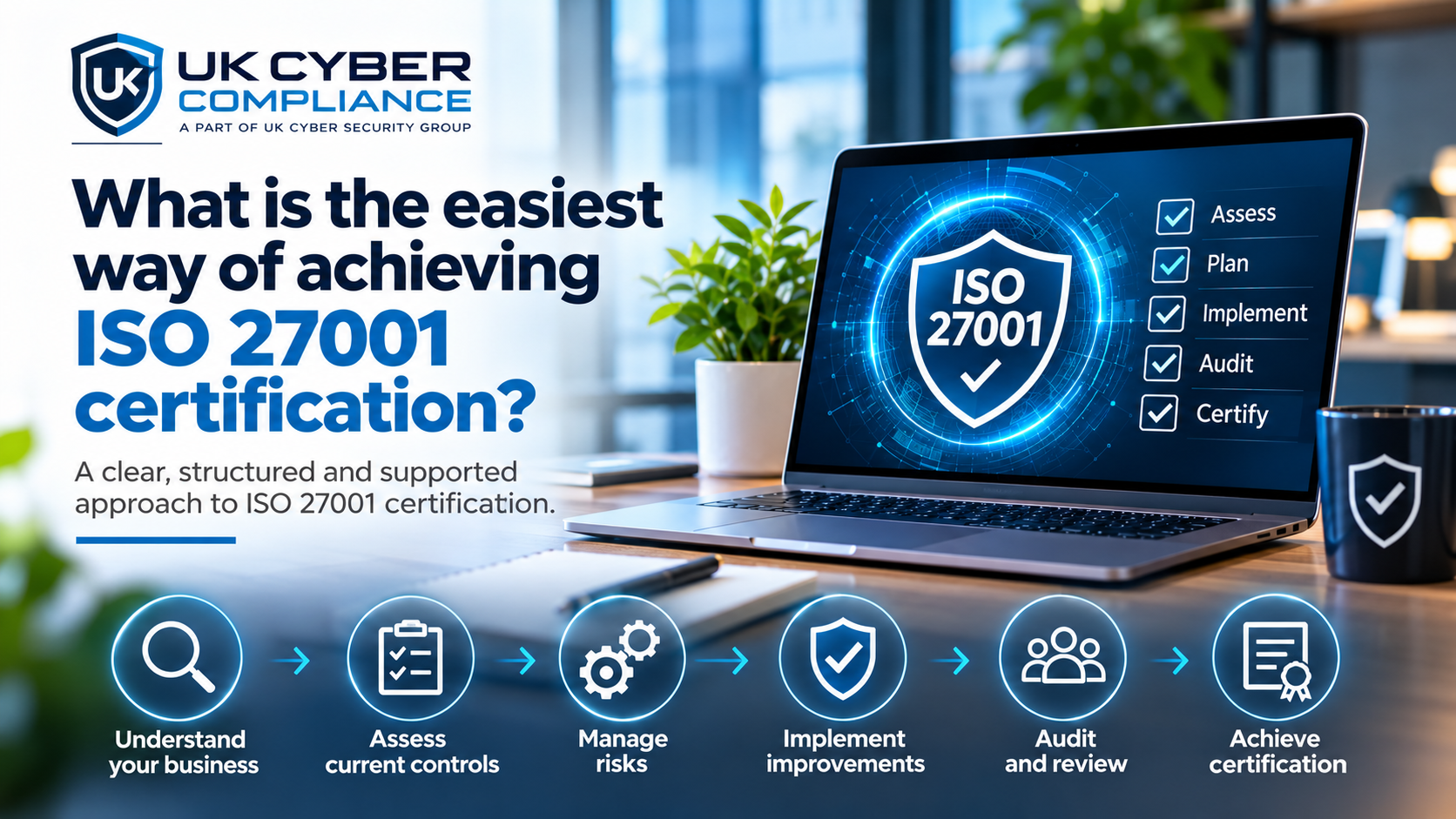
The process begins by understanding what the business does and which information needs protecting.
Next, the organisation determines the scope of its Information Security Management System.
It then assesses existing security arrangements against ISO 27001 requirements, identifies gaps and establishes a practical plan for addressing them.
Information security risks are evaluated, appropriate controls are selected and the necessary policies and procedures are developed.
The organisation must then demonstrate that its ISMS operates effectively.
This includes completing internal audits, conducting management reviews and addressing identified weaknesses.
Finally, an independent certification body assesses the management system.
The process becomes easier when these activities are organised through a single compliance platform rather than managed through disconnected documents.
Why businesses find ISO 27001 difficult
ISO 27001 covers more than technical cyber security.
It addresses how an organisation manages information security across its people, processes, technology and business relationships.
This means certification preparation may involve employees, suppliers, management responsibilities, customer information, contractual obligations and operational resilience.
For smaller organisations, these requirements can initially feel overwhelming.
A Managing Director might understand the importance of protecting customer information but have limited experience establishing formal risk assessment criteria or maintaining a Statement of Applicability.
An IT Manager may understand technical security controls but be less familiar with management reviews and internal auditing.
These challenges are normal.
The easiest approach is to break the requirements into manageable activities and establish clear responsibilities.
Automation and professional guidance can help businesses understand what they need to do without creating unnecessary complexity.
what is iso 27001 and what does certification involve?
ISO 27001 is an internationally recognised standard for establishing, implementing, maintaining and continually improving an Information Security Management System.
The current principal standard is ISO/IEC 27001:2022, supported by Amendment 1:2024 concerning climate action considerations.
The standard establishes requirements for managing information security risks through an organised management system.
Its central purpose is to help organisations protect the confidentiality, integrity and availability of information.
Confidentiality means ensuring that information is only available to authorised individuals and organisations.
Integrity means maintaining the accuracy and completeness of information and protecting it against inappropriate changes.
Availability means ensuring that information and supporting systems remain accessible when required.
An effective ISMS considers all three areas.
For example, a business might need to protect customer records against unauthorised access, prevent inappropriate changes to financial information and maintain access to essential operational systems.
ISO 27001 provides a structured approach to managing these concerns.
According to the International Organization for Standardization, the standard can be used by organisations across different industries and is designed to support effective information security management.
You do not need to start from nothing
Many businesses already operate security measures that support ISO 27001.
These might include employee access management, endpoint protection, data backups, security awareness training, supplier agreements and information security policies.
Existing arrangements may provide useful evidence.
For example, a company using centralised identity management may already maintain appropriate access records.
A business with managed endpoint protection might have existing security monitoring information.
An organisation with established backup and recovery arrangements may already hold relevant operational evidence.
The objective is to understand what already exists, determine whether it meets the relevant requirements and address genuine gaps.
Recreating documents and processes unnecessarily can make certification more difficult than it needs to be.
Start by defining a realistic certification scope
One of the most important decisions involves determining what the ISO 27001 certification will cover.
The ISMS scope establishes the organisational boundaries and activities included within the management system.
This could involve the entire organisation or a clearly defined part of its operations.
For example, a business providing several services might initially seek certification for a particular service division.
Another company may decide to include its complete business operation.
The scope must accurately reflect the relevant activities, information, dependencies and interfaces.
It should not be artificially restricted simply to avoid difficult security requirements.
Why getting the scope right makes certification easier
A clear scope helps businesses understand which processes, employees, information assets, suppliers and security risks require attention.
Without an accurate scope, organisations may spend time assessing irrelevant activities while overlooking important dependencies.
Consider a software company providing a cloud-based customer management service.
Its ISMS may need to consider employees supporting that service, customer information, cloud providers, development processes and relevant operational responsibilities.
Understanding those boundaries makes risk assessment and control selection more manageable.
The organisation should also consider relevant interested parties, including customers, regulators and contractual partners.
An automated platform can help businesses organise scope information and identify the activities relevant to their ISMS.
Carry out a gap assessment before creating documents
A gap assessment helps an organisation compare its existing arrangements against the requirements of ISO 27001.
This is one of the most effective ways to avoid unnecessary work.
Rather than immediately creating new policies and procedures, businesses can first establish what they already have.
For example, an organisation may already maintain an information security policy but have no formal process for management reviews.
Another business might have effective technical safeguards but lack an established information security risk assessment methodology.
A gap assessment helps identify these differences.
What should the assessment examine?
A practical gap assessment should consider the mandatory requirements of Clauses 4 to 10.
These cover organisational context, leadership, planning, support, operation, performance evaluation and improvement.
The assessment should also consider relevant information security controls and existing supporting evidence.
For example, the business might examine whether it has:
- A clearly defined ISMS scope
- An approved information security policy
- Appropriate management responsibilities
- Established risk assessment criteria
- Information security objectives
- Suitable employee competence and awareness arrangements
- Effective operational processes
- Internal audit arrangements
- Management review processes
- Corrective action procedures
- Relevant documented evidence
The purpose is to identify what needs attention and create a practical action plan.
UK Cyber Compliance supports organisations through structured compliance workflows and progress monitoring, helping businesses identify outstanding requirements.
Use an automated ISO 27001 platform to reduce administration
One of the easiest ways to manage certification preparation is to use a compliance platform that organises the relevant requirements.
Traditional manual approaches often involve separate spreadsheets, shared folders, policy templates and email correspondence.
This can make it difficult to determine which requirements have been completed and which activities remain outstanding.
For example, a business may maintain its risk register in one spreadsheet, record information security controls in another and store policy documents in separate folders.
Employees may also maintain evidence independently.
As the ISMS develops, keeping these records consistent becomes increasingly difficult.
Bringing compliance activities together
UK Cyber Compliance provides an automated and AI-driven platform designed to support ISO 27001 preparation.
The platform brings together guided compliance activities, risk assessment, risk treatment, policy generation, control management, progress monitoring and audit documentation.
This provides businesses with a more organised approach to certification.
Instead of attempting to remember every requirement, users can follow structured workflows that help identify the next relevant activity.
Progress tracking also helps management understand where additional attention is required.
What can AI genuinely help with?
Artificial intelligence can assist with preparing policy drafts, organising compliance information and supporting risk assessment activities.
For example, AI-assisted documentation can reduce the time required to create an initial policy based on information supplied by the organisation.
However, the document must still accurately describe the business and its real security arrangements.
AI should not be used to invent completed activities, security controls or evidence.
Likewise, an AI-generated risk assessment should be reviewed by someone who understands the organisation’s information, systems and operational dependencies.
Automation can reduce repetitive administration, but management remains responsible for compliance decisions.
The strongest approach combines automation with knowledgeable human review.
Make risk assessment manageable from the beginning
Information security risk assessment is a central requirement of ISO 27001.
However, businesses sometimes make the process unnecessarily complicated.
The organisation needs a consistent method for identifying, analysing and evaluating information security risks.
It should consider realistic events that could affect important information or business operations.
For example, a company might identify the possibility of compromised employee credentials providing unauthorised access to confidential customer records.
Another risk could involve ransomware disrupting access to important business documents.
A third might concern the failure of a critical cloud supplier.
The assessment should consider the potential consequences and relevant safeguards.
Keep risk records practical
A useful risk record might identify the affected business activity, risk scenario, likelihood, impact, existing controls and responsible risk owner.
Where appropriate, it should also identify any further treatment required.
The objective is to support informed decisions.
A concise assessment containing meaningful risks is more valuable than an extensive register filled with generic statements that nobody reviews.
ISO 27001 does not require every organisation to use an identical risk scoring matrix.
Businesses should establish suitable assessment criteria that support consistent and comparable results.
Risk ownership is essential
Important security risks should have clear ownership.
For example, a Finance Director may understand the commercial impact of losing access to accounting information.
An IT provider might manage the technical safeguards protecting that information.
Both have relevant responsibilities, but their roles differ.
The organisation should understand who is accountable for risk decisions and who carries out the necessary activities.
UK Cyber Compliance supports structured information security risk management, helping businesses organise risk information and associated actions.
Select appropriate controls rather than applying everything blindly
ISO/IEC 27001:2022 contains 93 information security controls in Annex A.
These are organised into four categories: organisational, people, physical and technological.
Businesses sometimes assume that achieving ISO 27001 requires every Annex A control to be implemented in exactly the same way.
That is not how the standard works.
The organisation must determine the controls necessary to manage its information security risks and meet applicable requirements.
It then compares those controls with Annex A to ensure that no necessary controls have been overlooked.
Why a risk-based approach is easier
A small consultancy using cloud services may have different information security requirements from a manufacturing company operating complex industrial systems.
Both organisations must satisfy the applicable ISO 27001 management system requirements.
However, their selected controls and supporting arrangements may differ.
For example, a business without its own physical server infrastructure may rely on cloud providers for certain operational safeguards.
It still needs to understand and manage relevant supplier responsibilities.
The objective is not to create an unnecessarily complicated security environment.
It is to select and operate safeguards appropriate to the organisation’s actual risks.
Prepare the Statement of Applicability efficiently
The Statement of Applicability, commonly called the SoA, is one of the most important ISO 27001 documents.
It records the information security controls the organisation has determined are necessary and provides relevant justifications.
It also identifies whether those controls have been implemented.
Where Annex A controls are excluded, the SoA must explain why.
This document helps connect risk treatment decisions with the organisation’s selected safeguards.
Why the SoA can become difficult
A manually maintained Statement of Applicability may become inaccurate when risk treatment decisions change.
For example, the organisation might identify a new risk requiring an additional control.
If the SoA is not reviewed, it may no longer accurately reflect the business’s security arrangements.
Similarly, the document may indicate that a control has been implemented even though the relevant activity remains incomplete.
A central compliance platform can make control management and documentation easier to coordinate.
UK Cyber Compliance supports Statement of Applicability preparation and control management through its automated platform.
However, the organisation must still ensure that its SoA accurately reflects its approved risk treatment decisions and implementation status.
Build policies around your actual business
Policy development is another area where automation can reduce administration.
ISO 27001 requires relevant documented information, including an information security policy.
Depending on its operations, an organisation may also maintain policies and procedures covering access management, asset management, supplier relationships, information handling and incident management.
However, businesses should avoid creating generic documents that do not reflect how they actually work.
Why copied policies create problems
Consider a company that uses an external managed IT provider.
A generic policy might state that an internal security department performs activities that are actually undertaken by the supplier.
This creates a mismatch between documentation and operational reality.
During an independent audit, employees may struggle to explain the process described in the policy.
A more effective approach is to create documents based on genuine responsibilities and existing arrangements.
AI-assisted policy generation can help produce initial drafts, but those drafts must be reviewed and approved appropriately.
UK Cyber Compliance provides automated documentation support designed to make this process more manageable.
Use existing evidence wherever possible
ISO 27001 certification requires organisations to demonstrate that their ISMS operates effectively.
However, not every requirement needs a newly created document.
Existing records can often provide suitable evidence.
For example, employee training records may support competence and awareness requirements.
Security monitoring reports may demonstrate relevant performance evaluation activities.
Management meeting records could provide evidence of decisions concerning information security.
Risk treatment records may demonstrate how identified risks are managed.
The important consideration is whether the evidence is accurate, relevant and sufficient.
Avoid unnecessary duplication
An organisation may already use specialist technology to maintain device inventories or security monitoring information.
There may be little benefit in recreating that information manually unless a separate record is necessary.
Instead, the business should establish how existing evidence supports its ISO 27001 requirements.
A compliance platform can help organise these records and maintain links between requirements and supporting information.
This approach can save time while improving audit readiness.
Internal audits are essential, even with automation
One of the most common misunderstandings is that completing every activity within an automated compliance platform automatically means an organisation is ready for certification.
The business must still demonstrate that its ISMS meets the relevant requirements and operates effectively.
Clause 9.2 requires internal audits at planned intervals.
An internal audit evaluates whether the organisation meets its own ISMS requirements and the applicable requirements of ISO 27001.
It also examines whether the management system has been effectively implemented and maintained.
Who can carry out the internal audit?
An internal audit can be conducted by a suitably competent employee or an external professional.
However, the organisation must ensure objectivity and impartiality.
For example, someone responsible for maintaining a particular process should not simply assess their own work without appropriate safeguards for independence.
Smaller businesses may find it practical to obtain external audit support when suitable internal resources are unavailable.
Why the internal audit makes certification easier
A properly conducted internal audit helps identify weaknesses before the independent certification assessment.
For example, the auditor might discover that risk assessments have not been reviewed according to the established schedule.
Another finding could involve incomplete training records or missing approval information.
The organisation can then address the identified problems.
This reduces avoidable surprises during the formal certification process.
Complete a meaningful management review
Clause 9.3 requires senior management to review the ISMS at planned intervals.
The purpose is to ensure that the management system remains suitable, adequate and effective.
The review must consider relevant information about security performance, risk management, audit findings and opportunities for improvement.
For example, management may identify that information security responsibilities require additional resources.
Another organisation might discover that important security objectives are not being achieved.
Management should consider whether changes are necessary.
Management review should produce decisions
A management review should involve more than reading reports.
It should help senior leadership understand how effectively the ISMS operates.
Where changes or improvements are necessary, appropriate decisions should be recorded.
The organisation must retain documented evidence of the review results.
A structured compliance platform can help management access relevant information, but it does not replace the requirement for senior leadership to conduct the review.
What is ISO 27001 Certification?
ISO 27001 certification is the process through which an independent certification body assesses an organisation’s Information Security Management System against ISO/IEC 27001 requirements.
Certification provides external assurance that the organisation has established and operates an ISMS meeting the applicable requirements within its defined scope.
An independent certification body conducts the assessment and makes the certification decision.
In the UK, businesses commonly choose certification bodies accredited by the United Kingdom Accreditation Service, known as UKAS.
Accreditation provides additional assurance about the certification body’s competence and impartiality.
Businesses can check accredited certification providers through the UKAS website.
Can an automated platform award ISO 27001 certification?
An automated compliance platform can support certification preparation, but it cannot replace the independent certification process.
UK Cyber Compliance helps businesses organise their ISMS, prepare evidence and work towards certification.
The formal certification decision must be made by an appropriate independent certification body.
Businesses should confirm how their certification assessment will be arranged before selecting a provider.
This distinction helps ensure that organisations obtain a certificate that meets their customers’ expectations.
Who needs iso 27001 certification
ISO 27001 certification can benefit organisations that manage confidential information, customer records, intellectual property or important business systems.
This includes businesses in technology, professional services, finance, healthcare, manufacturing, education and other sectors.
For example, a software company providing cloud-based services may seek certification to demonstrate its approach to information security.
A recruitment agency may need to provide assurance concerning candidate and employer information.
An engineering business might pursue certification to satisfy customer requirements relating to confidential commercial information.
Certification can also benefit smaller organisations seeking to improve security governance and strengthen customer confidence.
Is ISO 27001 mandatory for UK businesses?
ISO 27001 certification is generally voluntary.
However, customer contracts, procurement requirements or industry expectations may make certification commercially important.
Some organisations may need to demonstrate ISO 27001 certification before being considered for particular contracts.
Others may choose certification as part of their broader approach to managing information security.
Businesses should consider their contractual obligations and customer expectations when deciding whether certification is appropriate.
ISO 27001 Certification Levels
ISO 27001 does not establish separate bronze, silver or gold certification grades.
An organisation is assessed against the applicable requirements of the standard within its defined ISMS scope.
However, the certification process normally involves different stages.
Stage 1: Reviewing readiness
Stage 1 examines the organisation’s documented ISMS arrangements and readiness for further assessment.
The auditor considers relevant requirements and determines whether the organisation is sufficiently prepared for Stage 2.
Stage 2: Assessing implementation
Stage 2 involves a more detailed assessment of whether the ISMS has been implemented and operates effectively.
The auditor may examine risk records, policies, internal audit results, management reviews and relevant operational evidence.
Employees may also be asked to explain their responsibilities and describe how information security processes operate.
Maintaining certification
Following successful certification, surveillance audits normally take place during the certification cycle.
Recertification is typically required every three years.
This means organisations must maintain their ISMS after receiving certification.
An automated platform can help businesses keep compliance activities organised between audits.
How the Certification Works
The easiest way to understand the certification process is to view it as a connected series of activities.
First, the organisation determines its ISMS scope and relevant information security requirements.
Next, it reviews existing arrangements and identifies gaps.
Management then establishes suitable responsibilities, policies and information security objectives.
The organisation performs risk assessments and determines appropriate risk treatments.
It prepares its Statement of Applicability and implements necessary controls.
Relevant employees must understand their responsibilities, and the organisation must maintain appropriate supporting evidence.
Internal audits and management reviews then help evaluate whether the ISMS operates effectively.
Any identified nonconformities must receive appropriate attention.
Once the organisation is ready, an independent certification body conducts the formal assessment.
How long does ISO 27001 certification take?
There is no universal certification preparation period that applies to every business.
The time required depends on the organisation’s existing security arrangements, scope, complexity, available resources and readiness for assessment.
A smaller business with well-established security processes may require less preparation than an organisation with multiple locations, complicated supplier relationships and limited documentation.
Automation can reduce the time spent preparing and maintaining compliance records.
However, businesses still need to demonstrate that the ISMS genuinely operates.
The independent certification body’s availability and assessment arrangements will also affect the overall schedule.
Organisations should be cautious about promises of certification within an unusually short period without understanding what evidence and independent auditing are included.
Why ISO 27001 matters to UK businesses
Cyber security remains a significant concern for organisations throughout the United Kingdom.
The UK Government’s Cyber Security Breaches Survey 2025/2026, published on 30 April 2026, found that 43 per cent of UK businesses identified a cyber security breach or attack during the preceding twelve months.
This represents approximately 612,000 businesses.
The proportion increased to 65 per cent among medium businesses and 69 per cent among large businesses.
Phishing remained the most commonly identified attack, affecting 38 per cent of businesses.
These figures reflect incidents that organisations identified and reported, rather than every incident that may have occurred.
Many businesses still lack formal risk management
The same government survey found that only 30 per cent of businesses had conducted a cyber security risk assessment during the preceding twelve months.
Only 18 per cent reported carrying out a cyber security vulnerability audit.
The survey also found that 15 per cent reviewed cyber security risks associated with their immediate suppliers, while 6 per cent reviewed risks across their wider supply chains.
These findings do not directly measure ISO 27001 compliance.
However, they demonstrate why structured risk management and operational oversight are important.
ISO 27001 provides a recognised approach to managing information security through established responsibilities, risk assessment, appropriate controls and regular evaluation.
ISO 27001 is recognised internationally
ISO reports that more than 70,000 ISO/IEC 27001 certificates were recorded across 150 countries in its 2022 survey.
This historical figure demonstrates the international reach of the standard, although it should not be treated as the current total number of valid certificates.
The standard is used across many industries, from technology and professional services to manufacturing and public services.
For UK businesses working with international customers, ISO 27001 certification can provide a recognised method of demonstrating structured information security management.
Avoid the common mistakes that slow certification down
Many ISO 27001 preparation difficulties arise because organisations begin without a clear plan.
One common mistake is creating large amounts of documentation before determining the ISMS scope.
Another is copying generic policies that do not reflect the organisation’s actual activities.
Some businesses identify information security risks but fail to assign appropriate ownership or implement necessary treatment actions.
Others concentrate exclusively on technical security and overlook management system requirements.
Internal audits and management reviews may also be left until shortly before the external assessment.
These issues can create delays and unnecessary administrative work.
Documentation is not the same as compliance
A business may have an extensive collection of policies and still struggle to demonstrate that its ISMS operates effectively.
For example, a policy might state that employee access is reviewed regularly.
However, the organisation must also be able to demonstrate that the required reviews occur.
Similarly, a risk treatment plan may identify actions necessary to address security weaknesses.
The business must implement those actions and maintain appropriate evidence.
This is why using an automated platform should involve more than generating documents.
The platform should support a structured approach to managing actual compliance activities.
Avoid creating unnecessary complexity
ISO 27001 is designed to accommodate organisations with different operating arrangements.
A small consultancy does not necessarily need the same management structure as a multinational technology company.
The organisation should establish an ISMS appropriate to its activities and information security risks.
However, mandatory requirements under Clauses 4 to 10 still apply.
The easiest route is to satisfy these requirements through proportionate, clearly understood processes rather than unnecessarily complicated administration.
Can ISO 27001 certification be achieved without a consultant?
Yes, an organisation can prepare for ISO 27001 certification using its own employees, provided they have the necessary competence and resources.
The standard does not require businesses to engage an external consultant.
However, smaller organisations may find it challenging to interpret every requirement without specialist guidance.
For example, an IT Manager may understand technical security controls but need assistance establishing a formal ISMS risk assessment methodology.
A Director might understand business risks but have limited experience preparing a Statement of Applicability.
Professional support can help clarify these requirements and reduce avoidable mistakes.
Combining automation with expert guidance
An efficient approach is to use automation for repetitive compliance activities while obtaining professional advice where specialist judgement is necessary.
For example, a platform may help generate a policy draft.
A qualified professional can then review whether the document appropriately reflects the organisation’s security arrangements.
Similarly, a platform may help organise risk information, while management remains responsible for approving relevant decisions.
This combination can reduce administrative effort without sacrificing the quality of the ISMS.
Which UK-based firms offer ISO 27001 consultancy services?
UK businesses can obtain ISO 27001 support from specialist cyber security consultancies, information security professionals, managed service providers and compliance platform providers.
Useful consultancy support may include reviewing certification scope, conducting gap assessments, establishing risk assessment processes, developing relevant policies and preparing for independent audits.
When selecting support, businesses should consider whether the provider understands ISO/IEC 27001:2022 and has relevant experience working with organisations of a similar nature.
A provider should explain the requirements clearly and help establish processes that reflect the business’s actual operations.
UK Cyber Compliance and AI-driven certification preparation
UK Cyber Compliance, part of UK Cyber Security Group Ltd, provides ISO 27001 compliance and certification preparation services through an automated, AI-driven platform.
The platform is designed to simplify risk assessment, policy generation, control management, documentation and audit preparation.
Businesses can follow structured compliance workflows and monitor their progress towards readiness.
UK Cyber Compliance also provides access to professional information security guidance for organisations requiring additional support.
This approach can be particularly helpful for smaller businesses seeking a more manageable and affordable route to ISO 27001 certification.
Further information is available at www.ukcybercompliance.co.uk.
How UK Cyber Compliance makes ISO 27001 easier
ISO 27001 preparation becomes more manageable when businesses can clearly understand their requirements and see which activities remain outstanding.
UK Cyber Compliance brings together several important compliance functions through its online platform.
Guided compliance workflows
Structured workflows help businesses work through relevant ISO 27001 requirements systematically.
Instead of managing every activity independently, organisations can follow a coordinated approach.
This helps reduce uncertainty and supports more consistent progress.
AI-assisted policy generation
Preparing policies manually can require considerable time.
AI-assisted documentation can help businesses develop initial drafts based on relevant information.
These documents still need appropriate review and approval to ensure they accurately reflect business operations.
Intelligent risk assessment
The platform supports information security risk assessment and treatment activities.
Businesses can organise risk information, consider relevant controls and maintain supporting records.
This provides a more structured approach than relying entirely on disconnected spreadsheets.
Control management and the Statement of Applicability
UK Cyber Compliance supports the management of information security controls and associated documentation.
This helps organisations maintain a clearer relationship between identified risks, selected safeguards and implementation progress.
Audit preparation and progress monitoring
A centralised compliance environment can help businesses locate documentation and review outstanding activities.
Progress monitoring gives management better visibility of certification readiness.
However, the independent certification assessment remains necessary.
Reducing unnecessary administration
One of the main benefits of automation is reducing repetitive work.
Businesses can spend less time coordinating disconnected documents and more time understanding their risks and improving information security.
The platform is intended to simplify compliance management and potentially reduce the overall cost of certification preparation.
Actual benefits will depend on the organisation’s circumstances and existing arrangements.
What is the fastest realistic route for a small business?
For a small business, the easiest approach begins with understanding existing arrangements.
There is often no need to recreate information already maintained through normal operations.
A practical approach involves identifying relevant business services, establishing the ISMS scope and reviewing existing policies and controls.
The organisation can then use a structured compliance platform to identify gaps and complete the necessary activities.
Management should assign clear responsibilities and ensure that employees understand their information security obligations.
Risk assessments should focus on realistic concerns affecting important information and services.
The business should maintain suitable evidence as activities take place rather than attempting to reconstruct records immediately before the audit.
Internal auditing and management review should be planned early enough to allow identified weaknesses to be addressed.
Finally, the organisation can proceed to independent assessment when it has sufficient evidence of an effective ISMS.
Do not confuse speed with readiness
Attempting to complete documentation as quickly as possible may not produce a successful certification outcome.
An organisation needs to demonstrate that its management system actually operates.
For example, an internal audit report created without a genuine audit does not provide meaningful assurance.
Similarly, a management review record should reflect an actual review by senior leadership.
The easiest route is therefore not necessarily the shortest possible timeline.
It is the approach that reduces unnecessary work while ensuring that the relevant requirements are genuinely met.
Maintaining ISO 27001 becomes easier with the right processes
Certification is not the end of information security management.
Businesses need to maintain their ISMS as employees, technology, customer requirements and information security risks change.
Risk assessments must continue at planned intervals and when significant changes are proposed or occur.
Relevant security controls should be monitored and evaluated.
Internal audits and management reviews must continue according to established arrangements.
Nonconformities should receive appropriate corrective action, and the organisation must continually improve the ISMS.
A centralised compliance platform can help maintain visibility of these responsibilities.
For example, structured records can support future risk reviews, documentation updates and audit preparation.
This can reduce the work associated with maintaining certification over time.
A straightforward checklist for achieving ISO 27001 certification
Before arranging the independent certification assessment, businesses should be able to answer several important questions.
Understanding the organisation
Is the ISMS scope clearly defined?
Have relevant information security requirements and interested parties been identified?
Does senior management understand its responsibilities?
Planning and risk management
Has the organisation established appropriate risk assessment criteria?
Have relevant information security risks been assessed?
Are risk treatment decisions approved and recorded?
Is the Statement of Applicability accurate?
Operational security
Are necessary information security controls implemented?
Do employees understand their responsibilities?
Are relevant processes operating effectively?
Can the organisation demonstrate suitable evidence?
Performance evaluation
Are information security objectives monitored?
Has the organisation completed its planned internal audit activities?
Has senior management reviewed the ISMS?
Have relevant findings received appropriate attention?
Certification readiness
Are required documents and records available?
Can employees explain how relevant processes work?
Has the organisation considered the findings of its readiness reviews?
Has an appropriate independent certification body been selected?
A business that can answer these questions confidently has established a useful foundation for certification.
The easiest approach is structured, supported and practical
Achieving ISO 27001 certification does not need to involve unnecessary paperwork, confusing processes or excessive administration.
The most effective route begins with understanding the organisation’s information security requirements and establishing a realistic ISMS scope.
Businesses should then assess existing arrangements, identify gaps and develop appropriate risk management and operational processes.
Automation can help organise these activities and reduce repetitive administrative work.
However, technology should support genuine compliance rather than simply generate documents.
An effective ISMS requires management accountability, accurate evidence, appropriate security controls and regular evaluation.
Internal auditing and management review help demonstrate that the system works.
Independent certification then provides external assurance that the applicable requirements have been met.
UK Cyber Compliance, part of UK Cyber Security Group Ltd, provides an automated and AI-driven platform designed to make ISO 27001 preparation easier and more affordable for UK businesses.
By combining guided workflows, intelligent risk management, AI-assisted documentation, control tracking and audit preparation, the platform helps organisations manage certification requirements through a structured process.
Businesses interested in simplifying ISO 27001 certification preparation can visit www.ukcybercompliance.co.uk to explore the available services.
The easiest way to achieve ISO 27001 certification is not to bypass important requirements.
It is to remove unnecessary complexity, make the best use of existing resources and follow a clear process that helps the organisation demonstrate effective information security management.
With suitable guidance, appropriate automation and genuine management commitment, businesses can approach ISO 27001 certification with greater confidence while building stronger information security arrangements for the future.
UK Cyber Compliance is here to help
For more information, please do get in touch.
Please check out our Free Cyber Insurance
Other blog posts, Your ISO 27001 Questions Answered, Get ISO 27001 Certified ,
If you would like to know more, do get in touch as we are happy to answer any questions. Looking to improve your cybersecurity but not sure where to start? Begin by getting certified in Cyber Essentials, the UK government’s scheme that covers all the technical controls that will provide the protection that you need to help guard against criminal attacks.