What is the easiest way of getting ISO 27001 certified?
The easiest way of getting ISO 27001 certified is to treat certification as a structured business project rather than a paperwork exercise.
Businesses often make ISO 27001 harder than it needs to be. They start by downloading large collections of policies, creating complicated spreadsheets and trying to interpret every Annex A control before they have even defined what their Information Security Management System needs to cover.
A simpler route starts with your business.
Define the certification scope. Understand your organisation and its information security requirements. Identify your risks. Decide how you will treat them. Select the controls you genuinely need. Build the required documentation and evidence around those decisions. Then complete internal audit and management review before moving into the external certification audit.
Automation can make this much easier.
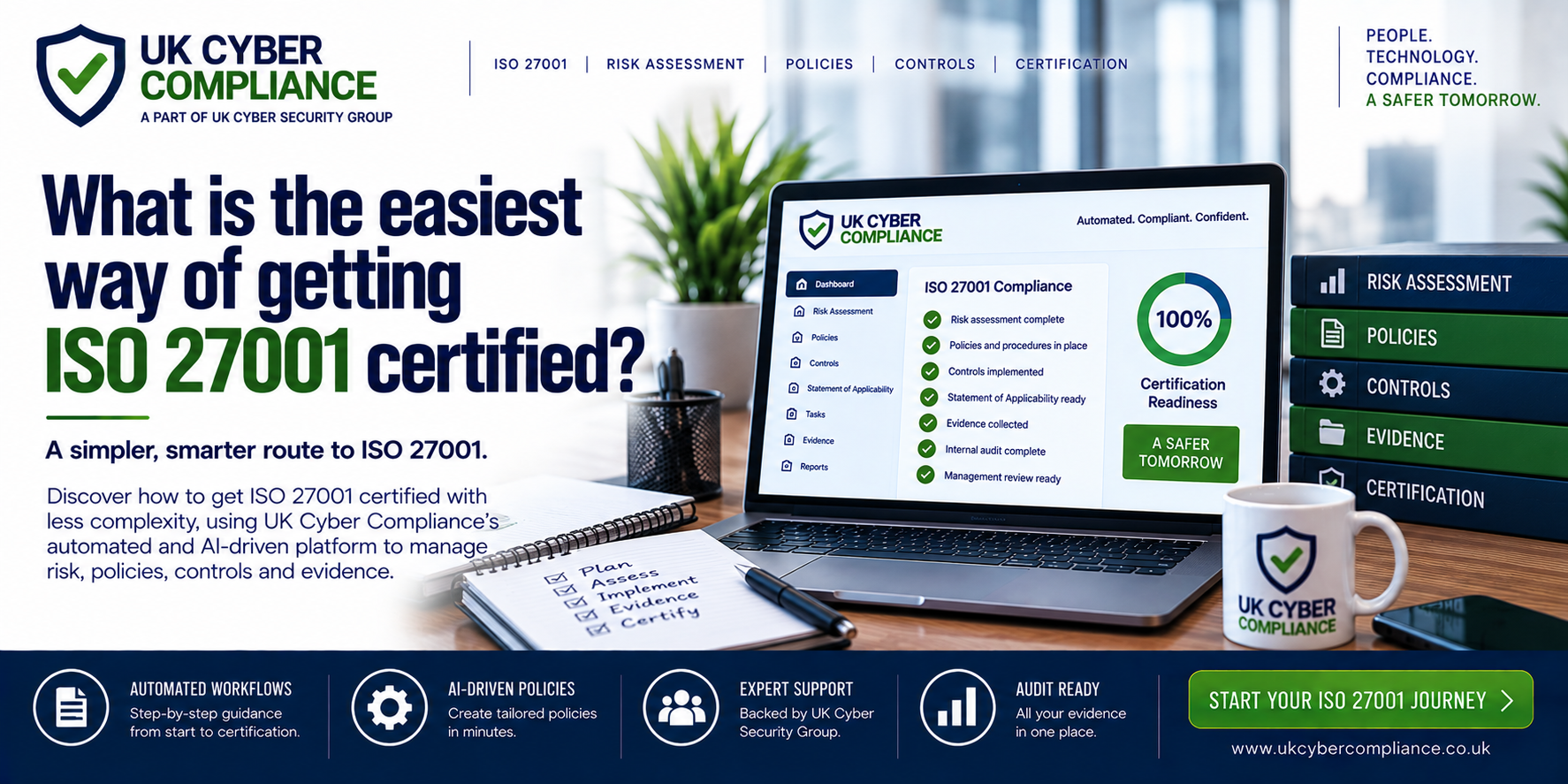
UK Cyber Compliance provides an automated and AI-driven ISO 27001 platform designed to guide organisations through risk assessment, policies, controls, the Statement of Applicability, compliance tracking and audit-ready documentation. Its current platform provides structured workflows, intelligent risk assessment, AI-supported policy generation, real-time progress tracking and audit reporting.
UK Cyber Compliance (a part of UK Cyber Security Group) provides these services and has a platform to make certification much easier and cheaper.
The current standard remains ISO/IEC 27001:2022, with Amendment 1:2024 covering climate-action changes. ISO confirms that ISO/IEC 27001:2022 remains the published international standard for Information Security Management Systems.
Start with the business, not the paperwork
One of the easiest ways to lose time during ISO 27001 preparation is to start writing documents before you understand what the ISMS needs to protect.
Begin with a straightforward question:
What part of the organisation do you want certified?
That answer becomes the foundation of your ISMS scope.
The scope may cover the whole organisation or defined business services, locations and functions.
For example, a technology business might certify the development, delivery and support of its cloud service.
A professional services company might include its customer management, IT, administration and delivery operations.
The important point is clarity.
Your auditor needs to understand exactly what certification covers.
A well-defined scope also prevents unnecessary work because you can concentrate effort on the people, information, systems and processes that genuinely support the certified activities.
what is iso 27001
ISO 27001 is the commonly used name for ISO/IEC 27001, the international requirements standard for an Information Security Management System.
An ISMS gives organisations a structured way to manage information security.
ISO describes ISO/IEC 27001 as the world’s best-known standard for Information Security Management Systems and states that it defines the requirements an ISMS must meet.
The standard focuses on protecting the confidentiality, integrity and availability of information.
Confidentiality means information reaches authorised people.
Integrity means information remains accurate and protected against unauthorised alteration.
Availability means information and services remain accessible when authorised users need them.
ISO 27001 achieves this through risk management.
Instead of requiring every organisation to implement exactly the same controls, the standard expects each organisation to understand its own risks and determine the measures required to manage them.
That flexibility can make ISO 27001 much easier when the organisation follows the process properly.
Use ISO 27001 as a sequence of manageable stages
The easiest implementation route is to break the project into logical stages.
A practical sequence looks like this:
- Understand the organisation.
- Identify interested parties.
- Define the ISMS scope.
- Establish responsibilities.
- Create risk criteria.
- Complete the information security risk assessment.
- Establish risk acceptance criteria.
- Decide how risks will receive treatment.
- Determine necessary controls.
- Create the Statement of Applicability.
- Establish relevant policies and processes.
- Implement the controls.
- Gather evidence.
- Train relevant employees.
- Set and monitor security objectives.
- Complete internal audit.
- Conduct management review.
- Address any weaknesses.
- Complete Stage 1.
- Complete Stage 2.
Following a structured order avoids duplication.
Each stage produces information needed by the next.
Understand your organisation before selecting controls
ISO 27001 asks organisations to understand their internal and external context.
Keep this practical.
Consider factors such as:
- Business activities
- Customers
- Technology
- Remote working
- Suppliers
- Regulatory responsibilities
- Contractual commitments
- Employee arrangements
- Cloud services
- Customer expectations
- Significant business changes
The 2024 amendment also requires management system standards to consider whether climate change represents a relevant issue. ISO confirms that ISO/IEC 27001:2022 currently has Amendment 1:2024 addressing climate action changes.
Do not write pages of generic business analysis.
Record the issues that can actually influence information security and your ISMS.
Identify interested parties early
Interested parties are organisations or people whose requirements can affect your ISMS.
They might include:
- Customers
- Employees
- Regulators
- Suppliers
- Insurers
- Business partners
- Shareholders
- Public-sector clients
Record the relevant security requirements.
For example, a customer may require protection of confidential data.
A contract might require incident notification.
Data protection law can create obligations around personal information.
A major cloud supplier can create operational dependencies.
Understanding these requirements early makes later risk and control decisions much easier.
Get senior management involved from the start
ISO 27001 is a management system standard.
It cannot operate effectively as an isolated IT project.
Senior management should understand why the organisation wants certification and what the ISMS is expected to achieve.
Management also needs to approve the Information Security Policy, provide appropriate resources, allocate responsibilities and review ISMS performance.
Getting leadership involved early prevents delays later.
If decisions about risk acceptance, resources and responsibilities wait until immediately before the audit, certification becomes harder.
Build one clear risk assessment method
Risk assessment is one of the most important parts of ISO 27001.
It does not need to be unnecessarily complicated.
Create a repeatable method that explains:
- How risks are identified
- How likelihood is measured
- How impact is measured
- How risk scores are determined
- Who owns risks
- Which risks need treatment
- Which risks may be accepted
- Who can approve acceptance
- How residual risk is assessed
- When risks receive review
Consistency matters more than complexity.
A simple likelihood and impact matrix often works well when the definitions are clear.
The assessment should reflect your real business rather than a generic list copied from another organisation.
Write risks that people can understand
Avoid risk statements such as:
“Cyber attack.”
“Data breach.”
“Cloud security.”
These phrases do not explain what could happen.
A better risk might say:
“An employee could disclose their cloud account credentials through phishing, allowing an unauthorised person to access confidential customer information.”
Now management can assess the likelihood, business impact and relevant controls.
Clear risk statements also make the external audit easier because the auditor can follow the organisation’s reasoning.
Create sensible risk acceptance criteria
Not every information security risk needs the same response.
Your organisation needs to decide which remaining risks it considers acceptable.
Define this before reviewing your entire register.
For example, lower risks may receive acceptance from the relevant business owner.
Higher risks may require senior management approval.
Certain legal or contractual obligations may prevent acceptance entirely.
Risk acceptance criteria help your organisation make consistent decisions.
They also prevent individuals from ignoring important risks simply because treatment feels inconvenient.
Let risk determine controls
One of the easiest ways to approach ISO 27001 is to stop thinking of Annex A as a long checklist that must automatically apply.
ISO/IEC 27001:2022 aligns Annex A with 93 information security controls.
UKAS confirms that the 2022 control set contains 93 controls arranged across four themes, with 11 controls added when the standard moved from the previous edition.
Your organisation first determines the controls necessary to treat its information security risks.
It then compares those controls with Annex A to confirm it has not overlooked relevant measures.
This is much easier than blindly trying to implement all 93 controls.
Some controls may not apply.
Others may already operate effectively.
Some may need improvement.
The Statement of Applicability records these decisions.
Build the Statement of Applicability as you go
Do not leave the Statement of Applicability until the week before the external audit.
Build it alongside your risk treatment process.
The SoA should show:
- The necessary controls
- Why they are needed
- Whether they have been implemented
- Why relevant Annex A controls have been excluded
UK Cyber Compliance describes the Statement of Applicability as a key connection between risks, treatment decisions and the controls the organisation operates.
Many organisations also record useful information such as control owners, related risks, policy references and evidence.
That makes the SoA useful throughout the year rather than simply during certification.
Avoid creating more policies than you need
Another common way organisations make ISO 27001 difficult is by producing a separate policy for every security subject.
ISO 27001 does require documented information, but not every Annex A control needs its own document.
Start with the required Information Security Policy.
Then create additional policies according to your risks and necessary controls.
Common areas may include:
- Access control
- Acceptable use
- Asset management
- Supplier security
- Incident management
- Backup
- Remote working
- Cloud security
- Vulnerability management
- Business continuity
- Data protection
- Secure development where relevant
Combine areas when that makes the documentation easier to understand.
Do not create paperwork simply because a template exists.
Use templates carefully
Templates can save considerable time.
They provide useful structure and help organisations understand what information may be required.
However, every template should receive review.
Change generic wording.
Remove commitments that do not apply.
Add real responsibilities.
Make the document match your business processes.
An auditor can quickly identify policies that have been copied without proper consideration.
Generic documents can actually make certification harder if they promise controls or activities that the organisation does not perform.
Use automation for repetitive compliance work
Technology can remove a large amount of administrative work from ISO 27001.
Traditional implementation often involves separate spreadsheets for risks, controls, actions and audit evidence.
Policies sit in folders.
The Statement of Applicability lives somewhere else.
Employees exchange evidence through email.
Management then struggles to understand the real certification position.
A compliance platform can connect these activities.
UK Cyber Compliance states that its platform provides guided workflows, intelligent risk assessment, AI-powered policy generation, real-time compliance visibility and automatically generated audit-ready evidence.
The platform also offers live progress tracking so organisations can see how far they have progressed through the certification journey.
This approach can reduce manual administration considerably.
Keep all evidence in one place
Auditors need evidence.
A policy saying that something happens does not prove it happened.
If your policy requires user access reviews, keep completed access review records.
If your backup process requires recovery testing, keep the test evidence.
If suppliers need security assessment, retain completed supplier reviews.
Useful ISO 27001 evidence may include:
- Risk assessments
- Risk treatment records
- Access reviews
- Training records
- Supplier assessments
- Incident records
- Backup tests
- Vulnerability reports
- Audit reports
- Management review minutes
- Security monitoring evidence
- Corrective actions
- Policy approvals
Centralising evidence makes Stage 1, Stage 2 and later surveillance audits much easier.
Reuse existing business processes
You do not need to replace working business processes simply because you are pursuing ISO 27001.
Integrate information security into what already works.
Employee onboarding can include access approval.
Employee departure can trigger account removal and equipment return.
Procurement can include supplier security assessment.
Project management can include information security risk review.
Business planning can include security objectives.
Management meetings can include major risks and ISMS performance.
This reduces duplication and helps information security become part of everyday operations.
Who needs iso 27001 certification
ISO 27001 can benefit organisations across many sectors.
Certification often becomes particularly valuable when a business:
- Handles sensitive information
- Provides technology services
- Manages customer data
- Supplies larger companies
- Works within regulated supply chains
- Participates in tenders
- Provides cloud services
- Needs independent security assurance
- Faces contractual information security requirements
ISO confirms that organisations from any sector can implement ISO/IEC 27001 and that companies can choose whether they also seek independent certification.
Certification is therefore a business decision rather than something every organisation must pursue.
For many companies, customer requirements provide the strongest commercial reason.
What is ISO 27001 Certification?
ISO 27001 certification provides independent assessment of your Information Security Management System against ISO/IEC 27001.
ISO publishes the standard but does not issue organisational certificates itself.
A certification body performs the external assessment.
In the UK, many businesses choose a certification body accredited by UKAS.
UKAS has updated its requirements for ISMS certification bodies to align with ISO/IEC 27006-1:2024. That standard updated areas including remote audit requirements, audit time calculations and alignment with ISO/IEC 27001:2022 controls.
Using an appropriately accredited certification body gives customers greater confidence in the independence and competence of the assessment.
ISO 27001 Certification Levels
ISO 27001 does not have formal bronze, silver, gold or similar certification levels.
You either achieve certification for your defined ISMS scope or you do not.
However, the audit journey contains several stages.
Initial certification normally includes:
- Stage 1
- Stage 2
Once certification has been issued, the organisation enters an ongoing audit cycle.
A certification provider such as NQA describes the standard three-year cycle as certification followed by surveillance audits and later recertification.
The focus should therefore remain on maintaining the ISMS rather than reaching an artificial higher level.
Prepare for Stage 1 before booking it
Stage 1 looks primarily at readiness.
The auditor wants confidence that your ISMS has been properly established and that the organisation appears ready for the fuller Stage 2 assessment.
Evidence can include:
- ISMS scope
- Information Security Policy
- Risk assessment process
- Risk register
- Risk treatment
- Statement of Applicability
- Objectives
- Required documented information
- Internal audit evidence
- Management review
Certification providers may also have specific readiness requirements.
For example, NQA currently states that organisations using its certification route must demonstrate an operational management system that has completed management review and a full internal audit cycle before the certification audit proceeds.
The easiest approach is therefore to become genuinely ready before booking the audit.
Use internal audit as a readiness test
Internal audit should help you identify weaknesses before the certification body does.
Do not treat it as an administrative formality.
An internal auditor should examine whether your ISMS meets the organisation’s own requirements and the requirements of ISO 27001.
Look at real evidence.
Sample access reviews.
Check risk records.
Review the SoA.
Examine supplier records.
Check employee awareness.
Review incidents.
Test whether policies reflect working practices.
Record any nonconformities and address them properly.
A thorough internal audit can significantly reduce surprises during Stage 2.
Complete a meaningful management review
Top management needs to review the ISMS.
Use this meeting to examine what is actually happening.
Consider:
- Security objectives
- Risk status
- Risk treatment
- Internal audit findings
- Incidents
- Performance measures
- Interested party feedback
- Changes affecting the ISMS
- Resources
- Improvement opportunities
- Previous management actions
Record decisions and actions.
A management review that simply states that everything is satisfactory provides limited value.
The meeting should help management make decisions about the ISMS.
How the Certification Works
The certification path becomes straightforward when you follow the ISMS in the correct order.
First, define why the organisation wants certification.
Next, establish scope.
Understand organisational context and interested parties.
Define responsibilities.
Create your risk methodology and acceptance criteria.
Carry out the risk assessment.
Decide how unacceptable risks will receive treatment.
Determine necessary controls.
Complete the Statement of Applicability.
Implement policies, processes and technical or organisational controls.
Gather operating evidence.
Train relevant employees.
Monitor objectives and ISMS performance.
Complete internal audit.
Conduct management review.
Resolve significant weaknesses.
Then move into the external certification audit.
Stage 1 evaluates readiness, scope and the design of the ISMS.
Stage 2 examines implementation and operation in much greater depth.
Current NQA guidance describes Stage 1 as a readiness assessment and Stage 2 as a full assessment of implementation, evidence, effectiveness and continual improvement.
After successful certification, surveillance activity checks that the ISMS continues to operate.
Keep Stage 2 in mind from day one
Stage 2 focuses on evidence.
The auditor may select one risk and trace it through the whole ISMS.
They could ask:
What caused you to identify this risk?
Who owns it?
How did you determine the rating?
What treatment did you select?
Which control addresses the risk?
Where is that control recorded in the SoA?
Can you show evidence that the control operates?
What residual risk remains?
Who accepted it?
A connected compliance platform can make this traceability much easier.
Instead of searching through multiple spreadsheets and folders, the organisation can connect risk, controls, evidence and responsibilities within one system.
Do not aim for perfection before starting
ISO 27001 is based partly on continual improvement.
Your ISMS does not need to represent some imaginary perfect security environment.
It needs to identify risks honestly and manage them systematically.
If you find a weakness, record it.
Assess the risk.
Create an action.
Assign an owner.
Set an appropriate target.
Monitor progress.
Auditors often gain confidence from organisations that recognise weaknesses and manage them properly.
Trying to hide problems can create greater concerns than having a documented improvement action.
Give every action an owner
Certification projects become difficult when tasks belong to “the business” rather than named people.
Assign ownership.
Someone should own:
- ISMS coordination
- Major risks
- Policies
- Individual controls
- Supplier assessments
- Security objectives
- Internal audit actions
- Corrective actions
- Management review actions
The same person can own several areas in a smaller organisation.
The important point is accountability.
Everyone should know who needs to do what.
Keep your action list realistic
ISO 27001 implementation can produce a large list of improvements.
Prioritise.
Focus first on issues affecting major information security risks and mandatory ISMS requirements.
Avoid trying to improve every security process simultaneously.
A structured platform can help by showing which tasks remain outstanding and how they affect certification readiness.
UK Cyber Compliance currently promotes real-time progress tracking specifically for this reason, helping organisations see progress across compliance requirements rather than relying on disconnected task lists.
Current cyber risk makes ISO 27001 increasingly relevant
The UK Government’s Cyber Security Breaches Survey 2025 to 2026 found that 43 per cent of UK businesses had identified a cyber security breach or attack during the previous 12 months.
That represents approximately 612,000 businesses.
The figure reached 65 per cent among medium businesses and 69 per cent among large businesses.
Phishing remained the most commonly identified attack, affecting 38 per cent of businesses.
The same survey estimated that 19 per cent of businesses experienced at least one cyber crime during the previous 12 months, representing approximately 267,000 businesses.
ISO 27001 does not guarantee that an organisation will never experience a security incident.
It provides a management framework for identifying, reducing and responding to information security risk.
That distinction matters.
Which UK-based firms offer ISO 27001 consultancy services?
UK organisations can obtain ISO 27001 assistance from information security consultancies, compliance specialists and technology-led compliance providers.
When choosing support, look for services that simplify the ISMS rather than create additional complexity.
Useful support should cover areas such as:
- ISMS scope
- Context
- Stakeholder requirements
- Risk assessment
- Risk acceptance criteria
- Risk treatment
- Statement of Applicability
- Policies
- Controls
- Evidence
- Internal audit readiness
- Management review
- Certification preparation
UK Cyber Compliance provides an automated and AI-driven ISO 27001 platform supported by compliance guidance.
Its website currently describes step-by-step workflows, intelligent risk assessment, consultant support, AI-powered policy generation, real-time progress tracking and automated audit-ready documentation.
This approach can be particularly helpful for businesses that want to avoid managing ISO 27001 through numerous standalone spreadsheets, folders and manual trackers.
Automation removes work, but not responsibility
AI and automation can make ISO 27001 considerably easier.
They can assist with:
- Drafting policies
- Organising risk information
- Tracking actions
- Mapping controls
- Preparing the SoA
- Monitoring progress
- Collecting evidence
- Producing reports
However, management still owns the ISMS.
An AI system cannot accept a business risk on behalf of senior management.
It cannot decide whether a contractual obligation matters without accurate business information.
It cannot make employees follow procedures.
The easiest certification route combines automation with human understanding.
Use technology for repetitive administration.
Use people for decisions, accountability and business context.
Choose the certification body early enough
Do not wait until every part of the ISMS is finished before considering your external certification body.
Selecting the body earlier helps you understand the audit process, application requirements and likely scheduling.
However, keep consultancy and independent certification roles clear.
The certification auditor needs to assess your ISMS objectively.
Where accredited certification matters to customers or contracts, confirm the certification body’s accreditation scope before proceeding.
UKAS currently requires ISMS certification bodies transitioning under its arrangements to work in line with ISO/IEC 27006-1:2024, which aligns certification requirements with ISO/IEC 27001:2022.
A simpler ISO 27001 readiness checklist
Before Stage 1, ask whether you can confidently answer yes to the following:
Is the ISMS scope clear?
Have we identified relevant interested parties?
Do we understand applicable information security requirements?
Has management approved the Information Security Policy?
Are responsibilities clear?
Do we have a consistent risk assessment method?
Are risk acceptance criteria defined?
Have we completed the information security risk assessment?
Are risk owners assigned?
Have unacceptable risks received treatment?
Have we determined the necessary controls?
Is the Statement of Applicability current?
Do our policies match actual working practices?
Have the necessary controls been implemented?
Do we have evidence that those controls operate?
Have relevant employees received training?
Are information security objectives being monitored?
Have we completed internal audit?
Have we addressed significant findings?
Has management completed its review?
Can we quickly retrieve audit evidence?
If several answers are no, continue implementation before booking the external audit.
The easiest route is the most organised route
There is no legitimate shortcut that removes the fundamental requirements of ISO 27001.
However, there is a much easier way to manage them.
Keep the ISMS scope sensible.
Follow the standard in a logical order.
Use your real business risks rather than generic templates.
Only create documentation that has a purpose.
Connect risk treatment with the Statement of Applicability.
Assign clear ownership.
Gather evidence as processes operate.
Integrate information security into existing business workflows.
Complete a genuine internal audit and management review before the certification body arrives.
Most importantly, use automation where it removes repetitive manual administration.
UK Cyber Compliance brings these activities together through an automated and AI-driven platform designed to guide businesses from initial ISMS preparation through risk assessment, policies, controls, evidence and audit readiness.
ISO 27001 certification becomes much easier when the organisation can see the entire process clearly.
The objective is not to create the biggest collection of compliance documents.
The objective is to build a working Information Security Management System that understands risk, operates appropriate controls and can demonstrate what it does.
When the ISMS already works before the external auditor arrives, Stage 1 and Stage 2 become verification of an existing management system rather than a frantic attempt to create one for audit day.
UK Cyber Compliance is here to help
For more information, please do get in touch.
Please check out our Free Cyber Insurance
Other blog posts, Your ISO 27001 Questions Answered, Get ISO 27001 Certified ,
If you would like to know more, do get in touch as we are happy to answer any questions. Looking to improve your cybersecurity but not sure where to start? Begin by getting certified in Cyber Essentials, the UK government’s scheme that covers all the technical controls that will provide the protection that you need to help guard against criminal attacks.