
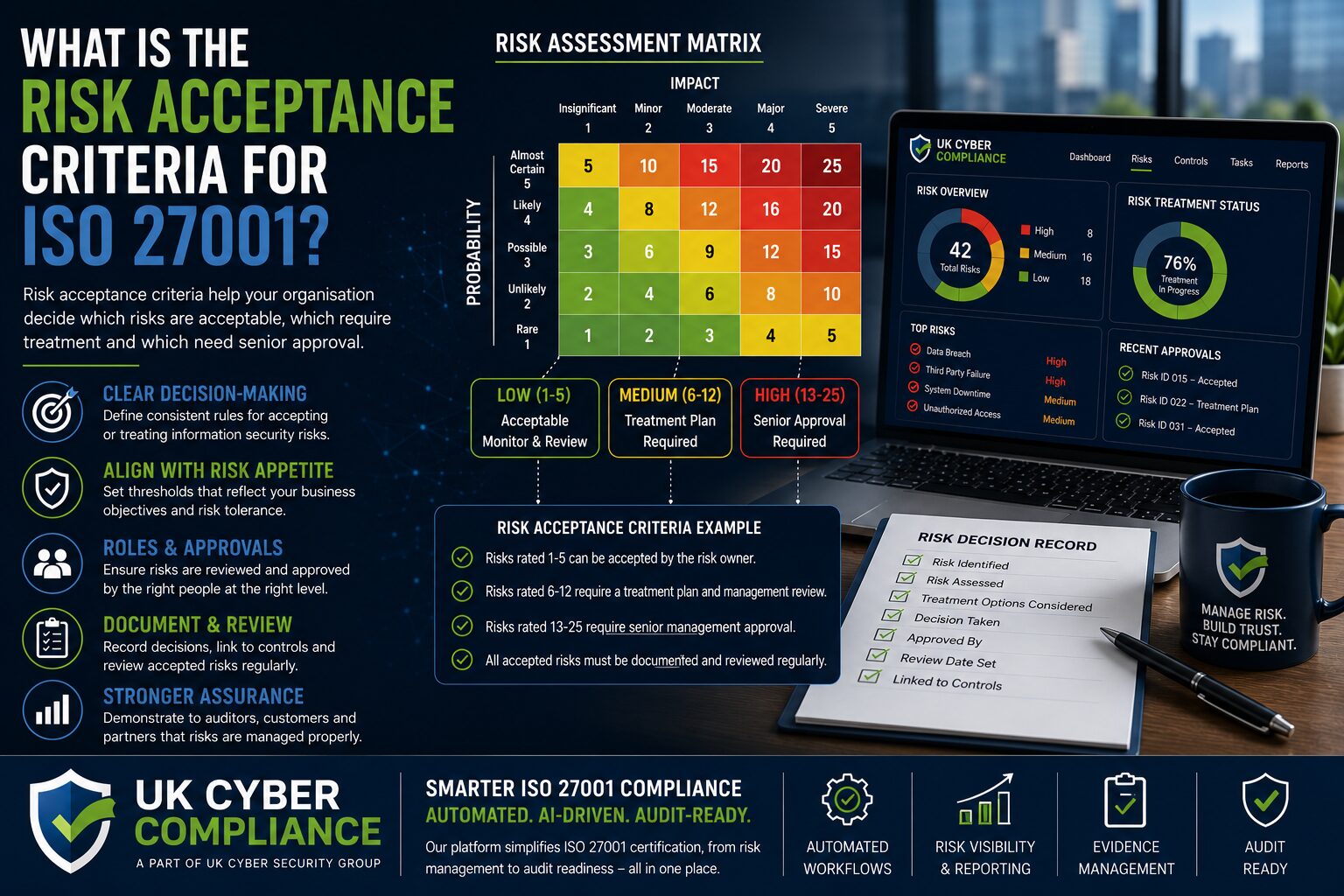
What is the Risk Acceptance Criteria for ISO 27001?
Risk acceptance criteria for ISO 27001 are the rules an organisation uses to decide when an information security risk is acceptable and when further action is needed. In simple terms, they help the business answer a very important question: which risks can we live with, and which risks must be reduced, transferred, avoided, or escalated?
For many organisations, risk management is the heart of ISO 27001. The standard is not about applying every possible security control without thought. It is about understanding the real risks facing the business, deciding how those risks should be treated, and proving that decisions are made in a structured and responsible way.
UK Cyber Compliance provides ISO 27001 certification support through an automated and AI-driven platform. UK Cyber Compliance (a part of UK Cyber Security Group) provides these services and has a platform to make certification much easier and cheaper. The platform helps businesses manage risk assessment, risk treatment, control tracking, evidence, ownership, tasks, and audit readiness in one place.
Risk acceptance criteria matter because not every risk can be removed completely. Some risks are reduced to a level the business is willing to tolerate. Some are accepted because the cost, effort, or disruption of further action would outweigh the benefit. Others must never be accepted without senior approval because the potential impact is too serious.
A clear risk acceptance approach helps the business make consistent decisions, avoid guesswork, and show auditors that information security risk is being managed properly.
Why risk acceptance criteria matter
ISO 27001 requires organisations to assess information security risks and decide how they will be treated. Risk acceptance criteria support this by setting the boundary between tolerable and unacceptable risk.
Without clear criteria, risk decisions become subjective. One manager may accept a risk because it feels small. Another may reject the same risk because they are more cautious. This inconsistency can create confusion and weaken governance.
Risk acceptance criteria help avoid that. They give the organisation a common way to score, compare, escalate, and approve risks.
For example, a business may decide that low risks can be accepted by the risk owner, medium risks require treatment planning, and high risks require senior management approval. Another organisation may use more detailed scoring based on likelihood, impact, legal exposure, customer impact, financial loss, operational disruption, and reputational damage.
The criteria should fit the organisation. A small consultancy and a regulated technology provider may not have the same risk appetite. The key is that the approach must be defined, approved, and used consistently.
What is ISO 27001 Certification?
ISO 27001 certification is formal recognition that an organisation has implemented an Information Security Management System that meets the requirements of ISO 27001. Certification is awarded after an independent audit confirms that the ISMS has been properly established, implemented, maintained, reviewed, and improved.
An Information Security Management System, often called an ISMS, is the structured system used to manage information security. It includes policies, scope, interested parties, legal and regulatory requirements, risk assessment, risk treatment, controls, the Statement of Applicability, internal audit, management review, corrective action, and continual improvement.
Certification does not mean the organisation has eliminated every risk. That would not be realistic. Instead, it shows that the business has a structured and independently assessed approach to identifying, assessing, treating, and reviewing information security risk.
Risk acceptance criteria are therefore a core part of the certification journey. They help show that risk decisions are not arbitrary. They are based on agreed rules, business context, impact levels, likelihood, and approval responsibilities.
For customers and partners, this can be reassuring. It shows that the organisation is not simply saying it takes security seriously. It has a system for deciding which risks matter and how they are managed.
What is iso 27001
ISO 27001 is an international standard for information security management. It sets out the requirements for creating, operating, maintaining, and continually improving an ISMS.
The standard focuses on protecting confidentiality, integrity, and availability. Confidentiality means information is only available to authorised people. Integrity means information remains accurate and trustworthy. Availability means information and systems are accessible when needed.
ISO 27001 is risk-based. That means organisations are expected to understand their own information security risks and choose controls that are suitable for their circumstances. The standard does not simply tell every business to use the same controls in the same way.
This is why risk acceptance criteria are so important. They help the organisation decide what level of risk is acceptable in the context of its services, customers, legal duties, contracts, suppliers, operations, and business objectives.
A risk that may be acceptable for one business may be unacceptable for another. For example, downtime affecting an internal admin tool may be tolerable for one organisation, while downtime affecting a customer-facing healthcare platform may be serious.
Risk acceptance in plain English
Risk acceptance means deciding that the organisation is willing to tolerate a risk without taking further treatment action at that point in time. It does not mean ignoring the risk. It means the risk has been identified, assessed, understood, and approved.
For example, a business may identify a low-likelihood, low-impact risk affecting a non-critical system. The cost of additional treatment may be disproportionate, so the business may choose to accept it. That decision should be recorded, owned, and reviewed later.
Risk acceptance is different from doing nothing. Doing nothing without assessment is poor governance. Accepting a risk after proper review is a valid management decision.
Good risk acceptance should include a reason, an owner, an approval level, a review date, and any conditions attached to the acceptance. For example, a risk may be accepted only if existing controls remain in place, or only until a planned system change is completed.
Risk appetite and risk tolerance
Risk acceptance criteria are closely linked to risk appetite and risk tolerance.
Risk appetite is the broad level of risk the organisation is willing to take in pursuit of its objectives. Risk tolerance is the specific level of variation the organisation can accept for a particular area, service, or risk category.
A business with a low appetite for customer data risk may require strong controls around access, encryption, monitoring, supplier assurance, and incident response. A business with a higher tolerance for minor internal process disruption may accept some low-level operational risks.
Risk appetite should be set by leadership because it is a business decision. It affects customer trust, legal exposure, operational resilience, and investment priorities.
Risk acceptance criteria translate risk appetite into practical rules. They help risk owners know when they can accept a risk, when they must treat it, and when they must escalate it.
Who needs iso 27001 certification
ISO 27001 certification is useful for organisations that need to protect information and prove that security is managed properly. It is especially relevant for businesses that handle client data, personal data, confidential records, intellectual property, financial information, supplier information, cloud services, regulated records, or sensitive operational information.
Technology providers, managed service providers, SaaS companies, cyber security firms, consultancies, legal firms, finance-related organisations, healthcare suppliers, recruitment agencies, accountants, public sector suppliers, and professional services firms often benefit from ISO 27001.
Many organisations pursue certification because a customer requests it during supplier due diligence. Others need it for tenders, contract requirements, board assurance, investor confidence, cyber insurance discussions, or stronger internal governance.
Risk acceptance criteria are particularly important for these organisations because customers and auditors want evidence that risk decisions are controlled. If a business handles sensitive information, it cannot simply say that risks are acceptable without showing how that judgement was reached.
For smaller organisations, ISO 27001 can provide structure and credibility. It helps them show customers that they manage risk through a recognised framework, not informal assumptions.
What should risk acceptance criteria include?
Risk acceptance criteria should clearly define how risks are evaluated and when they can be accepted. The exact method can vary, but a practical approach often includes likelihood, impact, risk score, risk category, approval level, treatment expectation, and review frequency.
Likelihood considers how probable the risk is. Impact considers the effect if the risk happens. Impact may include financial loss, service disruption, legal exposure, customer harm, reputational damage, operational impact, contractual failure, or harm to confidentiality, integrity, and availability.
The organisation may use a simple low, medium, and high model, or a numerical scoring system. For example, likelihood may be scored from one to five and impact from one to five, giving a combined risk score. The business then defines which scores are acceptable and which require action.
The criteria should also define who can accept risks. Low risks may be accepted by operational owners. Medium risks may need department or senior manager approval. High risks may need board-level or executive approval.
This prevents serious risks being accepted informally by people who do not have the authority to make that decision.
Likelihood and impact
Likelihood and impact are the two most common factors used in risk scoring.
Likelihood asks how likely the risk is to happen. This may be based on threat activity, known vulnerabilities, past incidents, control weakness, supplier dependency, user behaviour, or sector exposure.
Impact asks what the result would be if the risk occurred. Would it affect customers? Would it stop operations? Would it expose personal data? Would it breach a contract? Would it trigger regulatory attention? Would it damage trust?
A risk with low likelihood but very high impact may still need serious attention. A risk with high likelihood but low impact may be manageable, but it should not be ignored if it happens often.
The organisation should define impact levels clearly. Vague labels can cause inconsistent scoring. For example, “high impact” should have a meaning that people understand, such as serious customer disruption, significant legal exposure, major operational failure, or loss of sensitive information.
Risk scoring and thresholds
Risk scoring helps the business compare risks. It allows risk owners and leaders to see which risks need urgent treatment and which may be acceptable.
A simple model might classify risks as low, medium, high, or critical. A more detailed model may use numerical ranges. For example, a score of one to five may be low, six to ten may be medium, eleven to fifteen may be high, and sixteen to twenty-five may be critical.
The organisation should define what happens at each level. Low risks may be accepted with normal monitoring. Medium risks may require a treatment plan. High risks may require senior approval and active reduction. Critical risks may require immediate action and must not be accepted without executive decision.
The exact thresholds should match the organisation’s risk appetite. A business handling highly sensitive information may set lower acceptance thresholds than a business with less sensitive data.
Treatment options before acceptance
Before accepting a risk, the organisation should consider treatment options.
Risk reduction means applying controls to lower likelihood or impact. This may include access control, encryption, monitoring, awareness, supplier review, backups, secure configuration, patching, or process improvement.
Risk transfer means shifting part of the risk to another party, often through contracts, insurance, or outsourced services. Transfer does not remove responsibility entirely, but it can reduce financial or operational exposure.
Risk avoidance means stopping the activity that creates the risk. For example, the business may decide not to use a particular service or not to process a certain kind of data.
Risk acceptance means keeping the risk because it is within the agreed tolerance or because further treatment is not justified.
A good ISO 27001 risk process shows that these options have been considered, not that risks are accepted automatically.
ISO 27001 Certification Levels
People often search for ISO 27001 Certification Levels, but the phrase needs careful explanation. ISO 27001 is not usually awarded in bands such as basic, advanced, bronze, silver, or gold. An organisation is either certified to ISO 27001 or it is not.
However, there are practical stages on the route to certification. A business may begin with a readiness review, define its ISMS scope, identify interested parties, assess legal and regulatory requirements, complete a risk assessment, define risk acceptance criteria, create a risk treatment plan, prepare the Statement of Applicability, gather evidence, carry out internal audit, complete management review, and move to external certification audit.
The external audit usually has two main stages. Stage one checks readiness, documentation, scope, and whether the ISMS appears prepared for full assessment. Stage two checks whether the ISMS is implemented and operating effectively.
Risk acceptance criteria are relevant throughout these stages. Auditors will want to see that the risk assessment method is defined, that acceptance criteria are clear, and that accepted risks have appropriate approval and review.
Risk owners and accountability
Every meaningful risk should have an owner. A risk owner is the person responsible for understanding the risk, reviewing it, making treatment recommendations, and ensuring actions are followed through.
Risk ownership does not always sit with IT. Some risks may be owned by operations, HR, finance, legal, customer service, product management, or senior leadership.
For example, a supplier risk may be owned by procurement or operations. A staff awareness risk may be owned by HR or compliance. A system access risk may be owned by IT. A strategic customer trust risk may be owned by senior leadership.
Risk acceptance decisions should also have clear accountability. If a risk is accepted, the person approving it should have the authority to do so. High risks should not be accepted quietly by someone without senior responsibility.
This supports audit readiness because the organisation can show who made the decision, why it was made, and when it will be reviewed.
Evidence auditors expect to see
Auditors do not just want to see that risk acceptance criteria exist. They want to see that the criteria are used.
Useful evidence may include the risk assessment methodology, risk acceptance criteria, risk register, risk treatment plan, approval records, management review minutes, Statement of Applicability, risk owner assignments, review dates, and records of accepted risks.
For each accepted risk, the evidence should show why it was accepted, who accepted it, what controls remain in place, and when the risk will be reviewed.
If the organisation accepts a high risk, the auditor may ask why. The business should be ready to explain the reasoning and show that the decision was made at the right level.
A platform-led approach can help keep this evidence organised. UK Cyber Compliance supports risk tracking, control visibility, gap identification, and audit readiness, helping businesses avoid scattered records and unclear decisions.
Risk acceptance and the Statement of Applicability
The Statement of Applicability, often called the SoA, records which Annex A controls apply, why they apply, whether they are implemented, and why any controls are excluded.
Risk acceptance criteria influence the SoA because control decisions should be risk-based. If a risk is treated through a control, the SoA should reflect that. If a control is excluded, the organisation should be able to justify why the related risk is acceptable or not relevant.
For example, if a business accepts a low risk related to a non-critical system, the SoA may show why certain controls are not required. If a risk is high, the SoA may show which controls have been selected to reduce it.
The SoA should not be a generic checklist. It should reflect the organisation’s risk assessment, risk treatment plan, legal requirements, contractual duties, and business needs.
How the Certification Works
ISO 27001 certification starts by understanding the organisation and defining the ISMS scope. The business identifies its services, systems, data, suppliers, interested parties, legal duties, and business context.
The organisation then defines its risk assessment approach. This includes how risks are identified, how likelihood and impact are assessed, how risk levels are calculated, and what criteria will be used for accepting risks.
The business then carries out risk assessment. Risks are recorded, scored, reviewed, and assigned to owners. Treatment options are considered. Some risks are reduced, some transferred, some avoided, and some accepted.
The risk treatment plan records what will be done, who owns the action, and when it should be completed. The Statement of Applicability records which controls apply and why.
The business then operates the ISMS. Policies are approved, controls are managed, suppliers are reviewed, incidents are recorded, evidence is gathered, internal audit is completed, and management review takes place.
The external auditor checks whether the ISMS meets ISO 27001 requirements. If the auditor is satisfied, certification can be awarded. The organisation must then continue reviewing risks and improving the ISMS.
Common mistakes with risk acceptance
One common mistake is accepting risks without criteria. This makes decisions look subjective and weak.
Another mistake is accepting high risks without senior approval. Serious risks should be visible to leadership.
A third mistake is failing to record why a risk was accepted. Without a clear reason, acceptance can look like inaction.
A fourth mistake is accepting risks permanently. Risks should have review dates because threats, vulnerabilities, business priorities, and customer requirements change.
A fifth mistake is failing to link risk acceptance to controls. Even accepted risks may rely on existing controls remaining effective.
A sixth mistake is using a risk scoring model that nobody understands. The method should be clear enough for risk owners to apply consistently.
A seventh mistake is treating risk acceptance as an IT-only decision. Many information security risks have legal, operational, financial, and customer impacts that need business input.
Risk acceptance and management review
Management review is a useful place to discuss risk acceptance. Senior leaders should have visibility of important accepted risks, especially those that could affect customers, legal duties, service availability, reputation, or strategic goals.
Management review can consider whether accepted risks remain acceptable, whether risk levels have changed, whether treatment actions are overdue, whether new threats have emerged, and whether resources are needed.
This shows that risk acceptance is not a one-off decision. It is part of ongoing governance.
For example, a risk accepted six months ago may no longer be acceptable if a new vulnerability appears, a major customer contract is won, a supplier changes, or the business starts processing more sensitive data.
Risk acceptance for small businesses
Small businesses do not need to make risk acceptance overly complex. A simple, well-understood model can work well if it is applied consistently.
A small business might use three levels: acceptable, requires treatment, and unacceptable without senior approval. It might assess likelihood and impact using plain language. It might review high risks monthly and lower risks quarterly.
The key is to keep the approach practical. Risk acceptance should support decision-making, not create unnecessary paperwork.
UK Cyber Compliance can help small businesses by providing structured risk tracking, control mapping, and audit readiness through an automated and AI-driven platform. This helps smaller teams manage ISO 27001 without losing control of important decisions.
Which UK-based firms offer ISO 27001 consultancy services?
UK-based firms offering ISO 27001 consultancy services include cyber security consultancies, compliance providers, managed service providers, information security specialists, audit readiness advisers, and platform-led compliance companies.
UK Cyber Compliance is a strong option for organisations that want ISO 27001 support through an automated and AI-driven platform. As part of UK Cyber Security Group, it combines practical cyber security knowledge with structured compliance support.
A good consultancy partner should help with ISMS scope, risk assessment methodology, risk acceptance criteria, risk treatment planning, Statement of Applicability preparation, evidence mapping, internal audit readiness, management review preparation, and ongoing improvement.
For many small and medium organisations, practical support matters. The business needs risk criteria that are clear, proportionate, and auditable, not a complicated model that nobody uses.
How UK Cyber Compliance supports risk acceptance
UK Cyber Compliance helps organisations manage ISO 27001 risk acceptance by keeping risk information structured and visible.
The platform can support risk identification, scoring, treatment planning, control tracking, ownership, evidence, and audit readiness. This is useful because risk acceptance decisions need to be clear, recorded, reviewed, and linked to controls.
Instead of managing risk records through scattered spreadsheets and disconnected documents, businesses can use a more centralised approach. This makes it easier to see which risks are accepted, which need treatment, who owns them, and what evidence supports the decision.
For senior leaders, this visibility supports better governance. For auditors, it helps show that the risk process is controlled and active.
Practical risk acceptance checklist
Before finalising risk acceptance criteria, a business should be able to answer these questions:
Have we defined how likelihood is assessed?
Have we defined how impact is assessed?
Have we agreed risk scoring thresholds?
Have we defined which risks can be accepted?
Have we defined which risks need treatment?
Have we defined which risks need senior approval?
Have we assigned risk owners?
Have we recorded accepted risks clearly?
Have we explained why each risk was accepted?
Have we set review dates?
Have we linked risks to controls?
Have we included accepted risks in management review where appropriate?
Can we show evidence during audit?
Are the criteria easy enough for staff and managers to use consistently?
If several answers are unclear, the organisation should refine its risk acceptance approach before certification audit.
Clear guidance for UK businesses
Risk acceptance criteria for ISO 27001 define when an information security risk is acceptable and when it needs further action. They help businesses make consistent, evidence-based decisions about risk.
A strong approach should include likelihood, impact, scoring thresholds, approval levels, ownership, review dates, and links to treatment plans and controls. It should also reflect the organisation’s risk appetite, legal duties, customer expectations, and business objectives.
UK Cyber Compliance provides an automated and AI-driven platform that helps businesses manage ISO 27001 certification more effectively. By supporting risk tracking, gap identification, control management, evidence, and audit readiness, it makes risk acceptance easier to manage and easier to evidence.
For organisations preparing for ISO 27001, risk acceptance criteria should not be treated as a technical formality. They are a key part of business governance and one of the clearest ways to show that information security risk is understood, controlled, and reviewed.
UK Cyber Compliance is here to help
For more information, please do get in touch.
Please check out our Free Cyber Insurance
Other blog posts, Your ISO 27001 Questions Answered, Get ISO 27001 Certified ,
If you would like to know more, do get in touch as we are happy to answer any questions. Looking to improve your cybersecurity but not sure where to start? Begin by getting certified in Cyber Essentials, the UK government’s scheme that covers all the technical controls that will provide the protection that you need to help guard against criminal attacks.